Proposed installation works of Sihanoukville-Hong Kong (SHV-HK) Submarine Cable System gazetted
The Government proposes to allow China Unicom (Hong Kong) Operations Limited to install the Sihanoukville-Hong Kong (SHV-HK) Submarine Cable System within an area of approximately 1.81 hectares of foreshore and seabed from Tseung Kwan O to the eastern boundary of the Hong Kong Special Administrative Region. The extent of the area of foreshore and seabed affected is described in a notice gazetted today (June 13).
The proposed works comprise the installation of a submarine cable system which consists of a trunk cable bundled with two stub cables of approximately 35.4 kilometres in length and 135 millimetres in diameter. The proposed works are tentatively scheduled to commence in the third quarter of 2025 and are expected to be completed in approximately 90 working days.
The notice and its related plan are posted near the site. The plan is also available for inspection at:
* Survey and Mapping Office of the Lands Department (6/F, North Point Government Offices, 333 Java Road, North Point, Hong Kong) (where copies can be purchased on order);
* Sai Kung Home Affairs Enquiry Centre of the Sai Kung District Office (G/F, Sai Kung Tseung Kwan O Government Complex, 38 Pui Shing Road, Hang Hau, Tseung Kwan O, New Territories);
* Eastern Home Affairs Enquiry Centre of the Eastern District Office (G/F, Eastern Law Courts Building, 29 Tai On Street, Sai Wan Ho, Hong Kong);
* Southern Home Affairs Enquiry Centre of the Southern District Office (G/F, Ocean Court, 3 Aberdeen Praya Road, Aberdeen, Hong Kong); and
* Lands Department’s website (www.landsd.gov.hk) under Government Notices.
Any person who considers that he has an interest, right or easement in or over the foreshore and seabed involved may submit a written objection to the Director of Lands, 20/F, North Point Government Offices, 333 Java Road, North Point, Hong Kong, within two months from the gazette date, i.e. on or before August 13. The objector shall describe in the notice of objection his interest, right or easement, and the manner in which he will be allegedly affected.
Speech by FS at 2026 APEC Finance Ministers' Working Luncheon with ABAC on digital infrastructure financing
Following is the speech by the Financial Secretary, Mr Paul Chan, at the 2026 APEC (Asia-Pacific Economic Cooperation) Finance Ministers' Working Luncheon with the ABAC (APEC Business Advisory Council) on digital infrastructure financing today (October 20):
Minister Lan (Minister of Finance, Mr Lan Fo'an), fellow ministers, ABAC colleagues,
Good afternoon. Let me first thank the ABAC for hosting this luncheon. Our discussion goes beyond mobilising more capital. It is about making digital infrastructure investable, while ensuring that it delivers affordable and reliable services which are accessible to underserved communities.
In our view, three elements are essential.
First, create an enabling environment for investment. Investors need predictable government policies, transparent licensing and data-governance rules, enforceable contracts, and clarity over the availability of land, power supply and network connections. These pre-conditions should be co-ordinated early to provide a friendly and attractive investment environment.
Hong Kong's experience illustrates that governments need to go beyond just providing clear policies and rules. We have to be proactive and facilitative. For example, for data centre operators, Hong Kong provides them with one-stop assistance, bringing various statutory approvals and compliance requirements under one office, with procedural facilitation. Policy certainty, clear delineation of responsibilities among government departments, and co-ordinated procedures greatly reduce uncertainty and delays, and are very much appreciated by investors.
Second, develop shared digital infrastructure. Beyond physical infrastructure and networks, we should provide common platforms and trusted frameworks on which both the public and private sectors can work together, rather than leaving them to operate in isolation.
For example, Hong Kong's "iAM Smart" digital identity platform allows residents to access different public and private services using a single identity, thereby reducing paperwork and repeated identity verification. Its value lies not simply in putting services online, but in making them more convenient to use. We are planning to extend this digital platform to the business sector later this year.
Similarly, the Hong Kong Monetary Authority's Commercial Data Interchange securely connects banks with commercial data providers, allowing banks, with the prior consent of clients, to use their transaction data and other business records in credit assessment. By doing so, loans can be extended to the SMEs (small and medium-sized enterprises) on the basis of transaction documents, filling the financing gap much needed by SMEs who may not be able to provide real assets as collateral.
Third, we need financing approaches suited to different markets and stages of development. Private utility companies and operators play an important role in Hong Kong's public utility and infrastructure development. In the railway sector, we adopt a railway plus property development approach while in the public utility sector, we implement a franchise approach with schemes of control over their tariff. These require forward-looking policy certainty, with careful calibration to avoid unnecessary subsidies and excessive tariff on consumers.
In our view, MDBs (Multilateral Development Banks) can contribute not only in financing, but also in expertise and experience in project preparation, implementation and operation. There is a lot that MDBs can assist economies in the region in terms of assessing project viability, structuring viable revenue models, allocating risks and establishing transparent procurement arrangements.
On financing, besides bonds and syndicated loans, public listing and securitisation can provide economies with a useful refinancing channel for infrastructure. By bringing mature projects with established cash flows to the capital market, funds can be recycled to invest in new projects. The Hong Kong Mortgage Corporation and the HKEX (Hong Kong Exchanges and Clearing Limited) stand ready to provide the technical and financial help.
Finally, Chairman, success should be measured not only by capital mobilised, but also by affordable, reliable services delivered, and improvement to people's lives. Hong Kong, China, stands ready to share our experience and expertise with governments, businesses and MDBs to translate their priorities into bankable projects to accelerate their sustainable and inclusive growth. Thank you.
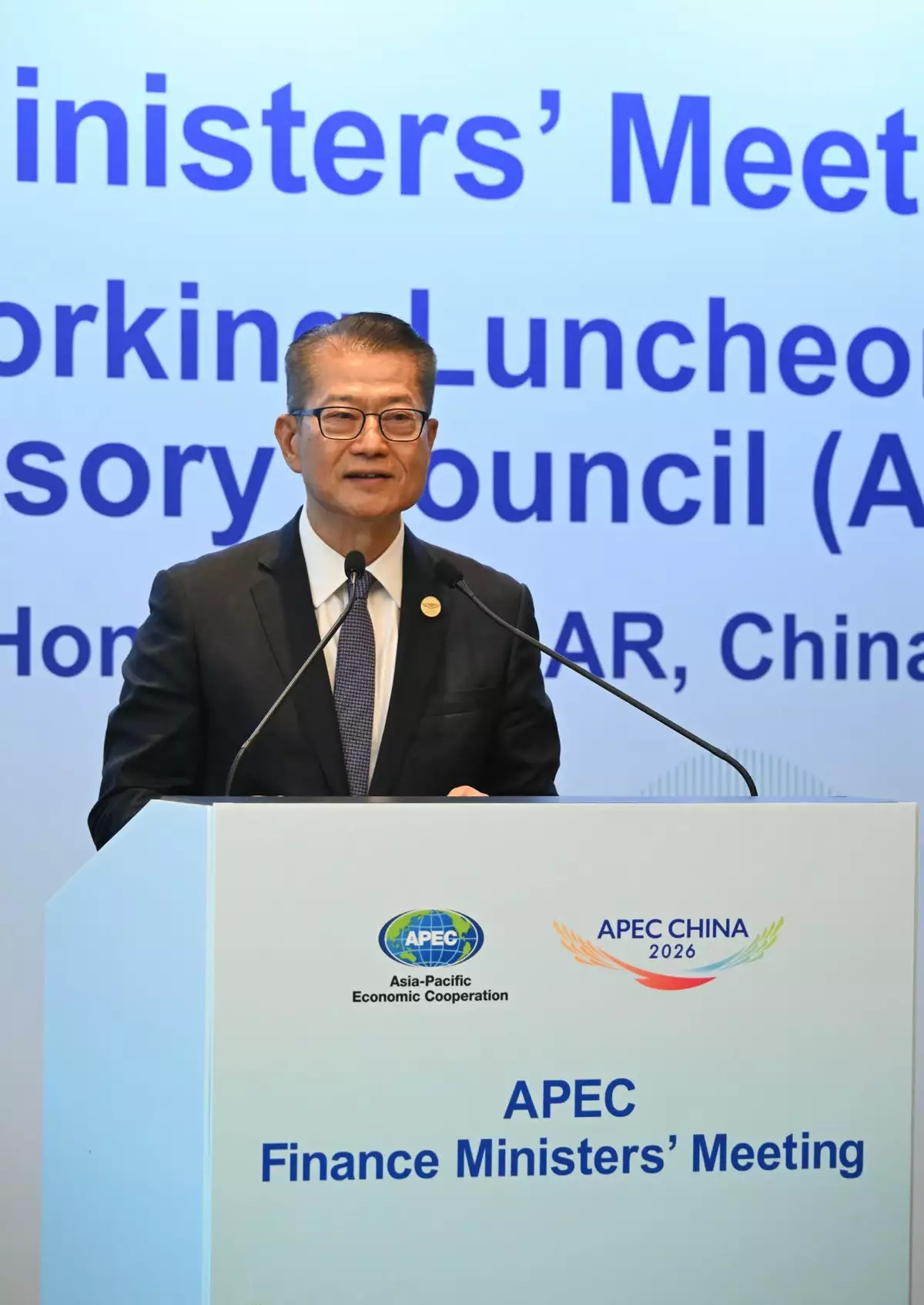
The Financial Secretary, Mr Paul Chan, speaks at the 2026 APEC (Asia-Pacific Economic Cooperation) Finance Ministers' Working Luncheon with APEC Business Advisory Council on digital infrastructure financing today (October 20). Source: HKSAR Government Press Releases