Chinese President Xi Jinping's reply to a letter from Central Asian students at China University of Petroleum has inspired the foreign students to better serve as the bridge of friendship between China and Central Asian countries.
Xi and his Central Asia counterparts are scheduled to gather in Astana, Kazakhstan, from June 16 to 18 for the second China-Central Asia Summit, in which they will weave tighter threads of trade, security and connectivity across the Eurasian heartland.
The inaugural China-Central Asia Summit held in Xi'an, capital of northwest China's Shaanxi Province, in May 2023 marked the first-ever meeting of heads of state under the China-Central Asia cooperation mechanism.
Prior to the 2023 Xi'an summit, Xi replied to a letter from Central Asian students at China University of Petroleum, encouraging them to make greater contributions to the promotion of ties between China and Central Asian countries.
In his reply, Xi stressed that friendly relations between China and Central Asian countries need to be carried forward from generation to generation by ambitious and promising young people.
Xi said the students have witnessed and benefited from China-Central Asia relations and, more importantly, they have helped boost China-Central Asia relations.
He encouraged them to act as envoys of friendship and bridges of cooperation to contribute to building an even closer China-Central Asia community with a shared future.
The recipients of Xi's reply were inspired by his words.
"This could be the biggest and most unforgettable thing during our study abroad," said Bayramdurdyyev Rahman from Turkmenistan, who is the main writer of the letter to President Xi.
"For us Central Asian students at China University of Petroleum, 2023 was a particularly significant year as it marked the 10th anniversary of the Belt and Road Initiative. President Xi first proposed the initiative of the Silk Road Economic Belt in Kazakhstan in 2013. Moreover, 2023 witnessed the inaugural China-Central Asia Summit," said Rahman, who has been living in China for 15 years.
The China-proposed Belt and Road Initiative, which refers to the Silk Road Economic Belt and the 21st Century Maritime Silk Road, aims to boost connectivity and promote global prosperity through infrastructure development and trade and investment facilitation.
"The letter we wrote to the President Xi was in the spring of 2023, which was from [students of] Turkmenistan, Kazakhstan, Tajikistan, Uzbekistan and Kyrgyzstan," said Kandakov Mehrbakhsh, a student from Tajikistan.
"The main reason for us to write to President Xi is to thank China and President Xi for giving us a very precious opportunity to study in China. It is also an expression of recognition of the development of friendship between China and Central Asia," said Polat Mukhammed, a student from Kazakhstan.
"In that letter, we shared our feelings about China, about our living (life) in China. While writing that letter, we were very excited, and hoped President Xi would see that letter," said Mehrbakhsh.
The students shared their immense joy upon receiving the reply letter from the president.
"I was particularly excited when the university informed us that we had received a reply from President Xi. I was so excited that I could not sleep well for three nights. I was always thinking whether it was true," said Rahman.
"President Xi replied to our message with warmth and encouragement. He also encouraged us to tell stories about the countries well and to be ambassadors of friendship between China and Central Asian countries to make better community and better interaction and cultural understanding between our countries. We were really impressed, and we feel so esteemed and respected by his reply," said Mehrbakhsh.
The students were motivated by Xi's words which firmed up their confidence in devoting themselves to promoting cooperation between Central Asia and China.
"The reply has given us the confidence to serve as a bridge of friendship between China and Central Asia," said Kenzhebay Aziz, a Kazakh student.
"Back then, I wasn't sure about my career or future. But after receiving this reply, I realized that I could first stay at our university and use my own experiences to guide younger students--helping them adapt to life in China more quickly, understand China, and get to know the country better," said Rahman, who has shifted from an international student to a student administrator at China University of Petroleum.
The students hailed China's rapid development and spoke highly of President Xi's firm commitment to fighting poverty and promoting the wellbeing of the people.
"After he became president, he solved many crucial and important problems which lots of other countries were struggling to solve. The Chinese life become a lot better. In my opinion, the person who lifted his country and nation out of poverty, he must be a genius and ready to sacrifice his life for his nation to accomplish that," said Mehrbakhsh.
Two years ago in Xi'an, the leaders of China and five Central Asian countries planted six pomegranate trees -- a symbol of unity, just like the seeds inside one fruit.
"It's just like the pomegranate that has a lot of seeds cling tightly together, protecting one another. This symbolizes the very essence of the Belt and Road Initiative. It's about joining hands for common development: I thrive, you thrive, and together we achieve even greater growth in the future," said Rahman.
Now, those trees have grown tall, with pomegranates, big and small, on the branches. Much like the growing ties between China and Central Asian countries -- they are deeply rooted, flourishing, and bearing visible results.
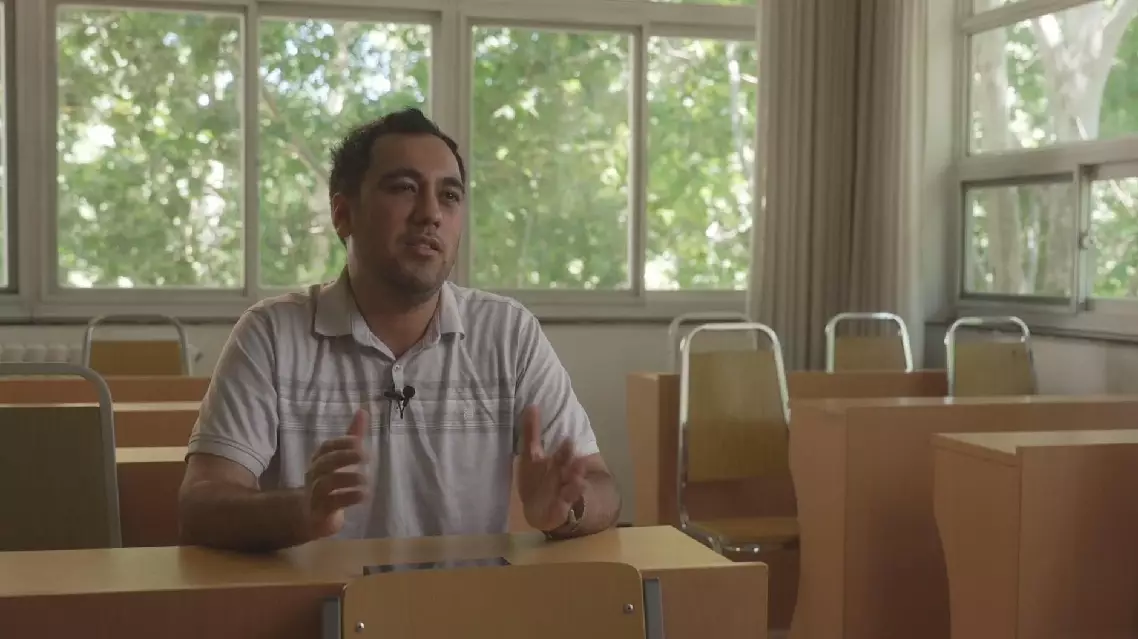
Central Asian students inspired by Xi's encouragement to act as envoys of friendship