SAN FRANCISCO--(BUSINESS WIRE)--Jun 16, 2025--
Levelpath, For most employees, engaging with procurement feels like navigating a maze—complex forms, unclear processes, and endless back-and-forth that delays critical business initiatives. Today, Levelpath, the leading AI-native procurement platform, announced the launch of two breakthrough innovations that eliminate this friction: AI Front Door, a conversational interface that uses Levelpath's Hyperbridge reasoning engine to guide users to the right workflows through natural language, and Pipeline, a centralized project visibility layer that brings real-time insight into procurement priorities and performance.
This press release features multimedia. View the full release here: https://www.businesswire.com/news/home/20250616332532/en/
These features continue Levelpath’s mission to eliminate the complexity of traditional procurement tools through intelligent automation, an intuitive user experience and enterprise-grade architecture designed to delight the business in the AI-native era.
"Procurement teams must move with urgency without sacrificing strategic insight. With AI Front Door and Pipeline, we are removing the friction that slows them down,” said Alex Yakubovich, Co-founder and CEO of Levelpath. “AI Front Door simplifies the user experience through intelligent guidance, and Pipeline gives teams a clear view of every project in flight, making it easier to prioritize work and demonstrate value. Together, these tools help organizations reduce complexity and operate with greater focus."
AI Front Door marks the latest expansion of Levelpath's AI-native capabilities, designed to delight business stakeholders while empowering procurement teams to deliver exceptional service across the enterprise. By combining natural language input with contextual awareness, AI Front Door eliminates friction for employees seeking procurement support, enabling them to simply describe their needs and be intelligently guided to the right workflows. This breakthrough allows procurement teams to transform their internal customer experience, moving beyond traditional barriers to create seamless, efficient interactions that drive measurable business outcomes.
Customers are already seeing measurable results with Levelpath's approach. TreeHouse Foods achieved over 200% return on investment in just six weeks by completely redesigning their claims intake process, eliminating spreadsheets and manual routing through Levelpath's intelligent automation.
"That level of efficiency at such a low investment is very rare," said Jim O'Rourke, former CPO at TreeHouse Foods. "The new AI front door and Pipeline capabilities unlock visibility, control and value in the long-overlooked tail spend where there was none before."
AI Front Door: A New Conversational Experience
The new AI front-door experience makes navigating organizational procurement policies and procedures intuitive and effortless. Enabled by Levelpath's Hyperbridge reasoning engine, stakeholders can type freeform into a chat window and be intelligently routed to the appropriate intake form to support requested procurement activities. The platform interprets the user's request, understands the context of their needs, and applies the organization's specific policies and procedures to guide them through the correct procurement process.
If clarification is needed, Levelpath's AI will ask targeted questions based on the organization's unique intake structure and policy requirements. For example, if a stakeholder requests to make a purchase, the AI will guide them through their organization's specific approval categories and compliance requirements. Once the AI understands what the stakeholder needs, it routes them to the correct workflow while pre-populating available information according to organizational policies.
This feature eliminates the need to manually research organizational policies or memorize complex procurement procedures. Instead, stakeholders can simply describe their needs in natural language, and the platform automatically applies the relevant organizational guidelines and compliance requirements.
AI Front Door seamlessly integrates with each organization's existing policies and approval structures without requiring changes to established procedures. By making organizational procurement policies more accessible and easier to navigate, Levelpath enables teams to spend less time deciphering compliance requirements and more time driving business results.
Pipeline: Real-Time Visibility Into Every Project
Pipeline allows teams to centrally visualize every procurement project from initial identification through completion in the Levelpath Hub. It surfaces critical metadata such as estimated spend, projected and actual savings, contract value, suppliers and project status in one accessible location.
Projects are created either through intake or directly in the Hub. From there, key fields such as requester, department and estimated spend are automatically populated and updated as the project progresses through workflow steps from initiation to completion.
Pipeline equips procurement and finance leaders with a unified, real-time view of their active and upcoming work. This makes it easier to allocate resources, track financial performance and align procurement activities with broader business goals. Users can filter projects by supplier, department, legal entity, region, cost center and other variables to focus on the most strategically important business issues.
By highlighting key savings metrics and project outcomes, Pipeline shifts procurement from reactive task management to proactive value generation. The platform supports strategic planning by helping teams align on high-impact projects, rebalance workloads based on capacity and priorities, and clearly demonstrate their contribution to organizational success. This visibility enables procurement leaders to showcase the tangible value their teams deliver while ensuring resources are directed toward initiatives that drive the greatest business impact.
Enhancements planned for later this quarter will include saved views, quick project summaries and filters based on project start and creation dates. These features will support more effective quarterly planning and allow organizations to surface trends, track impact and stay aligned at every stage of the procurement lifecycle.
The New Foundation for Strategic Procurement
Procurement is undergoing a structural shift. No longer bound by the constraints of legacy systems, leading organizations are embracing AI-native platforms that streamline operations, improve visibility and unlock enterprise-wide value. With AI Front Door and Pipeline, Levelpath gives procurement teams the ability to initiate transactional tasks through natural language and focus on strategic execution.
“We’re leaving behind monolithic legacy systems in favor of AI-native platforms built for operational efficiency,” said Dr. Elouise Epstein. “By automating transactional noise and streamlining workflows, sourcing, payments, contracts, we enable procurement professionals to focus where it matters: managing risk, building supplier relationships and unlocking competitive intelligence.”
The era of procurement as a reactive business function is reaching its end. With intelligent automation, seamless user experiences and real-time insight, organizations now have a path forward that matches the speed and complexity of modern business.
Supporting Procurement Leaders Through Technology Investment Success
Levelpath has published a comprehensive white paper, " Getting to Yes: The CPO's Guide to Technology Investment Approval, " designed to help procurement leaders secure approval and drive adoption of critical technology initiatives. The guide provides actionable strategies for overcoming common implementation barriers, from budget constraints and stakeholder resistance to change management complexities.
The whitepaper addresses the unique challenges procurement teams face when advocating for AI investments, including how to build compelling business cases that resonate with finance and IT stakeholders, navigate organizational politics, and demonstrate measurable ROI. With AI transformation accelerating across enterprises, procurement leaders need proven frameworks to position their teams as strategic value drivers rather than cost centers.
Key insights include the Power Framework for stakeholder engagement, strategies for quantifying efficiency gains, and methods for avoiding common failure patterns that derail technology projects before they deliver results. The guide also provides specific guidance on communicating AI benefits in language that resonates with different organizational functions, from technical specifications for IT teams to ROI projections for CFOs.
Download " Getting to Yes: The CPO's Guide to Technology Investment Approval " to access practical tools that help procurement teams secure investment, drive adoption, and deliver transformational results through AI-native solutions.
To learn more about Levelpath's AI-native procurement platform, visit https://www.levelpath.com/
About Levelpath
Levelpath is the AI-native procurement platform transforming how global enterprises manage indirect spend. Built from the ground up for the AI era, our platform unifies procurement operations through intelligent automation, featuring an intuitive stakeholder interface, advanced workflow orchestration, and our proprietary Hyperbridge reasoning engine that delivers real-time intelligence and complete visibility across all procurement activities. Trusted by leading Fortune enterprises worldwide, including Ace Hardware, Amgen, Coupang, Fortrea, GATX, SiriusXM, SSM Health, and Western Union, Levelpath's AI-native architecture enables organizations to collaborate smarter, operate faster, and scale procurement operations that drive measurable business value.
Headquartered in San Francisco, Levelpath is backed by Benchmark, Redpoint Ventures, Menlo Ventures, NewView Capital, and World Innovation Lab. Learn more at levelpath.com or connect with us on LinkedIn.
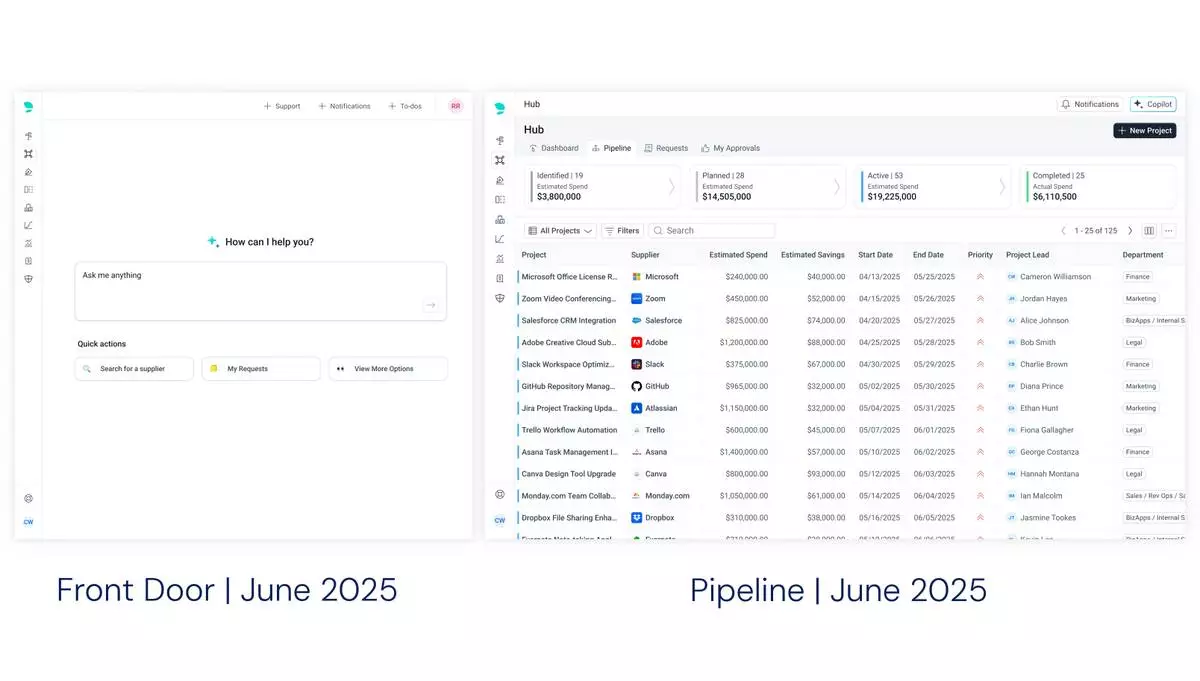
Levelpath's newly released features: AI Front Door and Pipeline