Skip to Content Facebook Feature Image

Trump fires Democratic commissioner of independent agency that oversees nuclear safety

News

Trump fires Democratic commissioner of independent agency that oversees nuclear safety
News

News

Trump fires Democratic commissioner of independent agency that oversees nuclear safety

2025-06-17 04:04 Last Updated At:04:11

WASHINGTON (AP) — President Donald Trump has fired a Democratic commissioner for the federal agency that oversees nuclear safety as he continues to assert more control over independent regulatory agencies.

Christopher Hanson, a former chairman of the U.S. Nuclear Regulatory Commission, said in a statement Monday that Trump terminated his position as NRC commissioner without cause, “contrary to existing law and longstanding precedent regarding removal of independent agency appointees.”

The firing of Hanson comes as Trump seeks to take authority away from the independent safety agency, which has regulated the U.S. nuclear industry for five decades. Trump signed executive orders in May intended to quadruple domestic production of nuclear power within the next 25 years, a goal experts say the United States is highly unlikely to reach. To speed up the development of nuclear power, the orders grant the U.S. energy secretary authority to approve some advanced reactor designs and projects.

White House spokesperson Anna Kelly said in an emailed statement that “all organizations are more effective when leaders are rowing in the same direction” and that the Republican president reserves the right to “remove employees within his own executive branch.”

Trump fired two of the three Democratic commissioners at the Equal Employment Opportunity Commission, an independent federal agency responsible for enforcing federal laws that prohibit discrimination in the workplace. In a similar move, two National Labor Relations Board members were fired. Willie Phillips, a Democratic member and former chairman of the independent Federal Energy Regulatory Commission, stepped down in April, telling reporters that the White House asked him to do so.

Trump also signed an executive order to give the White House direct control of independent federal regulators such as the Securities and Exchange Commission, the Federal Trade Commission and the Federal Communications Commission.

New Jersey Rep. Frank Pallone, the top Democrat on the the House Energy and Commerce Committee, called Hanson's firing illegal and another attempt by Trump to undermine independent agencies and consolidate power in the White House.

“Congress explicitly created the NRC as an independent agency, insulated from the whims of any president, knowing that was the only way to ensure the health, safety and welfare of the American people," Pallone said in a statement.

Senate Democrats also said Trump overstepped his authority. Sens. Sheldon Whitehouse, Patty Murray and Martin Heinrich said in a joint statement that “Trump’s lawlessness” threatens the commission’s ability to ensure that nuclear power plants and nuclear materials are safe and free from political interference.

Hanson was nominated to the commission by Trump in 2020. He was appointed chair by President Joe Biden in January 2021 and served in that role until Trump's inauguration to a second term as president. Trump selected David Wright, a Republican member of the commission, to serve as chair. Hanson continued to serve on the NRC as a commissioner. His term was due to end in 2029.

Wright’s term expires on June 30. The White House has not said if he will be reappointed.

Edwin Lyman, director of nuclear power safety at the Union of Concerned Scientists, called Hanson a dedicated public servant and a strong supporter of the NRC’s public health and safety mission. Firing Hanson is Trump's “latest outrageous move to undermine the independence and integrity” of the agency that protects the U.S. homeland from nuclear power plant disasters, Lyman said in a statement.

The NRC confirmed Hanson’s service ended on Friday, bringing the panel to two Democrats and two Republicans. The commission has functioned in the past with fewer than the required five commissioners and will continue to do so, the statement said.

McDermott reported from Providence, R.I.

The Associated Press’ climate and environmental coverage receives financial support from multiple private foundations. The AP is solely responsible for all content. Find the AP’s standards for working with philanthropies, a list of supporters and funded coverage areas at AP.org.

FILE - President Donald Trump holds an executive order regarding the reform of the Nuclear Regulatory Commission in the Oval Office of the White House, May 23, 2025, in Washington. (AP Photo/Evan Vucci, File)
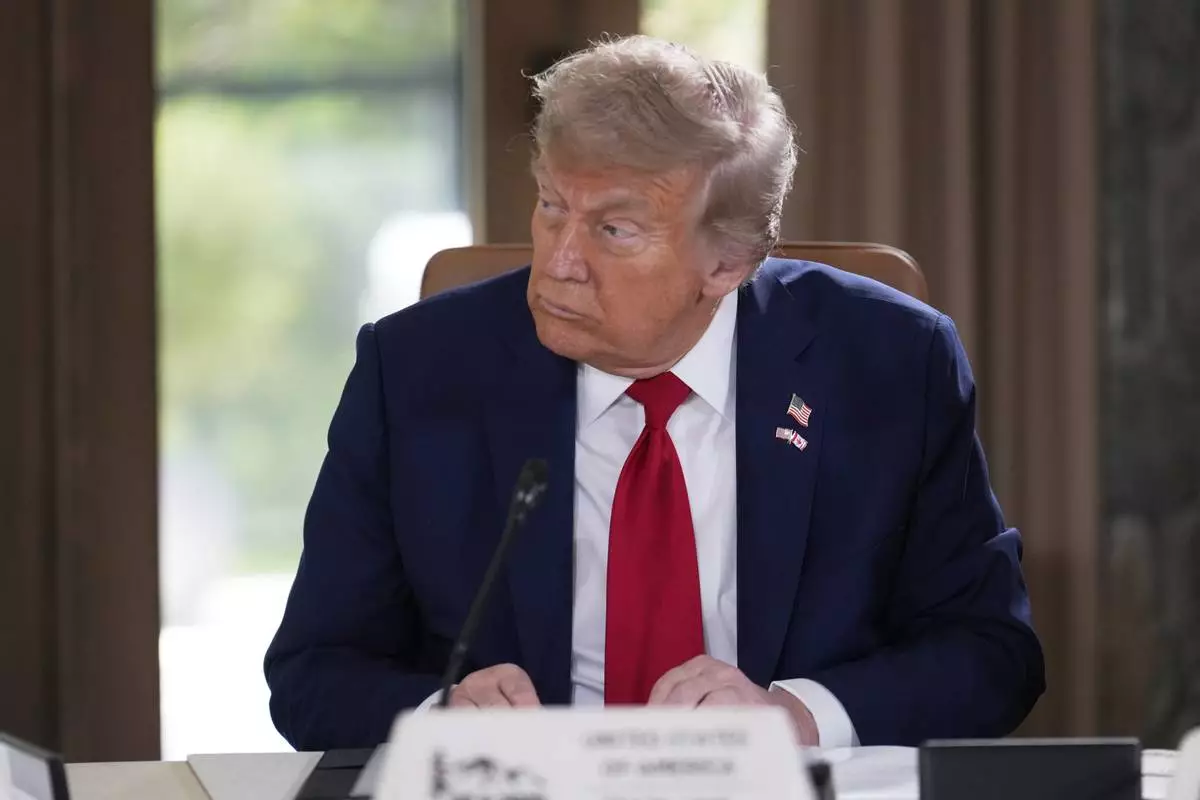
FILE - President Donald Trump holds an executive order regarding the reform of the Nuclear Regulatory Commission in the Oval Office of the White House, May 23, 2025, in Washington. (AP Photo/Evan Vucci, File)

President Donald Trump participates in a session of the G7 Summit, Monday, June 16, 2025, in Kananaskis, Canada. (AP Photo/Mark Schiefelbein)


President Donald Trump participates in a session of the G7 Summit, Monday, June 16, 2025, in Kananaskis, Canada. (AP Photo/Mark Schiefelbein)

WASHINGTON (AP) — Inflation likely remained elevated last month as the cost of electricity, groceries, and clothing may have jumped and continued to pressure consumers' wallets.

The Labor Department is expected to report that consumer prices rose 2.6% in December compared with a year earlier, according to economists' estimates compiled by data provider FactSet. The yearly rate would be down from 2.7% in November. Monthly prices, however, are expected to rise 0.3% in December, faster than is consistent with the Federal Reserve's 2% inflation goal.

The figures are harder to predict this month, however, because the six-week government shutdown last fall suspended the collection of price data used to compile the inflation rate. Some economists expect the December figures will show a bigger jump in inflation as the data collection process gets back to normal.

Core prices, which exclude the volatile food and energy categories, are also expected to rise 0.3% in December from the previous month, and 2.7% from a year earlier. The yearly core figure would be an increase from 2.6% in November.

In November, annual inflation fell from 3% in September to 2.7%, in part because of quirks in November's data. (The government never calculated a yearly figure for October). Most prices were collected in the second half of November, after the government reopened, when holiday discounts kicked in, which may have biased November inflation lower.

And since rental prices weren't fully collected in October, the agency that prepares the inflation reports used placeholder estimates that may have biased prices lower, economists said.

Inflation has come down significantly from the four-decade peak of 9.1% that it reached in June 2022, but it has been stubbornly close to 3% since late 2023. The cost of necessities such as groceries is about 25% higher than it was before the pandemic, and other necessities such as rent and clothing have also gotten more expensive, fueling dissatisfaction with the economy that both President Donald Trump and former President Joe Biden have sought to address, though with limited success.

The Federal Reserve has struggled to balance its goal of fighting inflation by keeping borrowing costs high, while also supporting hiring by cutting interest rates when unemployment worsens. As long as inflation remains above its target of 2%, the Fed will likely be reluctant to cut rates much more.

The Fed reduced its key rate by a quarter-point in December, but Chair Jerome Powell, at a press conference explaining its decision, said the Fed would probably hold off on further cuts to see how the economy evolves.

The 19 members of the Fed’s interest-rate setting committee have been sharply divided for months over whether to cut its rate further, or keep it at its curent level of about 3.6% to combat inflation.

Trump, meanwhile, has harshly criticized the Fed for not cutting its key short-term rate more sharply, a move he has said would reduce mortgage rates and the government's borrowing costs for its huge debt pile. Yet the Fed doesn't directly control mortgage rates, which are set by financial markets.

In a move that cast a shadow over the ability of the Fed to fight inflation in the future, the Department of Justice served the central bank last Friday with subpoenas related to Powell's congressional testimony in June about a $2.5 billion renovation of two Fed office buildings. Trump administration officials have suggested that Powell either lied about changes to the building or altered plans in ways that are inconsistent with those approved by planning commissions.

In a blunt response, Powell said Sunday those claims were “pretexts” for an effort by the White House to assert more control over the Fed.

“The threat of criminal charges is a consequence of the Federal Reserve setting interest rates based on our best assessment of what will serve the public, rather than following the preferences of the President,” Powell said. “This is about whether the Fed will be able to continue to set interest rates based on evidence and economic conditions—or whether instead monetary policy will be directed by political pressure or intimidation.”

FILE -American Giant clothing is displayed at the company's showroom in San Francisco, April 17, 2025. (AP Photo/Jeff Chiu, File)

FILE -American Giant clothing is displayed at the company's showroom in San Francisco, April 17, 2025. (AP Photo/Jeff Chiu, File)

FILE -A cashier rings up groceries in Dallas, Aug. 28, 2025. (AP Photo/LM Otero, File)

FILE -A cashier rings up groceries in Dallas, Aug. 28, 2025. (AP Photo/LM Otero, File)

Recommended Articles