Announcement of sixth batch of recognised medical qualifications under Medical Registration Ordinance
In accordance with the Medical Registration Ordinance (MRO), the Registrar of Medical Practitioners (i.e. the Director of Health) announced today (June 18) the sixth batch of 22 medical qualifications (see Annex 1) recognised by the Special Registration Committee (SRC). The list will be gazetted on June 20 and take effect on the same day. It will be submitted to the Legislative Council for negative vetting on June 25. Together with the first five batches of recognised medical qualifications announced, the SRC has so far recognised a total of 150 medical qualifications (see Annex 2).
The MRO provides that non-locally trained doctors who possess recognised medical qualifications, subject to their fulfilment of certain criteria, may apply for special registration to practise in the public healthcare institutions in Hong Kong (i.e. the Hospital Authority, the Department of Health, the University of Hong Kong and the Chinese University of Hong Kong). After serving for a certain period, obtaining recognised specialist qualifications and passing the assessment, they will be granted full registration to practise in Hong Kong. For non-locally trained medical graduates who possess recognised medical qualifications but have yet to undergo an internship outside Hong Kong, subject to their fulfilment of the relevant criteria, they may take the Licensing Examination of the Medical Council of Hong Kong (MCHK) in order to apply for special registration to practise in the public healthcare institutions in Hong Kong. They may also obtain full registration after meeting the requirements applicable to all special registration doctors.
The SRC under the MCHK is responsible for determining the list of recognised medical qualifications upon reviewing the programmes offered by non-local medical schools with quality comparable to those provided by the two medical schools in Hong Kong and submitting the list to the Registrar of Medical Practitioners for promulgation. When determining the list of recognised medical qualifications, the SRC will consider and recommend a medical qualification that fulfils the following criteria:
(a) that is at the level of degree or higher;
(b) that is awarded by a body broadly comparable to any local university awarding medical qualifications in terms of international rankings; and
(c) that is broadly comparable to the medical qualifications awarded by any local university in terms of:
(i) the curriculum of the programmes leading to the medical qualifications;
(ii) the medium of instruction of the programmes; and
(iii) any other aspects the SRC considers appropriate.
Employers and employees should make reasonable work arrangements after tropical cyclones or rainstorms
The Labour Department (LD) today (June 8) reminded employers to make practical and reasonable work arrangements for employees after the cancellation of tropical cyclone warnings or rainstorm warnings, with due consideration to the road and traffic conditions and other factors, and make flexible arrangements for staff to resume work or work remotely (if applicable). This will help maintain good labour-management relations, and ensure the safety of employees as well as the smooth operation of organisations.
"For staff who have genuine difficulties in resuming work on time upon cancellation of a tropical cyclone or rainstorm warning, employers should be sympathetic and handle each case flexibly. For example, employers may allow employees to resume work in stages, permit employees who have difficulties in returning to workplaces to work remotely (if applicable) or allow more time for them to report for duty and resume work," an LD spokesman said.
The spokesman reminded employers to observe the statutory liabilities and requirements under the Employment Ordinance, Occupational Safety and Health Ordinance, Factories and Industrial Undertakings Ordinance, Employees' Compensation Ordinance and Minimum Wage Ordinance.
"As natural calamities cannot be avoided, for employees who are not able to report for duty or resume duty on time due to adverse weather or extreme conditions, employers should neither deduct their wages, good attendance bonus or allowances, nor reduce employees' entitlement to annual leave, statutory holidays or rest days under the Employment Ordinance, or ask for additional hours of work from employees to compensate for the loss of working hours when they are unable to report for duty," the spokesman said.
Employers should note that they have an obligation to provide and maintain a safe working environment for their employees under the Occupational Safety and Health Ordinance. Moreover, under the Employees' Compensation Ordinance, employers are liable to pay compensation for injuries or deaths incurred when employees are travelling by a direct route from their residence to their workplace, or from their workplace back to their residence after work, four hours before or after working hours on a day when Tropical Cyclone Warning Signal No. 8 or higher, a Red or Black Rainstorm Warning Signal or extreme conditions are in force.
The LD has published the "Code of Practice in Times of Adverse Weather and 'Extreme Conditions'", which provides the major principles, reference guidelines and information on relevant legislation on making work arrangements for the reference of employers and employees. The booklet can be obtained from branch offices of the Labour Relations Division or downloaded from the department's webpage (www.labour.gov.hk/eng/public/wcp/Rainstorm.pdf).
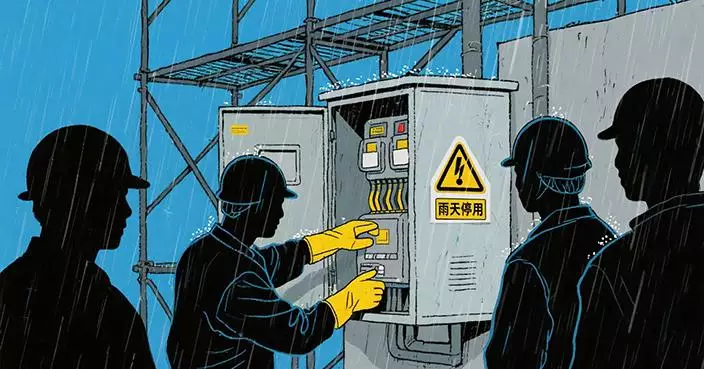
Source: AI-found images