Finding lifts veil of history and inspires even more searches
BEIJING, June 18, 2025 /PRNewswire/ -- A report from China Daily
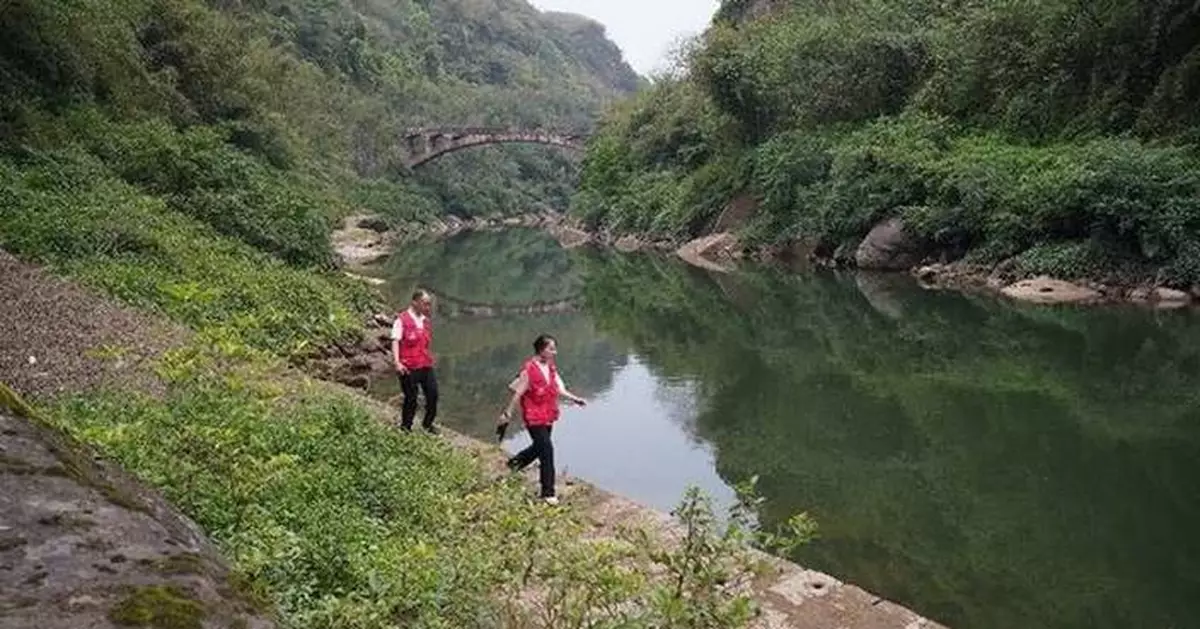
While tracing the stone capstan that trackers used to moor their boats along the Yongning River in Xuyong county, Luzhou, Sichuan province, Liu Xin and his colleagues made a serendipitous discovery of the Ancestral Temple of Caogong.
It was recorded in the local county annals for centuries but never physically located until March, when the county team was doing fieldwork of the ongoing fourth national census on cultural relics in China.
Caogong refers to the Ming Dynasty (1368-1644) official Cao Zhen, who followed the government decree to undertake the task of building Jiangmen Gorge to tame the river's dangerous rapids and reefs.
In 1550, to commemorate Cao's achievement, the Sichuan provincial governor ordered the construction of the ancestral temple, which was finished seven years later.
The 57-year-old Liu recalls that he first stumbled upon a heavily weathered stone tablet whose inscription had eroded.
His instinct suggested further relics might be present nearby, so he prompted the team to expand the search area.
Soon, two stone heads emerged from muddy deposits, encouraging them to work even harder. After removing mud, vegetation and tree roots for several hours, they couldn't believe their eyes when they saw the characters Caogong Ci carved on a stone slab beneath the main niche, confirming the site as the Ancestral Temple of Caogong.
"We were so thrilled! The greatest satisfaction is to discover new cultural relics," says Liu, a worker from the county's cultural relics protection and management office.
Within the main niche stand two figures — a male and a female — each 0.6 meters tall and 0.3 meters wide, adorned in Ming court regalia. There are also two other statues in another niche.
They also found a fractured stone slab bearing half of an antithetical couplet, with the other half missing, which is from a poem written by esteemed Ming scholar Yang Shen to extol Cao's achievement.
"It's an unprecedented discovery. Once the Qing Dynasty (1644-1911) official Dong Xince visited the county in search of the ancestral temple and composed a poem. In the past few years, several culture and history experts have attempted several times to locate it but all their efforts ended in failure," says Huang Ying, head of the county's cultural relics protection and management office.
After the gorge's construction, boat trackers started to work there for the official waterway that transported tribute rice and other goods.
Another new discovery of the fourth national census is the ruins of boat trackers infrastructure along the Yongning River, including a stone capstan on the bank and stone beds in a cliff cave serving as the trackers' rest area.
Liu's survey team also found remnants of a well-preserved Qing Dynasty port at another place, with stone stairs and traces of trackers hauling boats.
"These relics are vital tangible evidence of the Jiangmen Gorge's vibrant dredging and navigation activities, and we are making detailed protection plans. The gorge has greatly boosted trade between Sichuan and neighboring Yunnan and Guizhou provinces, making the ancient Xuyong site a bustling commercial hub," Huang says.
"Our initial aim was to check the stone capstan, but the true revelation was about 25 meters away, the unexpected discovery of the long-lost Ancestral Temple of Caogong," says Guo Jin, head of Jiangmen township's comprehensive cultural station.
Guo says trackers used the stone capstan to moor their boats to monitor and prevent collisions in turbulent waters.
The third national census on cultural relics in China was conducted from 2007 to 2011. Liu, who joined it as a novice in 2009, recalls the arduous expeditions through remote mountainous terrain where only unpaved paths existed.
"Today, we can drive closer to these cultural relics and hike much shorter distances, which has greatly improved our fieldwork efficiency," he says.
Back then, they had to climb a nearby mountain to find a vantage point to take panorama photos of a site. "Now, using a drone makes it much easier to do so, and our younger colleagues are adept at it. We're equipped with other new tools as well, which have saved a lot of effort," he says.
Before, they measured elevated cultural relics by climbing up and using bamboo poles tied with measuring tapes. Now, they use lasers to take precise dimensions.
A major task of the fourth national census is to recheck all cultural heritage registered in the third census, and the county has already finished the challenging task.
"After so many years, some sites have changed administrative jurisdictions or altered geological environments, and some elder villagers familiar with remote site locations have passed away," Liu says.
"Moreover, the original GPS coordinates in the third national census have errors of tens of meters. To locate these sites, we mainly rely on locals as guides, often hiking through forest mountains for entire days."
According to Huang, the county calls for grassroots cadres to join the fourth national census on cultural relics and assign veteran professionals like Liu with novices in a team to provide guiding.
Huang says they also promote public awareness of cultural heritage preservation via exhibition boards and brochures. A good example is Jiangmen township government. They encourage clues about cultural relics by rewarding tipsters with local specialties and have boosted participation among villagers.
In 2024, the Xuyong county government established a special fund dedicated to cultural heritage conservation, backed by fund management regulations, prioritizing the protection of the county's lower-tier cultural relics.
"Many lower-tier cultural relics are scattered across the county. They often lack both sufficient funding for preservation and public attention, unlike their national or provincial level counterparts," Huang says.
"It's an urgent task to protect lower-tier cultural relics because they not only carry important historical information and cultural value, but also serve as an integral part of the local cultural heritage system."
Contact the writer at xulin@chinadaily.com.cn
** The press release content is from PR Newswire. Bastille Post is not involved in its creation. **
Temple discovery rewards hard work