Huaiji County in south China’s Guangdong Province is challenged by its worst flooding in a century, with houses submerged, roads destroyed, and power cut, amid torrential rainfall triggered by Typhoon Wutip.
The Huaiji hydrometric station recorded a peak water level of 55.22 meters on Wednesday morning, 5.22 meters above the warning level of 50 meters, marking the highest flood level since the station was established.
About 180,000 residents in the county have been affected by the flood. Over 68,000 residents have been evacuated to safer areas.
Economic losses are already estimated at over 41 million yuan (about 5.71 million U.S. dollars).
Many businesspeople said they suffered great loss.
"We moved some goods to the attic as much as possible. Business is already hard, the flood didn’t help," said Mo Rusheng, who runs a store with his family.
"The water rose so soon, we just ran. I’m looking at tens of thousands in losses. I run a tiny bun shop. All of my machines have been damaged," said Chen Xiaoyan.
More than 10,000 responders at both provincial and local levels have been mobilized to clear debris, repair roads, and restore critical infrastructure.
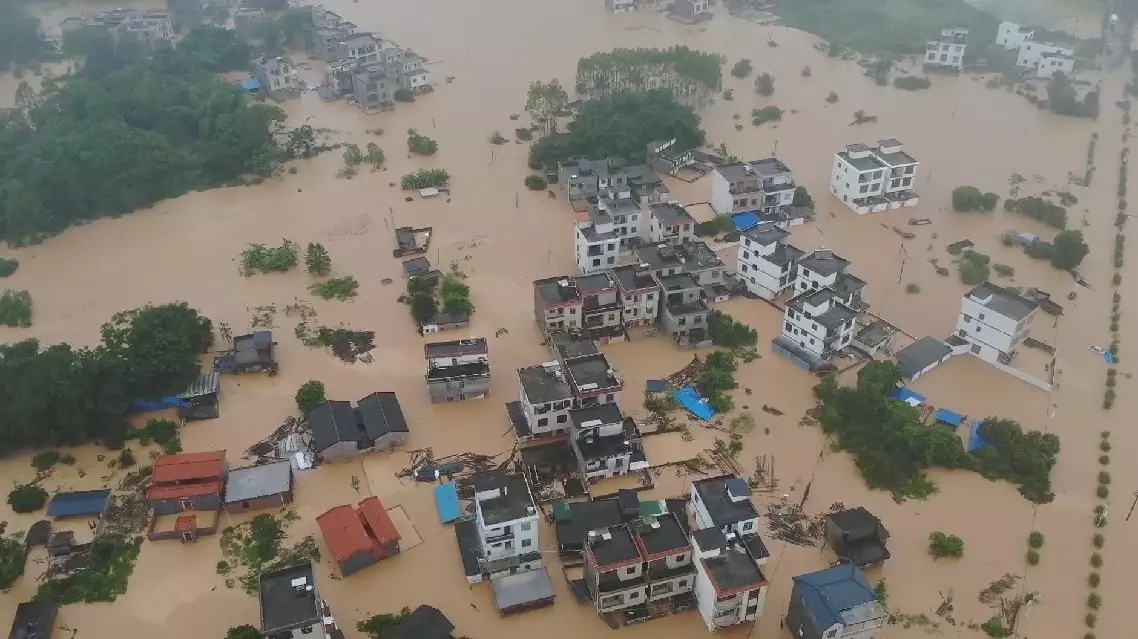
Once-in-a-century flooding swamps south China's Huaiji County
Chinese Premier Li Qiang on Thursday presided over a State Council executive meeting that studied work on building a unified national market and reviewed and approved a plan for the development of a modern emergency response system during the 15th Five-Year Plan period (2026-2030).
Noting that building a unified national market is essential to advancing high-quality development, the meeting called for deepening institutional frameworks in areas such as property rights protection, market access, fair competition, social credit and market exit mechanisms.
The meeting also urged efforts to advance high-standard connectivity of market infrastructure to facilitate smooth economic circulation and effectively reduce logistics costs across society.
Emergency management is critical to protecting people's lives and property, the meeting said. It called for accelerating the development of a modern emergency response system, deepening reform and innovation in emergency management, and improving coordinated response mechanisms.
Efforts should be made to strengthen risk prevention at the source, enhance monitoring, forecasting and early warning, and accelerate a shift in governance toward proactive prevention, according to the meeting.
A draft revision of the Law on the People's Bank of China was also discussed and approved in principle at the meeting, which decided to submit the draft to the Standing Committee of the National People's Congress for deliberation.
Chinese premier chairs State Council executive meeting