NEW YORK (AP) — Millions of Americans are seeing their credit scores drop now that the U.S. government has resumed referring missed student loan payments for debt collection. But there are things you can do to help your score rebound.
Courtney Alev, consumer advocate at Credit Karma, said it's understandable that people have missed payments because of the mixed messages around student loans.
“We’re really at a moment of enormous empathy for the consumer,” she said. “But now it's critical to make a plan."
The U.S. Department of Education paused federal student loan payments in March 2020, offering borrowers relief during the economic chaos of the coronavirus pandemic.
Though payments technically resumed in 2023, the Biden administration provided a one-year grace period that ended in October 2024. Last month, the Trump administration restarted the collection process for outstanding student loans, with plans to seize wages and tax refunds if the loans continue to go unpaid.
According to the Federal Reserve Bank of New York, about 1 in 4 people with federal student loans were more than 90 days behind on payments at the end of March.
Here's what you should keep in mind:
A credit score is a formula that helps lenders determine how likely you are to pay back a loan. Credit scores are based on your history of payments and your credit utilization and range from 300 to 850.
Experian, Equifax and TransUnion, the three main credit bureaus, each have their own model to calculate credit scores.
Factors frequently used to calculate your credit score are:
— Bill payment history
— Length of credit history
— Current unpaid debt
— How much of your available credit you’re using (also known as credit utilization)
— New credit requests
— If you have had debt sent to collection, foreclosure, or a bankruptcy
Each of the three credit bureaus allow you to check your credit score for free at least once a year, and many banks offer this service as well.
Other companies such as NerdWallet, Credit Karma and WalletHub also offer the service.
A score of 670 or higher is considered “good.” If your credit score is over 750, that's considered “great.”
“Fair” credit scores are in the 580-669 range, and a score below 580 is considered “poor.”
In the first three months of 2025, 2.2 million student loan recipients saw their scores drop by 100 points, and an additional 1 million had drops of 150 points or more, according to the Federal Reserve Bank of New York. The study's authors attribute those changes to loans falling into delinquency, or 90 days or more of nonpayment, which is then reported to credit bureaus.
To avoid those consequences, or to improve your score, the simplest steps include paying at least the monthly minimum payment and setting up auto-pay to make sure payments are never late.
Alev says that it's worthwhile to get into the habit of regularly checking your score, so that you're never surprised by any changes, and you can dispute any errors or negative dips.
“It's important to monitor for mistakes you need to dispute,” she said. “If you've only missed one payment, or it's your first time missing a payment, you can often call and ask for forgiveness because of a history of solid payments.”
Many borrowers reported that they never received notice from the Department of Education that their student loan payments were resuming, even though they were meant to have been notified at least three weeks in advance. Monitoring your credit score regularly means you can catch any changes before it’s too late to correct significant hits.
Maintaining a steady, low credit usage, known as credit utilization, is another straightforward way to improve your score, Alev said.
“It's kind of a confusing term, but credit usage is key,” she said. “It’s essentially what percentage of your available credit you’re currently using. If you have a $10,000 credit limit each month, and you use $2,000, that’s a 20% credit utilization. An easy rules of thumb to remember is to keep your utilization below 30%. That’s where you see the score impact accelerate.”
Checking your credit score doesn't lower it unless you're making a “ hard inquiry,” which is only done when requesting a line of credit.
Soft inquiries, which just let you know your current score, don't affect your score.
When you do apply for a line of credit such as for a mortgage or a car loan, lenders do make “hard inquiries,” which appear on your report and can affect your credit.
The Associated Press receives support from Charles Schwab Foundation for educational and explanatory reporting to improve financial literacy. The independent foundation is separate from Charles Schwab and Co. Inc. The AP is solely responsible for its journalism.

FILE - People demonstrate in Lafayette Park across from the White House in Washington, June 30, 2023, after a sharply divided Supreme Court has ruled that the Biden administration overstepped its authority in trying to cancel or reduce student loan debts for millions of Americans. (AP Photo/Andrew Harnik, File)

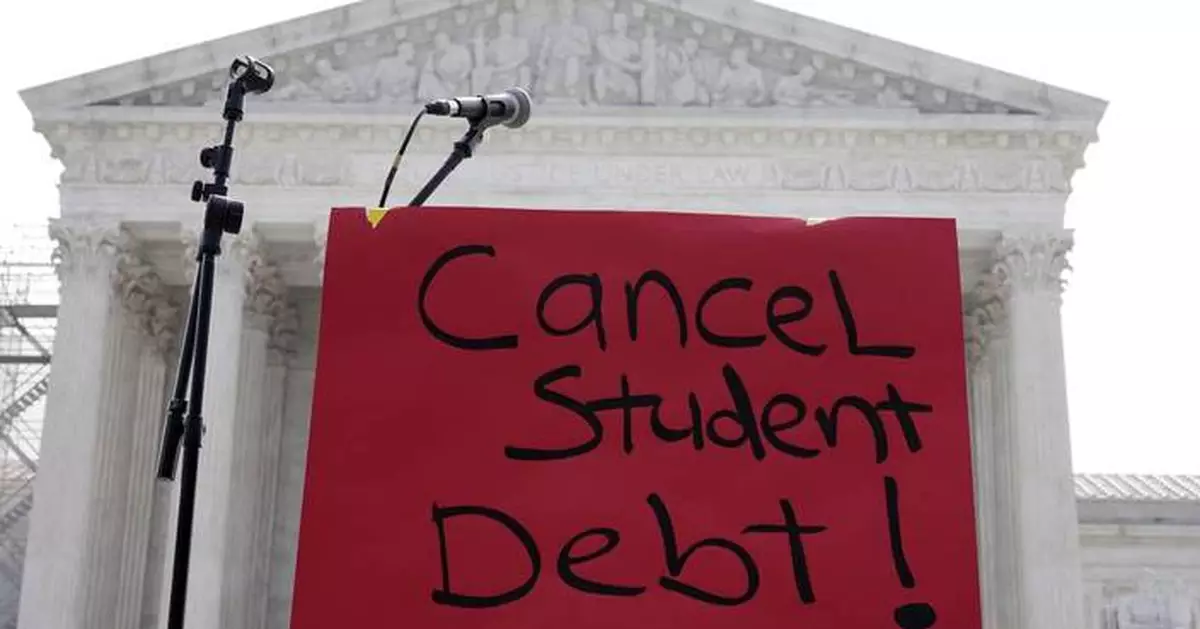
FILE - A sign reading "cancel student debt" is seen outside the Supreme Court, June 30, 2023, in Washington. (AP Photo/Mariam Zuhaib, File)
NAIVASHA, Kenya (AP) — When Dickson Ngome first leased his farm at Lake Naivasha in Kenya’s Rift Valley in 2008, it was over 2 kilometers (1.2 miles) from shore. The farm was on 1.5 acres (0.6 hectares) of fertile land where he grew vegetables to sell at local markets.

At the time, the lake was receding and people were worried that it might dry up altogether. But since 2011, the shore has crept ever closer. The rains started early this year, in September, and didn't let up for months.
One morning in late October, Ngome and his family woke up to find their home and farm inside the lake. The lake levels had risen overnight and about a foot of water covered everything.
“It seemed as if the lake was far from our homes,” Ngome’s wife, Rose Wafula, told The Associated Press. “And then one night we were shocked to find our houses flooded. The water came from nowhere.”
The couple and their four children have had to leave home and are camping out on the first floor of an abandoned school nearby.
Some 5,000 people were displaced by the rise in Lake Naivasha’s levels this year. Some scientists attribute the higher levels to increased rains caused by climate change, although there may be other factors causing the lake’s steady rise over the past decade.
The lake is a tourism hot spot and surrounded by farms, mostly growing flowers, which have gradually been disappearing into the water as the lake levels rise.
Rising levels have not been isolated to Naivasha: Kenya’s Lake Baringo, Lake Nakuru and Lake Turkana — all in the Rift Valley — have been steadily rising for 15 years.
“The lakes have risen almost beyond the highest level they have ever reached,” said Simon Onywere, who teaches environmental planning at Kenyatta University in Kenya’s capital Nairobi.
A study in the Journal of Hydrology last year found that lake areas in East Africa increased by 71,822 square kilometers (27,730 square miles) between 2011 and 2023. That affects a lot of people: By 2021, more than 75,000 households had been displaced across the Rift Valley, according to a study commissioned that year by the Kenyan Environment Ministry and the United Nations Development Program.
In Baringo, the submerged buildings that made headlines in 2020 and 2021 are still underwater.
“In Lake Baringo, the water rose almost 14 meters,” Onywere said. “Everything went under, completely under. Buildings will never be seen again, like the Block Hotels of Lake Baringo.”
Lake Naivasha has risen steadily too, “engulfing three quarters of some flower farms,” Onywere said.
Horticulture is a major economic sector in Kenya, generating just over a billion U.S. dollars in revenue in 2024 and providing 40% of the volume of roses sold in the European Union, according to Kenya’s Ministry of Foreign Affairs.
Significant research has gone into the reasons behind the rising lakes phenomenon: A 2021 study on the rise of Kenya’s Rift Valley lakes was coauthored by Kenyan meteorologist Richard Muita, who is now acting assistant director of the Kenya Meteorological Department.
“There are researchers who come up with drivers that are geological, others with reasons like planetary factors,” Muita said. “The Kenya Meteorological Department found that the water level rises are associated with rainfall patterns and temperature changes. When the rains are plentiful, it aligns with the increase in the levels of the Rift Valley lake waters.”
Sedimentation is also a factor. “From the research I have read, there’s a lot of sediment, especially from agricultural related activities, that flows into these lakes,” says Muita.
Naivasha’s official high water mark was demarcated at 1,892.8 meters (6,210 feet) above sea level by the Riparian Association in 1906, and is still used by surveyors today. That means this year’s flooding was still almost a meter (3 feet) below the high mark.
It also means that the community of Kihoto on Lake Naivasha where the Ngomes lived lies on riparian land — land that falls below the high water mark, and can only be owned by the government.
“It’s a mess established by the government … towards the late 1960s,” said Silas Wanjala, general manager of the Lake Naivasha Riparian Association, which was founded some 120 years ago and has been keeping meticulous records of the lake’s water levels since.
Back then, a farmer was given a “temporary agricultural lease” on Kihoto, said Wanjala. When it later flooded and the farmer packed up and left, the farmworkers stayed on the land and later applied for subdivisions, which were approved. In the 60-odd years since, a whole settlement has grown on land that is officially not for lease or sale.
This also isn’t the first time it’s been flooded, said Wanjala. It's just very rare that the water comes up this high. That’s little consolation for the people who have been displaced by this year’s floods and now cannot go home without risking confrontations with hippopotamuses.
To support those people, the county is focusing its efforts on where the need is greatest.
“We are tackling this as an emergency," says Joyce Ncece, chief officer for disaster management in Nakuru County, which oversees Lake Naivasha. “The county government has provided trucks to help families relocate. We have been helping to pay rent for those who lack the finances.”
Scientists like Onywere and Muita are hoping for longer-term solutions. “Could we have predicted this so that we could have done better infrastructure in less risk-prone areas?” Onywere said.
Muita wants to see a more concerted global effort to combat climate change, as well as local, nature-based solutions centered on Indigenous knowledge, such as “conservation agriculture, where there is very limited disturbance of the land,” to reduce sedimentation of the lakes.
But all of this is of little help to Ngome and Wafula, who are still living at the school with their children. As the rest of the world looks forward to the holidays and new year, their future is uncertain. Lake Naivasha’s continuous rise over the past 15 years does not bode well: They have no idea when, or if, their farm will ever be back on dry land.
For more on Africa and development: https://apnews.com/hub/africa-pulse
The Associated Press receives financial support for global health and development coverage in Africa from the Gates Foundation. The AP is solely responsible for all content. Find AP’s standards for working with philanthropies, a list of supporters and funded coverage areas at AP.org.
Residential buildings are submerged after Lake Naivasha swelled and flooded homes, in Kihoto Village, in Naivasha, Kenya's Rift Valley region, Tuesday, Nov. 11, 2025. (AP Photo/Andrew Kasuku)
People use a boat to cross floodwaters as residential buildings remain submerged after Lake Naivasha swelled and inundated homes, displacing people in Kihoto Village, in Naivasha, Kenya's Rift Valley region, on Tuesday, Nov. 11, 2025. (AP Photo/Andrew Kasuku)
A man salvages his belongings after Lake Naivasha swelled and inundated homes, displacing hundreds in Kihoto Village, in Naivasha, Kenya's Rift Valley region, on Tuesday, Nov. 11, 2025. (AP Photo/Andrew Kasuku)
Residential buildings are submerged after Lake Naivasha swelled and flooded homes, displacing hundreds in Kihoto Village, in Naivasha, Kenya's Rift Valley region, Tuesday, Nov. 11, 2025. (AP Photo/Andrew Kasuku)
A man paddles a boat next to flooded buildings after Lake Naivasha swelled and inundated homes, displacing hundreds in Kihoto Village in Naivasha, Kenya's Rift Valley region, Tuesday, Nov. 11, 2025. (AP Photo/Andrew Kasuku)