Chinese Foreign Minister Wang Yi on Wednesday said that Israel's attack on Iran violated international law and norms governing international relations, infringed upon Iran's sovereignty and security, and undermined regional peace and stability.
Wang, also a member of the Political Bureau of the Communist Party of China Central Committee, made the remarks in a phone conversation with Omani Foreign Minister Sayyid Badr bin Hamad bin Hamood Albusaidi at the latter's request, noting that China has always advocated the peaceful settlement of all disputes.
Stressing that the immediate priority is achieving a ceasefire and bringing an end to the conflict, Wang said that China supports the joint statement on the Israel-Iran conflict issued by 21 Arab and Islamic countries, including Oman, and hopes that Arab and Islamic countries will unite and continue their efforts to push peace talks.
China will also maintain communication and coordination with Oman and other regional countries, and play a constructive role at platforms such as the United Nations to help bring an end to the conflict and restore peace in the Middle East, Wang said.

Chinese FM holds phone talks with Omani FM over Israel-Iran conflict
At least 16 people have been killed and 11 seriously injured as of 05:20 on Friday after a 7.0-magnitude earthquake hit southwest China's Xizang Autonomous Region on Thursday night, according to Nagqu City's earthquake relief headquarters.
Local rescue teams were immediately dispatched to the epicenter of the quake in Baqeng County in Xizang’s Nagqu City, with an advance team from the Baqen County Fire and Rescue Brigade, consisting of eight personnel and two vehicles, successfully rescuing one trapped survivor after arriving at the scene in the early hours of Friday.
The Xizang Fire and Rescue Corps immediately mobilized 347 rescue personnel, 82 fire vehicles, and 15 search-and-rescue dogs, along with over 4,200 pieces of equipment and more than 9,400 items of logistical support supplies, to the quake zone.
Public security departments in Xizang also dispatched over 300 police officers to assist emergency rescue and relief operations. The police contingent will help evacuate residents to safe areas, assess structural damage to buildings, and ensure security in affected areas.
The epicenter of the quake, which struck at 22:33 on Thursday at a depth of 10km, was monitored at 32.40 degrees north latitude and 93.79 degrees east longitude, according to the China Earthquake Networks Center (CENC).
Xizang has activated a Level-II earthquake disaster emergency response, according to the regional emergency command center.
Maru Township, at the epicenter of the earthquake, is about 70 km from the county seat.
Lhawang Dagpo, deputy head of the township, said there had been reports of collapsed houses in Maru, and that rescue and relief operations were underway in villages across the township.
He added that the tremor was clearly felt at the township government office, where the walls of the office building sustained cracks.
Strong shaking was reported in the county seat of Baqen, where power was cut off and telecommunications services were disrupted.
Tremors were also felt in other parts of Xizang, including Qamdo and Nyingchi.
The office of the State Council earthquake relief headquarters and the Ministry of Emergency Management activated a Level-IV emergency response after the earthquake, sending a work team to the affected areas to guide emergency response and disaster relief work, according to the ministry.
A 4.3-magnitude aftershock was felt in Zadoi County in Qinghai Province, which borders Baqen County, at 23:12 on Thursday, according to CENC.
Strong tremors were felt in townships along the border between the two counties, with cracks appearing in some houses. No building collapses or casualties have been confirmed in these areas.
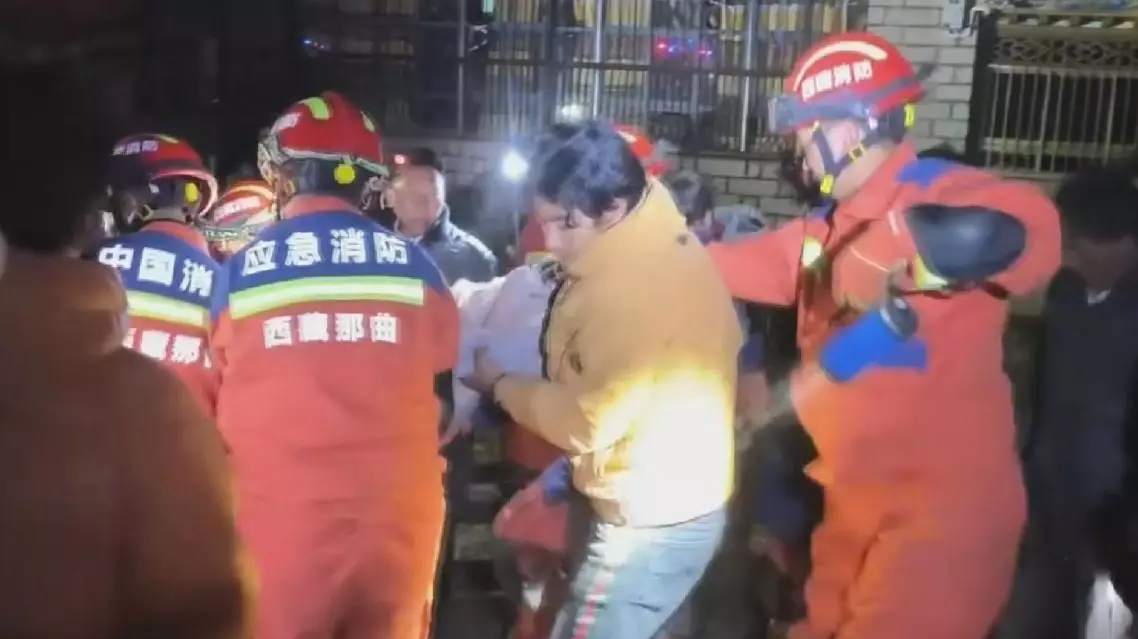
At least 16 killed in Xizang earthquake: local emergency command