BOSTON (AP) — Attorneys argued over whether a Harvard researcher accused of smuggling frog embryos brought “biological materials” into the U.S. in a court hearing Wednesday.
Kseniia Petrova, a Russian-born scientist conducting cancer research for Harvard Medical School, appeared in Massachusetts federal court Wednesday for a probable cause hearing, where government and defense attorneys argued over whether she brought “biological materials” into the U.S., ABC News reported.
She was returning from a vacation from France in February when she was questioned by U.S. Customs and Border Protection at Boston Logan International Airport.
Petrova, 30, had stopped at a lab specializing in splicing superfine sections of frog embryos and obtained a package of samples for research. Federal officials on the social media website X accused her of lying about “carrying substances” into the country and alleged that she planned to smuggle the embryos through customs without declaring them.
She told The Associated Press in an interview in April that she did not realize the items needed to be declared and was not trying to sneak anything into the country.
Petrova was told her visa was being canceled and detained by immigration officials in Vermont after her initial arrest. She filed a petition seeking her release and was briefly sent to an ICE facility in Louisiana, after which a judge ruled the immigration officers’ actions were unlawful. In May, she was charged with one count of smuggling.
The Homeland Security Investigations agent who wrote the affidavit in support of the criminal complaint, Brian Goldsworthy, testified Wednesday that Petrova would not have been able to leave the airport had she declared the frog embryos in her luggage, ABC News reported.
He said that Customs and Border Protection agriculture experts and a federal laboratory that reviewed the samples deemed them to be biological material, ABC News reported. Petrova's attorney argued it was unclear what definition the government was operating under and the requirement to declare items entering the country doesn't hinge on whether something is a biological material, ABC News reported.
After Wednesday's hearing, both sides will now have the opportunity to submit briefs to the judge.
If convicted of the smuggling charge, Petrova faces a sentence of up to 20 years in prison and a fine of up to $250,000.

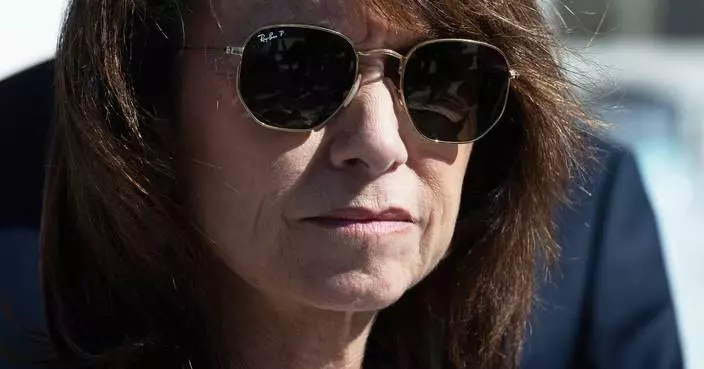
Harvard University researcher Kseniia Petrova, 30, departs the John Joseph Moakley United States Courthouse after being released on bail from federal custody on Thursday, June 12, 2025, in Boston. (AP Photo/Leah Willingham)
WEST PALM BEACH, Fla. (AP) — President Donald Trump said on Saturday that the U.S. will significantly reduce its troop presence in Germany, escalating a dispute with Chancellor Friedrich Merz as he seeks to scale back America’s commitment to European security.
The Pentagon on Friday had initially announced it would pull some 5,000 troops out of Germany, but when asked Saturday about the reason for the move, Trump didn't offer an explanation and said an even bigger reduction was coming.
“We’re going to cut way down. And we’re cutting a lot further than 5,000," Trump told reporters in Florida.
Earlier on Saturday, Germany's defense minister appeared to take in stride the news that 5,000 U.S. troops would be leaving his country.
Boris Pistorius said the drawdown, which Trump has threatened for years, was expected, and he said European nations needed to take on more responsibility for their own defense. But he also emphasized that security cooperation benefited both sides of the trans-Atlantic partnership.
“The presence of American soldiers in Europe, and especially in Germany, is in our interest and in the interest of the U.S.,” Pistorius told the German news agency dpa.
The planned withdrawal faced bipartisan resistance in Washington, with swift criticism from Democrats and concern from Republicans that it would send the “wrong signal” to Russian President Vladimir Putin, whose full-scale invasion of Ukraine recently entered its fifth year.
Trump's decision comes as he seethes at European allies over their unwillingness to join his campaign with Israel against Iran. He has lashed out at leaders like Merz, Spanish Prime Minister Pedro Sánchez and British Prime Minister Keir Starmer.
Merz last week criticized the war in Iran, saying the U.S. is being “humiliated” by the Iranian leadership and calling out Washington’s lack of strategy.
In another sign of friction, Trump accused the European Union of not complying with its U.S. trade deal and announced plans to increase tariffs next week on cars and trucks produced in the bloc to 25%, a move that would be particularly damaging to Germany, a major automobile manufacturer.
At least one EU lawmaker called the tariff hike “unacceptable” and accused Trump of breaking yet another U.S. commitment on trade.
A pullout of 5,000 soldiers from Germany would amount to about one-seventh of the 36,000 American service members stationed in the country. The Pentagon offered few details about which troops or operations would be affected. The Pentagon on Saturday did not immediately respond to a message seeking details on the further reductions.
The withdrawal of the 5,000 troops is scheduled to take place over the next six to 12 months, according to the Pentagon. Trump previously said he would pull 9,500 troops from Germany during his first term, but he didn’t start the process and Democratic President Joe Biden formally stopped the planned withdrawal soon after taking office in 2021.
More broadly, around 80,000-100,000 U.S. personnel are usually stationed in Europe — depending on operations, exercises and troop rotations. The U.S. increased its European deployment after Russia launched its full-scale war on Ukraine in February 2022. NATO allies like Germany have expected for over a year that these troops would be the first to leave.
Pistorius, in his comments to dpa, said, “We Europeans must take on more responsibility for our security,” while stressing recent efforts by Germany to boost its armed forces, accelerate procurement and develop infrastructure.
NATO spokesperson Allison Hart, in a post Saturday on X, said the trans-Atlantic alliance was “working with the U.S. to understand the details of their decision on force posture in Germany.”
“This adjustment underscores the need for Europe to continue to invest more in defense and take on a greater share of the responsibility for our shared security,” she added, noting “progress” toward a target among NATO allies to each invest 5% of their economic output to defense.
Pentagon spokesperson Sean Parnell said in a statement that the “decision follows a thorough review of the Department’s force posture in Europe and is in recognition of theater requirements and conditions on the ground.”
A U.S. defense official, speaking on condition of anonymity to discuss sensitive matters, said the branches of the U.S. military didn’t have prior knowledge of the decision to draw down the 5,000 troops and learned about it “in real time.”
In response, the Defense Department reiterated that it conducted a thorough review of its force posture in Europe.
“The decision to withdraw troops in Germany follows a comprehensive, multilayered process that incorporates perspectives from key leaders in EUCOM and across the chain of command,” acting Pentagon press secretary Joel Valdez wrote in an email, using the abbreviation for U.S. European Command.
Most U.S. troops in Germany come from the Army and Air Force.
Germany hosts several American military facilities, including the headquarters of the U.S. European and Africa commands, Ramstein Air Base and a medical center in Landstuhl, where casualties from the wars in Afghanistan and Iraq were treated. U.S. nuclear missiles are also stationed in the country.
Withdrawal of 5,000 troops — the size of a brigade combat team — from Germany would likely have limited impact on combat power, but “in terms of messaging of U.S. commitment though, it’s very different,” another U.S. defense official said.
The only permanent brigade combat team in Germany is the 2nd Cavalry Regiment, alongside an aviation brigade and other assets, which is considered to have an important role in America's — and NATO's — ability to deter threats.
After swift pushback from Democrats on Friday, Republican leaders of both armed services committees in Congress said Saturday they were “very concerned” about the troop withdrawal.
Sen. Roger Wicker of Mississippi and Rep. Mike Rogers of Alabama said the decision risked “undermining deterrence and sending the wrong signal to Vladimir Putin.”
They also said the Pentagon had decided to cancel the planned deployment of the Army's Long-Range Fires Battalion. Parnell's statement made no mention of that.
Wicker and Rogers said any significant change to the U.S. force posture in Europe warrants review and coordination with Congress.
“We expect the Department to engage with its oversight committees in the days and weeks ahead on this decision and its implications for U.S. deterrence and trans-Atlantic security,” they said in a joint statement.
They also noted that Germany has heeded Trump’s call to shoulder more of the burden of defense spending in Europe, while giving U.S. forces access to its bases and airspace in the war against Iran.
Burrows reported from London and Grieshaber from Berlin. Associated Press writers Ben Finley and Michelle L. Price in Washington and Jamey Keaten in Lyon, France, contributed to this report.
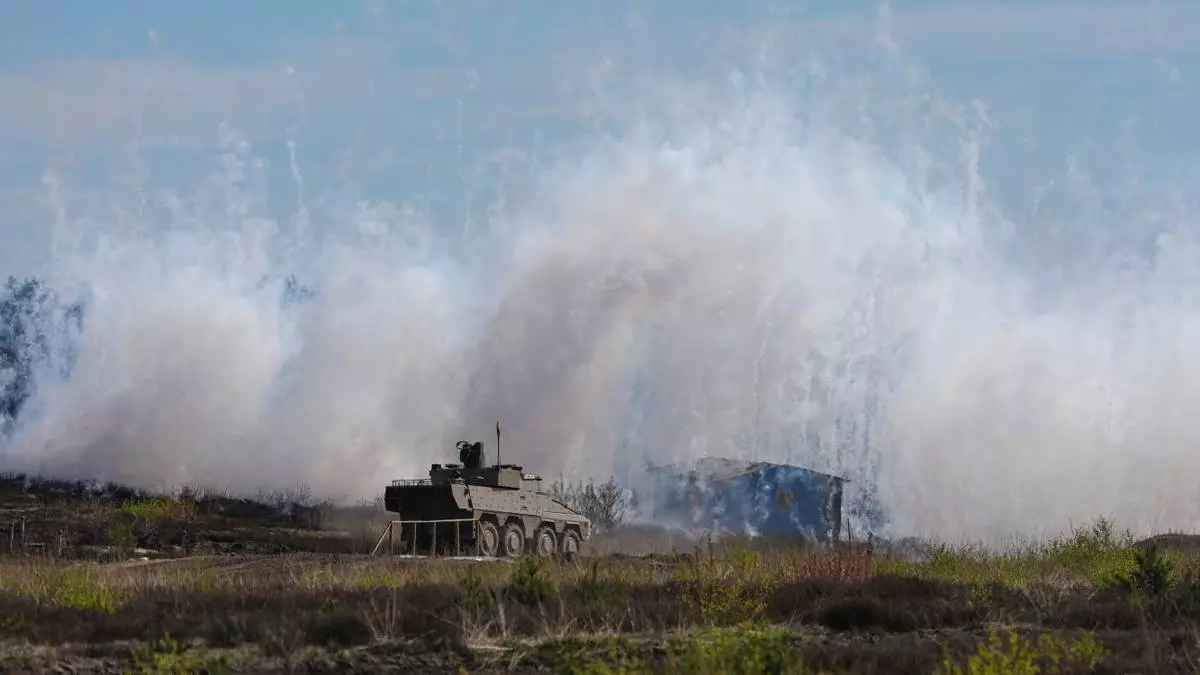
Bundeswehr troops demonstrate their capabilities during a visit of German Chancellor Friedrich Merz to the army at the Bundeswehr base in Munster, Germany, Thursday, April, 30, 2026. (AP Photo/Markus Schreiber)