The Associated Press is calling the current conflict between Israel and Iran a war, given the scope, intensity and duration of military activities on both sides.
Other news organizations also have decided to refer to the conflict as a war, while some are still sticking with words such as “conflict” or “fighting.”
When a conflict in the world spills into military action, it’s important to use the correct terms to describe it.
Sometimes a one-sided attack occurs without further action, or a conflict bubbles up and then ends quickly
Using “war” widely to describe these kinds of situations can diminish the word's importance. Then, when actual war breaks out, people might not understand its significance.
The Merriam-Webster definition of war is quite broad: “A state of usually open and declared armed hostile conflict between states or nations," or "a state of hostility, conflict, or antagonism.”
The fight between Israel and Iran meets those criteria, though neither has officially declared war.
Since Israel launched an air campaign targeting Iran’s military and nuclear program, there has been a significant escalation in the conflict. Iran has launched hundreds of missiles and drones into Israel. Israel has assassinated high-level Iranian officials; targeted the country’s infrastructure; called for hundreds of thousands of residents to evacuate Iran’s capital, Tehran; and said it will continue its offensive.
The AP provided guidance on the Russia-Ukraine war and the Israel-Hamas war in the days and weeks after fighting began.
In both cases, editors considered the number of casualties, the intensity of fighting, the involvement of each party, and what each country was calling the conflict.
In both cases, the AP started using the word “war” to describe the conflicts.
AP capitalizes the word “war” only as part of a formal name, which as of now does not exist.
Decisions on how AP uses the term “war” happen in real time. AP's news leaders and standards editors will continue to monitor developments to see whether changes are necessary.
At this point, the level of fighting constitutes the countries being at war, no matter what happens next. If fighting were to end soon, AP would continue saying the countries had been at war. News leaders would consider whether the level of fighting at that time amounted to being at war.
By attacking Iran’s nuclear facilities, the U.S. has intervened in the war. The AP is not saying the U.S. and Iran are at war.
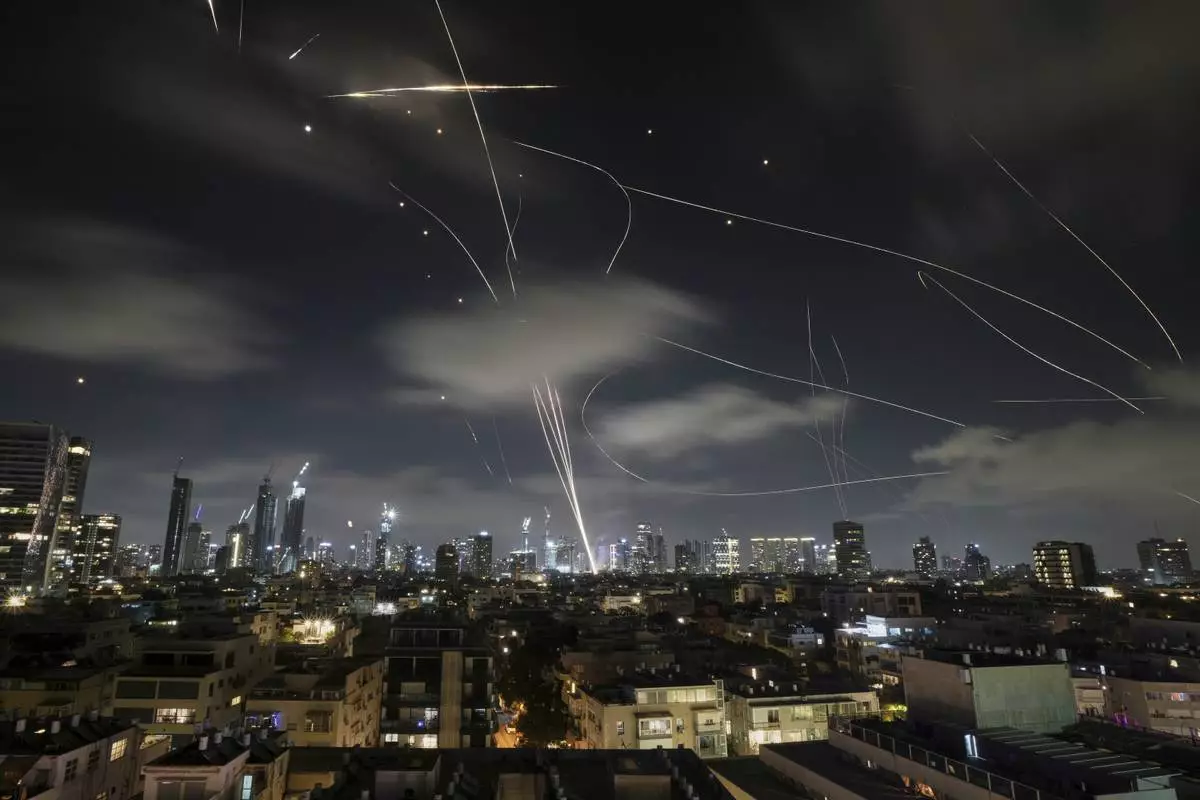
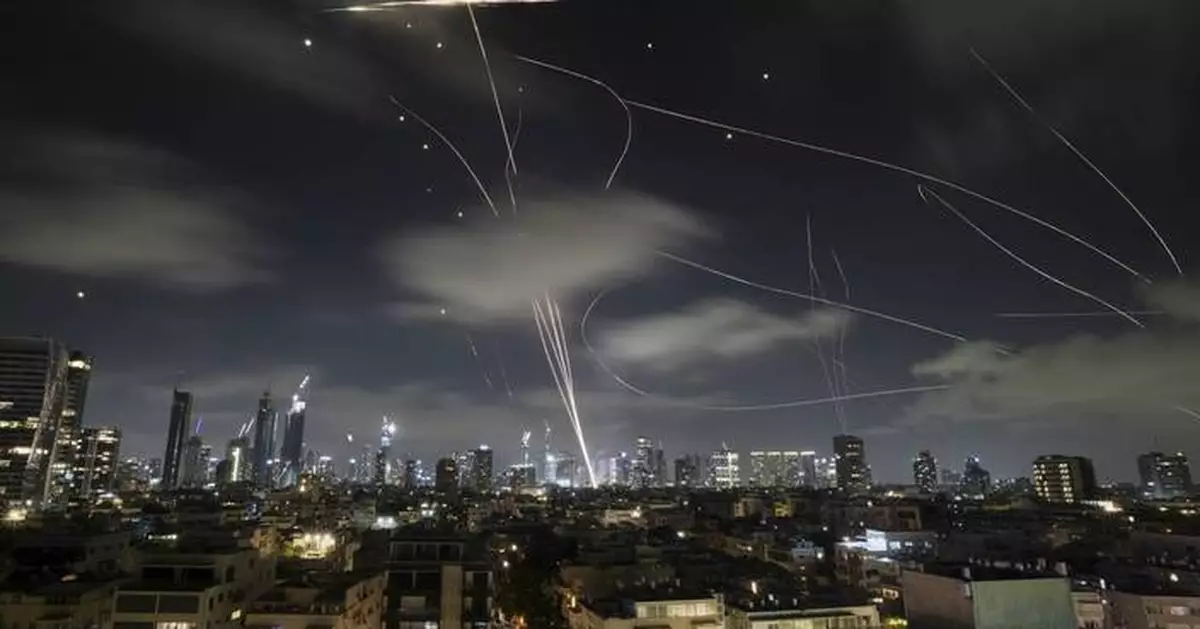
The Israeli Iron Dome air defense system fires to intercept missiles during an Iranian attack over Tel Aviv, Israel, early Wednesday, June 18, 2025. (AP Photo/Leo Correa)
DUBAI, United Arab Emirates (AP) — U.S. President Donald Trump and top Iranian officials exchanged dueling threats Friday as widening protests swept across parts of the Islamic Republic, further escalating tensions between the countries after America bombed Iranian nuclear sites in June.
At least eight people have been killed so far in violence surrounding the demonstrations, which were sparked in part by the collapse of Iran’s rial currency but have increasingly seen crowds chanting anti-government slogans.
The protests, now in their sixth day, have become the biggest in Iran since 2022, when the death of 22-year-old Mahsa Amini in police custody triggered nationwide demonstrations. However, the protests have yet to be as widespread and intense as those surrounding the death of Amini, who was detained over not wearing her hijab, or headscarf, to the liking of authorities.
Trump initially wrote on his Truth Social platform, warning Iran that if it “violently kills peaceful protesters,” the United States “will come to their rescue.”
“We are locked and loaded and ready to go,” Trump wrote, without elaborating.
Ali Larijani, a former parliament speaker who serves as the secretary of Iran’s Supreme National Security Council, alleged that Israel and the U.S. were stoking the demonstrations. He offered no evidence to support the allegation, which Iranian officials have repeatedly made during years of protests sweeping the country.
“Trump should know that intervention by the U.S. in the domestic problem corresponds to chaos in the entire region and the destruction of the U.S. interests,” Larijani wrote on X, which the Iranian government blocks. “The people of the U.S. should know that Trump began the adventurism. They should take care of their own soldiers.”
Larijani’s remarks likely referenced America’s wide military footprint in the region. Iran in June attacked Al Udeid Air Base in Qatar after the U.S. strikes on three nuclear sites during Israel's 12-day war on the Islamic Republic. No one was injured, though a missile did hit a structure there.
As of Friday, no major changes had been made to U.S. troop levels in the Middle East or their preparations following Trump’s social media posts, said a U.S. official, who spoke on condition of anonymity to discuss sensitive military plans.
In a letter late Friday to United Nations Secretary-General António Guterres and the U.N. Security Council, Iran's envoy asked the world body to condemn the rhetoric and reaffirm the country's "inherent right to defend its sovereignty, territorial integrity, and national security, and to protect its people against any foreign interference.”
“The United States of America bears full responsibility for any consequences arising from these unlawful threats and any ensuing escalation," said Amir Saeid Iravani, Iranian ambassador to the U.N.
Ali Shamkhani, an adviser to Supreme Leader Ayatollah Ali Khamenei who previously was the council’s secretary for years, separately warned that “any interventionist hand that gets too close to the security of Iran will be cut.”
Trump's online message marked a direct sign of support for the demonstrators, something other American presidents have avoided out of concern that activists would be accused of working with the West. During Iran's 2009 Green Movement demonstrations, President Barack Obama held back from publicly backing the protests — something he said in 2022 “was a mistake.”
But such White House support still carries a risk.
“Though the grievances that fuel these and past protests are due to the Iranian government’s own policies, they are likely to use President Trump’s statement as proof that the unrest is driven by external actors,” said Naysan Rafati, an analyst at the International Crisis Group.
“But using that as a justification to crack down more violently risks inviting the very U.S. involvement Trump has hinted at,” he added.
Iran’s Foreign Ministry spokesperson Esmail Baghaei recently cited a list of Tehran’s longtime grievances regarding U.S. intervention, including a CIA-backed coup in 1953, the downing of a passenger jet in 1988 and the strikes in June.
Protests continued Friday in various cities in the country, even as life largely continued unaffected in the capital, Tehran. Demonstrations have reached over 100 locations in 22 of Iran's 31 provinces, the U.S.-based Human Rights Activists News Agency reported. It said the death toll in the demonstrations rose to eight with the death of a demonstrator in Marvdasht in Iran's Fars province.
Demonstrators took to the streets in Zahedan in Iran's restive Sistan and Baluchestan province on the border with Pakistan. The burials of several demonstrators killed in the protests also took place Friday, sparking marches.
Videos purported to show mourners chasing off security force members who attended the funeral of 21-year-old Amirhessam Khodayari. He was killed Wednesday in Kouhdasht, over 400 kilometers (250 miles) southwest of Tehran in Iran's Lorestan province.
Footage also showed Khodayari's father denying his son served in the all-volunteer Basij force of Iran’s paramilitary Revolutionary Guard, as authorities claimed. The semiofficial Fars news agency later reported that there were now questions about the government's claims that he served.
Iran’s civilian government under reformist President Masoud Pezeshkian has been trying to signal it wants to negotiate with protesters. However, Pezeshkian has acknowledged there is not much he can do as Iran’s rial has rapidly depreciated, with $1 now costing some 1.4 million rials. That sparked the initial protests.
The protests, taking root in economic issues, have heard demonstrators chant against Iran’s theocracy as well. Tehran has had little luck in propping up its economy in the months since the June war.
Iran recently said it was no longer enriching uranium at any site in the country, trying to signal to the West that it remains open to potential negotiations over its atomic program to ease sanctions. However, those talks have yet to happen as Trump and Israeli Prime Minister Benjamin Netanyahu have warned Tehran against reconstituting its atomic program.
Associated Press writers Konstantin Toropin in Washington and Farnoush Amiri in New York contributed to this report.
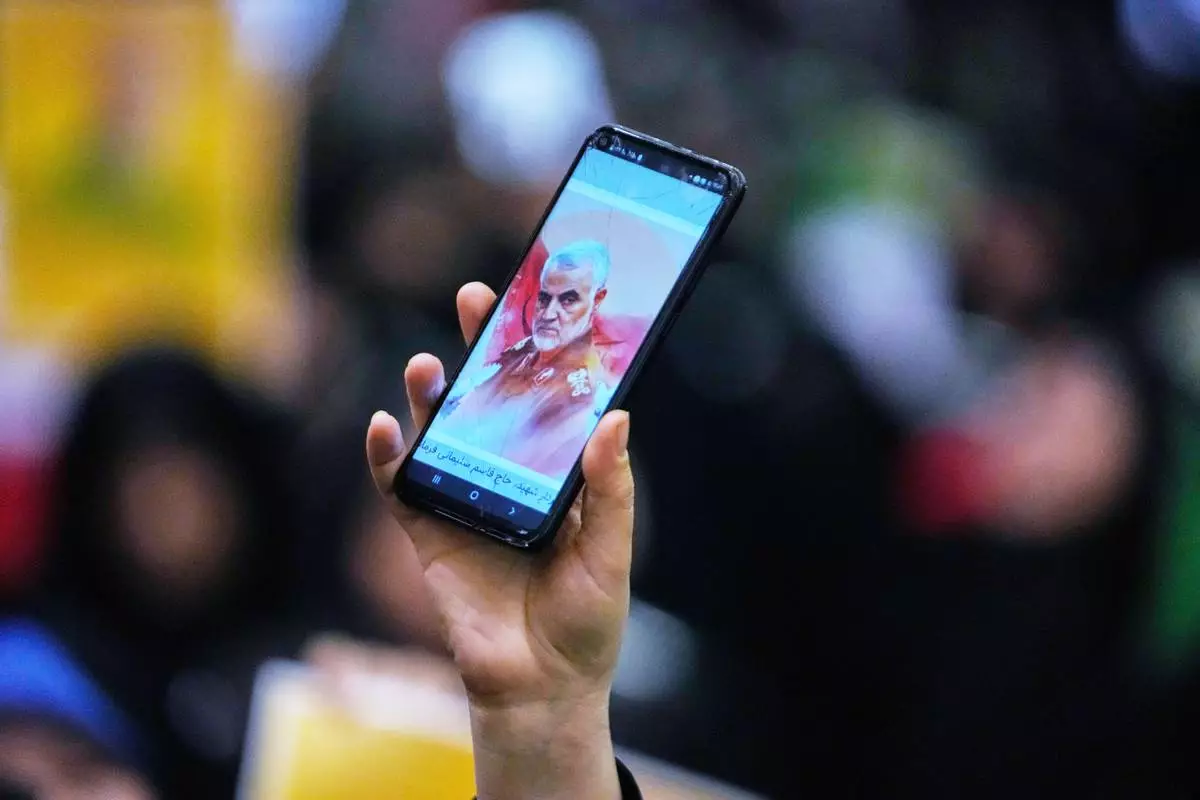
A woman shows a portrait of the late commander of Iran's Revolutionary Guard expeditionary Quds Force, Gen. Qassem Soleimani, who was killed in a U.S. drone attack in 2020 in Iraq, on her smartphone during a ceremony commemorating his death anniversary at the Imam Khomeini grand mosque in Tehran, Iran, Thursday, Jan. 1, 2026. (AP Photo/Vahid Salemi)
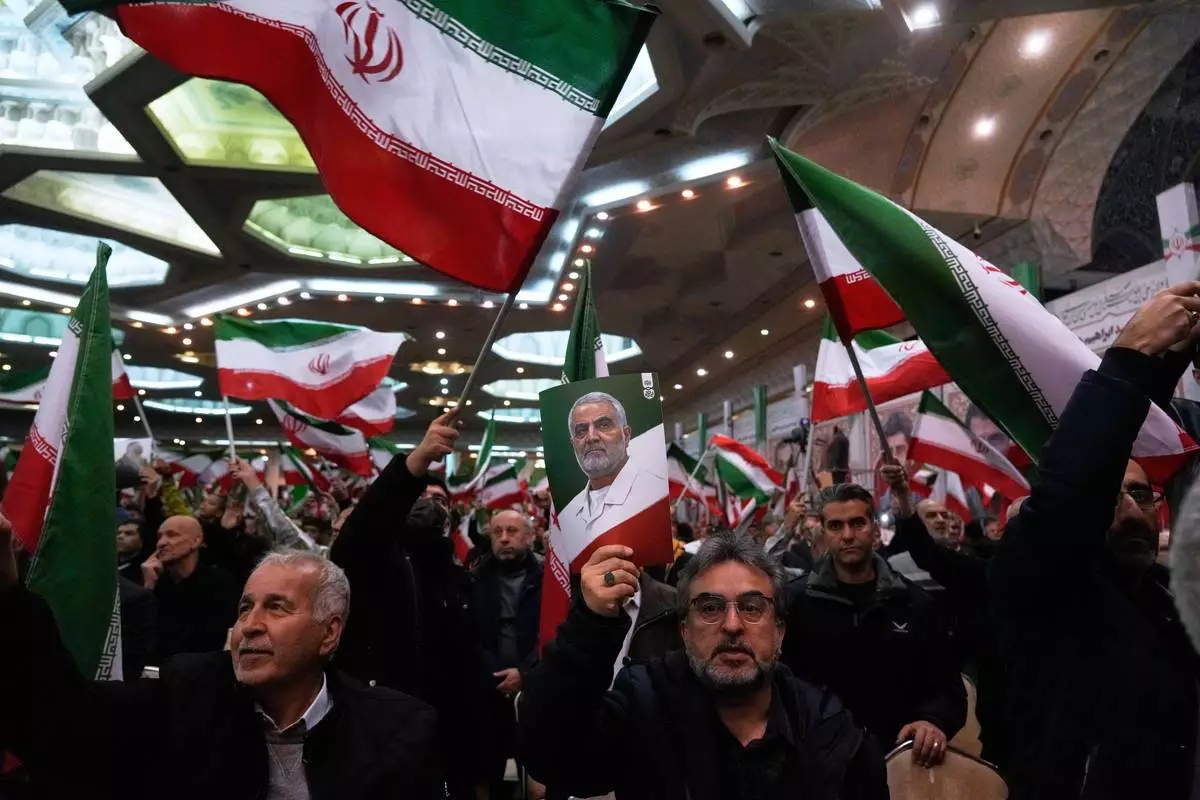
People wave Iranian flags as one of them holds up a poster of the late commander of the Iran's Revolutionary Guard expeditionary Quds Force, Gen. Qassem Soleimani, who was killed in a U.S. drone attack in 2020 in Iraq, during a ceremony commemorating his death anniversary at the Imam Khomeini grand mosque in Tehran, Iran, Thursday, Jan. 1, 2026. (AP Photo/Vahid Salemi)
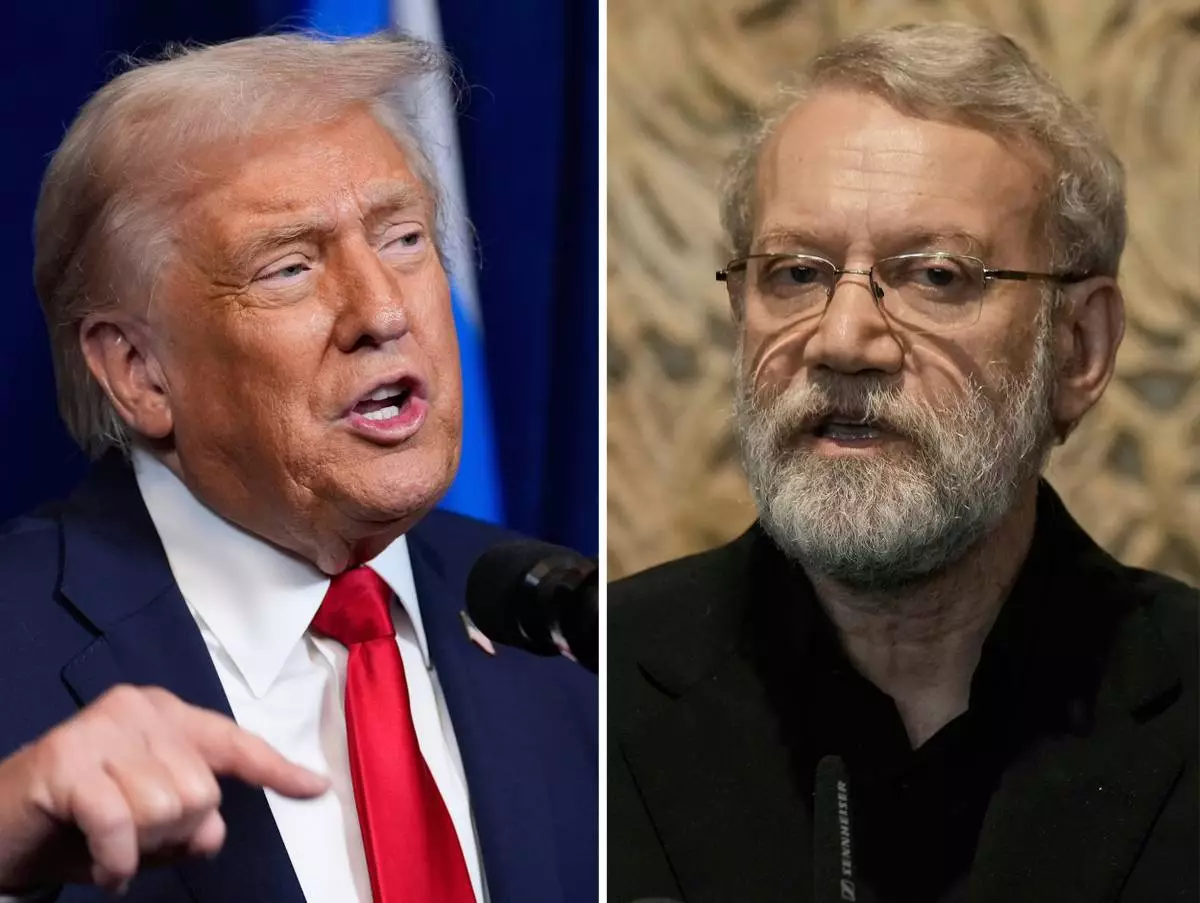
This combo shows President Donald Trump at Mar-a-Lago, Monday, Dec. 29, 2025, in Palm Beach, Fla. and Iranian Secretary of Supreme National Security Council Ali Larijani in Beirut, Lebanon, Wednesday, Aug. 13, 2025. (AP Photo/Alex Brandon, Bilal Hussein)