Since June 2023, provinces in northern China have focused on desertification prevention and control, accelerating efforts to strengthen the ecological security barrier in the country's northern regions. To date, more than 6.67 million hectares of forestation and land restoration have been completed.
This spring had seen rapid progress of three major strategic campaigns in the Three-North Shelterbelt Forest Program (TSFP), a large-scale afforestation project.
In the East, the sand lands of Horqin and Hunshandake have made significant strides in eliminating mobile sand dunes, with over 948,000 hectares of sand lands being reversed.
In the Central Region, efforts have focused on the "Great Bend" of the Yellow River, targeting both sand and water erosion issues. So far, 3.18 million hectares of land have been restored, significantly reducing sediment inflow into the Yellow River.
In the West, the campaign along the Hexi Corridor and the edges of the Taklimakan Desert has further reinforced ecological defenses through border forests and grasslands. As a result, the Tengger Desert's edge has retreated by 25 kilometers.
"Over the past two years, the central government has invested 57.7 billion yuan, launching 369 key projects. A total of 8.2 million hectares of land have been treated, marking the most intensive phase of investment, achievement, and impact in the history of the 'Three-North Shelterbelt Forest Program'," said Zhang Shengdong, deputy director of the Department of Ecological Protection at the National Forestry and Grassland Administration.
Covering nearly 46.7 percent of China's landmass, the project has been strategically divided into 68 key zones, guided by science and precise planning. The approach includes customized regional solutions and coordinated efforts across departments and provinces.
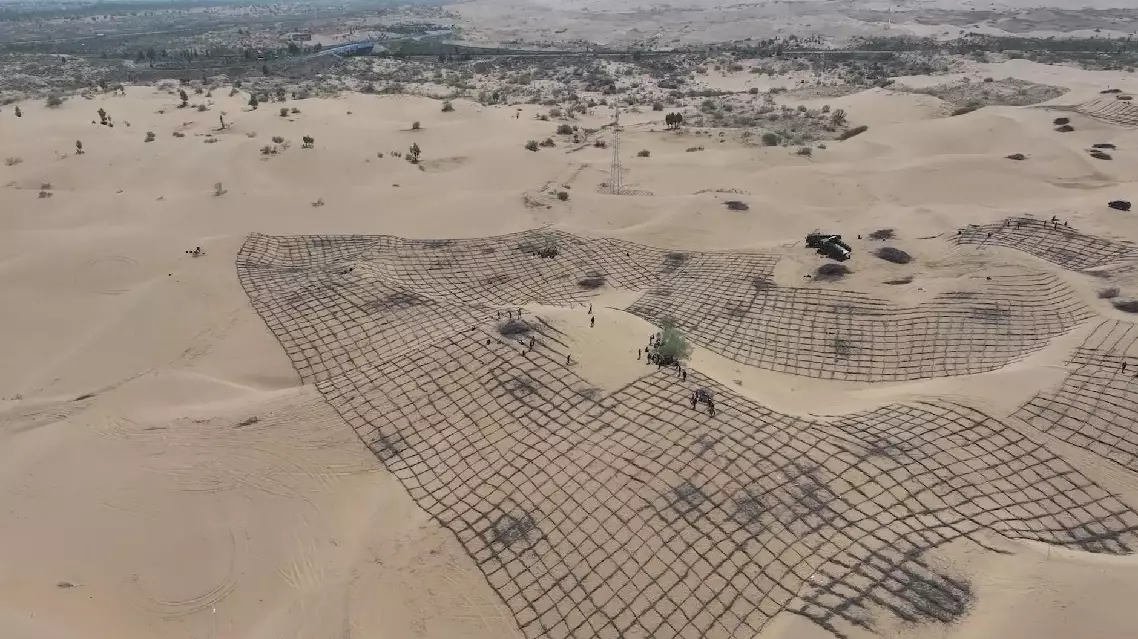
In Xilingol, north China's Inner Mongolia Autonomous Region, authorities have launched repairing road to combat sandification. Over 600 kilometers of roads will be built in both rural and pastoral areas this year to divide and block mobile sand with a grid-like transportation network.
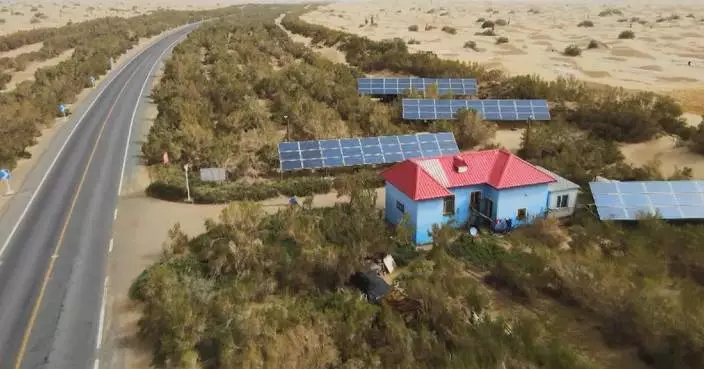
Along the edge of the Taklimakan Desert in northwest China's Xinjiang Uygur Autonomous Region, a massive "photovoltaic corridor" — over one kilometer wide and stretching approximately 800 kilometers — is under construction to curb desert expansion while promoting renewable energy.
Advanced technologies such as unmanned drones for seedling delivery, sand barrier laying machines and sand-fixation equipment are now widely used, dramatically increasing efficiency in afforestation and desert control.
"Focusing on challenges such as the scarcity of high-quality tree and grass species in the Three-North regions and the relatively low mechanization and intelligent adaptation level of desertification control, we have adopted a collaborative approach to tackle key issues. Over 100 major scientific and technological achievements have been applied in the Three-North regions. The proportion of mechanized afforestation in desert control has reached nearly 50 percent, while the utilization rate of improved tree and grass species exceeds 70 percent," said Lu Qi, director of the Three-North Project Research Institute under the Chinese Academy of Forestry.
Three-North Shelterbelt Forest Program creates ecological miracles