COLUMBUS, Ohio (AP) — A landmark U.S. Supreme Court ruling 10 years ago on June 26, 2015, legalized same-sex marriage across the U.S.
The Obergefell v. Hodges decision followed years of national wrangling during which some states moved to protect domestic partnerships or civil unions for same-sex partners and others declared that marriage could exist only between one man and one woman.
Click to Gallery
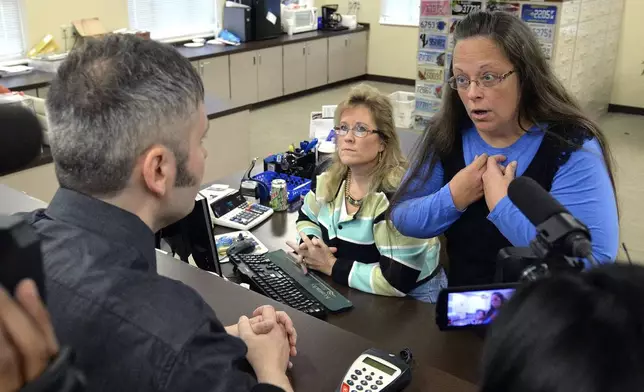
FILE - Rowan County Clerk Kim Davis, right, talks with David Moore following her office's refusal to issue marriage licenses at the Rowan County Courthouse in Morehead, Ky., on Sept. 1 2015. (AP Photo/Timothy D. Easley, File)
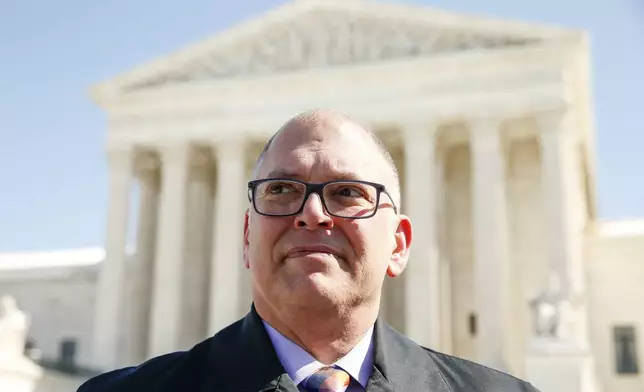
FILE - James Obergefell of the Human Rights Campaign speaks to a journalist as the campaign delivers copies of the "People's Brief," calling for full nationwide marriage equality, in Washington, March 6, 2015. (AP Photo/Andrew Harnik, File)
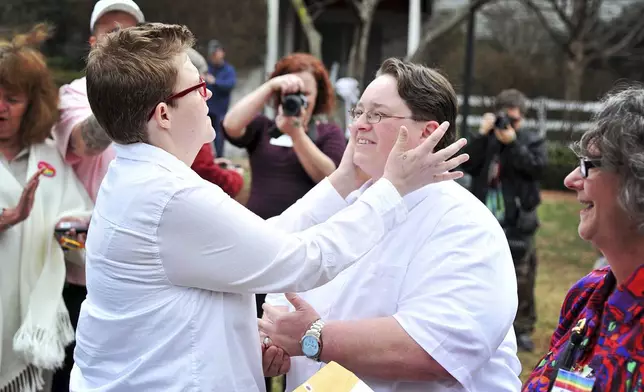
FILE - Same sex couples from Madison and surrounding counties celebrate as they get their marriage licenses and get married in Huntsville, Ala., Feb. 9, 2015, during a Wedding Week Huntsville event honoring the legalization of same-sex marriage. (Sarah Cole/The Huntsville Times via AP, File)
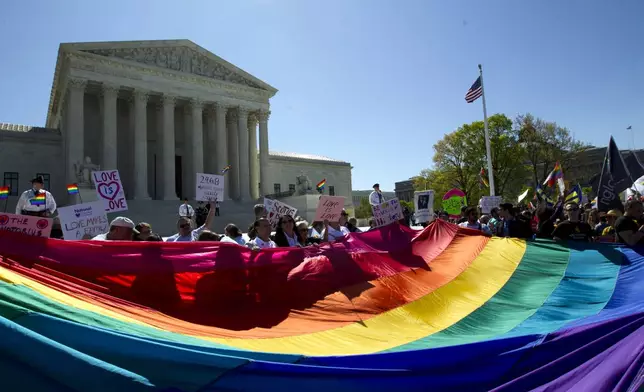
FILE - Demonstrators hold a rainbow pride flag outside the Supreme Court as justices deliberate Obergefell vs. Hodges, the case that legalized same-sex marriage nationwide, in Washington, April 28, 2015. (AP Photo/Jose Luis Magana, File)
In plaintiff James Obergefell's home state of Ohio, voters had overwhelmingly approved such an amendment in 2004 — effectively mirroring the federal Defense of Marriage Act, which denied federal recognition of same-sex couples. That laid the political groundwork for the legal challenge that bears his name.
Here's what you need to know about the lawsuit, the people involved and the 2015 ruling's immediate and longer-term effects:
Obergefell and John Arthur, who brought the initial legal action, were longtime partners living in Cincinnati. They had been together for nearly two decades when Arthur was diagnosed with ALS, or amyotrophic lateral sclerosis, in 2011. Obergefell became Arthur's caregiver as the incurable condition ravaged his health over time.
When in 2013 the Supreme Court struck down the federal Defense of Marriage Act, which had denied federal recognition of same-sex marriages, the pair acted quickly to get married. Their union was not allowed in Ohio, so they boarded a plane to Maryland and, because of Arthur's fragile health, married on the tarmac.
It was when they learned their union would not be listed on Arthur's death certificate that the legal battle began. They went to court seeking recognition of their marriage on the document, and their request was granted. Ohio appealed, and the case began its way up the ladder to the nation's high court.
Obergefell, a Democrat, made an unsuccessful run for the Ohio House in 2022.
Rick Hodges, a Republican, was director of the Ohio Department of Health, which handles death certificates, from August 2014 to 2017. Before being appointed by then-Gov. John Kasich, Hodges served five years in the state's House. Acquainted through the court case, he and Obergefell have become friends.
The lawsuit eventually titled Obergefell v. Hodges argued that marriage is guaranteed under the U.S. Constitution's Fourteenth Amendment, specifically the due process and equal protection clauses.
The litigation consolidated several lawsuits brought by same-sex couples in Ohio, Kentucky, Michigan and Tennessee who were denied marriage licenses or recognition for out-of-state marriages and whose cases resulted in conflicting opinions in federal circuit courts.
In a 5-4 decision, the Supreme Court ruled that the right to marry is fundamental, calling it “inherent in the liberty of the person” and therefore protected by the Constitution. The ruling effectively nullified state-level bans on same-sex marriages, as well as laws declining to recognize such unions performed in other jurisdictions.
The custody, property, tax, insurance and business implications of the decision have also had sweeping impacts on other areas of law.
Same-sex marriages surged in the immediate wake of the Obergefell decision, as dating couples and those already living as domestic partners flocked to courthouses and houses of worship that welcomed them to legalize their unions.
Over the ensuing decade, the number of married same-sex couples has more than doubled to an estimated 823,000, according to June data compiled by the Williams Institute at the University of California Los Angeles School of Law.
Not all Americans supported the change. A national symbol of opposition was Kim Davis, a then-clerk in Rowan County, Kentucky, who refused to issue marriage licenses on religious grounds. She was briefly jailed, touching off weeks of protests as same-sex marriage foes around the country praised her defiance.
Davis, a Republican, lost her bid for reelection in 2018. She was ordered to pay thousands of dollars in attorney fees incurred by a couple who were unable to get a license from her office. She appealed in July 2024, in a challenge that seeks to overturn Obergefell.
As he reflects on the 10th anniversary of the ruling, Obergefell has expressed worry about the state of LGBTQ+ rights in the country and the possibility that a case could reach the Supreme Court that might overturn the decision.
Eight states introduced resolutions this year urging a reversal, and the Southern Baptist Convention voted overwhelmingly at its meeting in Dallas this month in favor of banning same-sex marriage and overturning Obergefell. Meanwhile more than a dozen states have moved to strengthen legal protections for same-sex married couples in case the decision is overturned.
Polling from Gallup shows that Americans’ support for same-sex marriages is higher in 2025 than it was a decade ago: About 7 in 10 people surveyed said same-sex couples should be recognized by the law as valid, up from 60% in May 2015.
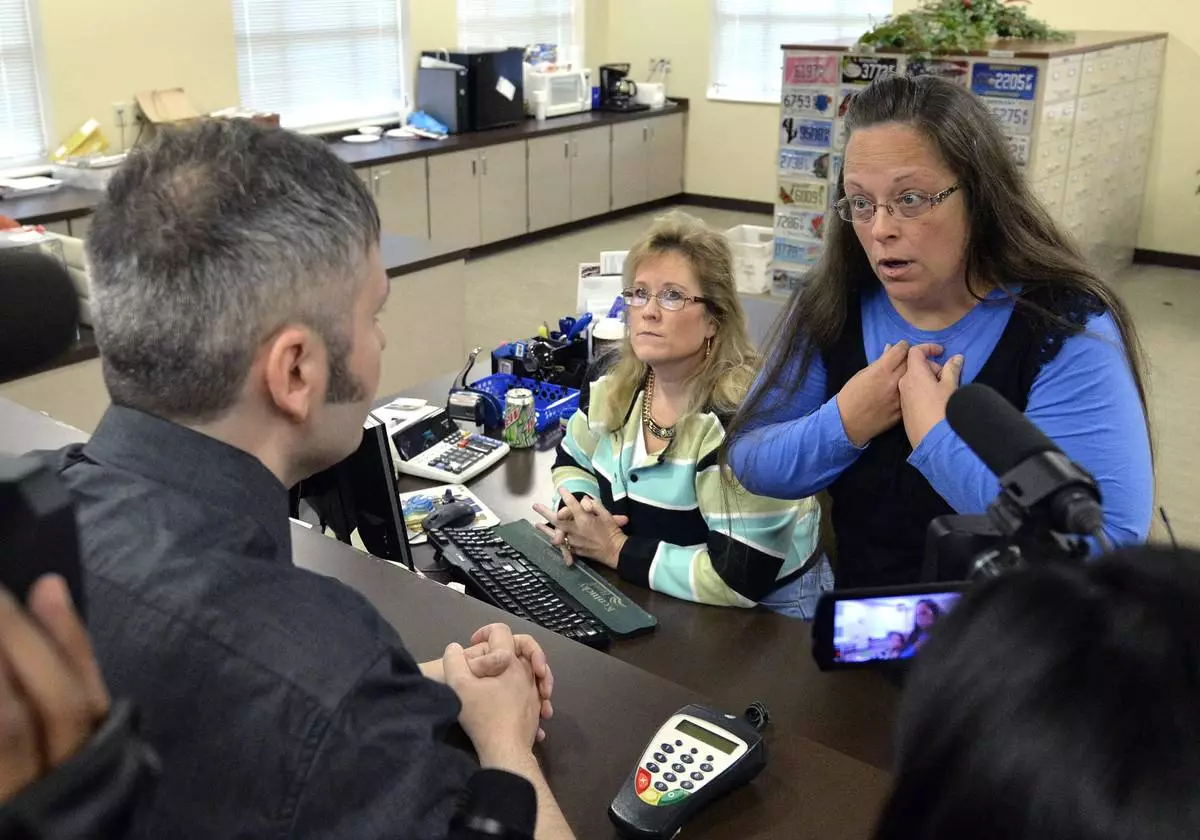
FILE - Rowan County Clerk Kim Davis, right, talks with David Moore following her office's refusal to issue marriage licenses at the Rowan County Courthouse in Morehead, Ky., on Sept. 1 2015. (AP Photo/Timothy D. Easley, File)
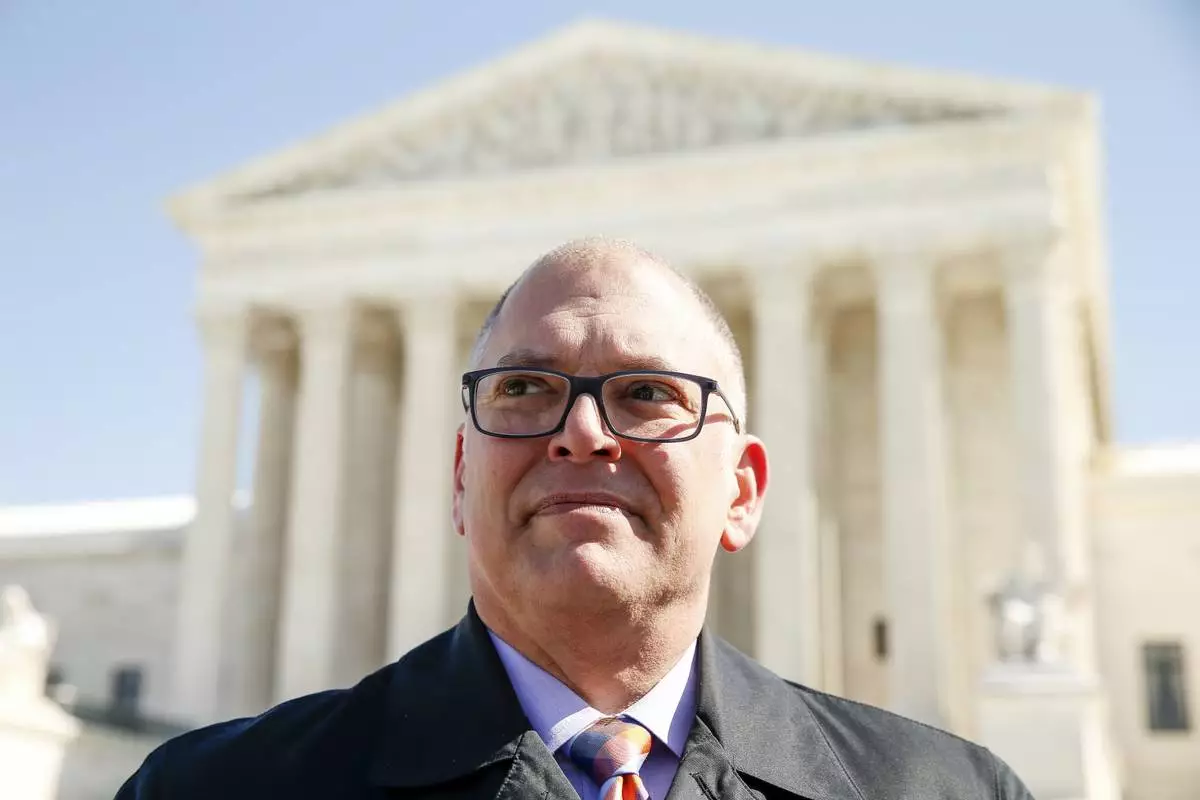
FILE - James Obergefell of the Human Rights Campaign speaks to a journalist as the campaign delivers copies of the "People's Brief," calling for full nationwide marriage equality, in Washington, March 6, 2015. (AP Photo/Andrew Harnik, File)
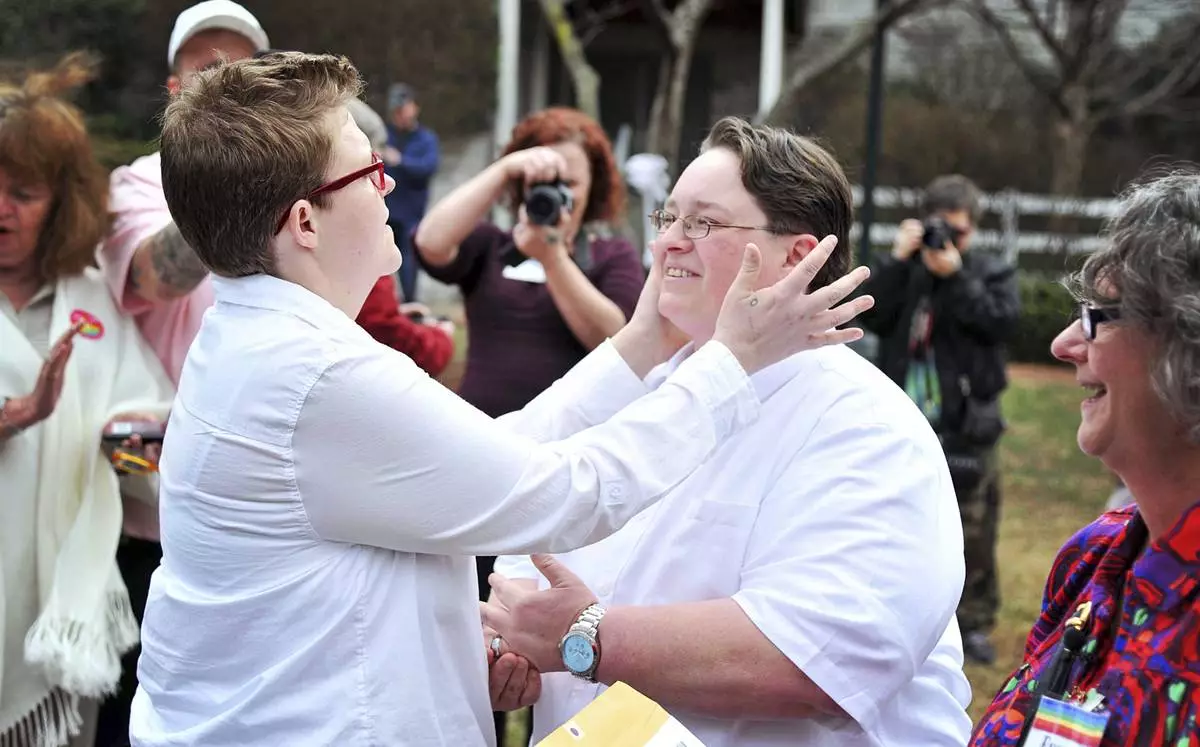
FILE - Same sex couples from Madison and surrounding counties celebrate as they get their marriage licenses and get married in Huntsville, Ala., Feb. 9, 2015, during a Wedding Week Huntsville event honoring the legalization of same-sex marriage. (Sarah Cole/The Huntsville Times via AP, File)
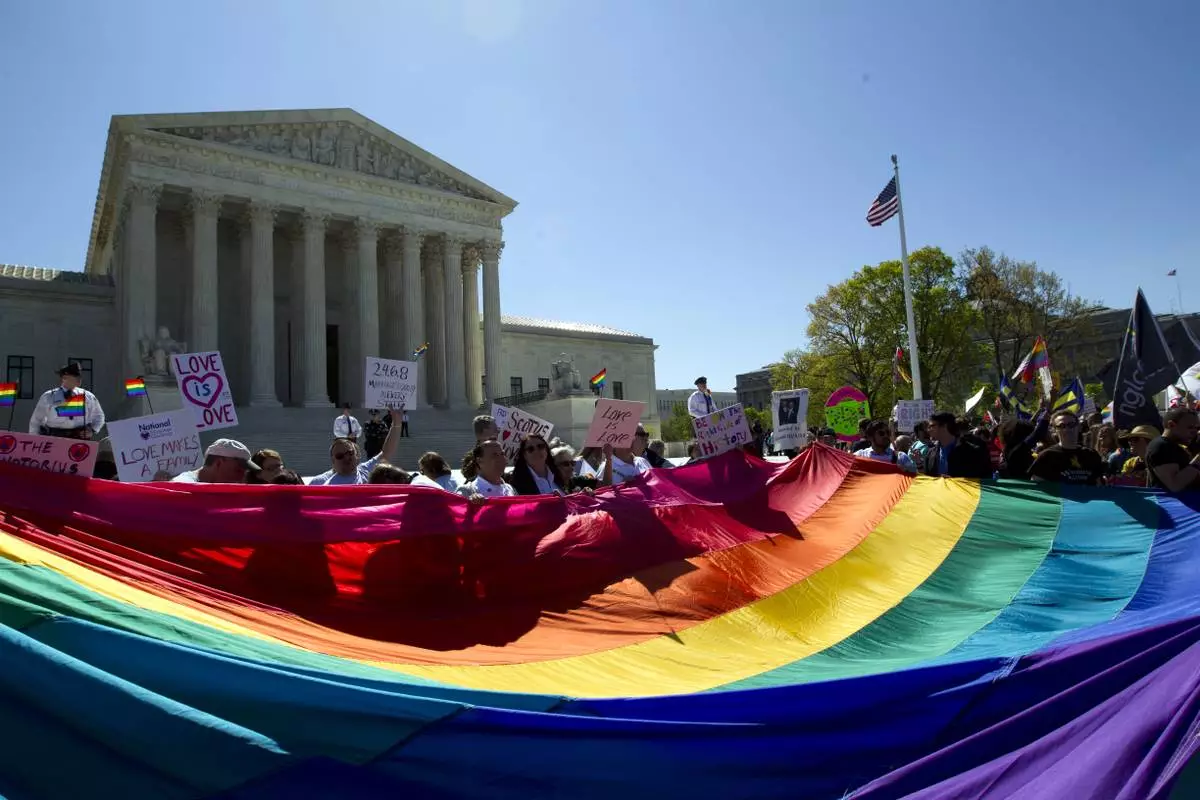
FILE - Demonstrators hold a rainbow pride flag outside the Supreme Court as justices deliberate Obergefell vs. Hodges, the case that legalized same-sex marriage nationwide, in Washington, April 28, 2015. (AP Photo/Jose Luis Magana, File)
VATICAN CITY (AP) — Pope Leo XIV celebrated his first Easter Mass as pontiff with a call Sunday to lay down arms and seek peace to global conflicts through dialogue, but he departed from a tradition of listing the world's woes by name in the Urbi et Orbi blessing from the loggia of St. Peter’s Basilica.
Leo, the first U.S.-born pope, emphasized Easter’s message of hope as a celebration of Jesus’ resurrection after being crucified.
“Let us allow our hearts to be transformed by his immense love for us! Let those who have weapons lay them down! Let those who have the power to unleash wars choose peace! Not a peace imposed by force, but through dialogue! Not with the desire to dominate others, but to encounter them!” the pope implored.
With the U.S.-Israeli war on Iran in its second month and Russia’s ongoing campaign in Ukraine, Leo acknowledged a sense of indifference “to the deaths of thousands of people ... to the repercussions of hatred and division that conflicts sow … to the economic and social consequences they produce.’’
Without mentioning the wars by name, Leo quoted his predecessor, Pope Francis, who during his last public appearance from the same loggia last Easter reminded the faithful of the “great thirst for death, for killing, we witness each day.’’
Francis, weakened by a long illness, died the next day on Easter Monday.
The Urbi et Orbi blessing, Latin for “to the city and the world,’’ has traditionally included a litany of the world’s woes. Leo followed that formula during his Christmas blessing. There was no immediate explanation for the shift.
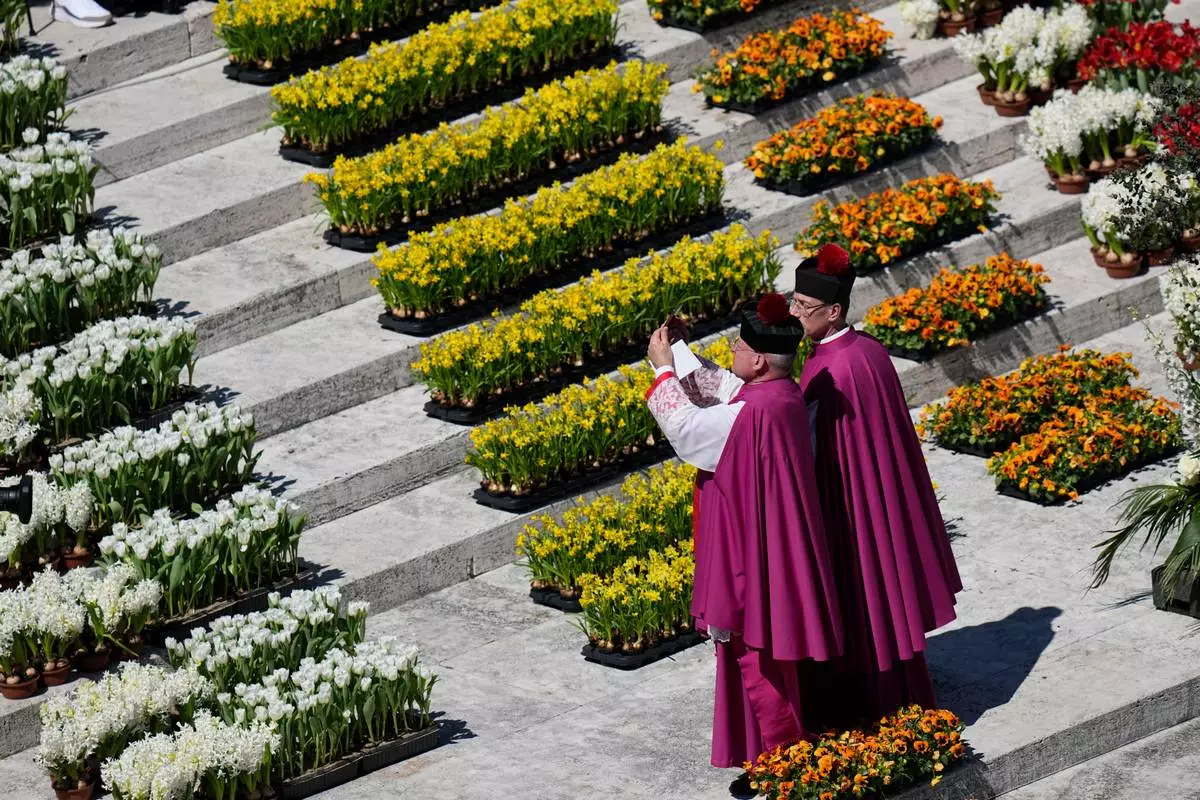
Earlier, Leo addressed some 50,000 faithful from an open-air altar in St. Peter’s Square flanked with white roses, while the steps leading down to the piazza where the faithful gathered were filled with spring perennials, symbolically resonating with the pope’s words.
He implored the faithful in his homily to keep their hope in the face of death, which lurks "in the abuses that crush the weakest among us, because of the idolatry of profit that plunders the earth’s resources, because of the violence of war that kills and destroys.’’
Speaking from the loggia, the pope announced a prayer vigil for peace April 11 in the basilica.
Leo greeted the global faithful in 10 languages, including Arabic, Chinese and Latin, reviving a practice that his predecessor Pope Francis had let lapse.
Before retreating into the basilica, Leo stepped forward out of the loggia’s shadow and waved to the cheering crowd below. He later greeted people in the piazza from the popemobile that took him all the way down Via della Conciliazione toward the Tiber River and back.
During the marathon that is Holy Week, Leo also reclaimed the tradition of washing priests’ feet on Holy Thursday, a gesture of encouragement toward clergy, after Francis had chosen a more inclusive path, traveling to prisons and homes for the disabled to wash the feet of women, non-Christians and prisoners.
The 70-year-old pontiff also became the first pope in decades to carry the light wooden cross for the entire 14 stations during the Way of the Cross on Good Friday.
Traditional ceremonies at the Church of the Holy Sepulchre, revered by Christians as the traditional site of Jesus’ crucifixion and resurrection, were scaled back under an agreement with Israeli police. Authorities have put limits on the sizes of public gatherings due to ongoing missile attacks.
The restrictions also dampened the recent Muslim holy month of Ramadan and Eid al-Fitr holiday, as well as the current weeklong Jewish festival of Passover. On Sunday, the Jewish priestly blessing at the Western Wall — normally attended by tens of thousands — was limited to just 50 people.
The restrictions have strained relations between Israeli authorities and Christian leaders. Police last week prevented two of the church’s top religious leaders, including Latin Patriarch Pierbattista Pizzaballa, from celebrating Palm Sunday at the Church of the Holy Sepulchre.
At the Holy Family church in Gaza City, Catholics young and old gathered for a traditional Easter Mass. Singing, they formed a queue in the aisle, waiting for their chance to kiss a sketch of Jesus held by a member of the clergy who wiped the glass frame between turns.
“There is great joy, especially after the ceasefire and after nearly three years of suffering and being unable to celebrate all the holy holidays,” said George Anton from Gaza City. “People are somewhat relieved and more stable.”
Armenian Christians observed Easter at a church in Iran’s capital on Sunday, striving to maintain a sense of normalcy five weeks into the war.
Families embraced and children exchanged painted eggs at the St. Sarkis Cathedral in central Tehran. Iran’s capital has been targeted by daily airstrikes since the United States and Israel launched the war on Feb. 28.
“Whether we like it or not, we have young children who do not understand what’s going on,” said Juanita Arakel, 40, an English language teacher. “They just need to feel normal.”
The Islamic Republic, with a population of around 90 million, is home to some 300,000 Christians, mostly Armenians, and three seats in parliament are reserved for Christians.
“Our calls and prayers are that we will be able to end this war,” said Sepuh Sargsyan, the archbishop of the Armenian Diocese of Tehran. “Our calls and prayers are that we will be able to end this war.”
Barry reported from Milan. Associated Press journalists Josef Federman in Jerusalem, Wafaa Shurafa in Deir al-Balah, Gaza Strip, and Bassem Mroue in Tehran, Iran, contributed to this report.
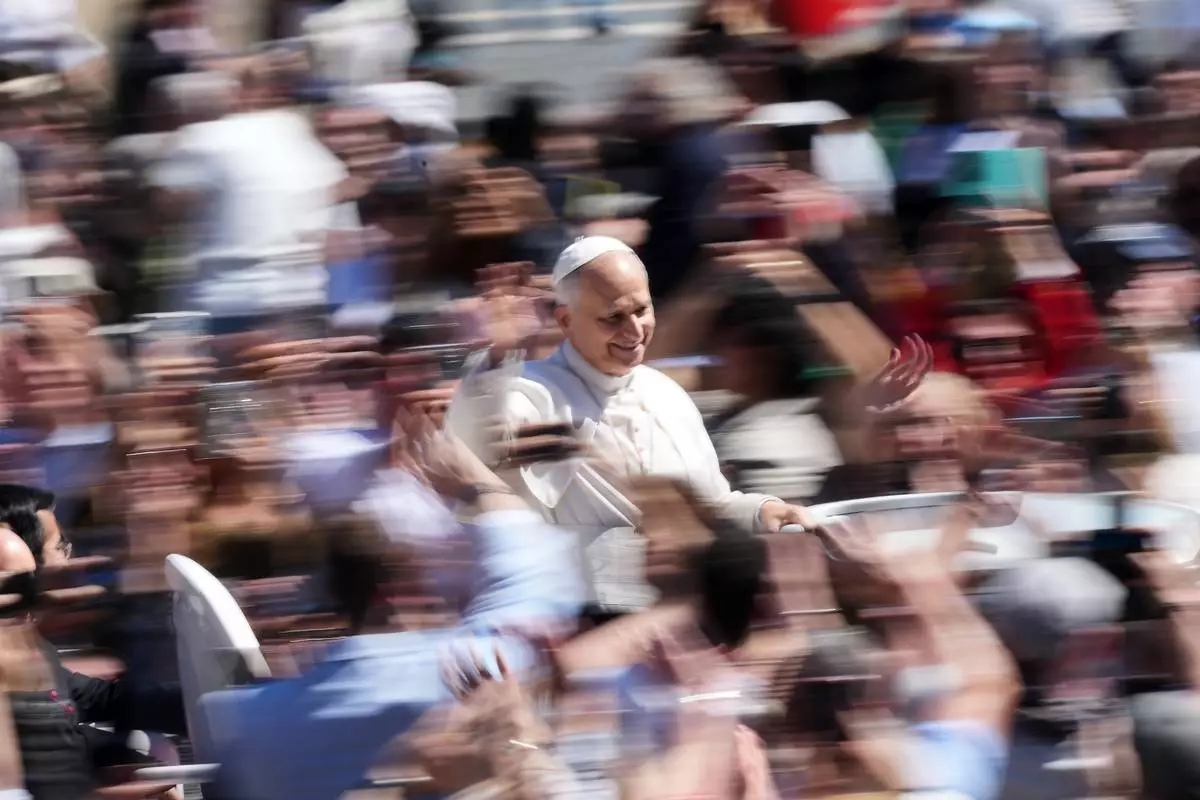
Pope Leo XIV greets the faithful at the end of Easter Mass he presided over in St. Peter's Square at the Vatican, Sunday, April 5, 2026. (AP Photo/Andrew Medichini)
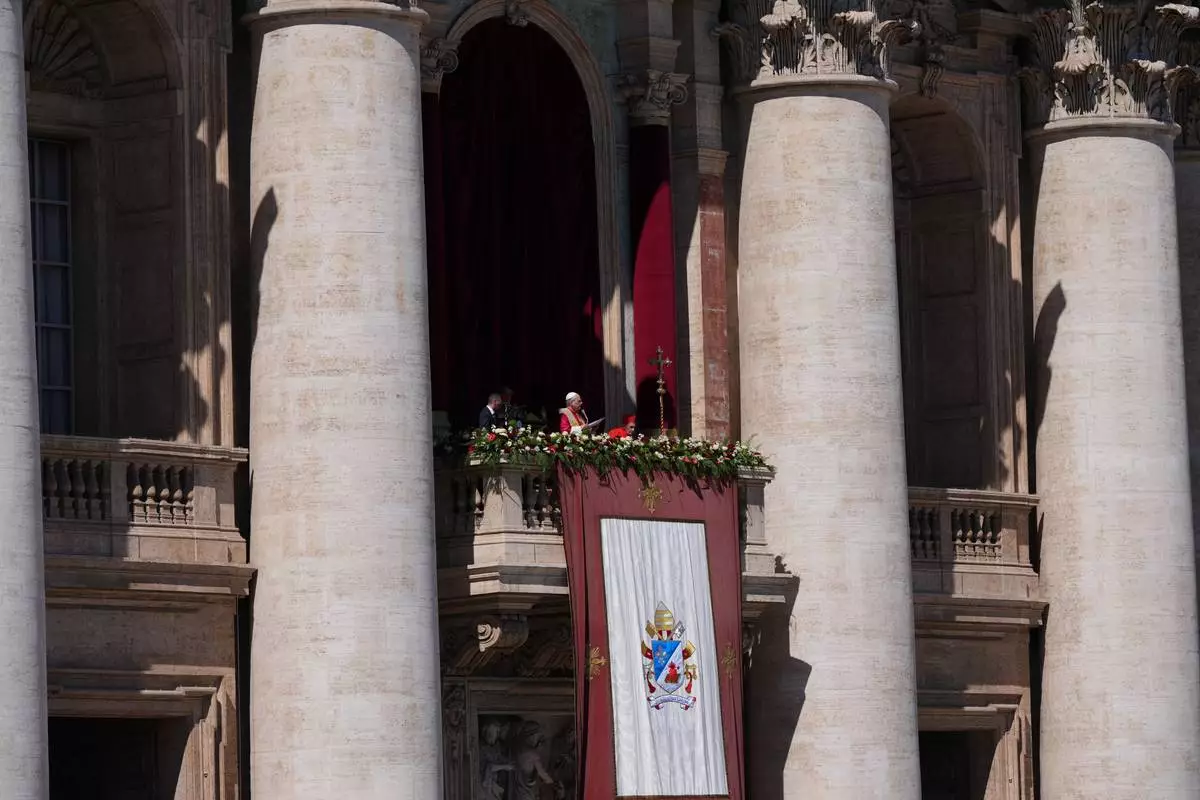
Pope Leo XIV addresses the faithful after delivering the Urbi et Orbi blessing - Latin for "to the city of Rome and to the world" - from the central loggia of St. Peter's Basilica at the end of Easter Mass he presided over in St. Peter's Square at the Vatican, Sunday, April 5, 2026. (AP Photo/Alessandra Tarantino)
Pope Leo XIV delivers the Urbi et Orbi blessing - Latin for "to the city of Rome and to the world" - from the central loggia of St. Peter's Basilica at the end of Easter Mass he presided over in St. Peter's Square at the Vatican, Sunday, April 5, 2026. (AP Photo/Alessandra Tarantino)
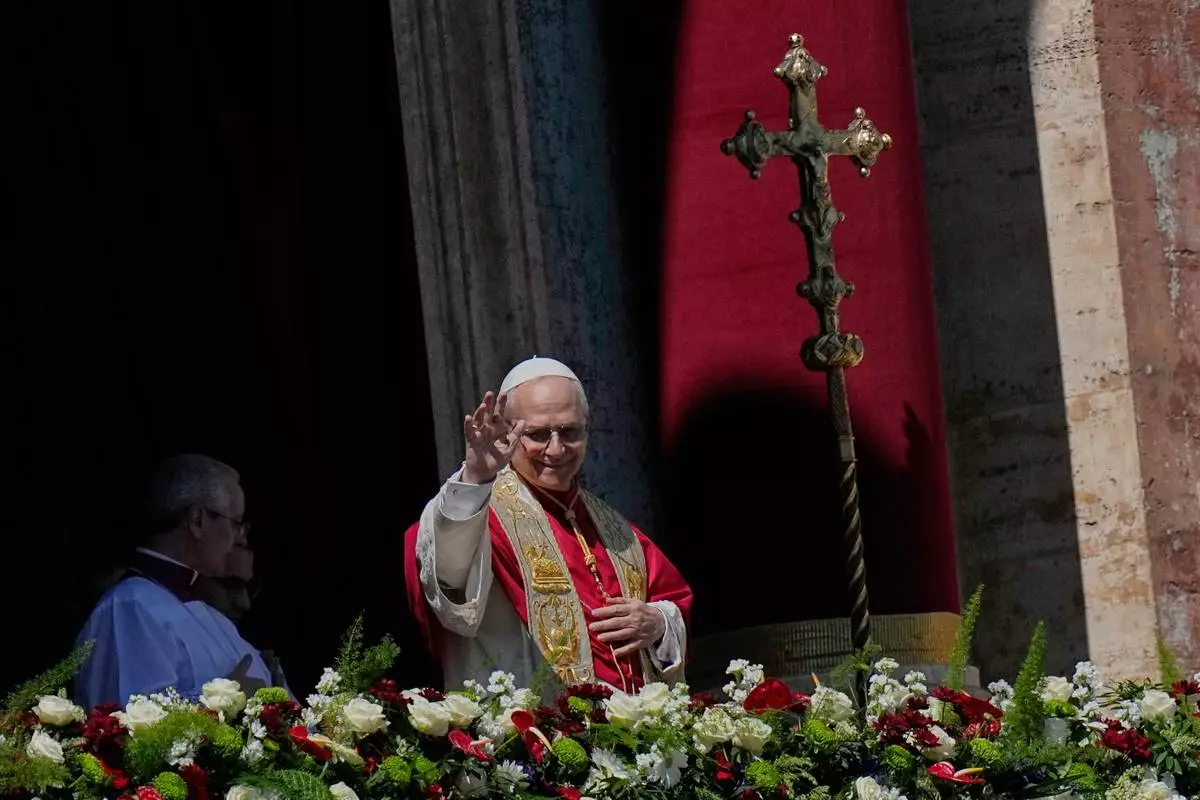
Pope Leo XIV addresses the faithful after delivering the Urbi et Orbi blessing - Latin for "to the city of Rome and to the world" - from the central loggia of St. Peter's Basilica at the end of Easter Mass he presided over in St. Peter's Square at the Vatican, Sunday, April 5, 2026. (AP Photo/Alessandra Tarantino)
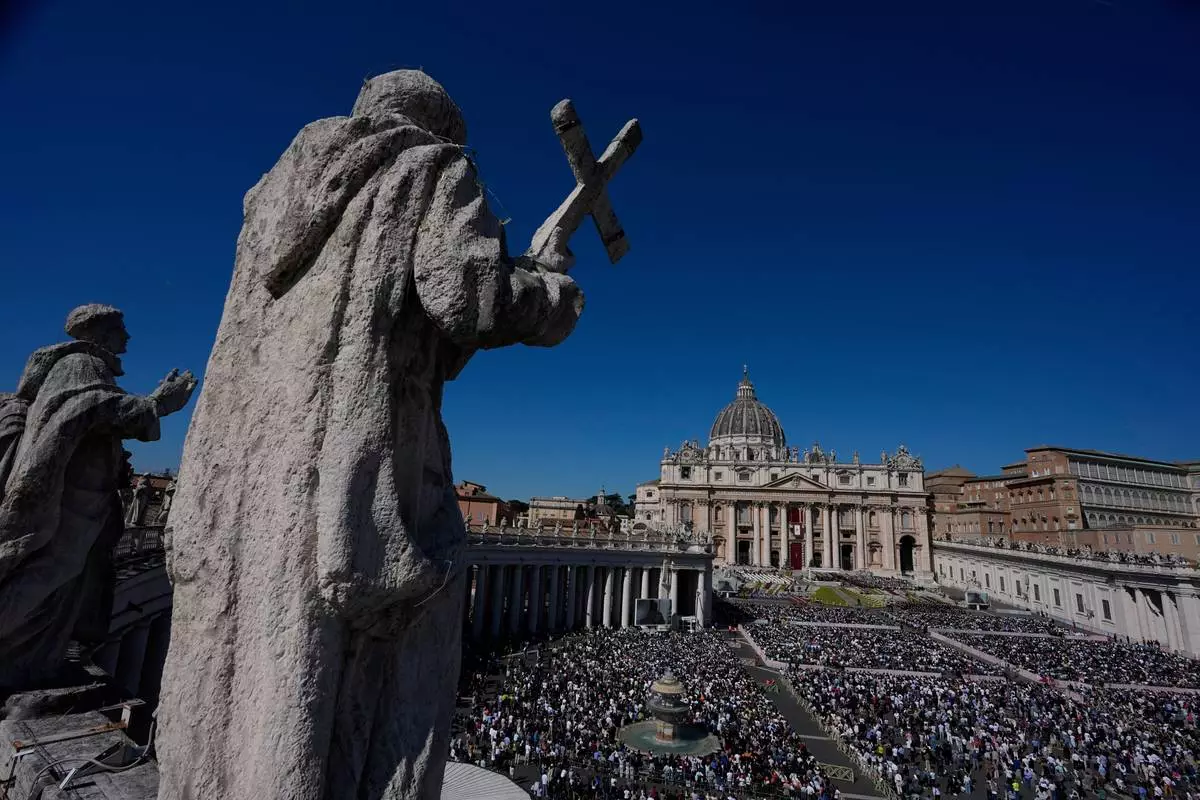
Pope Leo XIV presides over Easter Mass in St. Peter's Square at the Vatican, Sunday, April 5, 2026 (AP Photo/Alessandra Tarantino)
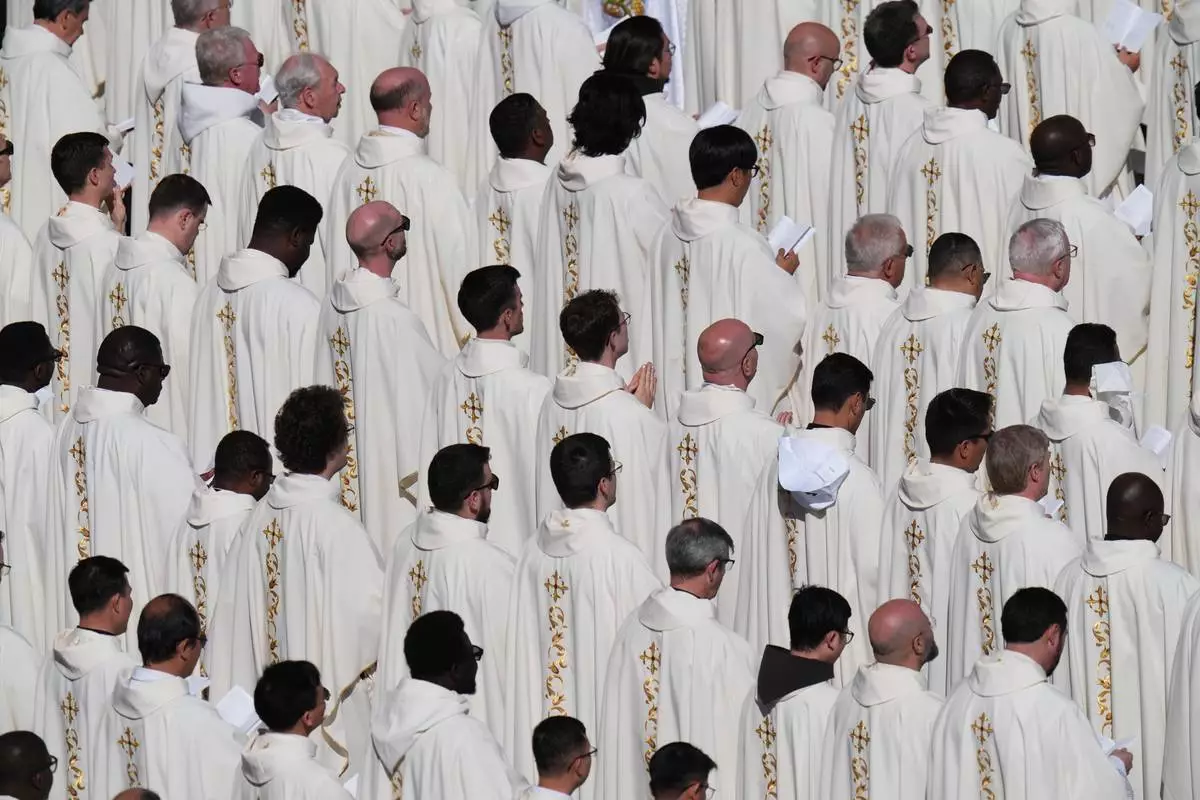
Clergy follow Pope Leo XIV as he presides over Easter Mass in St. Peter's Square at the Vatican, Sunday, April 5, 2026. (AP Photo/Alessandra Tarantino)
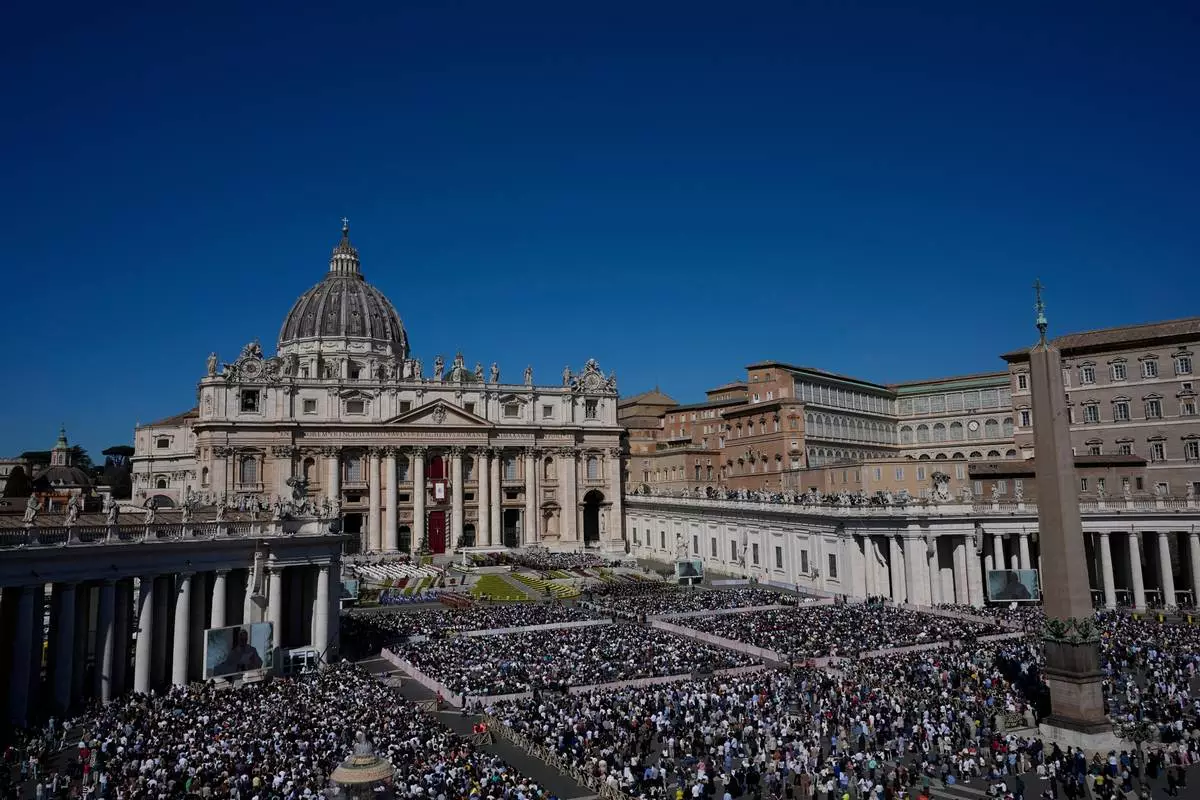
Pope Leo XIV presides over Easter Mass in St. Peter's Square at the Vatican, Sunday, April 5, 2026 (AP Photo/Alessandra Tarantino)
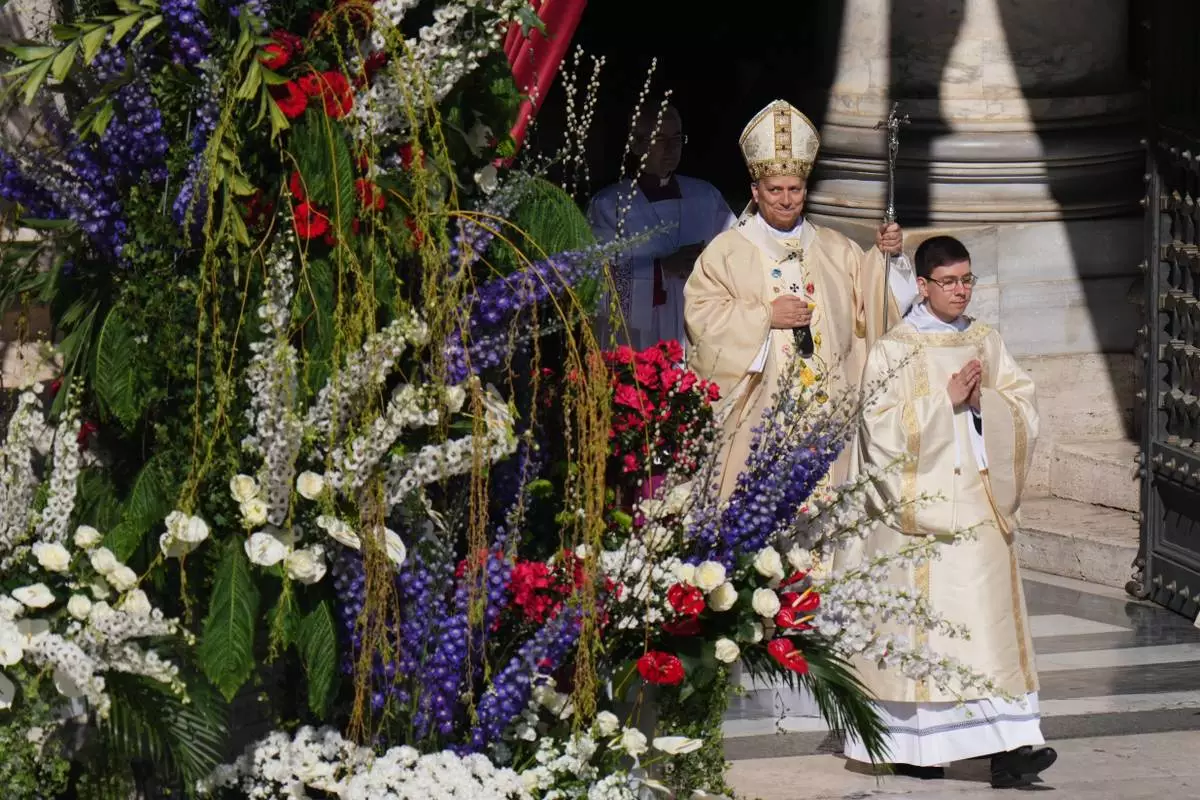
Pope Leo XIV arrives to preside over Easter Mass in St. Peter's Square at the Vatican, Sunday, April 5, 2026 (AP Photo/Alessandra Tarantino)
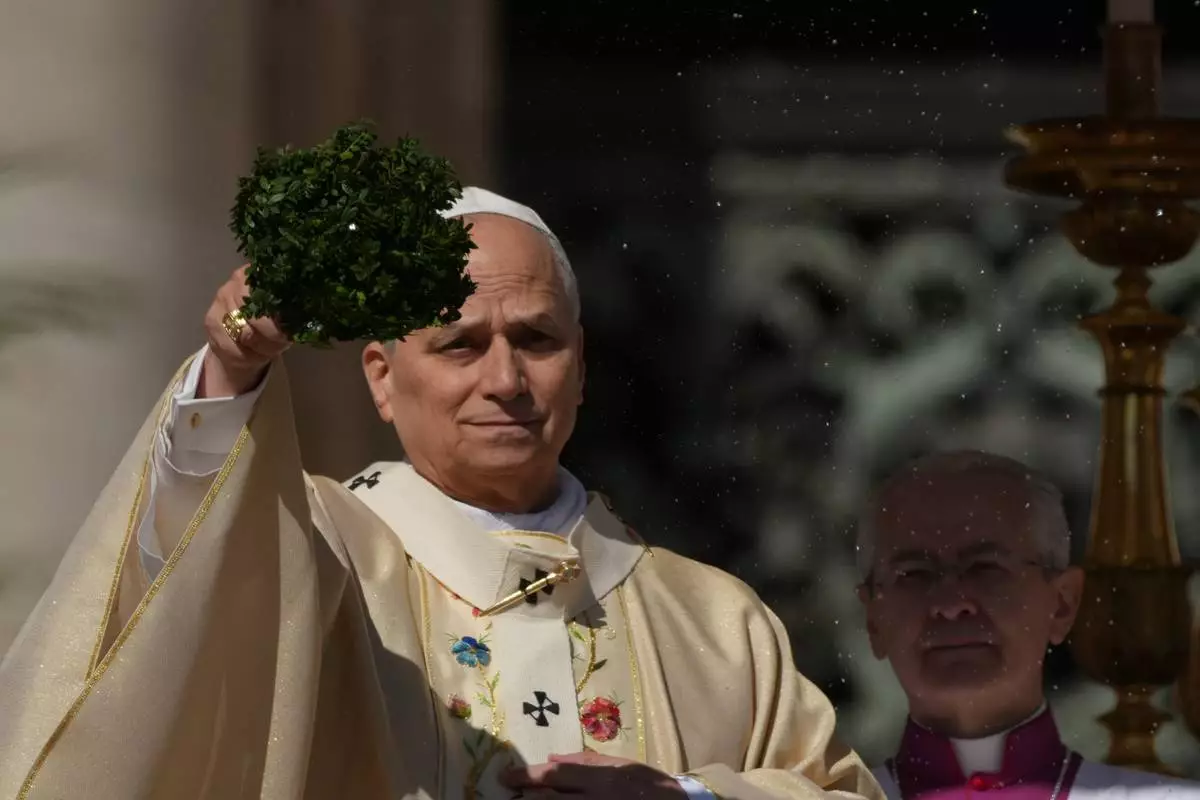
Pope Leo XIV sprinkles holy water with a bunch of hyssop sprigs as he presides over Easter Mass in St. Peter’s Square at the Vatican, Sunday, April 5, 2026. (AP Photo/Andrew Medichini)