Skip to Content Facebook Feature Image

DHL's E-Commerce Trends Report 2025: AI and social media reshaping online shopping in Asia Pacific

Business

DHL's E-Commerce Trends Report 2025: AI and social media reshaping online shopping in Asia Pacific
Business

Business

DHL's E-Commerce Trends Report 2025: AI and social media reshaping online shopping in Asia Pacific

2025-06-23 10:15 Last Updated At:10:35

  • Lack of delivery options is the number one conversion killer: 77% of shoppers in Asia Pacific abandon their carts when preferred delivery options are missing
  • A shift in sustainability: almost half of shoppers in Asia Pacific had also abandoned their carts due to sustainability concerns
  • Social commerce takes center stage: By 2030, 85% of consumers in Asia Pacific are expected to shop primarily through social media — bypassing traditional retail websites
  • AI becomes essential: 81% of shoppers in Asia Pacific want AI-driven shopping tools — from virtual try-ons to voice search — to guide their decisions

SINGAPORE, June 23, 2025 /PRNewswire/ -- DHL eCommerce has released its E-Commerce Trends Report 2025, drawing on insights from 24, 000 online shoppers across 24 key markets worldwide. For the Asia Pacific region, results show that delivery remains a significant barrier to purchase completion, with 77% of Asia Pacific shoppers abandoning their carts when their preferred delivery options are unavailable. Social commerce continues to rise in popularity, with 85% of the region's consumers expected to shop primarily through social media by 2030, bypassing traditional retail sites. Meanwhile, AI-driven shopping tools are in high demand, as 81% of shoppers seek features such as virtual try-ons and voice search to assist their purchasing decisions.

This year's study comprises eight chapters, featuring six shopper types across four generational segments, and highlights how evolving consumer expectations are reshaping the future of online retail. While the report addresses an extensive range of topics from cross-border purchasing to shoppers' views on sale days like Black Friday, four key findings stand out: the transformative impact of AI and social commerce on online shopping, the crucial role of delivery options in converting carts, and sustainability shaping customer loyalty.

"Asia Pacific has always been at the forefront of e-commerce due to its growing population of young, digital natives. The region's online shoppers know what they like, and it's important to recognize those changing behaviors that could make a significant difference to maintaining customer loyalty. As more of us shop online, we want a smooth experience. This is the entire journey from browsing to deciding if the item suits, to knowing that we have delivery options before making a convenient yet secure payment. Large and small business owners can rely on DHL eCommerce's insights and expertise to curate an experience that meets the needs of their customers," said Pablo Ciano, CEO of DHL eCommerce.

Shopping powered by AI: Smarter Journeys, Higher Expectations

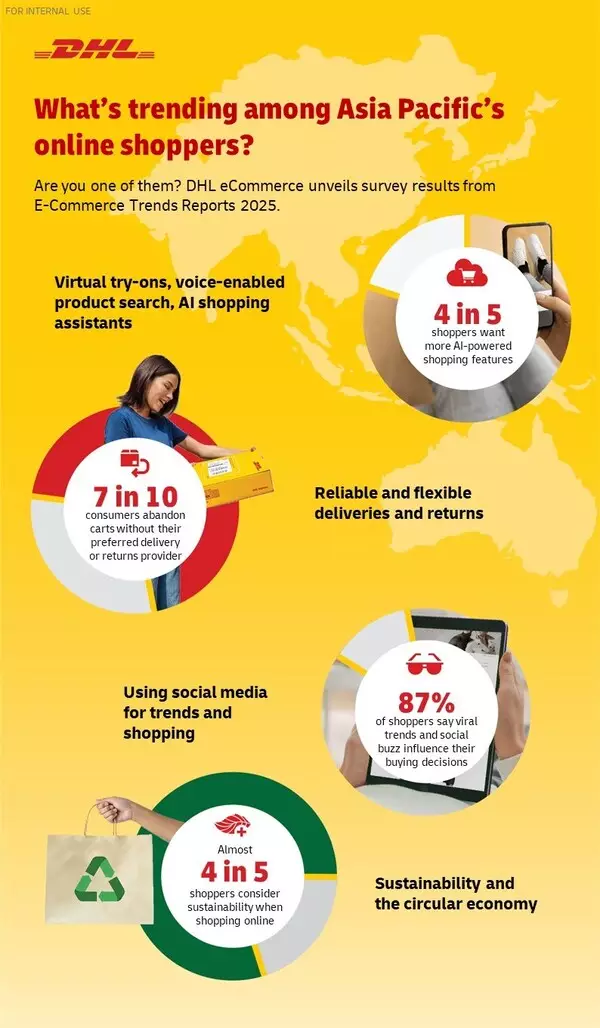
Advancements in generative AI are ushering in the next industrial revolution. But how will AI impact online shopping? DHL's latest e-commerce trend report reveals that AI is one of the most highly anticipated and demanded innovations among consumers, with 81% of shoppers in Asia Pacific wanting retailers to offer AI-powered shopping features. Virtual try-ons, AI-powered shopping assistants, and voice-enabled product search top the list of features consumers actively want to use. Shopping via voice commands is already on the rise, where about one in two (47%) of shoppers in the region make hands-free purchases. As digital expectations rise, so does the demand for intuitive, tech-enabled shopping journeys that blend utility with delight.

Social Commerce Becomes the New E-Commerce

The traditional e-commerce website is increasingly being replaced, or bypassed, by social platforms. Consumers are turning to apps like TikTok, Instagram, and Facebook not just for discovery, but for purchase. In Asia Pacific, 85% of shoppers say they have already made a purchase via social media. This is expected to stay with more than eight out of 10 (85%) expect these platforms to become their primary shopping destination by 2030.

The power of influence also plays a critical role: 87% of shoppers in Asia Pacific say viral trends and social buzz influence their buying decisions. TikTok, in particular, is driving change in markets such as Thailand and Malaysia, where 86% and 81% of online shoppers, respectively, report buying through the app. This shift signals a major transformation in the methods brands need to engage with their audiences, and calls for seamless, mobile-native experiences built for in-app conversion.

Delivery and Returns: The Ultimate Conversion Drivers

While new technologies continue to transform the digital shopping experience, the fundamentals of delivery and returns remain the biggest drivers of cart abandonment. Shoppers are not willing to compromise when it comes to convenience, flexibility, and control. 77% of consumers in the region will abandon their purchase if their preferred delivery option is not available. Just as critically, 75% will leave if the return process does not match their expectations. Trust also plays a major role, with 65% of shoppers in Asia Pacific reporting that they will not buy from a retailer if they do not trust the returns provider. These expectations emphasize the importance of transparent, customer-centric logistics strategies — not just as an operational concern, but as a core part of the conversion funnel.

Sustainability and the Circular Economy: From Buzzword to Bottom-Line Impact

Sustainability has evolved from a brand differentiator into a core consumer demand. In Asia Pacific, 79% of shoppers now consider sustainability when making online purchases. A significantly high consensus comes from India, where 92% find sustainability important when making an online purchase. This goes beyond packaging or shipping — one in two (49%) shoppers have abandoned their carts due to sustainability concerns.

Consumers in Asia Pacific are also embracing more circular models of consumption, with 52% opting for pre-owned or refurbished goods, motivated by both environmental values and cost efficiency. Additionally, 72% of shoppers in Asia Pacific express a willingness to participate in recycling or buy-back programs offered by retailers, with 85% of survey respondents from China indicating that they would do so. These behaviors point to a growing expectation that brands will not only reduce their footprint but also actively empower consumers to shop more sustainably.

As we look towards 2030, these insights provide a clear roadmap for retailers aiming to capture the attention of today's diverse shopper demographics. By embracing technology, prioritizing sustainability, and understanding the evolving preferences of consumers, businesses can transform challenges into opportunities. Further insights and information, as well as the full report, are available under the following link: dhl.com/e-commerce-report or dhl.com/reports

About the DHL E-Commerce Trends Report 2025

The E-Commerce Trends Report 2025 surveyed 24,000 consumers from Europe, the Americas, Asia-Pacific, Africa, and the Middle East. Its findings offer actionable insights for e-commerce brands seeking to meet changing expectations, personalize experiences, and create growth through smarter logistics and innovation. Asia Pacific markets include Australia, China, India, Malaysia and Thailand.

– End –

You can find the press release for download as well as further information on group.dhl.com/pressreleases

On the internet: group.dhl.com/press

Follow us at: X.com/DHLglobal

DHL – The logistics company for the world

DHL is the leading global brand in the logistics industry. Our DHL divisions offer an unrivalled portfolio of logistics services ranging from national and international parcel delivery, e-commerce shipping and fulfillment solutions, international express, road, air and ocean transport to industrial supply chain management. With approximately 400,000 employees in more than 220 countries and territories worldwide, DHL connects people and businesses securely and reliably, enabling global sustainable trade flows. With specialized solutions for growth markets and industries including technology, life sciences and healthcare, engineering, manufacturing & energy, auto-mobility and retail, DHL is decisively positioned as "The logistics company for the world".

DHL is part of DHL Group. The Group generated revenues of approximately 84.2 billion euros in 2024. With sustainable business practices and a commitment to society and the environment, the Group makes a positive contribution to the world. DHL Group aims to achieve net-zero emissions logistics by 2050.

  • Lack of delivery options is the number one conversion killer: 77% of shoppers in Asia Pacific abandon their carts when preferred delivery options are missing
  • A shift in sustainability: almost half of shoppers in Asia Pacific had also abandoned their carts due to sustainability concerns
  • Social commerce takes center stage: By 2030, 85% of consumers in Asia Pacific are expected to shop primarily through social media — bypassing traditional retail websites
  • AI becomes essential: 81% of shoppers in Asia Pacific want AI-driven shopping tools — from virtual try-ons to voice search — to guide their decisions

SINGAPORE, June 23, 2025 /PRNewswire/ -- DHL eCommerce has released its E-Commerce Trends Report 2025, drawing on insights from 24, 000 online shoppers across 24 key markets worldwide. For the Asia Pacific region, results show that delivery remains a significant barrier to purchase completion, with 77% of Asia Pacific shoppers abandoning their carts when their preferred delivery options are unavailable. Social commerce continues to rise in popularity, with 85% of the region's consumers expected to shop primarily through social media by 2030, bypassing traditional retail sites. Meanwhile, AI-driven shopping tools are in high demand, as 81% of shoppers seek features such as virtual try-ons and voice search to assist their purchasing decisions.

This year's study comprises eight chapters, featuring six shopper types across four generational segments, and highlights how evolving consumer expectations are reshaping the future of online retail. While the report addresses an extensive range of topics from cross-border purchasing to shoppers' views on sale days like Black Friday, four key findings stand out: the transformative impact of AI and social commerce on online shopping, the crucial role of delivery options in converting carts, and sustainability shaping customer loyalty.

"Asia Pacific has always been at the forefront of e-commerce due to its growing population of young, digital natives. The region's online shoppers know what they like, and it's important to recognize those changing behaviors that could make a significant difference to maintaining customer loyalty. As more of us shop online, we want a smooth experience. This is the entire journey from browsing to deciding if the item suits, to knowing that we have delivery options before making a convenient yet secure payment. Large and small business owners can rely on DHL eCommerce's insights and expertise to curate an experience that meets the needs of their customers," said Pablo Ciano, CEO of DHL eCommerce.

Shopping powered by AI: Smarter Journeys, Higher Expectations

Advancements in generative AI are ushering in the next industrial revolution. But how will AI impact online shopping? DHL's latest e-commerce trend report reveals that AI is one of the most highly anticipated and demanded innovations among consumers, with 81% of shoppers in Asia Pacific wanting retailers to offer AI-powered shopping features. Virtual try-ons, AI-powered shopping assistants, and voice-enabled product search top the list of features consumers actively want to use. Shopping via voice commands is already on the rise, where about one in two (47%) of shoppers in the region make hands-free purchases. As digital expectations rise, so does the demand for intuitive, tech-enabled shopping journeys that blend utility with delight.

Social Commerce Becomes the New E-Commerce

The traditional e-commerce website is increasingly being replaced, or bypassed, by social platforms. Consumers are turning to apps like TikTok, Instagram, and Facebook not just for discovery, but for purchase. In Asia Pacific, 85% of shoppers say they have already made a purchase via social media. This is expected to stay with more than eight out of 10 (85%) expect these platforms to become their primary shopping destination by 2030.

The power of influence also plays a critical role: 87% of shoppers in Asia Pacific say viral trends and social buzz influence their buying decisions. TikTok, in particular, is driving change in markets such as Thailand and Malaysia, where 86% and 81% of online shoppers, respectively, report buying through the app. This shift signals a major transformation in the methods brands need to engage with their audiences, and calls for seamless, mobile-native experiences built for in-app conversion.

Delivery and Returns: The Ultimate Conversion Drivers

While new technologies continue to transform the digital shopping experience, the fundamentals of delivery and returns remain the biggest drivers of cart abandonment. Shoppers are not willing to compromise when it comes to convenience, flexibility, and control. 77% of consumers in the region will abandon their purchase if their preferred delivery option is not available. Just as critically, 75% will leave if the return process does not match their expectations. Trust also plays a major role, with 65% of shoppers in Asia Pacific reporting that they will not buy from a retailer if they do not trust the returns provider. These expectations emphasize the importance of transparent, customer-centric logistics strategies — not just as an operational concern, but as a core part of the conversion funnel.

Sustainability and the Circular Economy: From Buzzword to Bottom-Line Impact

Sustainability has evolved from a brand differentiator into a core consumer demand. In Asia Pacific, 79% of shoppers now consider sustainability when making online purchases. A significantly high consensus comes from India, where 92% find sustainability important when making an online purchase. This goes beyond packaging or shipping — one in two (49%) shoppers have abandoned their carts due to sustainability concerns.

Consumers in Asia Pacific are also embracing more circular models of consumption, with 52% opting for pre-owned or refurbished goods, motivated by both environmental values and cost efficiency. Additionally, 72% of shoppers in Asia Pacific express a willingness to participate in recycling or buy-back programs offered by retailers, with 85% of survey respondents from China indicating that they would do so. These behaviors point to a growing expectation that brands will not only reduce their footprint but also actively empower consumers to shop more sustainably.

As we look towards 2030, these insights provide a clear roadmap for retailers aiming to capture the attention of today's diverse shopper demographics. By embracing technology, prioritizing sustainability, and understanding the evolving preferences of consumers, businesses can transform challenges into opportunities. Further insights and information, as well as the full report, are available under the following link: dhl.com/e-commerce-report or dhl.com/reports

About the DHL E-Commerce Trends Report 2025

The E-Commerce Trends Report 2025 surveyed 24,000 consumers from Europe, the Americas, Asia-Pacific, Africa, and the Middle East. Its findings offer actionable insights for e-commerce brands seeking to meet changing expectations, personalize experiences, and create growth through smarter logistics and innovation. Asia Pacific markets include Australia, China, India, Malaysia and Thailand.

– End –

You can find the press release for download as well as further information on group.dhl.com/pressreleases

On the internet: group.dhl.com/press

Follow us at: X.com/DHLglobal

DHL – The logistics company for the world

DHL is the leading global brand in the logistics industry. Our DHL divisions offer an unrivalled portfolio of logistics services ranging from national and international parcel delivery, e-commerce shipping and fulfillment solutions, international express, road, air and ocean transport to industrial supply chain management. With approximately 400,000 employees in more than 220 countries and territories worldwide, DHL connects people and businesses securely and reliably, enabling global sustainable trade flows. With specialized solutions for growth markets and industries including technology, life sciences and healthcare, engineering, manufacturing & energy, auto-mobility and retail, DHL is decisively positioned as "The logistics company for the world".

DHL is part of DHL Group. The Group generated revenues of approximately 84.2 billion euros in 2024. With sustainable business practices and a commitment to society and the environment, the Group makes a positive contribution to the world. DHL Group aims to achieve net-zero emissions logistics by 2050.

** The press release content is from PR Newswire. Bastille Post is not involved in its creation. **
DHL's E-Commerce Trends Report 2025: AI and social media reshaping online shopping in Asia Pacific


DHL's E-Commerce Trends Report 2025: AI and social media reshaping online shopping in Asia Pacific

  • New framework brings together Aon's Risk Capital and Human Capital data with public sentiment analysis from Gallup to create a portfolio view of risk
  • Creates further clarity into how risks compound across four megatrends, how resilience is built and activated and where targeted actions can most effectively influence performance
  • DUBLIN, Jan. 16, 2026 /PRNewswire/ -- Aon plc (NYSE: AON), a leading global professional services firm, announced today that it is releasing insights from a new, data-driven tool to help organizations build sustainable resilience and unlock growth: Aon's Resilience Quotient.

    Developed in collaboration with Gallup, Aon's Resilience Quotient responds to a critical insight: in a time of increasing populism and fragmented sources of information, quantitative data alone is not enough to make long-term decisions. Combining public sentiment on global issues with risk and people data and analytics enables greater clarity and confidence to invest and grow amidst uncertainty and volatility.

    By integrating Aon's proprietary Risk Capital and Human Capital analytics with the results of Gallup's World Poll covering 140 countries for more than 20 years, the firm's Resilience Quotient captures both objective conditions and subjective sentiment, revealing where sentiment signals hidden risks and potential opportunities to achieve greater resilience. This system-level view enables leaders to spot emerging risks sooner, prioritize resilience investments and move from reactive risk management to proactive decision-making.

    "When making decisions around investment, workforce or managing geopolitical risk, a portfolio view is far superior to a siloed perspective," said Greg Case, president and CEO of Aon. "Understanding sentiment can be an opportunity signal or an early warning. Leaders who are limited to only some of the relevant metrics risk missing the signals that matter most. Aon's Resilience Quotient delivers an integrated view to help organizations act decisively, strengthen resilience and unlock sustainable growth."

    Four interconnected megatrends – Trade, Technology, Weather and Workforce – are reshaping the global operating environment in ways that traditional models struggle to anticipate. Aon's Resilience Quotient provides a clearer view of the tradeoffs within these interactions: how trade volatility can amplify technology risk, how climate pressures influence workforce mobility and how sentiment can either reinforce resilience or heighten operational risk, even when the fundamentals appear strong.   

    To illustrate the insights from its Resilience Quotient, the firm published three case studies addressing some of the most relevant and urgent issues facing the 2026 global economy:

    • Realizing the Opportunity of AI: Securing Data Center Growth
      Data centers are the backbone of the digital economy and with nearly $1.3 trillion projected to be invested globally in data centers by 2030, their rapid expansion brings unprecedented risks. Aon's Resilience Quotient shows that resilience varies sharply at the sub-national level, often more than underlying risk. Within the U.S., Iowa emerges as the most resilient destination for data center development, combining very low overall risk with exceptionally strong trade and weather resilience.

      "Aon's Resilience Quotient shows that Iowa's resilience–risk balance is roughly twice the national median, demonstrating how governance quality, institutional confidence and preparedness materially shape long-term infrastructure outcomes," said Joe Peiser, CEO of Commercial Risk Solutions at Aon. "This underscores the opportunity for leaders who understand the combined effect of low risk, resilient trade and weather systems and a strong foundation of public trust — factors that ultimately determine where AI infrastructure can grow at scale."

    DUBLIN, Jan. 16, 2026 /PRNewswire/ -- Aon plc (NYSE: AON), a leading global professional services firm, announced today that it is releasing insights from a new, data-driven tool to help organizations build sustainable resilience and unlock growth: Aon's Resilience Quotient.

    Developed in collaboration with Gallup, Aon's Resilience Quotient responds to a critical insight: in a time of increasing populism and fragmented sources of information, quantitative data alone is not enough to make long-term decisions. Combining public sentiment on global issues with risk and people data and analytics enables greater clarity and confidence to invest and grow amidst uncertainty and volatility.

    By integrating Aon's proprietary Risk Capital and Human Capital analytics with the results of Gallup's World Poll covering 140 countries for more than 20 years, the firm's Resilience Quotient captures both objective conditions and subjective sentiment, revealing where sentiment signals hidden risks and potential opportunities to achieve greater resilience. This system-level view enables leaders to spot emerging risks sooner, prioritize resilience investments and move from reactive risk management to proactive decision-making.

    "When making decisions around investment, workforce or managing geopolitical risk, a portfolio view is far superior to a siloed perspective," said Greg Case, president and CEO of Aon. "Understanding sentiment can be an opportunity signal or an early warning. Leaders who are limited to only some of the relevant metrics risk missing the signals that matter most. Aon's Resilience Quotient delivers an integrated view to help organizations act decisively, strengthen resilience and unlock sustainable growth."

    Four interconnected megatrends – Trade, Technology, Weather and Workforce – are reshaping the global operating environment in ways that traditional models struggle to anticipate. Aon's Resilience Quotient provides a clearer view of the tradeoffs within these interactions: how trade volatility can amplify technology risk, how climate pressures influence workforce mobility and how sentiment can either reinforce resilience or heighten operational risk, even when the fundamentals appear strong.   

    To illustrate the insights from its Resilience Quotient, the firm published three case studies addressing some of the most relevant and urgent issues facing the 2026 global economy:

    "Aon's Resilience Quotient shows that Iowa's resilience–risk balance is roughly twice the national median, demonstrating how governance quality, institutional confidence and preparedness materially shape long-term infrastructure outcomes," said Joe Peiser, CEO of Commercial Risk Solutions at Aon. "This underscores the opportunity for leaders who understand the combined effect of low risk, resilient trade and weather systems and a strong foundation of public trust — factors that ultimately determine where AI infrastructure can grow at scale."

    • Workforce Transformation: AI Adoption and the Next Generation Workforce 
      The acceleration of AI adoption is transforming the workforce, but most organizations face a critical gap between the demand for AI skills and their readiness to adapt. The Resilience Quotient highlights how workforce engagement, trust and institutional preparedness are essential to harnessing AI's potential, making resilience the key differentiator between organizations that thrive through change and those that risk falling behind.

      "Aon's Resilience Quotient equips leaders to navigate rapid AI change with confidence," said Lisa Stevens, chief administrative officer at Aon. "These insights help create the conditions for early‑career employees to build the skills and confidence they need — so instead of losing a generation of talent, we cultivate one that is more capable and resilient than ever."

    "Aon's Resilience Quotient equips leaders to navigate rapid AI change with confidence," said Lisa Stevens, chief administrative officer at Aon. "These insights help create the conditions for early‑career employees to build the skills and confidence they need — so instead of losing a generation of talent, we cultivate one that is more capable and resilient than ever."

    • Rethinking Humanitarian Finance: A New Approach to Forced Migration
      Over 120 million people are currently displaced by conflict, climate and systemic crises, reshaping societies and economies worldwide. Aon's Resilience Quotient highlights Venezuela and Colombia to illustrate the tradeoffs between investing resources at the source of migration — supporting those facing institutional erosion, food insecurity and economic collapse — or directing investment to more stable countries like Colombia that are absorbing people fleeing unlivable conditions.

      "Forced displacement results from extreme weather and man-made disasters like conflict and economic failure," said Bridget Gainer, chief public affairs officer at Aon. "If we could leverage the forecasting and financial capability of insurance to better predict and more quickly mitigate the impact of this volatility, we could help create conditions that allow populations to remain and rebuild in their home countries."

    "Forced displacement results from extreme weather and man-made disasters like conflict and economic failure," said Bridget Gainer, chief public affairs officer at Aon. "If we could leverage the forecasting and financial capability of insurance to better predict and more quickly mitigate the impact of this volatility, we could help create conditions that allow populations to remain and rebuild in their home countries."

    "Resilience is not a single blueprint, it's the way systems mitigate, adapt and transform under pressure. Aon's Resilience Quotient functions as a pressure gauge, surfacing the trade‑offs and early signals that help leaders strengthen resilience where it matters most," said Joe Daly, managing partner at Gallup. "We're proud to collaborate with Aon to combine Gallup's global sentiment analytics with Aon's Risk Capital and Human Capital data, turning confidence into actionable insight."

    New insights from Aon's Resilience Quotient suggest that going forward, resilience priorities will shift from static risk management to dynamic, localized strategies. As disruptions become more complex and frequent, organizations will need to tailor resilience investments to specific geographies, sectors and even sub-regional contexts. Aon's Resilience Quotient is supported with a real-time analytics and AI-enabled insights platform, built by Quantum Rise, providing deeper visibility into evolving risk and resilience signals as conditions change.

    Aon and Gallup will join global decision-makers at the World Economic Forum Annual Meeting to advance these critical discussions on restoring confidence and unlocking sustainable growth.

    Learn more about Aon's Resilience Quotient and explore the case studies here.

    About Aon
    Aon plc (NYSE: AON) exists to shape decisions for the better — to protect and enrich the lives of people around the world. Through actionable analytic insight, globally integrated Risk Capital and Human Capital expertise, and locally relevant solutions, our colleagues provide clients in over 120 countries with the clarity and confidence to make better risk and people decisions that help protect and grow their businesses.

    Follow Aon on LinkedInXFacebook and Instagram. Stay up-to-date by visiting Aon's newsroom and sign up for news alerts here.

    Media Contact
    mediainquiries@aon.com
    Toll-free (U.S., Canada and Puerto Rico): +1 833 751 8114
    International: +1 312 381 3024

    ** The press release content is from PR Newswire. Bastille Post is not involved in its creation. **

    Aon's Resilience Quotient Cuts Through Uncertainty and Volatility to Help Businesses Move from Risk to Resilience and Growth

    Aon's Resilience Quotient Cuts Through Uncertainty and Volatility to Help Businesses Move from Risk to Resilience and Growth

Recommended Articles