Skip to Content Facebook Feature Image

China's 5G development exemplary, helps bridge digital divide: GSMA director general

China

China

China

China's 5G development exemplary, helps bridge digital divide: GSMA director general

2025-06-23 16:20 Last Updated At:19:37

China has played an exemplary role in the development of 5G mobile communication technology and made impressive efforts to bridge digital divides in the world, an industry insider said at the just-concluded 2025 Mobile World Congress (MWC) in Shanghai.

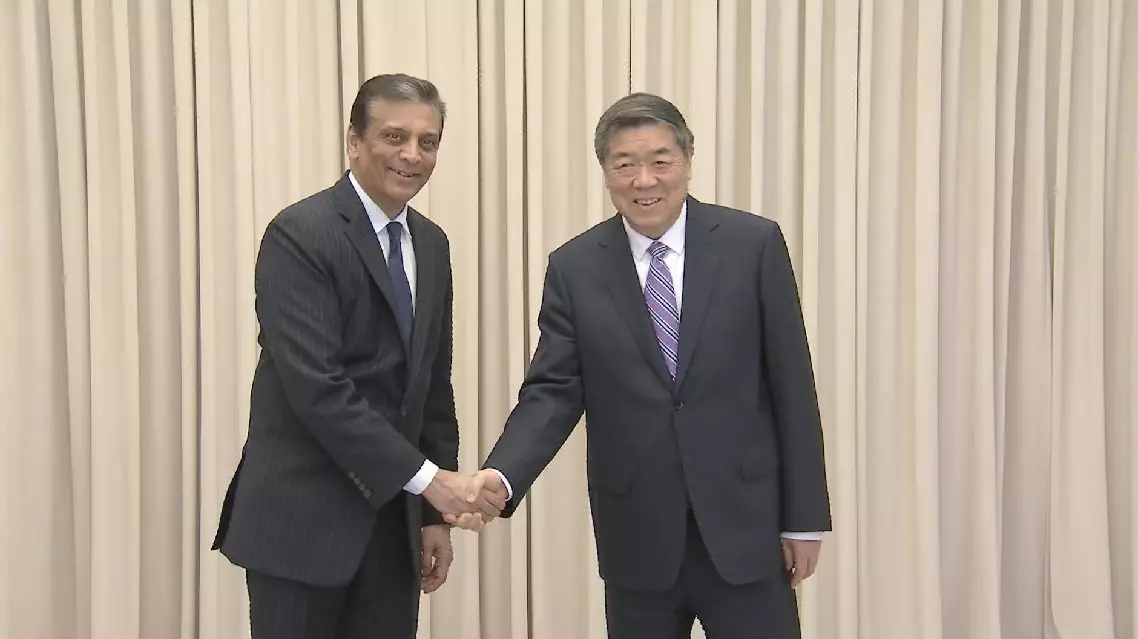
Vivek Badrinath, director general of the Global System for Mobile Communications Association (GSMA), an international organization representing the interests of mobile network operators worldwide, said he believes that China leads the global 5G development.

"To a large extent, I would say the 5G development in China is exemplary. It is about leaning in to the technology, to use it to do what it was designed for. 5G was always about enterprise, which means that to achieve the full potential of 5G, you have to turn on all these features that are in 5G standalone and then in 5G-advanced. These features make a difference and what we see in China is a number of applications that actually translate into benefits," he said.

In 2024, the mobile industry contributed 1.2 trillion U.S. dollars to China's economy, and is projected to contribute a massive 2 trillion U.S. dollars to it by 2030, according to the GSMA.

Established in 1987, the GSMA has always aimed to bridge digital divides in the world. Countries in Africa and South Asia are still facing huge usage gaps compared with other areas of the world and China is helping these regions to catch up.

"I think China brings two benefits. One, the scale of the Chinese economy benefits the whole world in general because it brings down unit costs for everyone. And I think that benefit has been seen across the world. It's a fact that Chinese suppliers have been very active in South Asia, in Africa to bring their technologies at an efficient cost and that will help develop to bridge the digital divide," said Badrinath.

This year, the Mobile World Congress Shanghai, which runs from Wednesday to Friday, has attracted over 400 speakers from around the world to share their insights regarding leading mobile technologies such as the integration of 5G and AI.

The Mobile World Congress is the largest event for the mobile and telecommunications industry. For MWC Shanghai this year, over 30 percent of the speakers are from outside the telecommunication sector. The belief is that this will boost integration among various industries.

China's 5G development exemplary, helps bridge digital divide: GSMA director general
China's 5G development exemplary, helps bridge digital divide: GSMA director general

Dense fog and icy conditions have forced the closure of major expressways in multiple provincial-level regions across China since Friday morning.

At 12:00 on Friday, traffic control measures, including closures, remained in effect on 16 sections of national and provincial trunk roads in Hebei, Henan, Shandong and Xinjiang. Among these, two sections had their mainlines closed, while toll stations on 14 sections were shut.

Starting from the early hours of Friday, multiple areas in Dezhou City of Shandong Province experienced dense fog, with Xiajin, Pingyuan and Yucheng reporting visibility less than 100 meters.

In parts of Xiajin, visibility dropped below 50 meters, prompting local meteorological authorities to issue a red alert for dense fog.

Affected by the fog, temporary control measures were implemented on some expressways within Dezhou, with multiple entrances closed. Traffic police strengthened presence at service areas, entrances and exits of expressways to ensure road safety.

So far, all expressway entrances and exits in Dezhou have resumed normal operation.

Many areas in Hebei also experienced dense fog, with visibility less than 200 meters in eastern Baoding, western Cangzhou, Xingtai, and eastern Handan in the province. Some localities even reported visibility below 50 meters.

Shortly after 6:00, the Hebei Provincial Meteorological Observatory issued an orange alert for dense fog.

From 23:00 on Thursday to Friday morning, over 10 key routes in Hebei, including the Beijing-Hong Kong-Macao, Beijing-Kunming, Daqing-Guangzhou, Tianjin-Shijiazhuang, and Qingdao-Lanzhou expressways, were affected by dense fog.

Expressway traffic police closed some toll stations along these expressways according to fog conditions, and activated traffic diversion points to divert vehicles.

By 10:00 Friday, as visibility improved, some toll stations resumed operation.

On expressway sections with insufficient visibility, traffic police used patrol cars to lead and control the speed of vehicles, guiding stranded traffic to pass through orderly and safely.

Additionally, due to snowfall and icy road surfaces, control measures were taken on 28 expressway sections in Inner Mongolia, Heilongjiang and Xinjiang. Among them, the mainlines of 14 sections were closed, while toll gates were shut on the other 14 ones.

The National Meteorological Center (NMC) issued a blue alert for snowfall on Friday morning, with parts of Inner Mongolia, Heilongjiang and Gansu expected to be hit by heavy snow.

Foggy, icy weather forces road closure across China

Foggy, icy weather forces road closure across China

Recommended Articles