A former advisor for the International Atomic Energy Agency (IAEA) has criticized U.S. airstrikes on Iranian nuclear facilities as reckless, unnecessary, and in violation of international law, and said there was still considerable room for negotiation with Iran over the nuclear issue prior to the attack.
U.S. President Donald Trump announced late on Saturday that the United States had successfully struck three Iranian nuclear facilities at Esfahan, Fordow and Natanz, a military intervention which drew praise from Israeli Prime Minister Benjamin Netanyahu.
Iran confirmed the attacks but said they have not harmed the country's nuclear efforts as the sites had been evacuated and the materials had previously been removed.
In a phonecall with French President Emmanuel Macron on Sunday, Iranian President Masoud Pezeshkian said that the U.S. must "receive the response to its aggression" following the strikes.
In an exclusive interview with China Global Television Network (CGTN) on Sunday, Behrooz Bayat, an ex-IAEA advisor who is now a senior fellow at the Center for Middle East and Global Order (CMEG), described the U.S. strikes as an unjustified escalation which ruined any possibility of diplomatic engagement over the nuclear issue.
"First of all, I condemn this reckless attack by the Trump administration in cooperation let's say with Netanyahu's regime. We have to (deal) with two ruling regimes, one Netanyahu and the other one, the Khamenei regime in Iran. But it was not really urgent to destroy the nuclear facilities of Iran. There was a lot of space still for negotiation, for diplomacy," said Bayat.
Asked about the legal significance of such strikes on IAEA-supervised facilities, Bayat stressed that the attacks directly violated international norms.
"Actually the nuclear facilities are protected by law, by international law and Mr. [Rafael] Grossi, the head of the International Atomic Energy Agency, he has put it many times that attacking nuclear facilities is in contradiction to international law, but the regime of Netanyahu, he doesn't care of international law as well as Mr. Trump, as we have seen that. Mr. Trump did it without the permission of the [U.S.] Congress. That is unfortunately the sad situation right now in the world," he said.
Bayat also voiced concerns about the potential environmental fallout, especially at the Isfahan site, which lies in a densely populated area.
"And we should not forget that this attack could release lots of contamination, nuclear contamination, radioactive contamination in the whole area around the site, specifically in Isfahan, which is in the middle of a [large] population [and] would have grave consequences," he said.
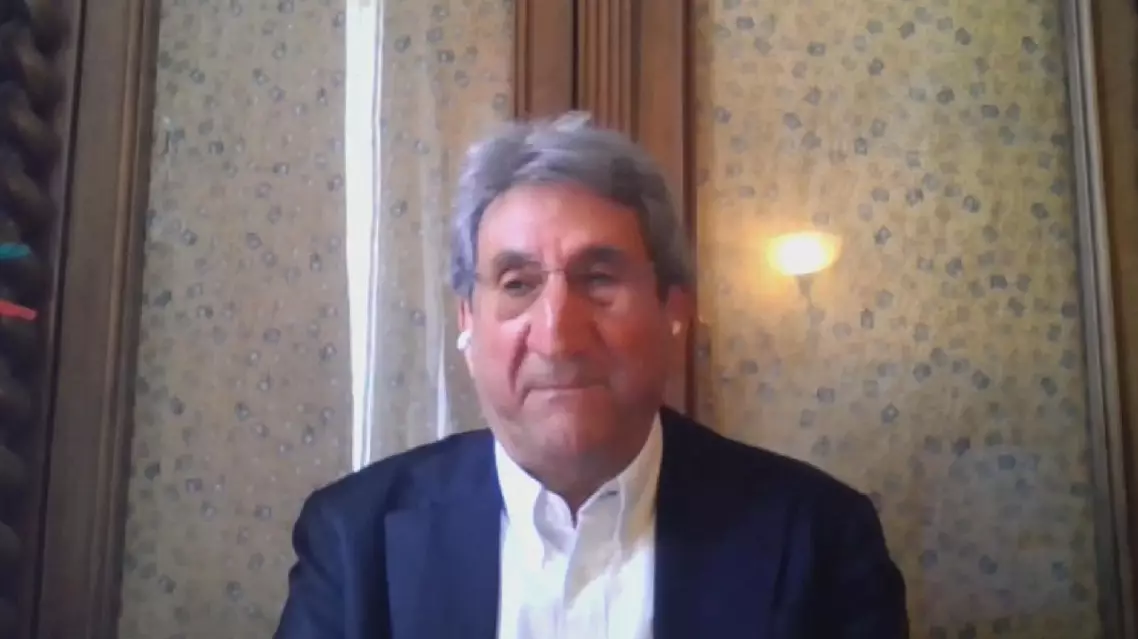
US airstrikes on Iran "reckless", "violate int'l law": ex-IAEA advisor