Foreign nationals have been rushing to leave Iran after the United States attacked three Iranian nuclear facilities on Saturday, following days of Israeli attacks on targets across Iran.
With commercial flights grounded, many foreigners have made the journey by land, reaching the Kapikoy border crossing between Türkiye and Iran.
"We left Tehran around 7 o'clock in the morning and arrived in Tabriz at 2:30 a.m. the next day. We only slept a few hours before continuing. It took almost 15 hours to reach the border," said Ziba, a French traveler accompanied by her daughter.
The fleeing foreign nationals said their concerns mounted when news emerged of the U.S. airstrikes.
"There were explosions every night in Tehran and in other cities, but we weren't afraid at that time, because we thought that Iran is very large. However, the worst moment was when the Americans started bombing," said Ziba.
"I came two or three weeks ago to visit my dad in the hospital. And then all this happened. Then I had to travel to northern Iran, arrange with relatives in Tabriz area, stay with them last night, drove to the border. Somebody got to help me with the van to get us through the border. We just got here and are waiting," said a Canadian traveler named Rami, who had come to Iran for a family visit only to get caught up in the conflict.
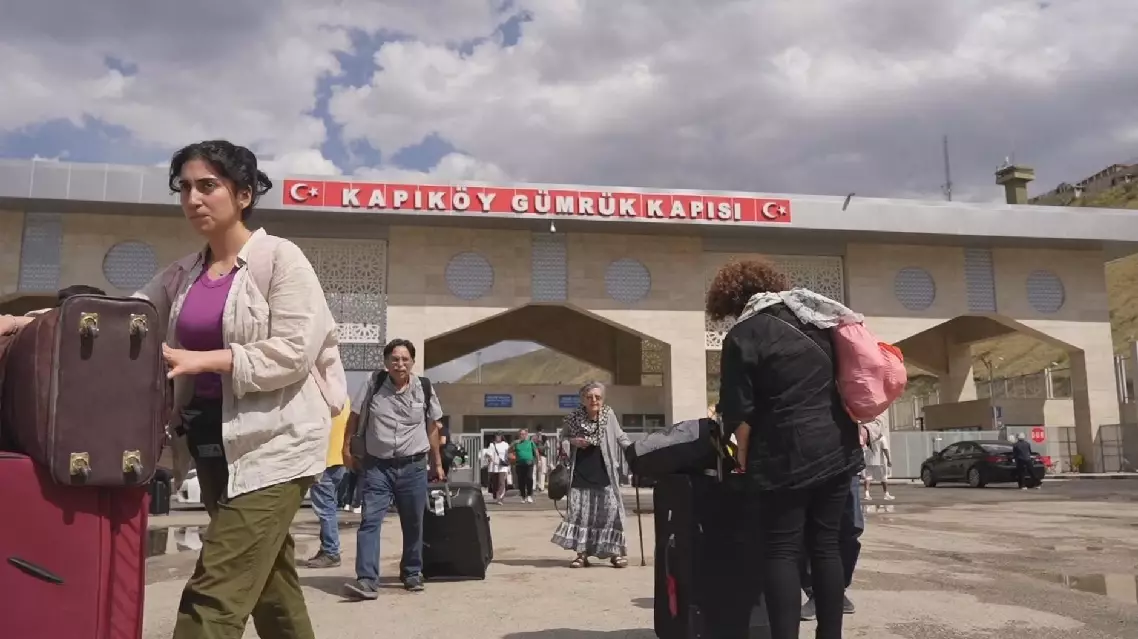
Foreign nationals flee Iran after U.S. airstrikes
The United States cannot legitimize an operation that attacked Venezuela and captured its president, a Chinese scholar said Sunday.
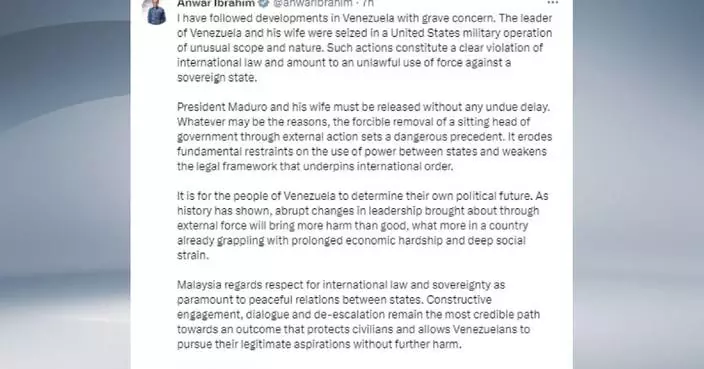
On Saturday, the United States launched a large-scale strike on Venezuela, during which Venezuelan President Nicolas Maduro and his wife were 'captured and flown out of Venezuela' according to a post by U.S. President Donald Trump on his Truth Social account.
Teng Jianqun, director of the Center for Diplomatic Studies at Hunan Normal University, said in an interview with China Global Television Network (CGTN) that the aim of this operation is to take full control of Venezuela’s natural resources.
"I don't think the United States can legitimize this operation to take custody of the president of Venezuela. And also I don't think the United States can legitimize its any action in taking the oil reserves of that country. This is actually a very dangerous game played by the Trump administration. And of course, the United States would like to take full control of that country and to take full control of the natural resources, especially the large reserve of oil in Venezuela," said Teng.
Teng said Venezuela is not an isolated case but a common practice by the United States. The United States launched an invasion of Panama on Dec. 20, 1989, which continued until January 1990, with the stated objective of capturing Panamanian strongman Manuel Noriega on charges of drug trafficking and organized crime.
"We still remember the so-called sentence of the former president of Panama in the late 1980s. And this time, the president of Venezuela will be under some judicial condition (judicial proceedings) for the so-called drug trafficking and some other crimes. So I think this is not a single case for the Venezuela country, but also this is actually a practice by the United States -- to use force, to use so-called justice under law against any leaders in Latin America and the Caribbean waters," he said.

US cannot legitimize operation against Venezuela: Chinese scholar