THE HAGUE, Netherlands (AP) — Two words came up again and again around NATO’s annual summit this week: Article 5.
Over the years, President Donald Trump has suggested that his backing for other allies under NATO's collective security guarantee would depend on whether U.S. allies are spending enough on defense.
Click to Gallery
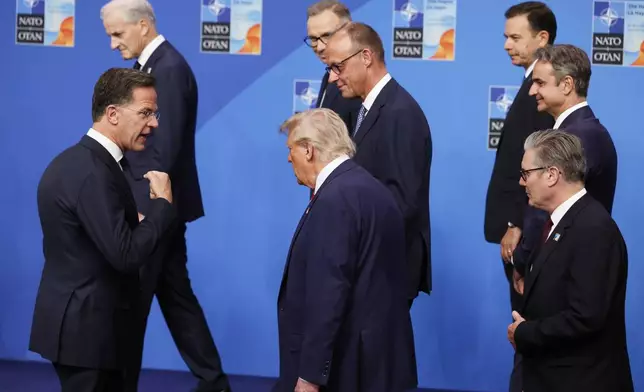
NATO Secretary General Mark Rutte, left, speaks with President Donald Trump, center, and Britain's Prime Minister Keir Starmer, right, after a group photo of NATO heads of state and government at the NATO summit in The Hague, Netherlands, Wednesday, June 25, 2025. (AP Photo/Geert Vanden Wijngaert)
NATO Secretary General Mark Rutte, left, speaks with President Donald Trump, center, and Britain's Prime Minister Keir Starmer, right, after a group photo of NATO heads of state and government at the NATO summit in The Hague, Netherlands, Wednesday, June 25, 2025. (AP Photo/Geert Vanden Wijngaert)
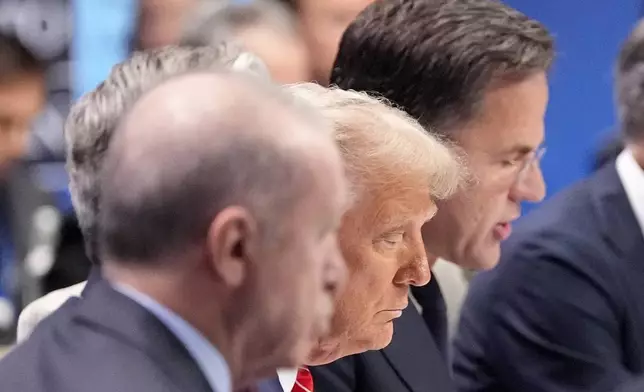
President Donald Trump listens to NATO Secretary General Mark Rutte, right, during a plenary session at the NATO summit in The Hague, Netherlands, Wednesday, June 25, 2025. (AP Photo/Alex Brandon)
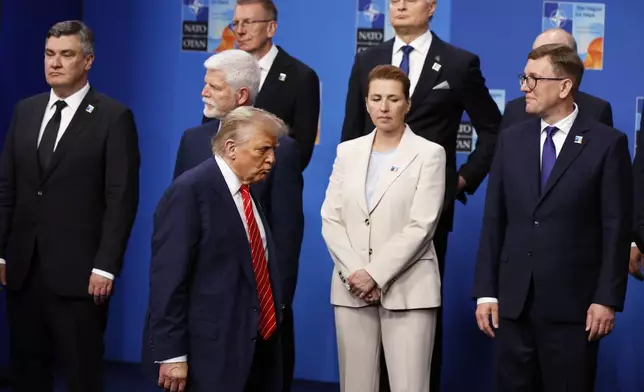
President Donald Trump, center left, walks by Denmark's Prime Minister Mette Frederiksen, center front, prior to a group photo of NATO heads of state and government at the NATO summit in The Hague, Netherlands, Wednesday, June 25, 2025. (AP Photo/Geert Vanden Wijngaert)
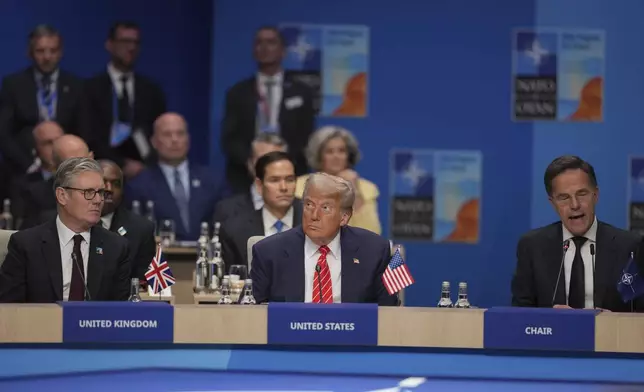
United States President Donald Trump, centre, with Britain's Prime Minister Keir Starmer, left listen to Nato General Secretary Mark Rutte during a North Atlantic Council plenary meeting during the the NATO summit in The Hague, Netherlands, Wednesday, June 25, 2025. (AP Photo Kin Cheung, Pool)
President Donald Trump speaks during a media conference at the end of the NATO summit as Foreign Secretary Marco Rubio, right, and Defence Secretary Pete Hegseth listen, in The Hague, Netherlands, Wednesday, June 25, 2025. (AP Photo/Alex Brandon)
As a candidate in 2016, Trump suggested that he as president would not necessarily heed the alliance’s mutual defense guarantee. In March this year, he expressed uncertainty that NATO would come to the United States’ defense if needed.
But on Wednesday, after he and his NATO counterparts had jointly underlined their “ironclad commitment” to come to each other’s aid if attacked, Trump appeared to have changed his tune.
“They want to protect their country, and they need the United States, and without the United States, it’s not going to be the same,” he told reporters in The Hague.
“I left there saying that these people really love their countries. It’s not a rip off. And we’re here to help them protect their country,” he said.
Article 5 is the foundation stone on which the 32-member North Atlantic Treaty Organization is built. It states that an armed attack against one or more of the members shall be considered an attack against all members.
It also states that if such an armed attack occurs, each member would take, individually and in concert with others, “such action as it deems necessary, including the use of armed force, to restore and maintain the security of the North Atlantic area.’’
That security guarantee is the reason previously neutral Finland and Sweden sought to join NATO after Russia launched its full-scale invasion of Ukraine in 2022 and why Ukraine itself and other countries in Europe also want in.
Article 5 was only invoked once, in the wake of the September 11, 2001, terror attacks on the United States, paving the way for NATO’s biggest ever operation in Afghanistan.
But NATO allies have also taken collective defense measures, including joining the U.S. to fight the Islamic State group in Syria, Iraq and Afghanistan, as well as help keep the peace in the Balkans.
The Three Musketeers-like pledge of all for one, one for all, is at the heart of NATO’s deterrent effect. To question it too loudly might invite an adversary to test it. European officials have said that Russia is planning to do just that.
NATO’s credibility hinges on Article 5 and its commitment to offer membership to any European country that can contribute to security in Europe and North America.
But Ukraine, currently in the middle of war with Russia, might oblige all 32 member countries to spring to its defense militarily, potentially igniting a wider war with a nuclear-armed country. Trump is vetoing its membership for the foreseeable future.
Article 5 becomes problematic when the territory of a member is unclear. For instance, Russian forces entered Georgia in August 2008, a few months after NATO leaders first promised the country it would join, along with Ukraine.
Georgia’s NATO application is still pending but seems unlikely for many years. Russia continues to occupy large swaths of Ukraine and other parts are contested, meaning that its borders cannot be easily defined.
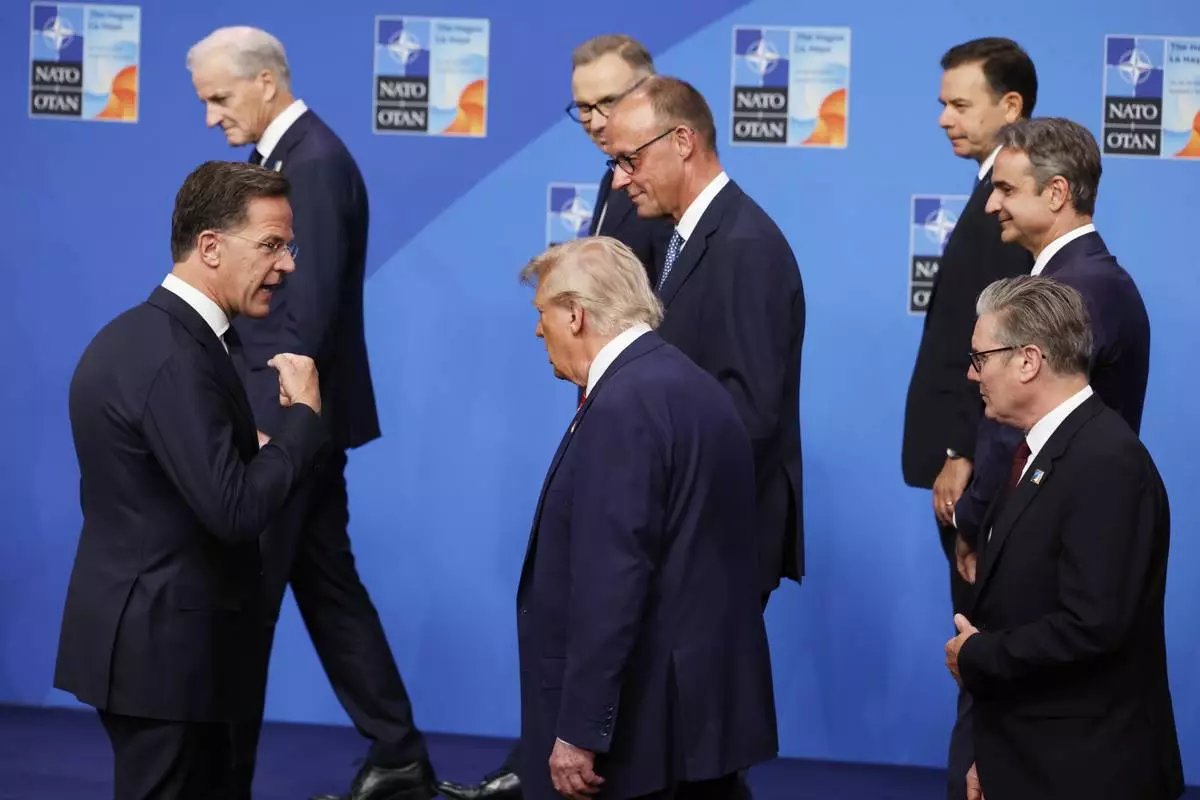
NATO Secretary General Mark Rutte, left, speaks with President Donald Trump, center, and Britain's Prime Minister Keir Starmer, right, after a group photo of NATO heads of state and government at the NATO summit in The Hague, Netherlands, Wednesday, June 25, 2025. (AP Photo/Geert Vanden Wijngaert)
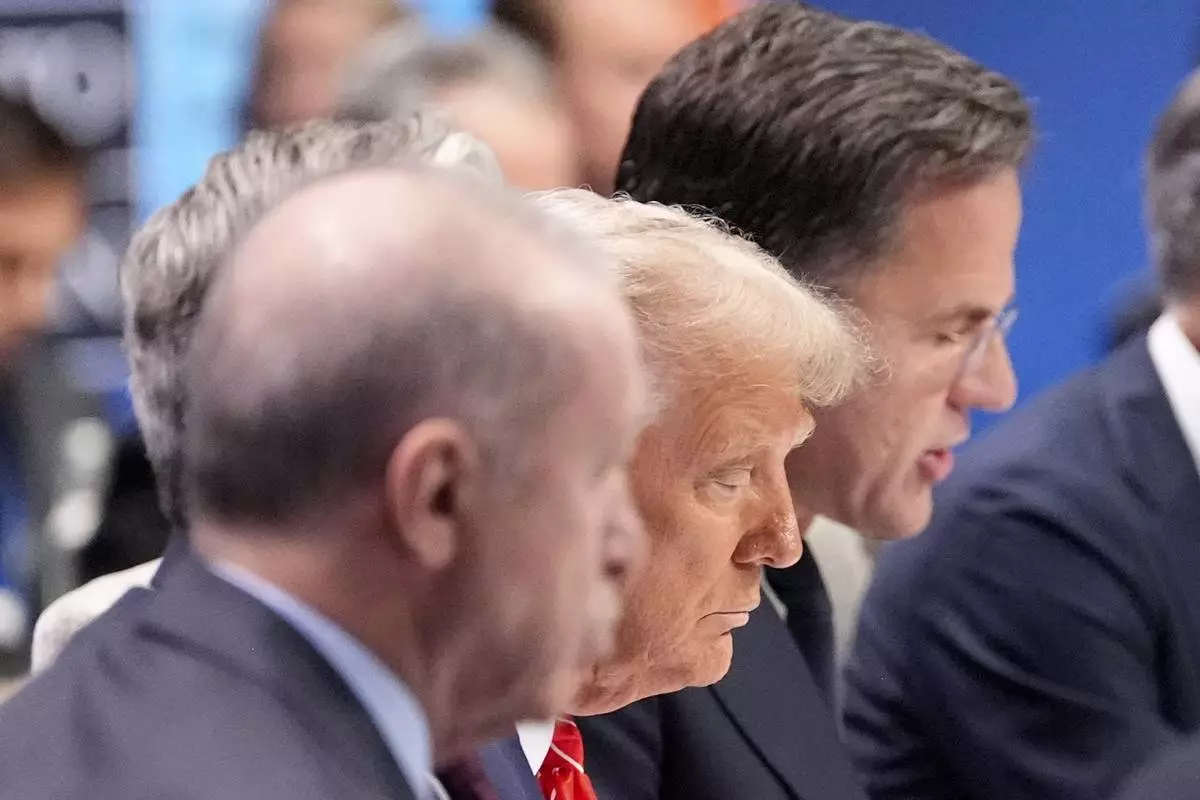
President Donald Trump listens to NATO Secretary General Mark Rutte, right, during a plenary session at the NATO summit in The Hague, Netherlands, Wednesday, June 25, 2025. (AP Photo/Alex Brandon)
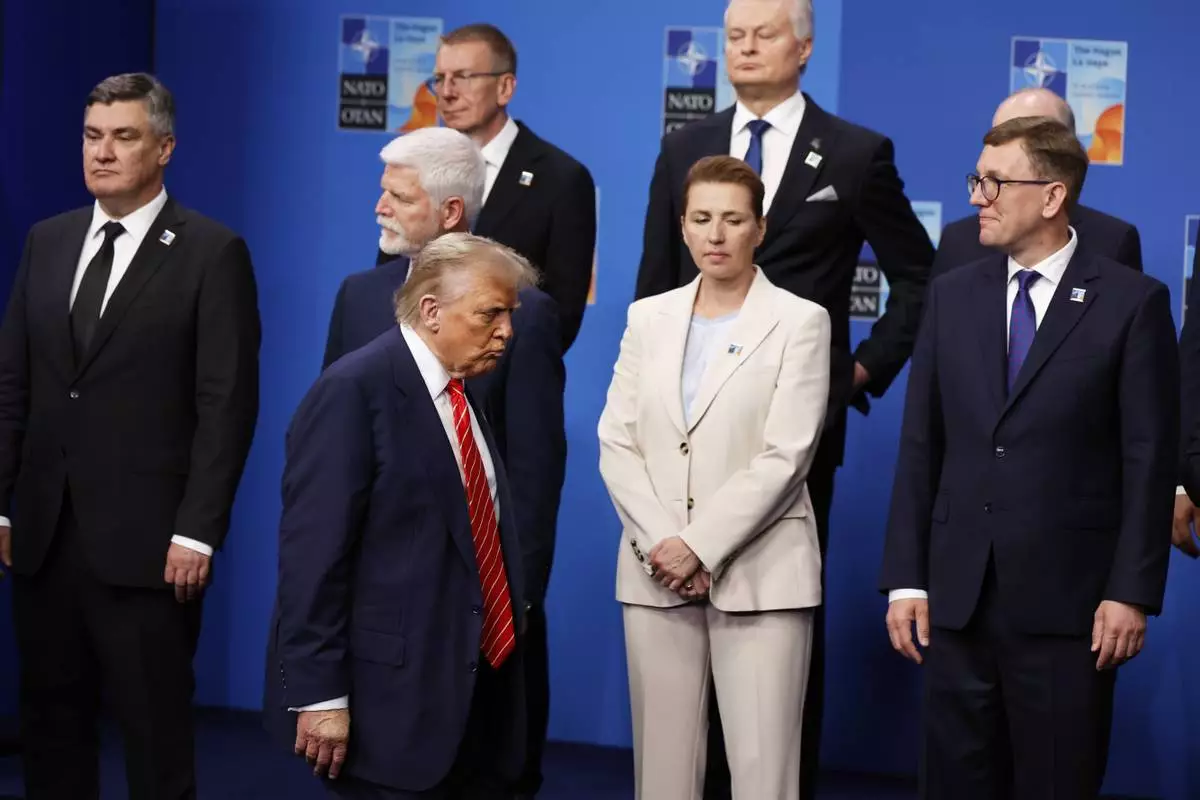
President Donald Trump, center left, walks by Denmark's Prime Minister Mette Frederiksen, center front, prior to a group photo of NATO heads of state and government at the NATO summit in The Hague, Netherlands, Wednesday, June 25, 2025. (AP Photo/Geert Vanden Wijngaert)
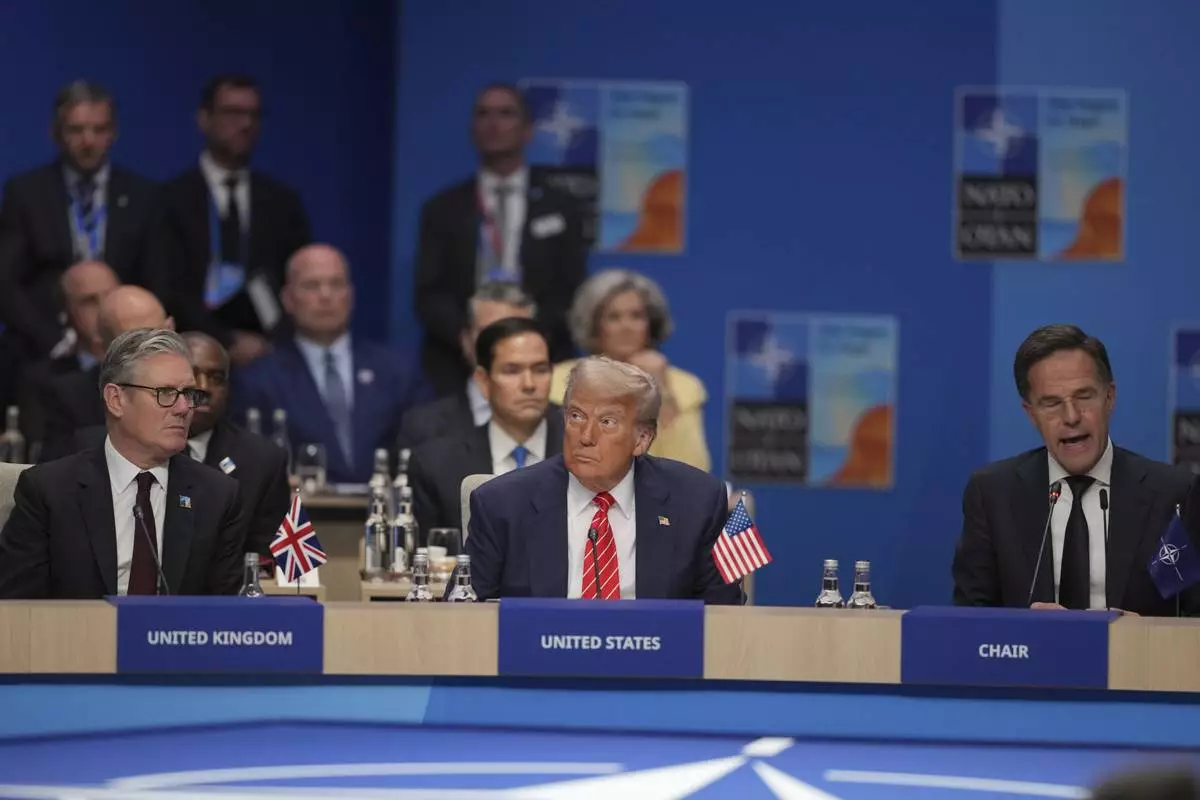
United States President Donald Trump, centre, with Britain's Prime Minister Keir Starmer, left listen to Nato General Secretary Mark Rutte during a North Atlantic Council plenary meeting during the the NATO summit in The Hague, Netherlands, Wednesday, June 25, 2025. (AP Photo Kin Cheung, Pool)

President Donald Trump speaks during a media conference at the end of the NATO summit as Foreign Secretary Marco Rubio, right, and Defence Secretary Pete Hegseth listen, in The Hague, Netherlands, Wednesday, June 25, 2025. (AP Photo/Alex Brandon)
WASHINGTON (AP) — Becky Pepper-Jackson finished third in the discus throw in West Virginia last year though she was in just her first year of high school. Now a 15-year-old sophomore, Pepper-Jackson is aware that her upcoming season could be her last.
West Virginia has banned transgender girls like Pepper-Jackson from competing in girls and women's sports, and is among the more than two dozen states with similar laws. Though the West Virginia law has been blocked by lower courts, the outcome could be different at the conservative-dominated Supreme Court, which has allowed multiple restrictions on transgender people to be enforced in the past year.
The justices are hearing arguments Tuesday in two cases over whether the sports bans violate the Constitution or the landmark federal law known as Title IX that prohibits sex discrimination in education. The second case comes from Idaho, where college student Lindsay Hecox challenged that state's law.
Decisions are expected by early summer.
President Donald Trump's Republican administration has targeted transgender Americans from the first day of his second term, including ousting transgender people from the military and declaring that gender is immutable and determined at birth.
Pepper-Jackson has become the face of the nationwide battle over the participation of transgender girls in athletics that has played out at both the state and federal levels as Republicans have leveraged the issue as a fight for athletic fairness for women and girls.
“I think it’s something that needs to be done,” Pepper-Jackson said in an interview with The Associated Press that was conducted over Zoom. “It’s something I’m here to do because ... this is important to me. I know it’s important to other people. So, like, I’m here for it.”
She sat alongside her mother, Heather Jackson, on a sofa in their home just outside Bridgeport, a rural West Virginia community about 40 miles southwest of Morgantown, to talk about a legal fight that began when she was a middle schooler who finished near the back of the pack in cross-country races.
Pepper-Jackson has grown into a competitive discus and shot put thrower. In addition to the bronze medal in the discus, she finished eighth among shot putters.
She attributes her success to hard work, practicing at school and in her backyard, and lifting weights. Pepper-Jackson has been taking puberty-blocking medication and has publicly identified as a girl since she was in the third grade, though the Supreme Court's decision in June upholding state bans on gender-affirming medical treatment for minors has forced her to go out of state for care.
Her very improvement as an athlete has been cited as a reason she should not be allowed to compete against girls.
“There are immutable physical and biological characteristic differences between men and women that make men bigger, stronger, and faster than women. And if we allow biological males to play sports against biological females, those differences will erode the ability and the places for women in these sports which we have fought so hard for over the last 50 years,” West Virginia's attorney general, JB McCuskey, said in an AP interview. McCuskey said he is not aware of any other transgender athlete in the state who has competed or is trying to compete in girls or women’s sports.
Despite the small numbers of transgender athletes, the issue has taken on outsize importance. The NCAA and the U.S. Olympic and Paralympic Committees banned transgender women from women's sports after Trump signed an executive order aimed at barring their participation.
The public generally is supportive of the limits. An Associated Press-NORC Center for Public Affairs Research poll conducted in October 2025 found that about 6 in 10 U.S. adults “strongly” or “somewhat” favored requiring transgender children and teenagers to only compete on sports teams that match the sex they were assigned at birth, not the gender they identify with, while about 2 in 10 were “strongly” or “somewhat” opposed and about one-quarter did not have an opinion.
About 2.1 million adults, or 0.8%, and 724,000 people age 13 to 17, or 3.3%, identify as transgender in the U.S., according to the Williams Institute at the UCLA School of Law.
Those allied with the administration on the issue paint it in broader terms than just sports, pointing to state laws, Trump administration policies and court rulings against transgender people.
"I think there are cultural, political, legal headwinds all supporting this notion that it’s just a lie that a man can be a woman," said John Bursch, a lawyer with the conservative Christian law firm Alliance Defending Freedom that has led the legal campaign against transgender people. “And if we want a society that respects women and girls, then we need to come to terms with that truth. And the sooner that we do that, the better it will be for women everywhere, whether that be in high school sports teams, high school locker rooms and showers, abused women’s shelters, women’s prisons.”
But Heather Jackson offered different terms to describe the effort to keep her daughter off West Virginia's playing fields.
“Hatred. It’s nothing but hatred,” she said. "This community is the community du jour. We have a long history of isolating marginalized parts of the community.”
Pepper-Jackson has seen some of the uglier side of the debate on display, including when a competitor wore a T-shirt at the championship meet that said, “Men Don't Belong in Women's Sports.”
“I wish these people would educate themselves. Just so they would know that I’m just there to have a good time. That’s it. But it just, it hurts sometimes, like, it gets to me sometimes, but I try to brush it off,” she said.
One schoolmate, identified as A.C. in court papers, said Pepper-Jackson has herself used graphic language in sexually bullying her teammates.
Asked whether she said any of what is alleged, Pepper-Jackson said, “I did not. And the school ruled that there was no evidence to prove that it was true.”
The legal fight will turn on whether the Constitution's equal protection clause or the Title IX anti-discrimination law protects transgender people.
The court ruled in 2020 that workplace discrimination against transgender people is sex discrimination, but refused to extend the logic of that decision to the case over health care for transgender minors.
The court has been deluged by dueling legal briefs from Republican- and Democratic-led states, members of Congress, athletes, doctors, scientists and scholars.
The outcome also could influence separate legal efforts seeking to bar transgender athletes in states that have continued to allow them to compete.
If Pepper-Jackson is forced to stop competing, she said she will still be able to lift weights and continue playing trumpet in the school concert and jazz bands.
“It will hurt a lot, and I know it will, but that’s what I’ll have to do,” she said.

Heather Jackson, left, and Becky Pepper-Jackson pose for a photograph outside of the U.S. Supreme Court in Washington, Sunday, Jan. 11, 2026. (AP Photo/Jose Luis Magana)
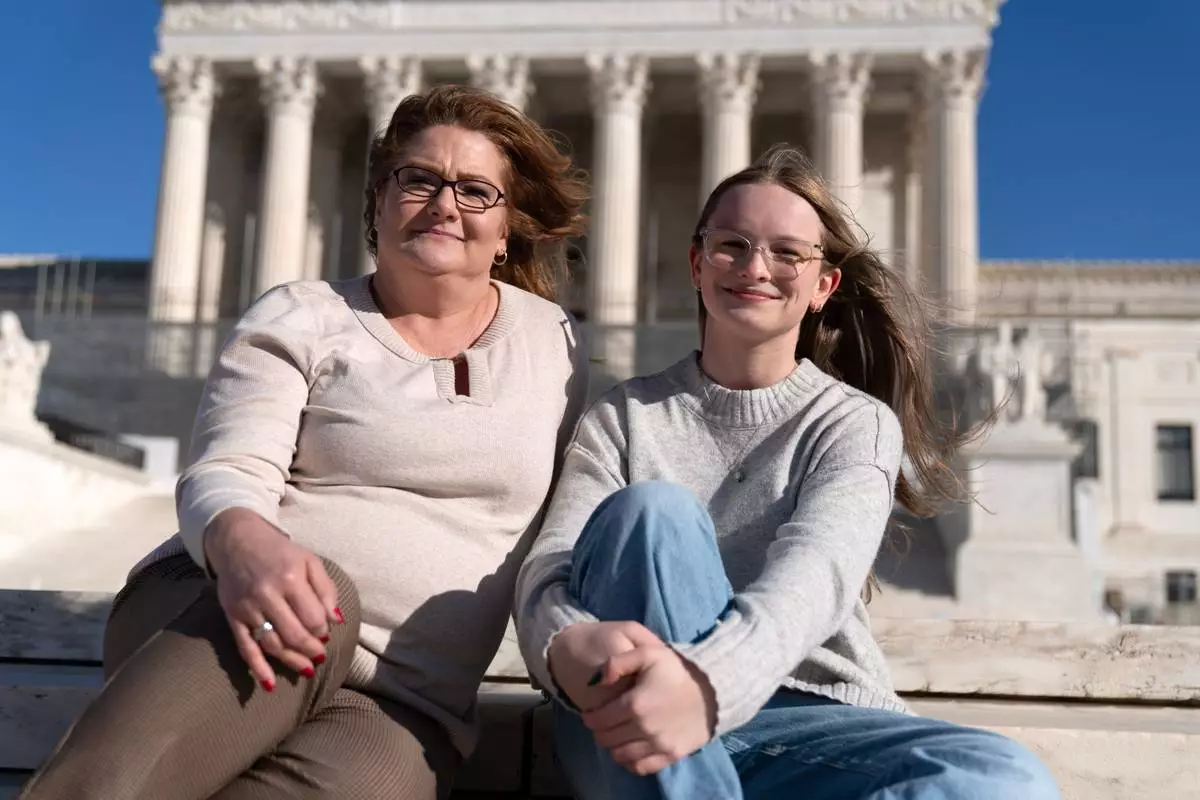
Heather Jackson, left, and Becky Pepper-Jackson pose for a photograph outside of the U.S. Supreme Court in Washington, Sunday, Jan. 11, 2026. (AP Photo/Jose Luis Magana)

Becky Pepper-Jackson poses for a photograph outside of the U.S. Supreme Court in Washington, Sunday, Jan. 11, 2026. (AP Photo/Jose Luis Magana)
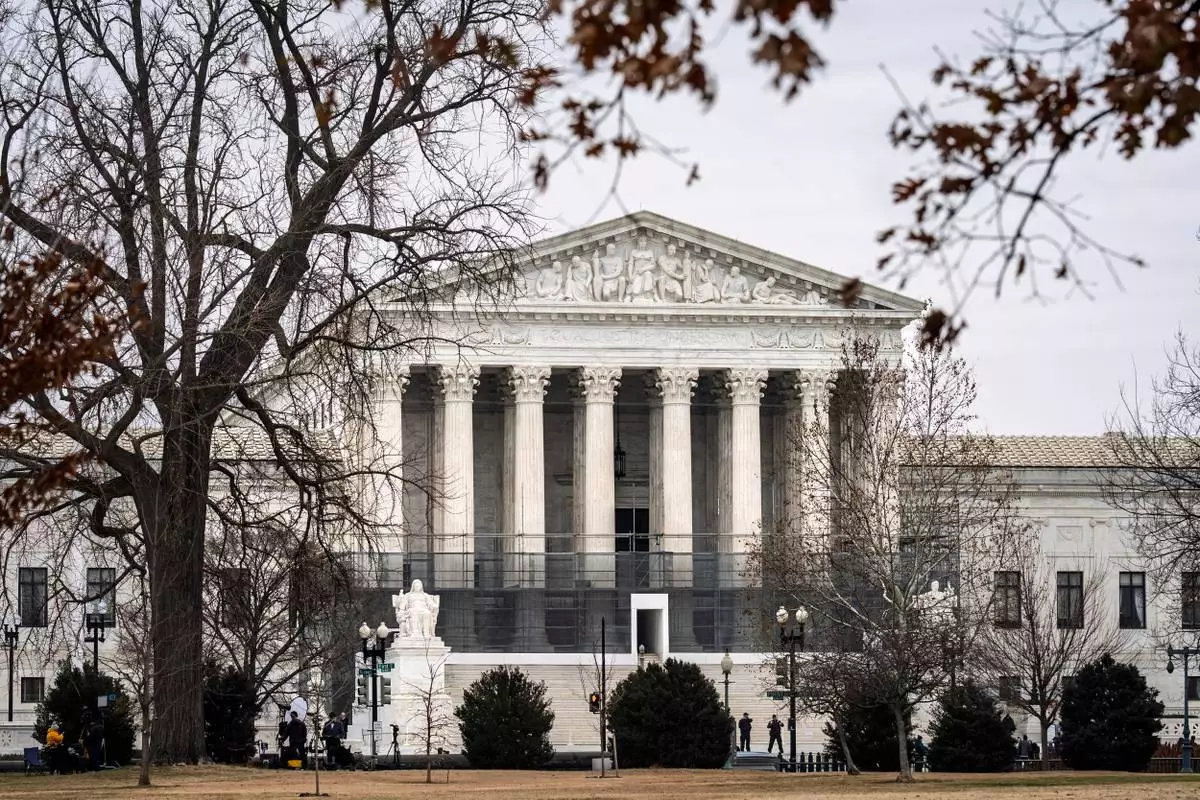
The Supreme Court stands is Washington, Friday, Jan. 9, 2026. (AP Photo/J. Scott Applewhite)

FILE - Protestors hold signs during a rally at the state capitol in Charleston, W.Va., on March 9, 2023. (AP Photo/Chris Jackson, file)