Skip to Content Facebook Feature Image

Trump grapples for upper hand in debate over damage caused by US strikes on Iran

News

Trump grapples for upper hand in debate over damage caused by US strikes on Iran
News

News

Trump grapples for upper hand in debate over damage caused by US strikes on Iran

2025-06-26 08:50 Last Updated At:09:01

THE HAGUE, Netherlands (AP) — President Donald Trump on Wednesday rejected an early intelligence assessment that U.S. strikes inflicted only a marginal setback on Iran's nuclear program, insisting that his country's spies did not have the full picture and defending his own swift conclusion that American bombs and missiles delivered a crushing blow.

“This was a devastating attack, and it knocked them for a loop,” Trump said as his administration scrambled to support his claims, made only hours after the attack, that Iranian nuclear facilities were “completely and fully obliterated.”

Trump said Defense Secretary Pete Hegseth and other military officials would hold an “interesting and irrefutable” news conference Thursday morning to “fight for the Dignity of our Great American Pilots” who carried out the mission.

He wrote on social media that “these Patriots were very upset” by “Fake News” reports about the limited impact of the strikes.

The issue dominated Trump's attendance at NATO's annual summit in the Netherlands, which was otherwise focused on European security. The White House highlighted an Israeli statement that Iran's nuclear efforts were delayed by years, much longer than the few months determined by American intelligence. A spokesperson for the Iranian foreign ministry also said the facilities have suffered significant damage.

But those comments fell short of Trump's hyperbole and did little to suggest that U.S. strikes had eliminated the threat of Iran developing a nuclear weapon.

Secretary of State Marco Rubio, speaking in an interview with Politico, limited his own assessment to saying Iran was “much further away from a nuclear weapon today than they were before the president took this bold action.”

Drawing reliable conclusions about the impact of the U.S. strikes remains difficult, especially only days after they took place. That makes the issue a breeding ground for competing claims that could determine how American voters view Trump’s risky decision to join Israel’s attacks on Iran.

Jeffrey Lewis, a professor of nonproliferation at the Middlebury Institute, said Trump was trying to have it both ways.

“If it’s too early to know, why is Trump saying it’s obliterated?” he said. “Either it’s too early to know, or you know.”

Also at stake are Trump’s next steps in the Middle East, where diplomatic efforts could be required to prevent Iran from rebuilding its nuclear program.

Trump said U.S. and Iranian officials would meet soon, resuming a dialogue that was interrupted by nearly two weeks of war, even as he suggested that negotiations were no longer necessary.

“I don’t care if I have an agreement or not,” Trump said, because Iran was too badly damaged to even consider rebuilding its program. “They’re not going to be doing it anyway. They’ve had it.”

Iran maintains that its atomic ambitions are for peaceful purposes, while U.S. and Israeli leaders have described the country’s nuclear program as the precursor to obtaining a nuclear weapon.

The episode has triggered some of Trump’s long-standing vendettas against leaks and intelligence officials, whom he has often viewed as a part of a “deep state” dedicated to undermining his agenda. He also lashed out at media outlets that reported on the classified assessment, describing them as “scum” and “disgusting.”

The intelligence assessment was produced by the Defense Intelligence Agency, which is part of the Pentagon. Out of all the country's spy services, it's usually “the fastest on the draw” to produce preliminary results, said Frank Montoya, a former counterintelligence leader.

“They have to respond quickly to what the war fighters are looking for, but those preliminary assessments are still based on information that’s out there,” Montoya said.

Leon Panetta, who held top national security roles under President Barack Obama, said it's too soon to have a more complete understanding of the strikes' impact.

“Bottom line is, that’s going to take an extended period of time, at least a number of weeks, before we have a full assessment of the damage done by the attack,” Panetta said.

However, Trump administration officials have been chiming in with their own statements emphasizing the damage done by the American mission.

CIA Director John Ratcliffe said there’s “a body of credible intelligence” showing “several key Iranian nuclear facilities were destroyed and would have to be rebuilt over the course of years.”

Trump said questioning the effectiveness of the strikes was disrespectful to the military, which flew stealth bombers halfway around the world to attack with weapons designed to penetrate deep underground.

The reports, he said, were “very unfair to the pilots, who risked their lives for our country.”

He described the American attack as a definitive conclusion to what he's dubbed “the 12-day war,” much like the dropping of the atomic bombs on Hiroshima and Nagasaki heralded the end of World War II.

“That ended that war,” he said. “This ended the war.”

During a news conference at the NATO summit, Trump briefly ceded the stage to Hegseth, who also lashed out at the media.

“There’s a reason the president calls out the fake news for what it is,” he said. Hegseth said reporters were using a leaked intelligence assessment to politically damage Trump.

“They want to spin it to try to make him look bad,” he said.

Trump pointed to satellite photos that showed the area around the nuclear facilities was “burned black,” and he said that underground tunnels where uranium was enriched and stored were “all collapsed.” He also suggested that Israel had sources on the ground in Iran, saying “they have guys that go in there after the hit” to evaluate the damage.

The bombing “rendered the enrichment facility inoperable,” according to a statement distributed by the White House and the office of Israeli Prime Minister Benjamin Netanyahu.

The American strikes, combined with Israeli strikes on other elements of Iran’s military nuclear program, have “set back Iran’s ability to develop nuclear weapons by many years,” the Israel Atomic Energy Commission said.

In addition, Iranian Foreign Ministry spokesperson Esmail Baghaei told Al Jazeera that there was significant damage from U.S. bombers.

“Our nuclear installations have been badly damaged, that’s for sure,” he said.

One critical question is whether enriched uranium, which could be developed into fuel for a nuclear bomb, was moved out of facilities before the U.S. strikes.

“I believe they didn’t have a chance to get anything out, because we acted fast,” Trump said. He added that “it’s very hard to move that kind of material, and very dangerous.”

In the wake of the leak, the White House going forward intends to try to limit the sharing of classified documents with Congress, according to a senior White House official.

The official, who was not authorized to comment publicly on the matter and spoke on the condition of anonymity, did not provide detail on how the administration would go about limiting the flow of classified information to lawmakers.

The move, first reported by Axios, seems certain to be challenged by members of Congress.

Classified briefings for lawmakers, originally scheduled for Tuesday, are now expected to take place Thursday and Friday.
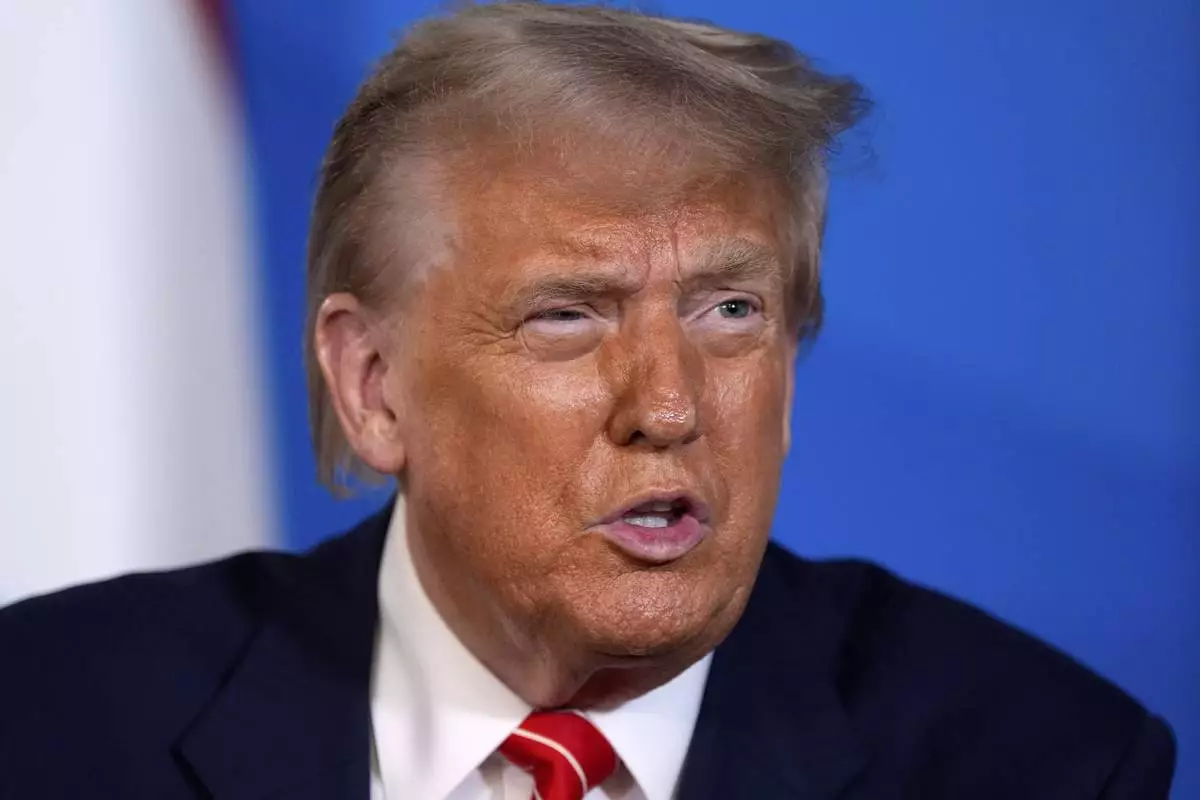
President Donald Trump speaks as he meets with Netherlands' Prime Minister Dick Schoof on the sidelines of a NATO summit in The Hague, Netherlands, Wednesday, June 25, 2025. (AP Photo/Alex Brandon)
President Donald Trump speaks as he meets with Netherlands' Prime Minister Dick Schoof on the sidelines of a NATO summit in The Hague, Netherlands, Wednesday, June 25, 2025. (AP Photo/Alex Brandon)

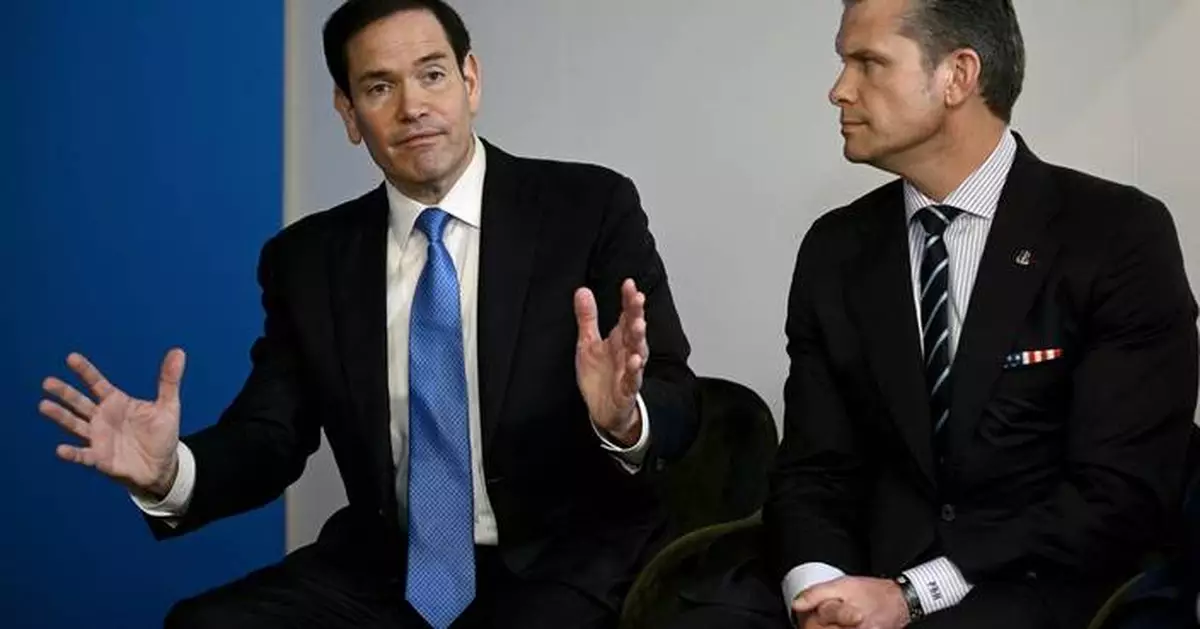
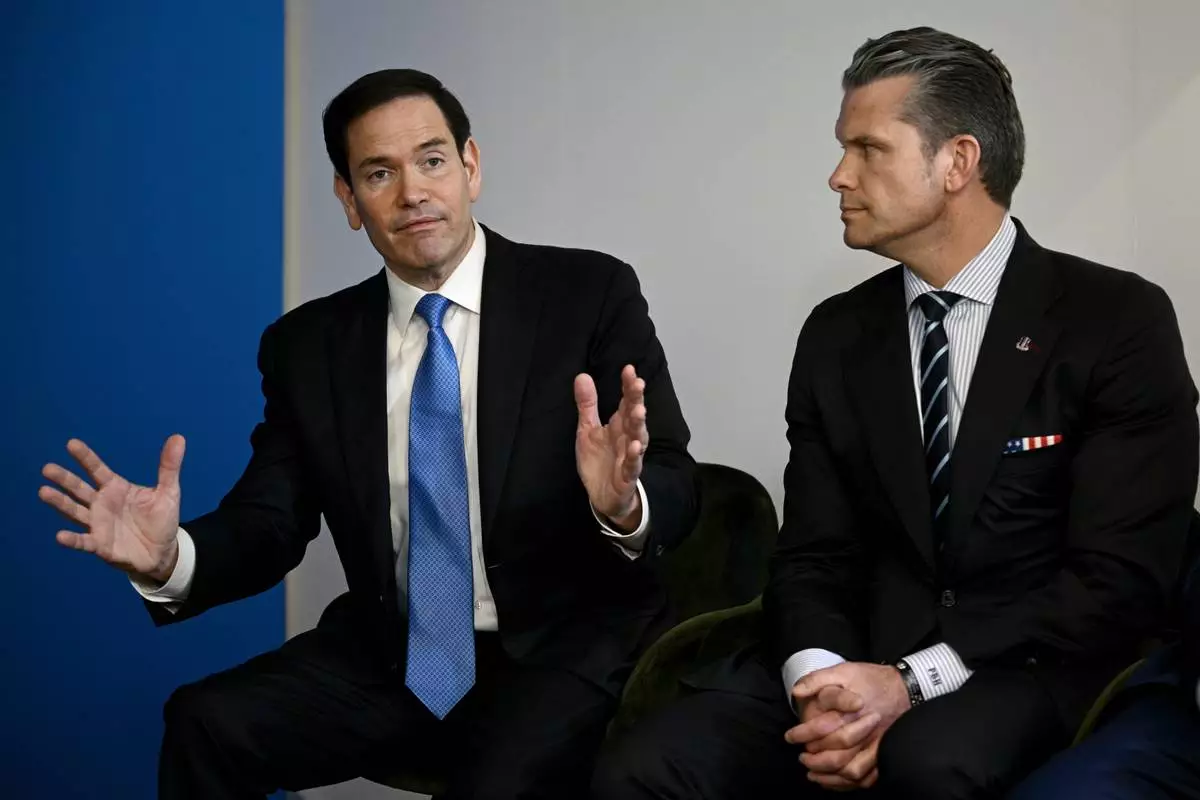
U.S. Secretary of State Marco Rubio, left, speaks next to U.S. Defense Secretary Pete Hegseth during a meeting between U.S. President Donald Trump with NATO Secretary General Mark Rutte at the NATO summit of heads of state and government in The Hague, Netherlands, Wednesday, June 25, 2025.(Brendan Smialowski/Pool Photo via AP)
U.S. Secretary of State Marco Rubio, left, speaks next to U.S. Defense Secretary Pete Hegseth during a meeting between U.S. President Donald Trump with NATO Secretary General Mark Rutte at the NATO summit of heads of state and government in The Hague, Netherlands, Wednesday, June 25, 2025.(Brendan Smialowski/Pool Photo via AP)
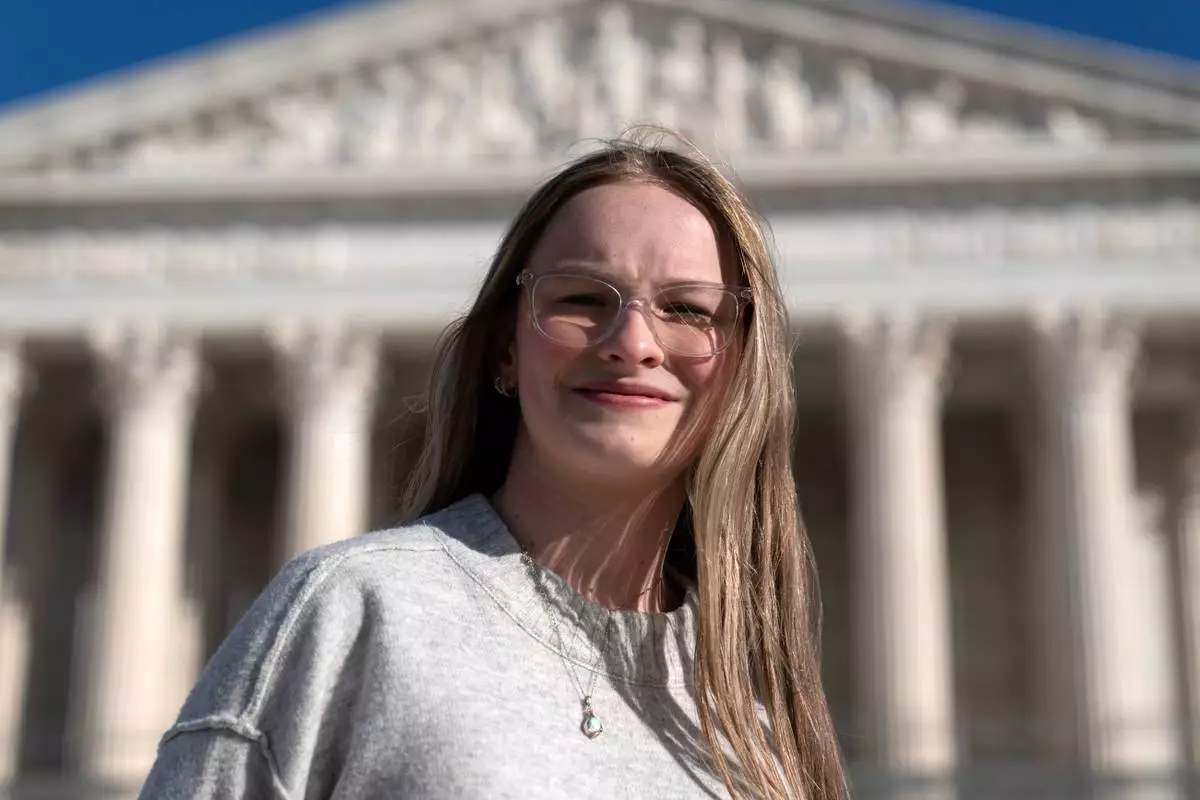
WASHINGTON (AP) — Becky Pepper-Jackson finished third in the discus throw in West Virginia last year though she was in just her first year of high school. Now a 15-year-old sophomore, Pepper-Jackson is aware that her upcoming season could be her last.

West Virginia has banned transgender girls like Pepper-Jackson from competing in girls and women's sports, and is among the more than two dozen states with similar laws. Though the West Virginia law has been blocked by lower courts, the outcome could be different at the conservative-dominated Supreme Court, which has allowed multiple restrictions on transgender people to be enforced in the past year.

The justices are hearing arguments Tuesday in two cases over whether the sports bans violate the Constitution or the landmark federal law known as Title IX that prohibits sex discrimination in education. The second case comes from Idaho, where college student Lindsay Hecox challenged that state's law.

Decisions are expected by early summer.

President Donald Trump's Republican administration has targeted transgender Americans from the first day of his second term, including ousting transgender people from the military and declaring that gender is immutable and determined at birth.

Pepper-Jackson has become the face of the nationwide battle over the participation of transgender girls in athletics that has played out at both the state and federal levels as Republicans have leveraged the issue as a fight for athletic fairness for women and girls.

“I think it’s something that needs to be done,” Pepper-Jackson said in an interview with The Associated Press that was conducted over Zoom. “It’s something I’m here to do because ... this is important to me. I know it’s important to other people. So, like, I’m here for it.”

She sat alongside her mother, Heather Jackson, on a sofa in their home just outside Bridgeport, a rural West Virginia community about 40 miles southwest of Morgantown, to talk about a legal fight that began when she was a middle schooler who finished near the back of the pack in cross-country races.

Pepper-Jackson has grown into a competitive discus and shot put thrower. In addition to the bronze medal in the discus, she finished eighth among shot putters.

She attributes her success to hard work, practicing at school and in her backyard, and lifting weights. Pepper-Jackson has been taking puberty-blocking medication and has publicly identified as a girl since she was in the third grade, though the Supreme Court's decision in June upholding state bans on gender-affirming medical treatment for minors has forced her to go out of state for care.

Her very improvement as an athlete has been cited as a reason she should not be allowed to compete against girls.

“There are immutable physical and biological characteristic differences between men and women that make men bigger, stronger, and faster than women. And if we allow biological males to play sports against biological females, those differences will erode the ability and the places for women in these sports which we have fought so hard for over the last 50 years,” West Virginia's attorney general, JB McCuskey, said in an AP interview. McCuskey said he is not aware of any other transgender athlete in the state who has competed or is trying to compete in girls or women’s sports.

Despite the small numbers of transgender athletes, the issue has taken on outsize importance. The NCAA and the U.S. Olympic and Paralympic Committees banned transgender women from women's sports after Trump signed an executive order aimed at barring their participation.

The public generally is supportive of the limits. An Associated Press-NORC Center for Public Affairs Research poll conducted in October 2025 found that about 6 in 10 U.S. adults “strongly” or “somewhat” favored requiring transgender children and teenagers to only compete on sports teams that match the sex they were assigned at birth, not the gender they identify with, while about 2 in 10 were “strongly” or “somewhat” opposed and about one-quarter did not have an opinion.

About 2.1 million adults, or 0.8%, and 724,000 people age 13 to 17, or 3.3%, identify as transgender in the U.S., according to the Williams Institute at the UCLA School of Law.

Those allied with the administration on the issue paint it in broader terms than just sports, pointing to state laws, Trump administration policies and court rulings against transgender people.

"I think there are cultural, political, legal headwinds all supporting this notion that it’s just a lie that a man can be a woman," said John Bursch, a lawyer with the conservative Christian law firm Alliance Defending Freedom that has led the legal campaign against transgender people. “And if we want a society that respects women and girls, then we need to come to terms with that truth. And the sooner that we do that, the better it will be for women everywhere, whether that be in high school sports teams, high school locker rooms and showers, abused women’s shelters, women’s prisons.”

But Heather Jackson offered different terms to describe the effort to keep her daughter off West Virginia's playing fields.

“Hatred. It’s nothing but hatred,” she said. "This community is the community du jour. We have a long history of isolating marginalized parts of the community.”

Pepper-Jackson has seen some of the uglier side of the debate on display, including when a competitor wore a T-shirt at the championship meet that said, “Men Don't Belong in Women's Sports.”

“I wish these people would educate themselves. Just so they would know that I’m just there to have a good time. That’s it. But it just, it hurts sometimes, like, it gets to me sometimes, but I try to brush it off,” she said.

One schoolmate, identified as A.C. in court papers, said Pepper-Jackson has herself used graphic language in sexually bullying her teammates.

Asked whether she said any of what is alleged, Pepper-Jackson said, “I did not. And the school ruled that there was no evidence to prove that it was true.”

The legal fight will turn on whether the Constitution's equal protection clause or the Title IX anti-discrimination law protects transgender people.

The court ruled in 2020 that workplace discrimination against transgender people is sex discrimination, but refused to extend the logic of that decision to the case over health care for transgender minors.

The court has been deluged by dueling legal briefs from Republican- and Democratic-led states, members of Congress, athletes, doctors, scientists and scholars.

The outcome also could influence separate legal efforts seeking to bar transgender athletes in states that have continued to allow them to compete.

If Pepper-Jackson is forced to stop competing, she said she will still be able to lift weights and continue playing trumpet in the school concert and jazz bands.

“It will hurt a lot, and I know it will, but that’s what I’ll have to do,” she said.

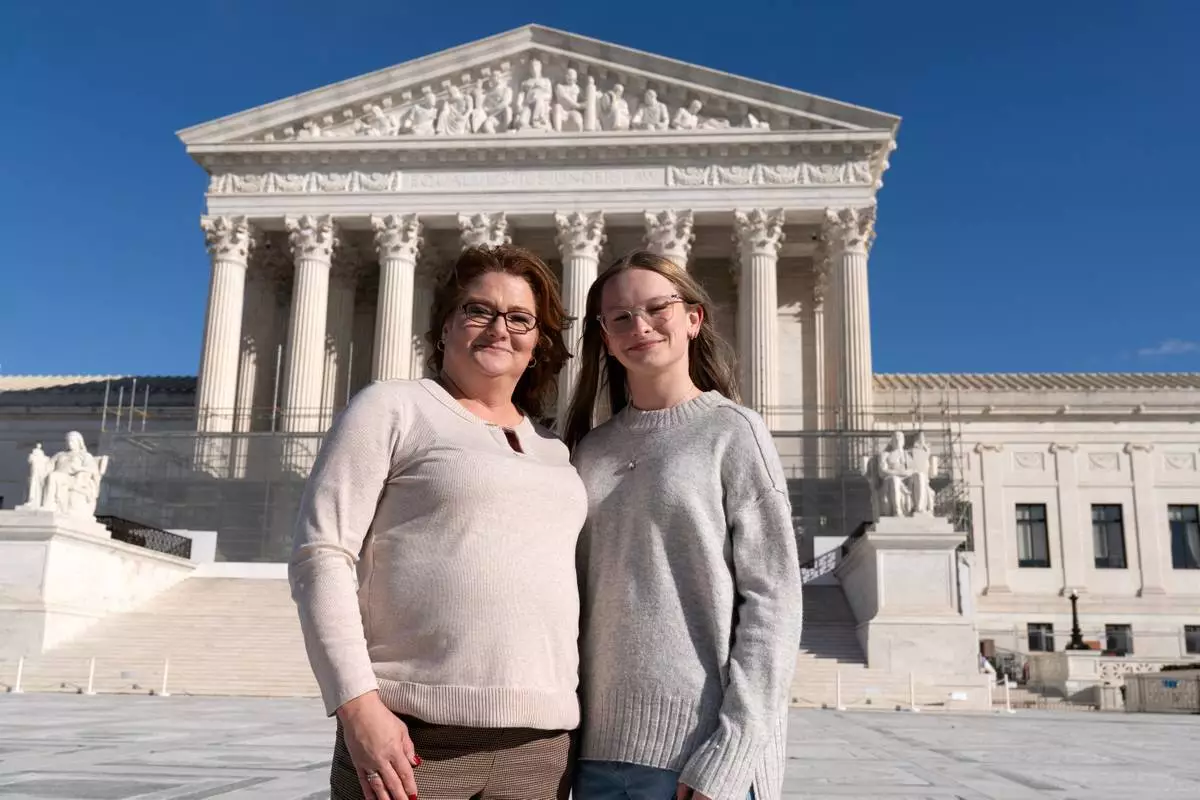
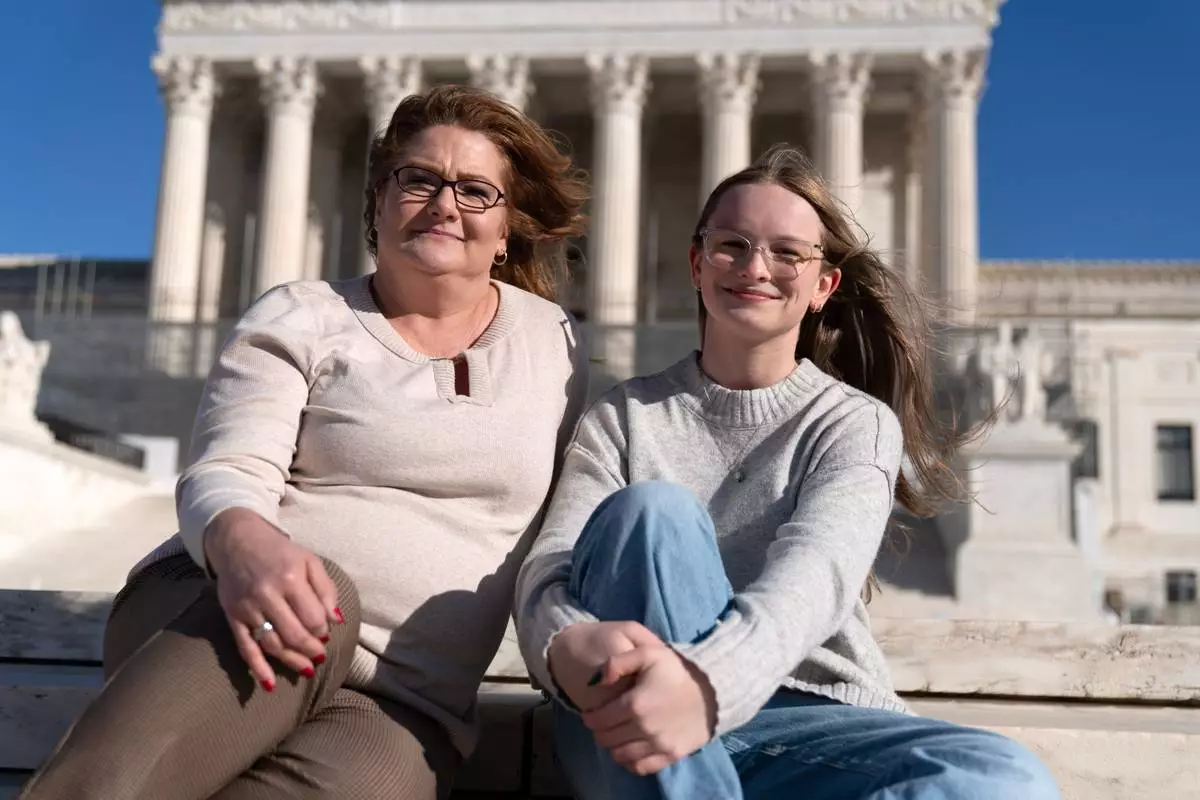
Heather Jackson, left, and Becky Pepper-Jackson pose for a photograph outside of the U.S. Supreme Court in Washington, Sunday, Jan. 11, 2026. (AP Photo/Jose Luis Magana)

Heather Jackson, left, and Becky Pepper-Jackson pose for a photograph outside of the U.S. Supreme Court in Washington, Sunday, Jan. 11, 2026. (AP Photo/Jose Luis Magana)

Heather Jackson, left, and Becky Pepper-Jackson pose for a photograph outside of the U.S. Supreme Court in Washington, Sunday, Jan. 11, 2026. (AP Photo/Jose Luis Magana)

Heather Jackson, left, and Becky Pepper-Jackson pose for a photograph outside of the U.S. Supreme Court in Washington, Sunday, Jan. 11, 2026. (AP Photo/Jose Luis Magana)

Becky Pepper-Jackson poses for a photograph outside of the U.S. Supreme Court in Washington, Sunday, Jan. 11, 2026. (AP Photo/Jose Luis Magana)

Becky Pepper-Jackson poses for a photograph outside of the U.S. Supreme Court in Washington, Sunday, Jan. 11, 2026. (AP Photo/Jose Luis Magana)

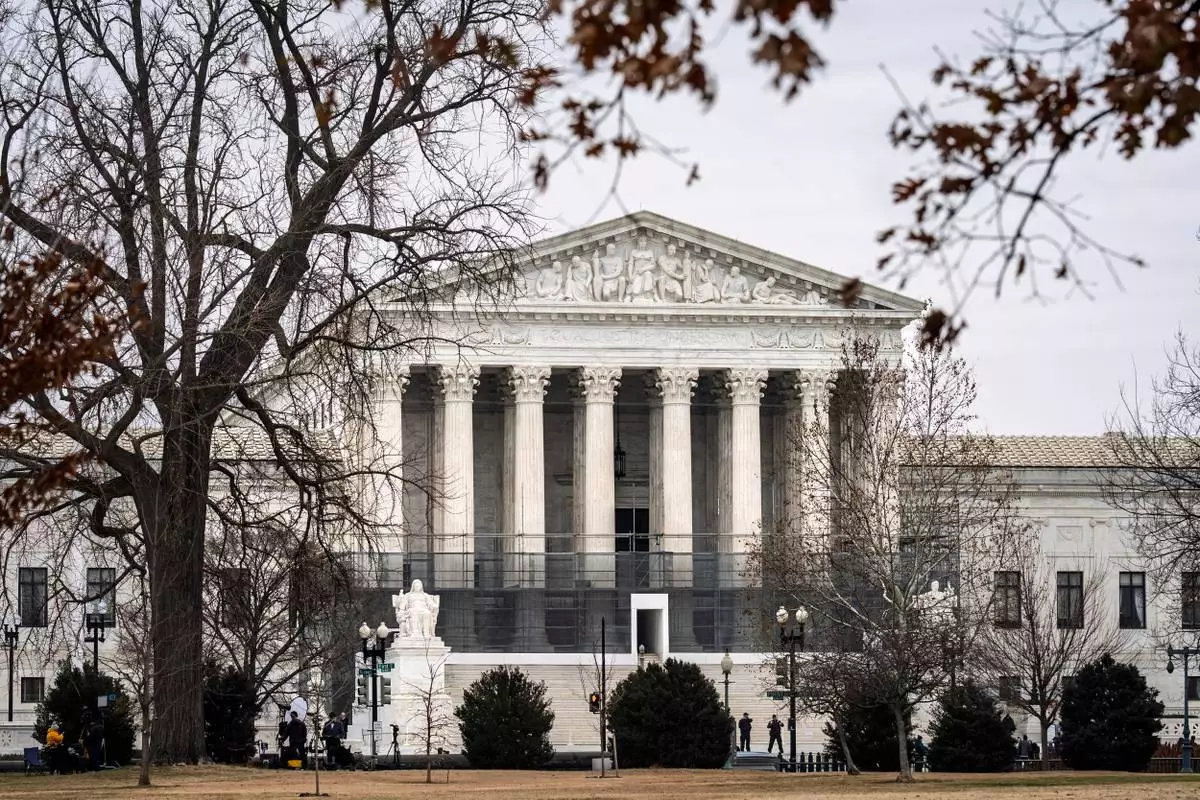
The Supreme Court stands is Washington, Friday, Jan. 9, 2026. (AP Photo/J. Scott Applewhite)

The Supreme Court stands is Washington, Friday, Jan. 9, 2026. (AP Photo/J. Scott Applewhite)

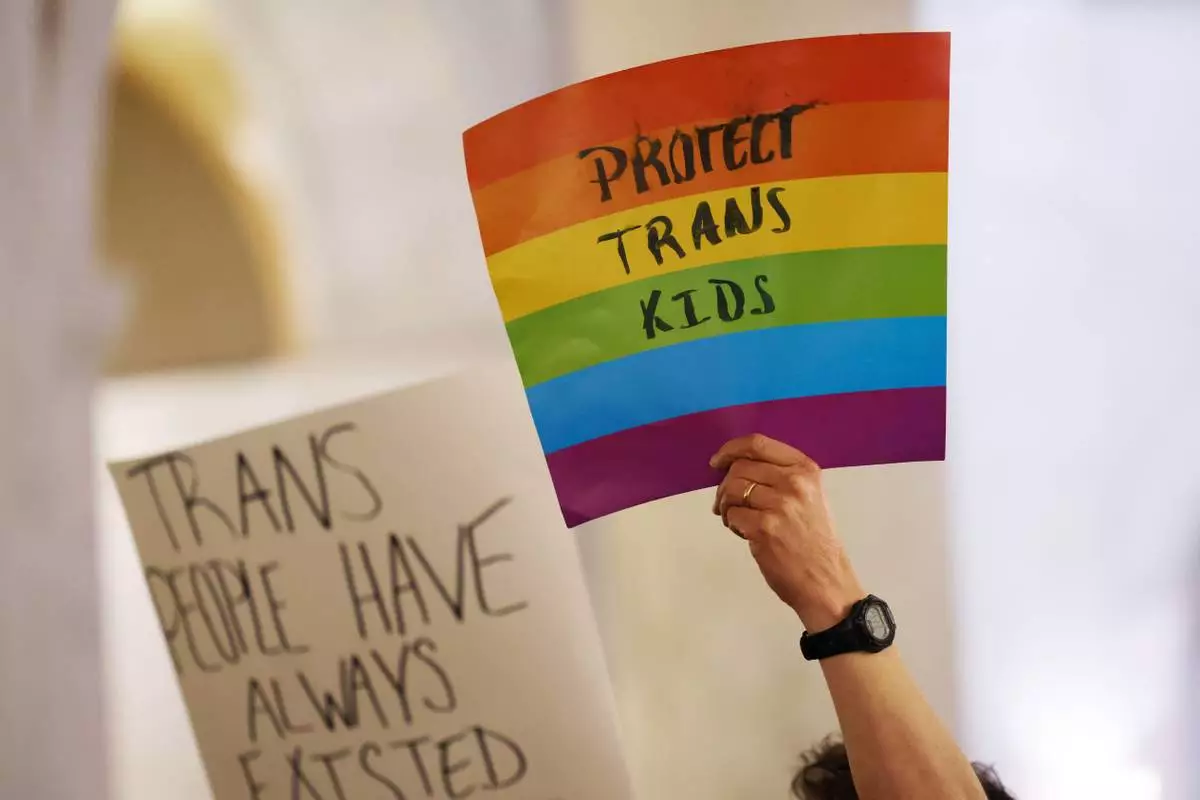
FILE - Protestors hold signs during a rally at the state capitol in Charleston, W.Va., on March 9, 2023. (AP Photo/Chris Jackson, file)

FILE - Protestors hold signs during a rally at the state capitol in Charleston, W.Va., on March 9, 2023. (AP Photo/Chris Jackson, file)

Recommended Articles