Announced during London Climate Action Week, the collaboration marks a new phase of ambition and action across the global battery system
LONDON, June 26, 2025 /PRNewswire/ -- At London Climate Action Week, CATL and the Ellen MacArthur Foundation shared an ambition for accelerating the transition to a circular battery economy —that new battery production must be decoupled from the use of virgin raw materials. Doing so will enable a future where access, resilience, and sustainability go hand in hand — and where growth is no longer tied to extraction.
Since forming their Strategic Partnership earlier this year, CATL and the Ellen MacArthur Foundation have been working together to map out how circular economy principles can be applied across the battery value chain. The shared ambition offers a starting point — a North Star — for the collaboration and innovation that must follow. It is intended to guide not only CATL, but a broad community of global stakeholders seeking to redesign the system for long-term success.
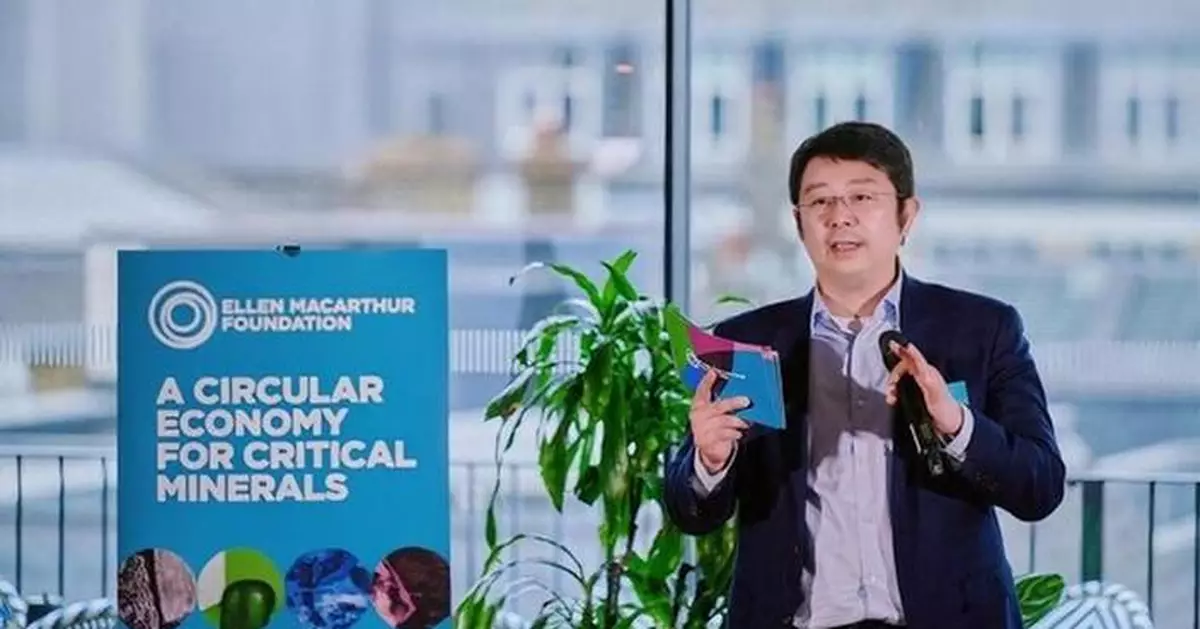
The ambition was introduced by Jiang Li, vice president and Board Secretary of CATL at a high-level panel hosted by the Ellen MacArthur Foundation. The panel explored how stakeholders across research, industry, and government can work together to bring this ambition to life — and to identify what is needed to achieve it at scale.
To help bring this ambition into focus, CATL has introduced a directional goal: that within 20 years, 50% of new battery production could be decoupled from virgin raw materials. This is a long-term marker — one that will guide how we explore circular models, scale partnerships, and invest in innovation across the value chain.
Jiang Li highlighted that the circular economy will unlock new economic opportunities as well as environmental and social values. By 2040, the global battery recycling market is expected to exceed RMB 1.2 trillion (about 165 billion U.S. dollars), and the battery value chain could generate more than 10 million jobs—over half of which would be in developing countries.
Four principles to guide industry transformation
At the heart of this ambition are four practical principles, adapted from the Ellen MacArthur Foundation's circular economy framework. These principles are designed to guide transformation across the battery value chain — from mining and manufacturing to mobility and energy systems. They offer a starting point to create further alignment with key stakeholders to design collaborative action to accelerate the shift toward a more circular battery economy.
Rethink Systems. A circular approach requires systemic change across the battery ecosystem. By embedding circularity into each stage of the value chain, it becomes possible to support low-carbon development, reduce waste, and enable the continuous flow of materials. This principle emphasises optimising the structure and interactions of the value chain to enable more efficient and resilient use of resources.
Redesign Products. Circularity begins at the design stage. Batteries must be built for longevity, disassembly, and second-life applications — using modular architecture and durable components. Designing with reuse and recycling in mind ensures that products can retain value for longer and be recovered more efficiently at the end of life.
Rethink Business Models. New business models are essential to decoupling resource use from economic growth. By shifting from traditional ownership to shared, service-based, or second-life models, batteries can deliver greater utility and become more accessible to users. This principle supports the creation of economically viable pathways for circularity to scale.
Recycle Materials. A high-performing recycling system is essential to circularity. Materials must be recovered efficiently and returned to high-value use, increasing the proportion of closed-loop recycling. This reduces dependence on virgin resources and helps establish a more sustainable, secure, and low-impact supply of critical raw materials.
Jiang Li also shared examples of CATL's implementation of the four pillars.
- At system level, CATL launched its Carbon Chain Management System to help decarbonize the battery value chain.
- In product design, CATL has extended battery lifespan significantly—its energy storage batteries now reach up to 18,000 cycles—reducing both materials demand and emissions.
- CATL also plans to deploy over 10,000 battery swap stations, improving battery efficiency and facilitating large-scale collection of retired batteries.
- In recycling, CATL operates the world's largest battery take-back network and in 2024 alone recycled around 130,000 tons of end-of-life batteries, recovering 17,000 tons of lithium salts.
Piloting change through GECC
To test and expand upon the shared ambition in real-world conditions, CATL is advancing the Global Energy Circularity Commitment (GECC) — Announced in March, GECC is an open, global platform where stakeholders from industry, cities, and academia come together to test circular economy solutions in practice. CATL looks to work with players across the value chain through this platform, exploring and sharing insights to help scale impact. This collective approach is key to building a resilient and sustainable battery system.
Looking ahead
This shared ambition is a starting point — a foundation for building new forms of collaboration, transparency, and systems innovation across the global battery landscape. CATL and the Ellen MacArthur Foundation will continue to engage with public- and private-sector partners to refine, expand, and operationalise the ideas set out here.
"The circular battery system won't be built in a lab or a boardroom — it will be shaped through collaboration, testing, and shared effort," said Jiang Li. "This ambition is a signal to help drive that work forward. Achieving it will require global collaboration, cross-sector learning, and open engagement across the value chain — all of which the Ellen MacArthur Foundation has long championed."
** The press release content is from PR Newswire. Bastille Post is not involved in its creation. **

CATL and the Ellen MacArthur Foundation share ambition for a circular battery future
CATL and the Ellen MacArthur Foundation share ambition for a circular battery future
|
HONG KONG, Dec. 29, 2025 /PRNewswire/ -- CNN's Tomorrow Transformed examines how society and businesses are changing through innovation and technology, and what this means for the future. The latest episode examines the diverse innovations driving a cleaner future – from making the aviation industry greener through sustainable jet fuel to advancing solar efficiency and developing revolutionary hydrogen power solutions.
Tomorrow Transformed travels to Sydney, Australia, to explore the global energy revolution being led by the University of New South Wales (UNSW). Known as a "hotbed of innovation" in photovoltaics, the institution is home to Professor Martin Green, the "father of solar energy," whose PERC Cell design is used in over 90% of solar cells installed worldwide. At UNSW, Professor Ned Ekins-Daukes and PhD student Jamie Harrison are demonstrating how thermodynamics can be used to harvest energy as heat leaves the earth's surface for the cold sky. While solar now provides the cheapest energy in history, researchers are pushing further to eliminate manufacturing bottlenecks. Vince Allen, co-founder of the startup SunDrive, is pioneering a shift away from expensive and rare silver in solar cell production, replacing it with copper - a material that is 1000 times more abundant and 100 times cheaper.
The journey continues to Cape Town, South Africa, where HYENA (Hydrogen Energy Applications) is reimagining how the world's most abundant element can provide reliable power to the African continent. CNN speaks with HYENA co-founder Jack Fletcher to explore how their "Power Pod" technology uses hydrogen to offer a quieter, more efficient, and significantly cleaner alternative to traditional diesel generators. By converting available fuels like LPG into electricity via a chemical process rather than combustion, the system drastically reduces emissions and eliminates the noise of a standard engine.
Lastly, Tomorrow Transformed visits Hong Kong-based biofuels company, EcoCeres, in the southern region of Johor in Malaysia. A global leader in sustainable aviation fuel (SAF), EcoCeres is helping to power a more environmentally friendly future for air travel through advanced, low carbon jet fuel made from renewable resources.
In its state-of-the-art biorefinery, the company is re-engineering waste and residue oil, known as 'feedstock', from food factories, palm oil mills and restaurants across the region. The end product is an eco jet fuel that has the right freezing point and structure for flying at cruising altitude, ready to be pumped directly into waiting airplanes. At full capacity, the biorefinery will be able to produce 420,000 tonnes of fuel per year, with large quantities of SAF powering partner airlines including Cathay Pacific, Qantas and British Airways.
Matti Lievonen, CEO of EcoCeres, though proud of the science behind transforming waste feedstock into a viable jet fuel alternative, states that the real innovation is in the system his company has in place. EcoCeres is actively expanding its presence across Southeast Asia to complement its existing refinery and strong feedstock network in China and is looking to replicate this model in other markets.
In the very near future, the next flight you take may be powered by recycled cooking oil from a restaurant in Beijing, street food stalls in Malaysia or from a factory that produces your favourite brand of potato chips.
Tomorrow Transformed trailers: https://bit.ly/3KWFFfF
Tomorrow Transformed images: https://bit.ly/4jb0DE9
Airtimes for 30-minute special:
Sunday, 28th December at 5am, 12pm and 8pm HKT
About CNN International
CNN's portfolio of news and information services is available in seven different languages across all major TV, digital and mobile platforms, reaching more than 379 million households around the globe. CNN International is the number one international TV news channel according to all major media surveys across Europe, the Middle East and Africa, the Asia Pacific region, and Latin America and has a US presence that includes CNNgo. CNN Digital is a leading network for online news, mobile news and social media. CNN is at the forefront of digital innovation and continues to invest heavily in expanding its digital global footprint, with a suite of award-winning digital properties and a range of strategic content partnerships, commercialised through a strong data-driven understanding of audience behaviours. CNN has won multiple prestigious awards around the world for its journalism. Around 1,000 hours of long-form series, documentaries and specials are produced every year by CNNI's non-news programming division. CNN has 36 editorial offices and more than 1,100 affiliates worldwide through CNN Newsource. CNN International is a Warner Bros. Discovery company.
HONG KONG, Dec. 29, 2025 /PRNewswire/ -- CNN's Tomorrow Transformed examines how society and businesses are changing through innovation and technology, and what this means for the future. The latest episode examines the diverse innovations driving a cleaner future – from making the aviation industry greener through sustainable jet fuel to advancing solar efficiency and developing revolutionary hydrogen power solutions.
Tomorrow Transformed travels to Sydney, Australia, to explore the global energy revolution being led by the University of New South Wales (UNSW). Known as a "hotbed of innovation" in photovoltaics, the institution is home to Professor Martin Green, the "father of solar energy," whose PERC Cell design is used in over 90% of solar cells installed worldwide. At UNSW, Professor Ned Ekins-Daukes and PhD student Jamie Harrison are demonstrating how thermodynamics can be used to harvest energy as heat leaves the earth's surface for the cold sky. While solar now provides the cheapest energy in history, researchers are pushing further to eliminate manufacturing bottlenecks. Vince Allen, co-founder of the startup SunDrive, is pioneering a shift away from expensive and rare silver in solar cell production, replacing it with copper - a material that is 1000 times more abundant and 100 times cheaper.
The journey continues to Cape Town, South Africa, where HYENA (Hydrogen Energy Applications) is reimagining how the world's most abundant element can provide reliable power to the African continent. CNN speaks with HYENA co-founder Jack Fletcher to explore how their "Power Pod" technology uses hydrogen to offer a quieter, more efficient, and significantly cleaner alternative to traditional diesel generators. By converting available fuels like LPG into electricity via a chemical process rather than combustion, the system drastically reduces emissions and eliminates the noise of a standard engine.
Lastly, Tomorrow Transformed visits Hong Kong-based biofuels company, EcoCeres, in the southern region of Johor in Malaysia. A global leader in sustainable aviation fuel (SAF), EcoCeres is helping to power a more environmentally friendly future for air travel through advanced, low carbon jet fuel made from renewable resources.
In its state-of-the-art biorefinery, the company is re-engineering waste and residue oil, known as 'feedstock', from food factories, palm oil mills and restaurants across the region. The end product is an eco jet fuel that has the right freezing point and structure for flying at cruising altitude, ready to be pumped directly into waiting airplanes. At full capacity, the biorefinery will be able to produce 420,000 tonnes of fuel per year, with large quantities of SAF powering partner airlines including Cathay Pacific, Qantas and British Airways.
Matti Lievonen, CEO of EcoCeres, though proud of the science behind transforming waste feedstock into a viable jet fuel alternative, states that the real innovation is in the system his company has in place. EcoCeres is actively expanding its presence across Southeast Asia to complement its existing refinery and strong feedstock network in China and is looking to replicate this model in other markets.
In the very near future, the next flight you take may be powered by recycled cooking oil from a restaurant in Beijing, street food stalls in Malaysia or from a factory that produces your favourite brand of potato chips.
Tomorrow Transformed trailers: https://bit.ly/3KWFFfF
Tomorrow Transformed images: https://bit.ly/4jb0DE9
Airtimes for 30-minute special:
Sunday, 28th December at 5am, 12pm and 8pm HKT
About CNN International
CNN's portfolio of news and information services is available in seven different languages across all major TV, digital and mobile platforms, reaching more than 379 million households around the globe. CNN International is the number one international TV news channel according to all major media surveys across Europe, the Middle East and Africa, the Asia Pacific region, and Latin America and has a US presence that includes CNNgo. CNN Digital is a leading network for online news, mobile news and social media. CNN is at the forefront of digital innovation and continues to invest heavily in expanding its digital global footprint, with a suite of award-winning digital properties and a range of strategic content partnerships, commercialised through a strong data-driven understanding of audience behaviours. CNN has won multiple prestigious awards around the world for its journalism. Around 1,000 hours of long-form series, documentaries and specials are produced every year by CNNI's non-news programming division. CNN has 36 editorial offices and more than 1,100 affiliates worldwide through CNN Newsource. CNN International is a Warner Bros. Discovery company.
** The press release content is from PR Newswire. Bastille Post is not involved in its creation. **

CNN's Tomorrow Transformed explores global innovations powering a greener future