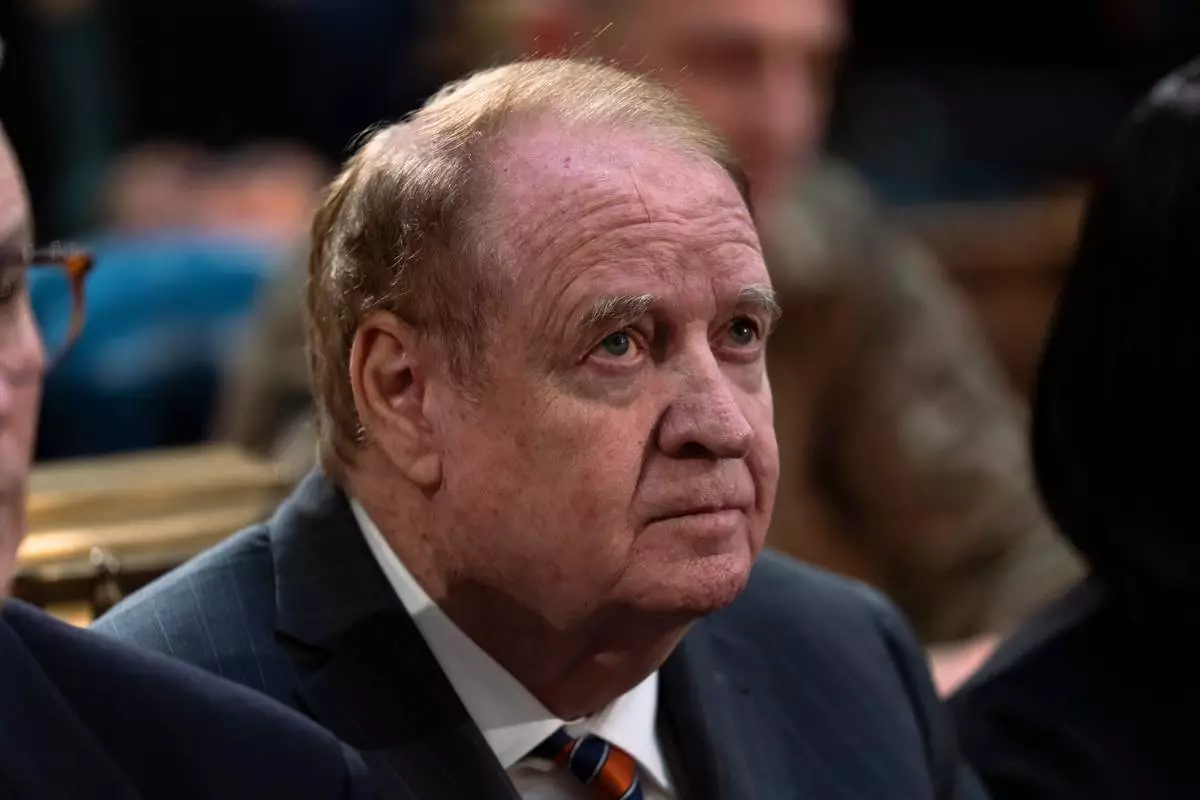
WASHINGTON (AP) — The Senate parliamentarian has advised that a Medicaid provider tax overhaul central to President Donald Trump's tax cut and spending bill does not adhere to the chamber's procedural rules, delivering a crucial blow as Republicans rush to finish the package this week.
Guidance from the parliamentarian is rarely ignored and Republican leaders are now forced to consider difficult options. Republicans were counting on big cuts to Medicaid and other programs to offset trillions of dollars in Trump tax breaks, their top priority. Additionally, the parliamentarian, who is the Senate's chief arbiter of its often complicated rules, advised against various GOP provisions barring certain immigrants from health care programs.
Click to Gallery

President Donald Trump speaks at an event to promote his domestic policy and budget agenda in the East Room of the White House, Thursday, June 26, 2025, in Washington. (AP Photo/Mark Schiefelbein)
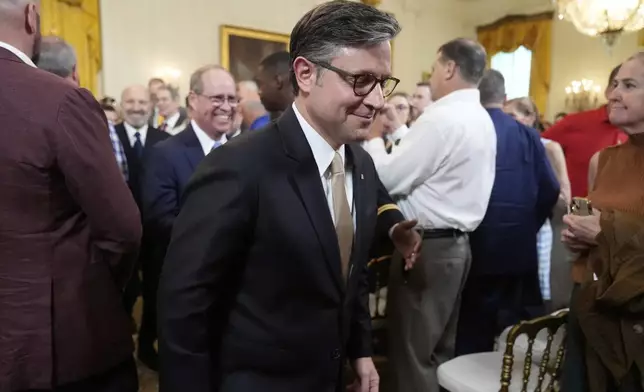
House Speaker Mike Johnson, R-La., departs an event to promote President Donald Trump's domestic policy and budget agenda in the East Room of the White House, Thursday, June 26, 2025, in Washington. (AP Photo/Mark Schiefelbein)

President Donald Trump speaks at an event to promote his domestic policy and budget agenda in the East Room of the White House, Thursday, June 26, 2025, in Washington. (AP Photo/Mark Schiefelbein)
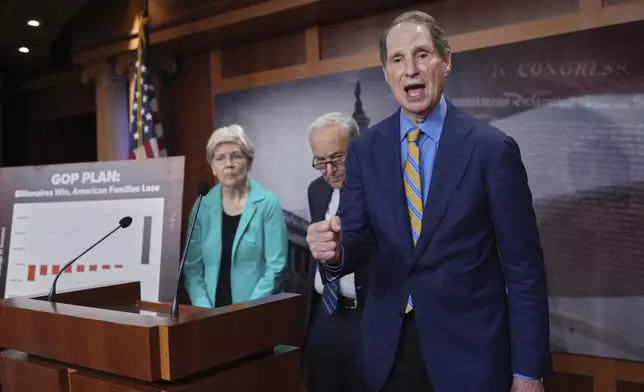
Sen. Ron Wyden, D-Ore., the ranking member of the Senate Finance Committee, is joined at left by Sen. Elizabeth Warren, D-Mass., ranking member of the Senate Banking, Housing, and Urban Affairs Committee, and Senate Minority Leader Chuck Schumer, D-N.Y., as they talk to reporters about Senate Republicans' efforts to pass President Donald Trump's tax cut and spending agenda with deeper Medicaid cuts, at the Capitol in Washington, Wednesday, June 18, 2025. (AP Photo/J. Scott Applewhite)

President Donald Trump gestures after arriving on Air Force One, Wednesday, June 25, 2025, at Joint Base Andrews, Md. (AP Photo/Alex Brandon)
Republicans scrambled Thursday to respond, with some calling for challenging, or ever firing, the nonpartisan parliamentarian, who has been on the job since 2012. GOP leaders dismissed those views and instead worked to revise the various proposals.
“We have contingency plans,” said Majority Leader John Thune of South Dakota.
Friday's expected votes appeared to be slipping, but Thune insisted that “we’re plowing forward.”
But Democrats, who are unified against the package as a tax giveaway for the wealthy at the expense of American safety net programs, said the procedural decisions would devastate the GOP package.
Sen. Ron Wyden, the top Democrat on the Senate Finance Committee, said the Republican proposals would have meant $250 billion less for the health care program, “massive Medicaid cuts that hurt kids, seniors, Americans with disabilities and working families.”
The outcome is a setback as Senate Republicans race toward a weekend session to pass the bill and send it back to the House for another vote before Trump’s Fourth of July deadline. Trump hosted House Speaker Mike Johnson and other GOP lawmakers in the East Room at the White House, joined by truck drivers, firefighters, tipped workers, ranchers and others that the administration says will benefit from the bill.
“We don’t want to have grandstanders,” Trump said of the GOP holdouts.
Trump said there are “hundreds of things” in the emerging package of tax breaks, spending cuts and bolstered money to carry out his mass deportation plans. “It's so good.”
At its core, the big bill, which has passed the House and is now being revised in the Senate, includes $3.8 trillion in tax breaks that had been approved during Trump's first term but will expire in December, imposing a tax hike if Congress fails to act. To help offset lost revenues, Republicans are relying on steep cuts to health care and food stamps, and imposing new fees on immigrants.
GOP leaders were already struggling to rally support for Medicaid changes that some senators said went too far and would have left millions without coverage. The nonpartisan Congressional Budget Office has said more than 10.9 million more people would not have health care under the House-passed bill; Senate Republicans were proposing deeper cuts.
After the parliamentarian advised against the Medicaid provider tax change, Republicans said they would try to revise the provision to make it acceptable, perhaps by extending the start date of any changes. They are rushing to come up with similar adjustments to other proposals that have run into violations, including one to change the Supplemental Nutrition Assistance Program, or food stamps.
It's all delaying action on the bill, but Republican leaders have little choice. They are counting on the health care restrictions to save billions of dollars and offset the cost of trillions of dollars in tax cuts.
Sen. Lindsey Graham, R-S.C., the Budget Committee chairman, rejected calls to fire the parliamentarian, and said in a statement he was working with the office to “find a pathway forward.”
States impose the so-called provider tax on hospitals and other entities as a way to help fund Medicaid, largely by boosting the reimbursements they receive from the federal government. Critics say the system is a type of “laundering,” but almost every state except Alaska uses it to help provide health care coverage.
The House-passed bill would freeze the tax, while the Senate would cut the tax that some states are allowed to impose.
Several GOP senators have opposed cutting the Medicaid provider tax, saying it would hurt rural hospitals that depend on the money. Hospital organizations have warned that it could lead to hospital closures.
Sen. Josh Hawley, R-Mo., among those fighting the change, said he had spoken to Trump late Wednesday and the president told him to revert to the earlier proposal from the House.
“I think it just confirms that we weren’t ready for a vote yet,” said Sen. Thom Tillis, R-N.C., who also had raised concerns about the provider tax cuts.
More than 80 million people in the United States use the Medicaid program, alongside the Obama-era Affordable Care Act. Republicans want to scale Medicaid back to what they say is its original mission, providing care mainly to women and children, rather than a much larger group of people.
To help defray lost revenues to the hospitals, one plan Republicans had been considering would have created a rural hospital fund with $15 billion as backup. Some GOP senators said that was too much; others, including Sen. Susan Collins of Maine, wanted at least $100 billion.
The parliamentarian has worked around the clock to assess the legislation and ensure it complies with the so-called Byrd Rule, named for the late Sen. Robert C. Byrd of West Virginia. It essentially bars policy matters in budget reconciliation bills.
If leaders moved ahead without altering the provisions, the measures could be challenged, requiring a 60-vote threshold to overcome objections. That would be a tall order in a Senate divided 53-47 and with Democrats unified against Trump's bill.
“It's pretty frustrating,” said Sen. Rick Scott, R-Fla., who wants even steeper reductions.
Overnight Wednesday the parliamentarian advised against GOP student loan repayment plans, and Thursday the parliamentarian cited those that would have blocked access to Medicaid and other health care programs from immigrants who are not citizens. Earlier, plans to gut the Consumer Financial Protection Bureau were also found to violate the rules.
But Sen. Kevin Cramer, R-N.D., said there's no desire to challenge the parliamentarian's advice. “It's the institutional integrity,” he said. “Even if I'm convinced 100% she's wrong.”
At the same time, Republicans lost another potential revenue source Thursday after agreeing to a request from Treasury Secretary Scott Bessent to remove the so-called revenge tax provision, section 899, that would have allowed the government to impose taxes on companies with foreign owners and investors from certain countries. Bessent said he has reached a separate agreement with such countries.
__
Associated Press writers Kevin Freking, Leah Askarinam, Joey Cappelletti, Michelle L. Price and Fatima Hussein contributed to this report.

President Donald Trump speaks at an event to promote his domestic policy and budget agenda in the East Room of the White House, Thursday, June 26, 2025, in Washington. (AP Photo/Mark Schiefelbein)
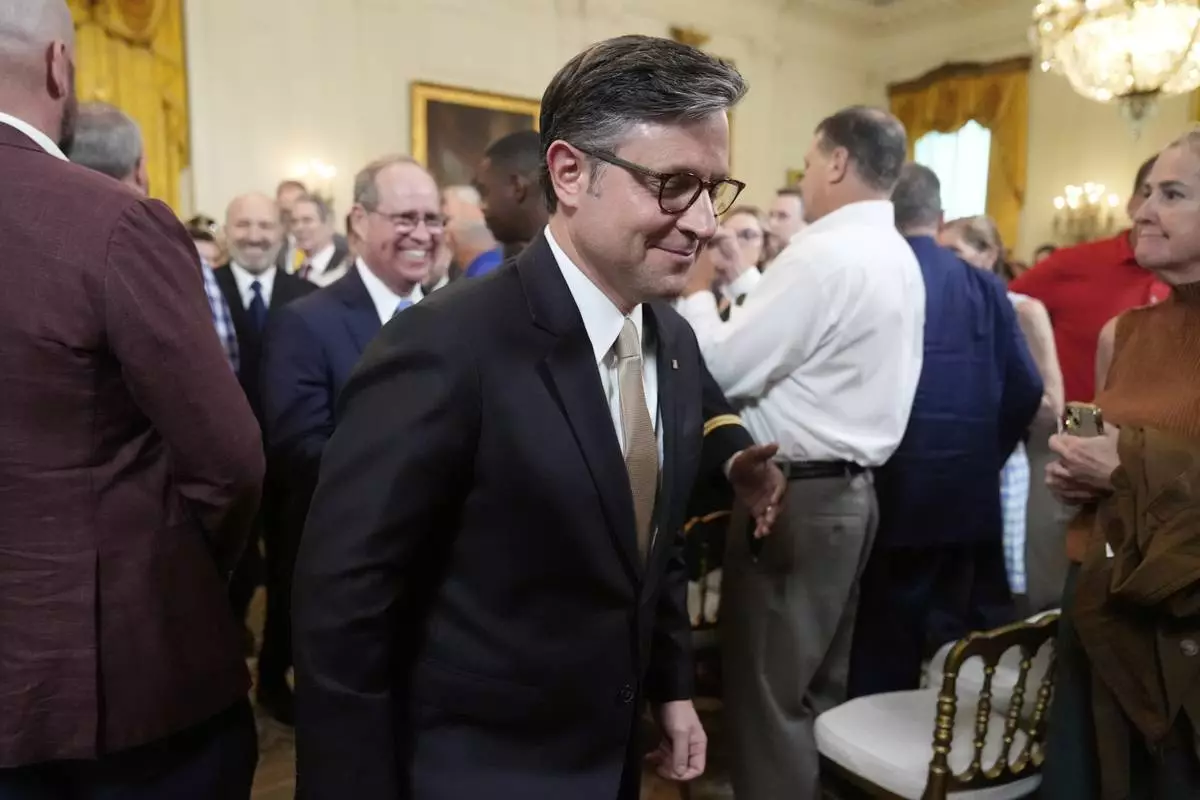
House Speaker Mike Johnson, R-La., departs an event to promote President Donald Trump's domestic policy and budget agenda in the East Room of the White House, Thursday, June 26, 2025, in Washington. (AP Photo/Mark Schiefelbein)

President Donald Trump speaks at an event to promote his domestic policy and budget agenda in the East Room of the White House, Thursday, June 26, 2025, in Washington. (AP Photo/Mark Schiefelbein)
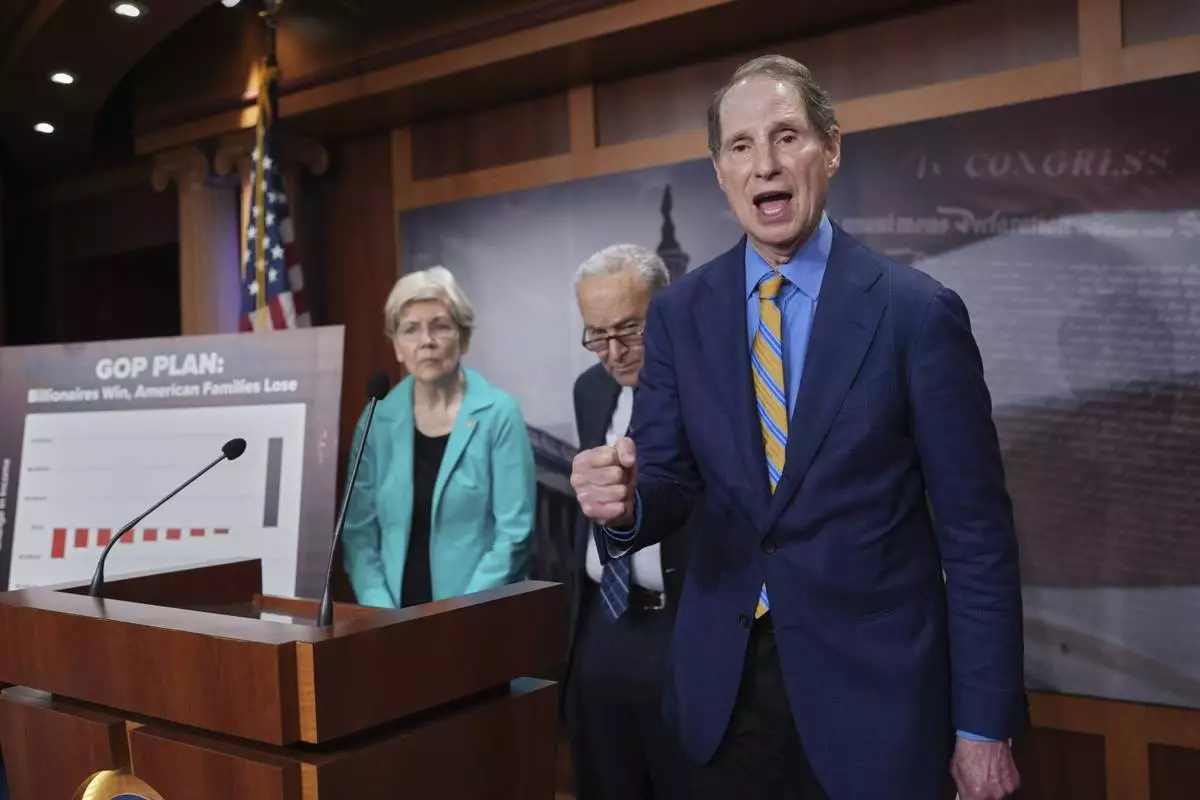
Sen. Ron Wyden, D-Ore., the ranking member of the Senate Finance Committee, is joined at left by Sen. Elizabeth Warren, D-Mass., ranking member of the Senate Banking, Housing, and Urban Affairs Committee, and Senate Minority Leader Chuck Schumer, D-N.Y., as they talk to reporters about Senate Republicans' efforts to pass President Donald Trump's tax cut and spending agenda with deeper Medicaid cuts, at the Capitol in Washington, Wednesday, June 18, 2025. (AP Photo/J. Scott Applewhite)

President Donald Trump gestures after arriving on Air Force One, Wednesday, June 25, 2025, at Joint Base Andrews, Md. (AP Photo/Alex Brandon)