Louisiana is the latest state to redefine natural gas as green energy under a new law the Republican governor signed this week, even though it's a fossil fuel that emits planet-warming greenhouse gases.
Three other states led by Republicans— Indiana, Ohio and Tennessee— have passed similar legislation. In some Democratic-led states, there have been efforts to phase out natural gas. New York and California cities like San Francisco and Berkeley have moved to ban natural gas hookups in new buildings, though some of these policies have been successfully challenged in court.
President Donald Trump has signed a spate of executive orders promoting oil, gas and coal, which all warm the planet when burned to produce electricity. The European Union previously designated natural gas and nuclear as sustainable, a move that Greenpeace and the Austrian government are suing over.
Louisiana Gov. Jeff Landry, a major booster of the state's petrochemical industry, says the new law “sets the tone for the future” and will help the state “pursue energy independence and dominance.”
Environmental groups say these new laws are part of a broader push by petrochemical industry-backed groups to rebrand fossil fuel as climate friendly and head off efforts to shift electric grids to renewables, such as solar and wind. It's "pure Orwellian greenwashing,” said Tim Donaghy, research director of Greenpeace USA.
Globally, the term green energy is used to refer to energy derived from natural sources that do not pollute — solar, wind, hydropower and geothermal energy. Louisiana's law could enable funds slated for state clean energy initiatives to be used to support natural gas.
Natural gas has been the top source of electricity generation in the United States for about a decade, since surpassing coal. Coal and natural gas both produce carbon dioxide that warms the planet when burned, but coal produces over twice as much.
Switching from coal to natural gas lowers carbon dioxide emissions, but it can increase emissions of methane. The primary component of natural gas, methane is an extraordinarily powerful greenhouse gas, more potent at trapping heat than carbon dioxide and responsible for about 30% of today’s global warming.
Besides coal, everything else is better than gas for the planet, said Rob Jackson, a Stanford University climate scientist. Building new gas plants locks in fossil fuel emissions for decades, he added.
Louisiana’s law orders state agencies and utilities regulators to “prioritize” natural gas, along with nuclear power, on the grounds that it will improve the affordability and reliability of the state's electricity.
The law’s author, Republican Rep. Jacob Landry, runs an oil and gas industry consulting firm.
“I don’t think it’s anything crippling to wind or solar, but you got to realize the wind don’t blow all the time and the sun don’t shine every day,” Landry said. The legislation “is saying we need to prioritize what keeps the grid energized,” he added.
Landry told The Associated Press that he used a model bill by the American Legislative Exchange Council as a template. ALEC is a conservative think tank with ties to the oil and gas industry’s billionaire Koch family.
ALEC helped shape Ohio’s 2023 law to legally redefine natural gas as a source of green energy, according to documents obtained by the watchdog group Energy and Policy Institute and first reported by the Washington Post.
ALEC spokesperson Lars Dalseide said that just because an Ohio lawmaker left the 2022 ALEC convention with what he described as a model for legislation to define natural gas as clean energy does not mean the group shaped Ohio law. Dalseide said the convention is “a place where legislators from across the country gather to exchange ideas.”
Ohio's legislation was also heavily influenced by an advocacy group led by Republican megadonor Tom Rastin, a now retired gas industry executive.
According to Dave Anderson, policy and communications manager for the Energy and Policy Institute, these laws are part of a long-running disinformation campaign by the gas industry to cast their product as clean to protect their businesses and prevent a shift to renewable energy sources that will address the climate crisis.
“The goal is to elbow out competition from renewables from wind and solar, and in some cases preempt localities' ability to choose to pursue 100% truly clean energy,” Anderson said, adding that ALEC's legislation makes natural gas “eligible for state and local clean energy standards and funding.”
Gov. Landry and other proponents of the new law said they want to make sure that residents and businesses have a reliable electric grid. Nearly 80% of Louisiana’s grid is already powered by natural gas.
Landry said that businesses will come to Louisiana if they know they can count on the state's electric grid. He highlighted Meta's plan to build a massive AI data center powered by three natural gas plants.
Louisiana’s law orders utilities providers to prioritize nuclear energy as well. Nuclear power does not emit greenhouse gases while producing electricity. However, critics say it is more expensive than solar and wind and the U.S. does not have a sufficient long-term solution for storing the waste.
Consumer advocates say states do not need to embrace natural gas at the expense of wind, solar and other technologies to have a reliable grid.
Legally mandating that utilities prioritize natural gas is “blind to innovation, market evolution, and the practical demands of modern electric systems,” Jeffrey Clark, president of the Advanced Power Alliance, a renewable energy advocacy group, wrote in a statement opposing Louisiana's law.
It's unclear to what extent Louisiana's utilities regulators will act on the order to prioritize natural gas over renewable energy. While Public Service Commissioner Davante Lewis, a Democrat, called the law “unenforceable” and pledged to ignore it, his Republican counterpart Jean-Paul Coussan said promoting natural gas “aligns well” with the state's economic growth.
McDermott reported from Providence, Rhode Island.
Brook is a corps member for The Associated Press/Report for America Statehouse News Initiative. Report for America is a nonprofit national service program that places journalists in local newsrooms to report on undercovered issues.
The Associated Press’ climate and environmental coverage receives financial support from multiple private foundations. AP is solely responsible for all content. Find AP’s standards for working with philanthropies, a list of supporters and funded coverage areas at AP.org.
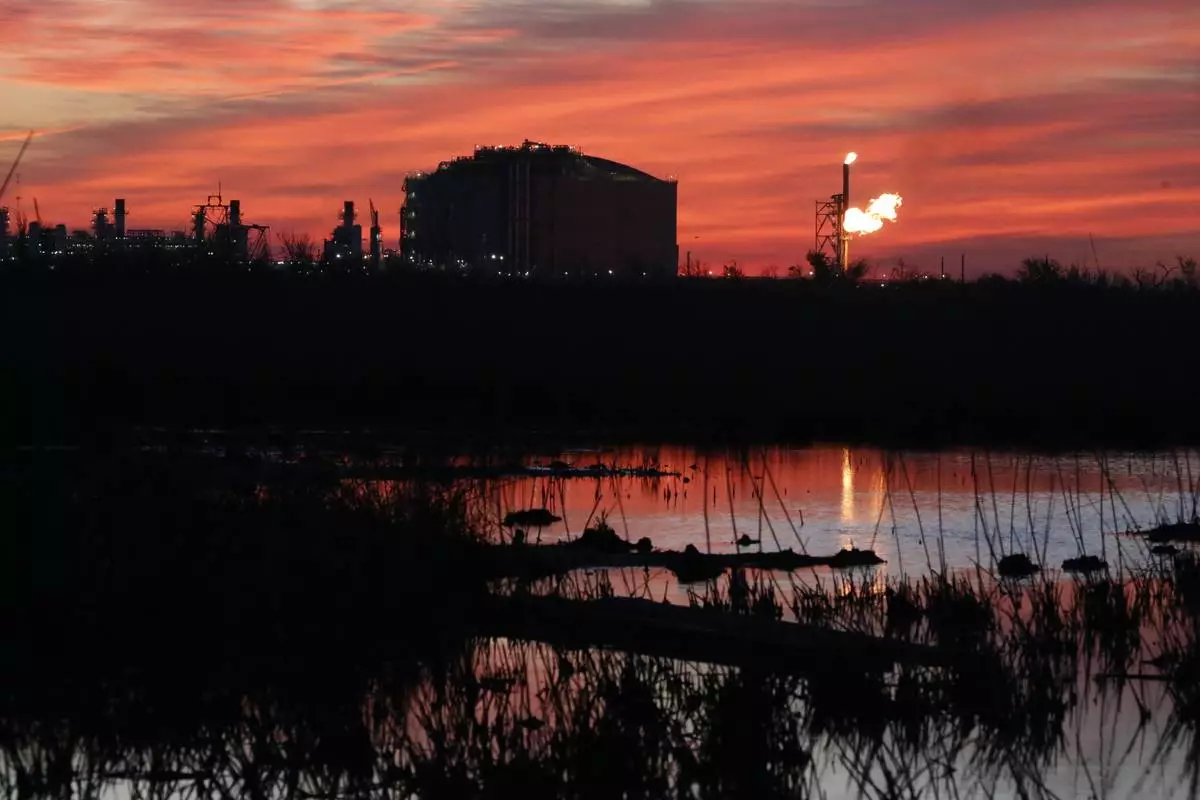
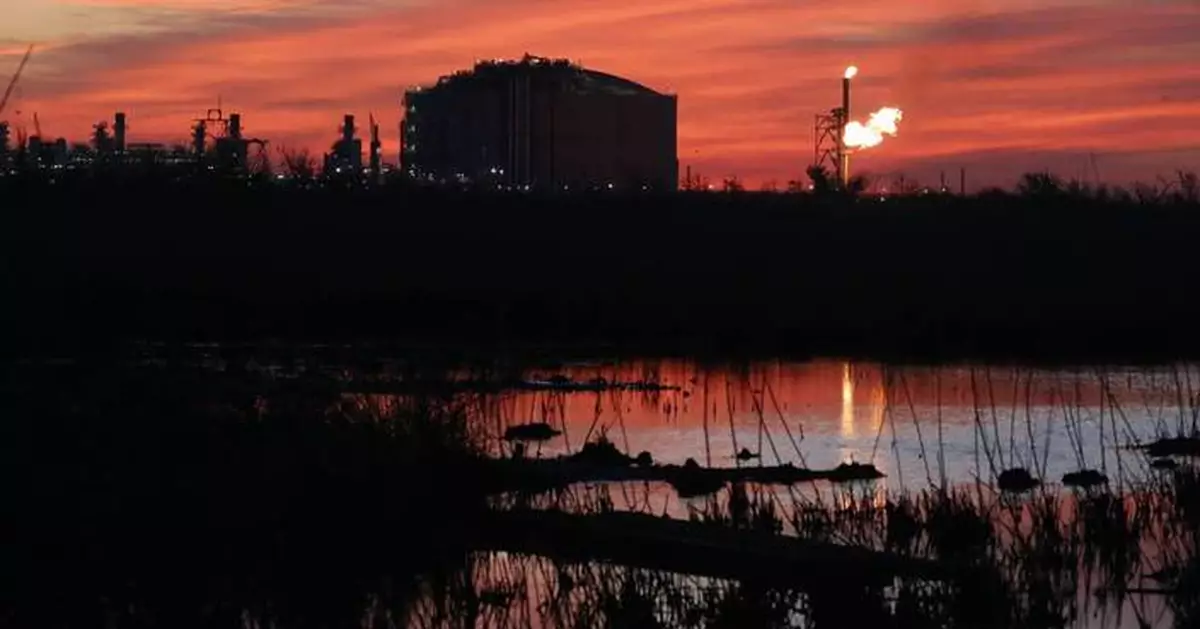
FILE - A flare burns at Venture Global LNG in Cameron, La., April 21, 2022. (AP Photo/Martha Irvine, File)
WASHINGTON (AP) — Becky Pepper-Jackson finished third in the discus throw in West Virginia last year though she was in just her first year of high school. Now a 15-year-old sophomore, Pepper-Jackson is aware that her upcoming season could be her last.
West Virginia has banned transgender girls like Pepper-Jackson from competing in girls and women's sports, and is among the more than two dozen states with similar laws. Though the West Virginia law has been blocked by lower courts, the outcome could be different at the conservative-dominated Supreme Court, which has allowed multiple restrictions on transgender people to be enforced in the past year.
The justices are hearing arguments Tuesday in two cases over whether the sports bans violate the Constitution or the landmark federal law known as Title IX that prohibits sex discrimination in education. The second case comes from Idaho, where college student Lindsay Hecox challenged that state's law.
Decisions are expected by early summer.
President Donald Trump's Republican administration has targeted transgender Americans from the first day of his second term, including ousting transgender people from the military and declaring that gender is immutable and determined at birth.
Pepper-Jackson has become the face of the nationwide battle over the participation of transgender girls in athletics that has played out at both the state and federal levels as Republicans have leveraged the issue as a fight for athletic fairness for women and girls.
“I think it’s something that needs to be done,” Pepper-Jackson said in an interview with The Associated Press that was conducted over Zoom. “It’s something I’m here to do because ... this is important to me. I know it’s important to other people. So, like, I’m here for it.”
She sat alongside her mother, Heather Jackson, on a sofa in their home just outside Bridgeport, a rural West Virginia community about 40 miles southwest of Morgantown, to talk about a legal fight that began when she was a middle schooler who finished near the back of the pack in cross-country races.
Pepper-Jackson has grown into a competitive discus and shot put thrower. In addition to the bronze medal in the discus, she finished eighth among shot putters.
She attributes her success to hard work, practicing at school and in her backyard, and lifting weights. Pepper-Jackson has been taking puberty-blocking medication and has publicly identified as a girl since she was in the third grade, though the Supreme Court's decision in June upholding state bans on gender-affirming medical treatment for minors has forced her to go out of state for care.
Her very improvement as an athlete has been cited as a reason she should not be allowed to compete against girls.
“There are immutable physical and biological characteristic differences between men and women that make men bigger, stronger, and faster than women. And if we allow biological males to play sports against biological females, those differences will erode the ability and the places for women in these sports which we have fought so hard for over the last 50 years,” West Virginia's attorney general, JB McCuskey, said in an AP interview. McCuskey said he is not aware of any other transgender athlete in the state who has competed or is trying to compete in girls or women’s sports.
Despite the small numbers of transgender athletes, the issue has taken on outsize importance. The NCAA and the U.S. Olympic and Paralympic Committees banned transgender women from women's sports after Trump signed an executive order aimed at barring their participation.
The public generally is supportive of the limits. An Associated Press-NORC Center for Public Affairs Research poll conducted in October 2025 found that about 6 in 10 U.S. adults “strongly” or “somewhat” favored requiring transgender children and teenagers to only compete on sports teams that match the sex they were assigned at birth, not the gender they identify with, while about 2 in 10 were “strongly” or “somewhat” opposed and about one-quarter did not have an opinion.
About 2.1 million adults, or 0.8%, and 724,000 people age 13 to 17, or 3.3%, identify as transgender in the U.S., according to the Williams Institute at the UCLA School of Law.
Those allied with the administration on the issue paint it in broader terms than just sports, pointing to state laws, Trump administration policies and court rulings against transgender people.
"I think there are cultural, political, legal headwinds all supporting this notion that it’s just a lie that a man can be a woman," said John Bursch, a lawyer with the conservative Christian law firm Alliance Defending Freedom that has led the legal campaign against transgender people. “And if we want a society that respects women and girls, then we need to come to terms with that truth. And the sooner that we do that, the better it will be for women everywhere, whether that be in high school sports teams, high school locker rooms and showers, abused women’s shelters, women’s prisons.”
But Heather Jackson offered different terms to describe the effort to keep her daughter off West Virginia's playing fields.
“Hatred. It’s nothing but hatred,” she said. "This community is the community du jour. We have a long history of isolating marginalized parts of the community.”
Pepper-Jackson has seen some of the uglier side of the debate on display, including when a competitor wore a T-shirt at the championship meet that said, “Men Don't Belong in Women's Sports.”
“I wish these people would educate themselves. Just so they would know that I’m just there to have a good time. That’s it. But it just, it hurts sometimes, like, it gets to me sometimes, but I try to brush it off,” she said.
One schoolmate, identified as A.C. in court papers, said Pepper-Jackson has herself used graphic language in sexually bullying her teammates.
Asked whether she said any of what is alleged, Pepper-Jackson said, “I did not. And the school ruled that there was no evidence to prove that it was true.”
The legal fight will turn on whether the Constitution's equal protection clause or the Title IX anti-discrimination law protects transgender people.
The court ruled in 2020 that workplace discrimination against transgender people is sex discrimination, but refused to extend the logic of that decision to the case over health care for transgender minors.
The court has been deluged by dueling legal briefs from Republican- and Democratic-led states, members of Congress, athletes, doctors, scientists and scholars.
The outcome also could influence separate legal efforts seeking to bar transgender athletes in states that have continued to allow them to compete.
If Pepper-Jackson is forced to stop competing, she said she will still be able to lift weights and continue playing trumpet in the school concert and jazz bands.
“It will hurt a lot, and I know it will, but that’s what I’ll have to do,” she said.
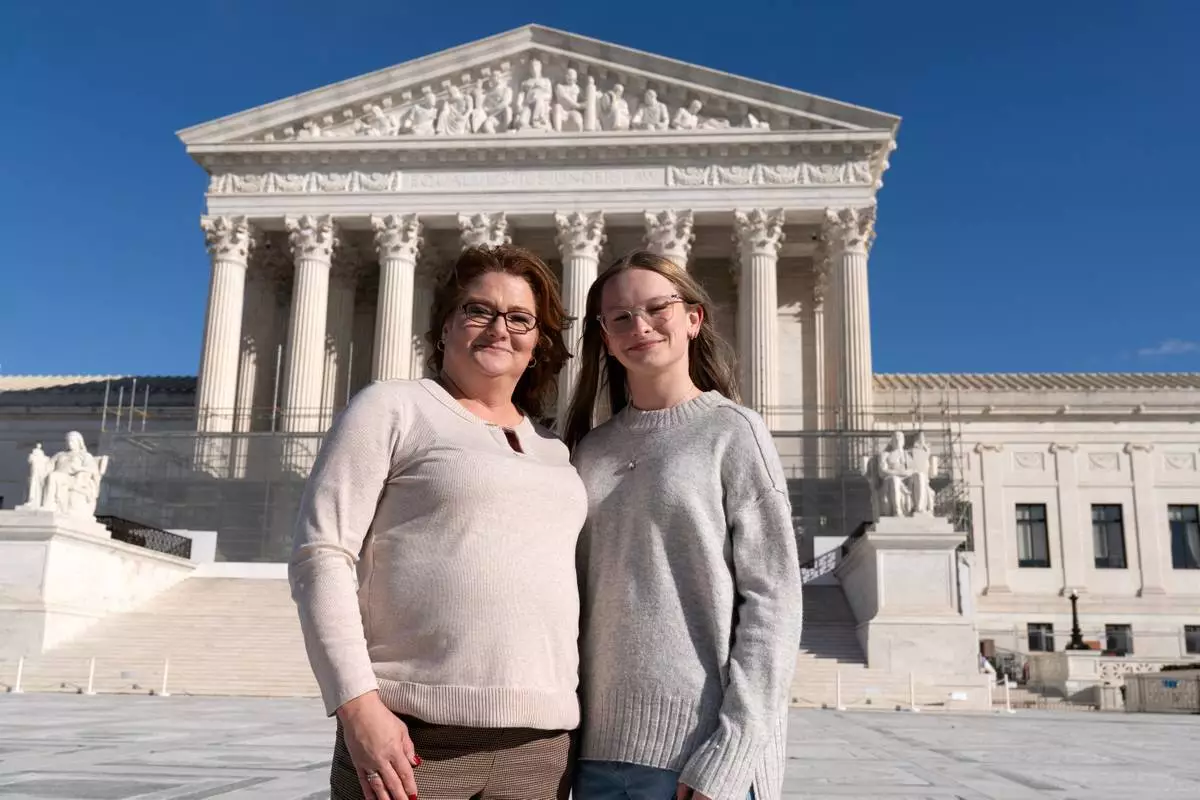
Heather Jackson, left, and Becky Pepper-Jackson pose for a photograph outside of the U.S. Supreme Court in Washington, Sunday, Jan. 11, 2026. (AP Photo/Jose Luis Magana)
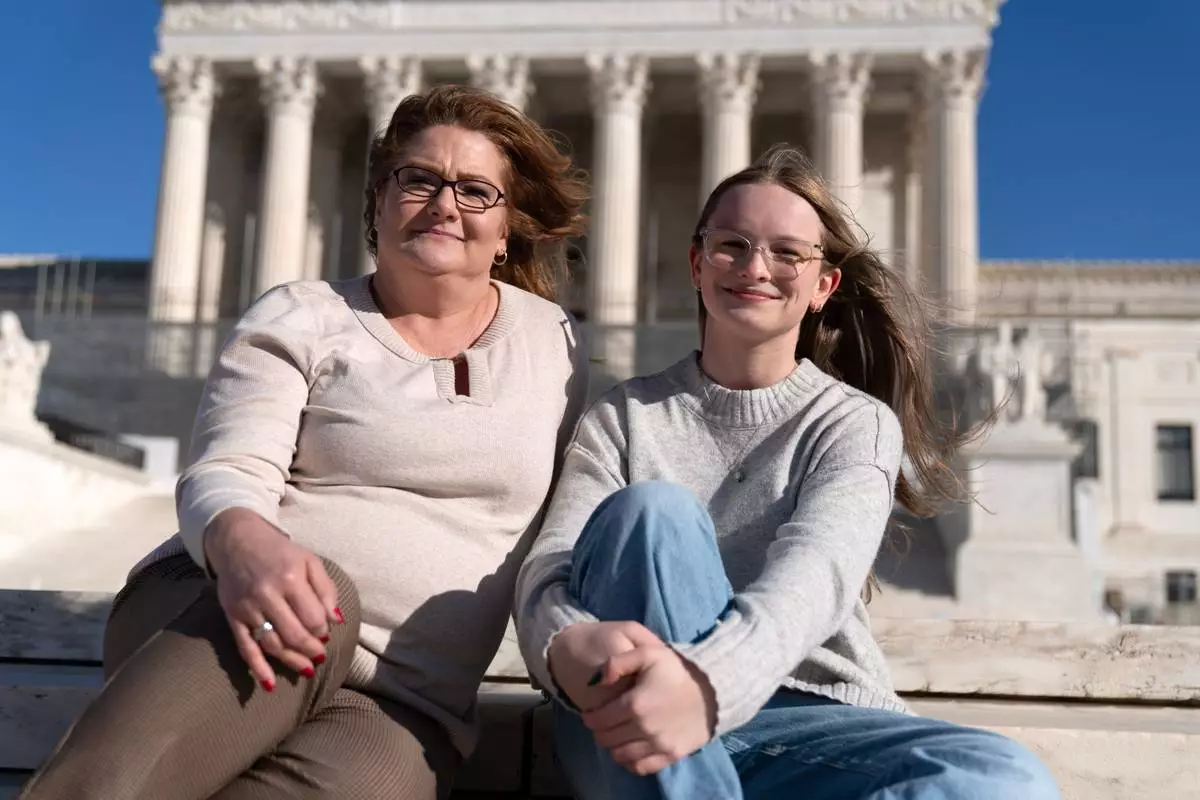
Heather Jackson, left, and Becky Pepper-Jackson pose for a photograph outside of the U.S. Supreme Court in Washington, Sunday, Jan. 11, 2026. (AP Photo/Jose Luis Magana)

Becky Pepper-Jackson poses for a photograph outside of the U.S. Supreme Court in Washington, Sunday, Jan. 11, 2026. (AP Photo/Jose Luis Magana)
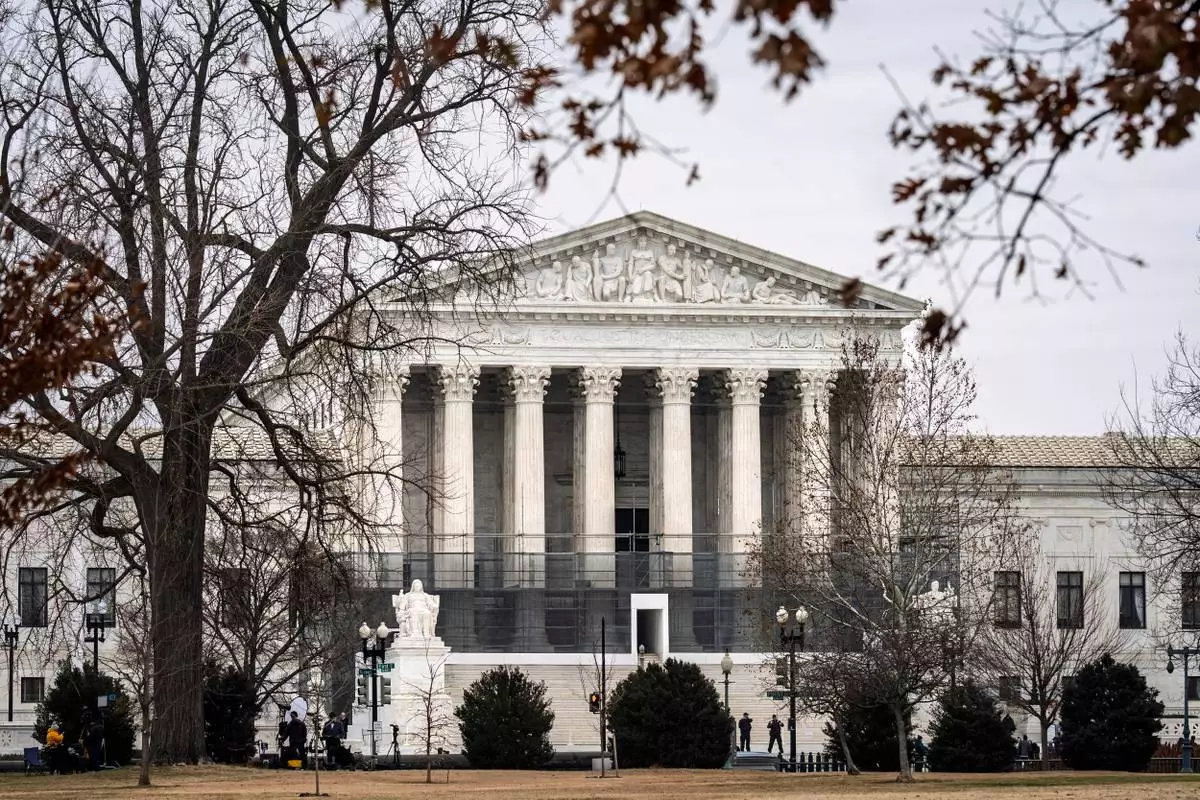
The Supreme Court stands is Washington, Friday, Jan. 9, 2026. (AP Photo/J. Scott Applewhite)
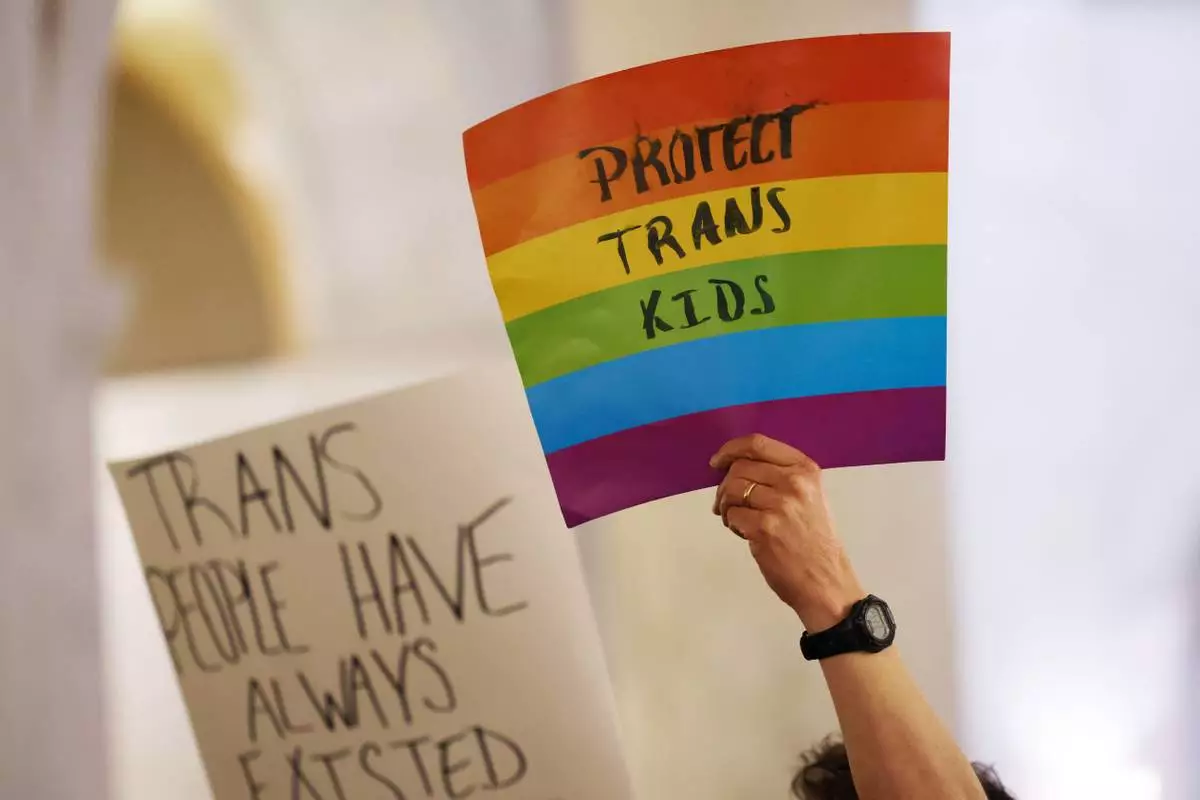
FILE - Protestors hold signs during a rally at the state capitol in Charleston, W.Va., on March 9, 2023. (AP Photo/Chris Jackson, file)