ANAHEIM, Calif. (AP) — Los Angeles Angels manager Ron Washington will miss the rest of the season because of an unspecified medical issue, the team said Friday.
Washington, the oldest manager in the major leagues at 73, has been sidelined for the past week.
He experienced shortness of breath and appeared fatigued toward the end of a four-game series at the New York Yankees that ended on June 19. Washington flew back to Southern California, underwent a series of tests and was placed on medical leave.
Angels bench coach Ray Montgomery, who has filled in for Washington for the past week, was named interim manager. Infield coach Ryan Goins was promoted to bench coach.
Washington is 664-611 in 10 seasons as a major league manager, eight with Texas and two with Los Angeles.
He led the Rangers to back-to-back World Series appearances in 2010 and 2011 before stepping down abruptly in September 2014. Washington returned to the sport as a coach with the Athletics and the Atlanta Braves, who won the World Series in 2021, before landing a second managerial job in Orange County.
The Angels were 40-40 entering Friday night's game against the visiting Washington Nationals, winning three straight under Montgomery and seven of 10 overall. Los Angeles has played better than most expected from a team with major league-worst streaks of nine straight losing seasons and 10 straight non-playoff seasons.
The 55-year-old Montgomery is getting his first job as a major league manager. The native of New York's Westchester County is a former Houston Astros outfielder who served as the scouting director for Arizona and Milwaukee before joining the Angels as their director of player personnel for the 2020 season.
Montgomery became Los Angeles' bench coach in 2021 after general manager Perry Minasian took over the front office, and he stayed with the Angels while Joe Maddon, Phil Nevin and Washington managed the club.
Goins played eight seasons in the major leagues before Washington hired him as the Angels' infield coach before the 2024 season.
AP MLB: https://apnews.com/hub/mlb

Los Angeles Angels manager Ron Washington looks on from the dugout during a baseball game against the Baltimore Orioles in Baltimore, Saturday, June 14, 2025. (AP Photo/Terrance Williams)
SEOUL, South Korea (AP) — Ahn Sung-ki, one of South Korean cinema’s biggest stars whose prolific 60-year career and positive, gentle public image earned him the nickname “The Nation’s Actor,” died Monday. He was 74.
Ahn, who had suffered blood cancer for years, was pronounced dead at Seoul's Soonchunhyang University Hospital, his agency, the Artist Company, and hospital officials said.
“We feel deep sorrow at the sudden, sad news, pray for the eternal rest of the deceased and offer our heartfelt condolences to his bereaved family members," the Artist Company said in a statement.
President Lee Jae Myung issued a condolence message saying Ahn provided many people with comfort, joy and time for reflection. “I already miss his warm smile and gentle voice,” Lee wrote on Facebook.
Born to a filmmaker in the southeastern city of Daegu in 1952, Ahn made his debut as a child actor in the movie “The Twilight Train” in 1957. He subsequently appeared in about 70 movies as a child actor before he left the film industry to live an ordinary life.
In 1970, Ahn entered Seoul’s Hankuk University of Foreign Studies as a Vietnamese major. Ahn said he graduated with top honors but failed to land jobs at big companies, who likely saw his Vietnamese major largely useless after a communist victory in the Vietnam War in 1975.
Ahn returned to the film industry in 1977 believing he could still excel in acting. In 1980, he rose to fame for his lead role in Lee Jang-ho’s “Good, Windy Days,” a hit coming-of-age movie about the struggle of working-class men from rural areas during the country’s rapid rise. Ahn won the best new actor award in the prestigious Grand Bell Awards, the Korean version of the Academy Awards.
He later starred in a series of highly successful and critically acclaimed movies, sweeping best actor awards and becoming arguably the country’s most popular actor in much of the 1980-90s.
Some of his memorable roles included a Buddhist monk in 1981’s “Mandara,” a beggar in 1984’s “Whale Hunting,” a Vietnam War veteran-turned-novelist in 1992’s “White Badge,” a corrupt police officer in 1993’s “Two Cops,” a murderer in 1999’s “No Where To Hide,” a special forces trainer in 2003’s “Silmido” and a devoted celebrity manager in 2006’s “Radio Star.”
Ahn had collected dozens of trophies in major movie awards in South Korea, including winning the Grand Bell Awards for best actor five times, an achievement no other South Korean actors have matched yet.
Ahn built up an image as a humble, trustworthy and family-oriented celebrity who avoided major scandals and maintained a quiet, stable personal life. Past public surveys chose Ahn as South Korea’s most beloved actor and deserving of the nickname “The Nation’s Actor.”
Ahn said he earlier felt confined with his “The Nation's Actor” labeling but eventually thought that led him down the right path. In recent years, local media has given other stars similar honorable nicknames, but Ahn was apparently the first South Korean actor who was dubbed “The Nation's Actor.”
“I felt I should do something that could match that title. But I think that has eventually guided me on a good direction,” Ahn said in an interview with Yonhap news agency in 2023.
In media interviews, Ahn couldn’t choose what his favorite movie was, but said that his role as a dedicated, hardworking manger for a washed-up rock singer played by Park Jung-hoon resembled himself in real life the most.
Ahn was also known for his reluctance to do love scenes. He said said he was too shy to act romantic scenes and sometimes asked directors to skip steamy scenes if they were only meant to add spice to movies.
“I don’t do well on acting like looking at someone who I don’t love with loving eyes and kissing really romantically. I feel shy and can’t express such emotions well,” Ahn said in an interview with the Shindonga magazine in 2007. “Simply, I’m clumsy on that. So I couldn’t star in such movies a lot. But ultimately, that was a right choice for me.”
Ahn is survived by his wife and their two sons. A mourning station at a Seoul hospital was to run until Friday.
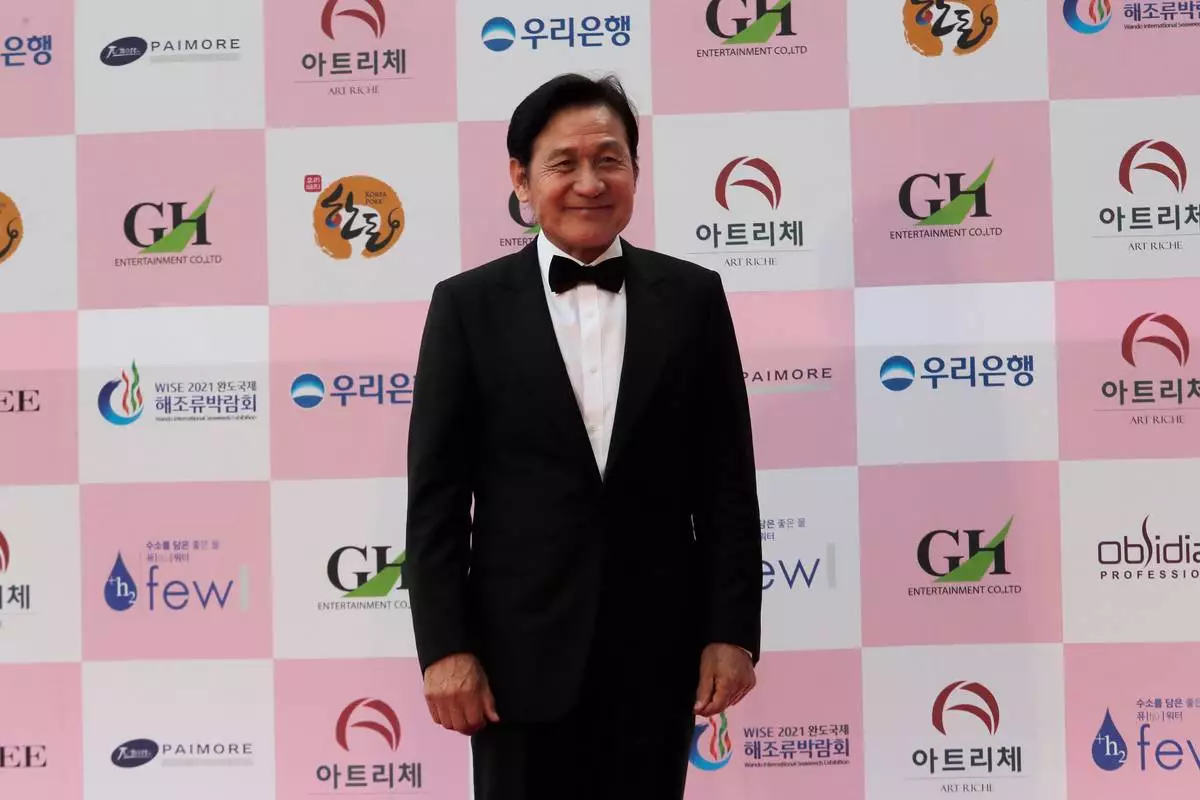
FILE - South Korean actor Ahn Sung-ki smiles for a photo on the red carpet at the 56th Daejong Film Awards ceremony in Seoul, South Korea, June 3, 2020. (AP Photo/Ahn Young-joon, File)

FILE - South Korean actor Ahn Sung-ki attends an event as part of the 11th Pusan International Film Festival in Busan, South Korea, Oct. 13, 2006. (AP Photo/Kin Cheung, File)