Skip to Content Facebook Feature Image

What to know about the US Supreme Court's ruling on public school lessons using LGBTQ books

News

What to know about the US Supreme Court's ruling on public school lessons using LGBTQ books
News

News

What to know about the US Supreme Court's ruling on public school lessons using LGBTQ books

2025-06-28 12:21 Last Updated At:12:30

A divided U.S. Supreme Court has sided with religious parents who want to pull their children out of the classroom when a public school lesson uses LGBTQ-themed storybooks.

The 6-3 decision Friday in a case brought by parents in Maryland comes as certain books are increasingly being banned from public schools and libraries.

In Justice Samuel Alito's majority opinion — joined by the rest of the court's conservatives — he wrote that the lack of an “opt-out” for parents places an unconstitutional burden on their rights to religious freedom.

Justice Sonia Sotomayor wrote in dissent for the three liberal justices that public schools expose children to different views in a multicultural society.

“That experience is critical to our Nation's civic vitality,” she wrote. “Yet it will become a mere memory if children must be insulated from exposure to ideas and concepts that may conflict with their parents’ religious beliefs."

Here's what to know about the case and its potential impacts:

The decision was not a final ruling in the case. It reversed lower-court rulings that sided with the Montgomery County school system, which introduced the storybooks in 2022 as part of an effort to better reflect the district’s diversity.

At first, the school district allowed parents to opt their children out of the lessons for religious and other reasons, but the district later reversed course, saying it became disruptive. The move prompted protests and eventually a lawsuit.

Now, the case goes back to the lower court to be reevaluated under the Supreme Court ’s new guidance. But the justices strongly suggested that the parents will win in the end.

The court ruled that policies like the one at issue in this case are subjected to the strictest level of review, nearly always dooming them.

Jessica Levinson, a law professor at Loyola Law School in Los Angeles, said the court's ruling could inspire similar lawsuits in other states.

“I think any school district that reads similar books to their children is now subject to suit by parents who don't want their kids to hear these books because it substantially interferes with their religious beliefs," she said.

Whether it could open the door to broader legal challenges remains to be seen.

Levinson said the majority opinion's emphasis on the content of the books at the center of the case, including “Uncle Bobby’s Wedding,” a story about a two men getting married, could narrow its impact.

“The question that people will ask," Levinson said, “is if this could now allow parents to say, ‘We don’t want our kids to learn about certain aspects of American history.’ ”

Adam Zimmerman, who has two kids in school in Montgomery County, Maryland, called the ruling abhorrent.

“We need to call out what’s being dressed up as religious faith and values and expose it for the intolerance that it really is,” he said.

Zimmerman has lived in Montgomery County for 16 years and wanted to raise his son and daughter there, in large part, because of the school district's diversity. It was important to him, he said, that his kids be exposed to people from all walks of life.

“It's a beautiful thing, and this ruling just spits on that diversity," he said.

Other rights groups described the court's decision as harmful and dangerous.

"No matter what the Supreme Court has said, and what extremist groups are advocating for, book bans and other censorship will not erase LGBTQIA+ people from our communities,” said Fatima Goss Graves, CEO and president of the National Women's Law Center.

Republican U.S. Sen. Bill Cassidy of Louisiana, who was part of an amicus brief filed in the case in support of the Maryland parents, called the ruling a “win for families.”

"Students should not be forced to learn about gender and sexuality subject matter that violates their family’s religious beliefs,” he said.

Lawyer Eric Baxter, who represented the parents at the Supreme Court, also called the decision a “historic victory for parental rights.”

“Kids shouldn’t be forced into conversations about drag queens, pride parades, or gender transitions without their parents’ permission,” Baxter said.

PEN America, a group advocating for free expression, said the court's decision could open the door to censorship and discrimination in classrooms.

“In practice, opt outs for religious objections will chill what is taught in schools and usher in a more narrow orthodoxy as fear of offending any ideology or sensibility takes hold,” said Elly Brinkley, a staff attorney at PEN America.

In a joint statement Friday, some of the authors and illustrators of the books in question described the ruling as a threat to First Amendment rights to free speech, as well as diversity in schools.

“To treat children’s books about LGBTQ+ characters differently than similar books about non-LGBTQ+ characters is discriminatory and harmful,” the statement said.
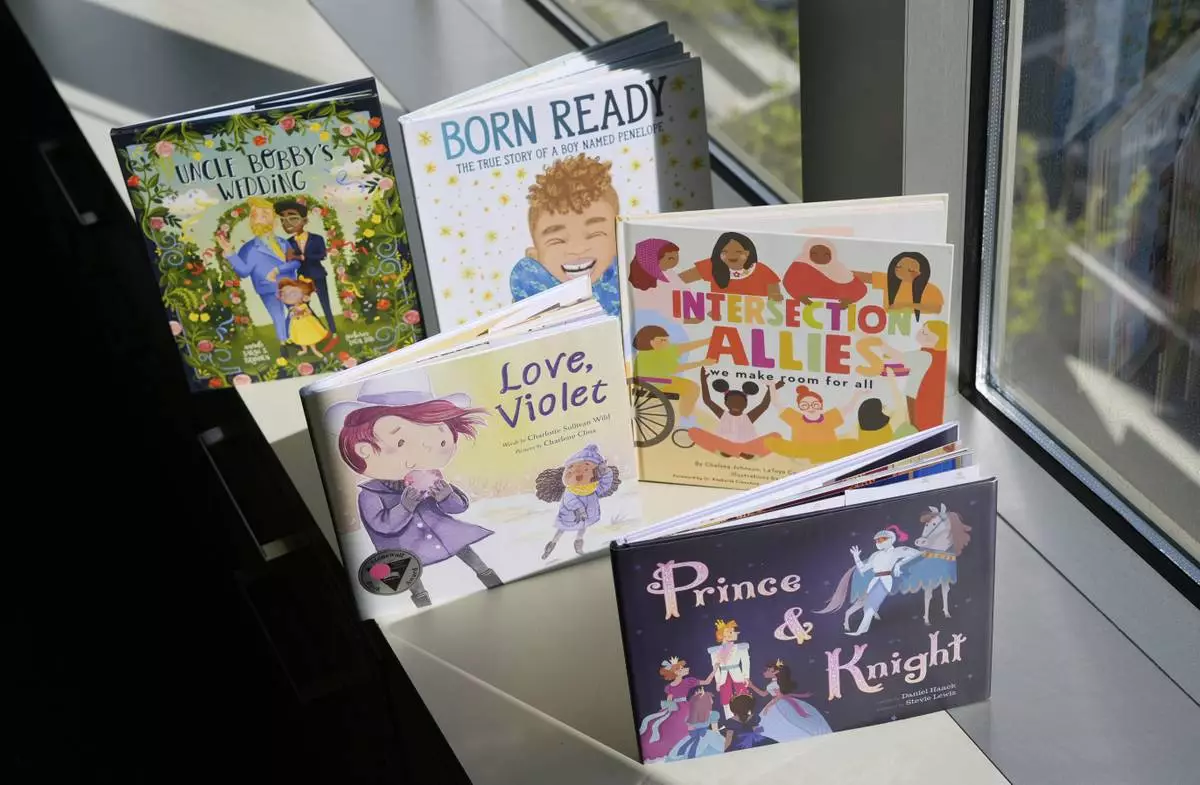
FILE - A selection of books featuring LGBTQ characters that are part of a Supreme Court case are pictured, April, 15, 2025, in Washington. (AP Photo/Pablo Martinez Monsivais, File)
FILE - A selection of books featuring LGBTQ characters that are part of a Supreme Court case are pictured, April, 15, 2025, in Washington. (AP Photo/Pablo Martinez Monsivais, File)
DUBAI, United Arab Emirates (AP) — U.S. President Donald Trump and top Iranian officials exchanged dueling threats Friday as widening economic protests swept across parts of the Islamic Republic, further escalating tensions between the countries after America bombed Iranian nuclear sites in June.

Trump initially wrote on his Truth Social platform, warning Iran that if it “violently kills peaceful protesters,” the United States “will come to their rescue.” At least seven people have been killed so far in violence surrounding the demonstrations, sparked in part by the collapse of Iran's rial currency.

“We are locked and loaded and ready to go,” Trump wrote, without elaborating.

Shortly after, Ali Larijani, a former parliament speaker who serves as the secretary of Iran’s Supreme National Security Council, alleged on the social platform X that Israel and the U.S. were stoking the demonstrations. He offered no evidence to support the allegation, which Iranian officials have repeatedly made during years of protests sweeping the country.

“Trump should know that intervention by the U.S. in the domestic problem corresponds to chaos in the entire region and the destruction of the U.S. interests,” Larijani wrote on X, which the Iranian government blocks. “The people of the U.S. should know that Trump began the adventurism. They should take care of their own soldiers.”

Larijani’s remarks likely referenced America’s wide military footprint in the region. Iran in June attacked Al Udeid Air Base in Qatar after the U.S. strikes on three nuclear sites during Israel's 12-day war on the Islamic Republic.

Ali Shamkhani, an adviser to Supreme Leader Ayatollah Ali Khamenei who previously was the council's secretary for years, warned that “any interventionist hand that gets too close to the security of Iran will be cut.”

“The people of Iran properly know the experience of ‘being rescued’ by Americans: from Iraq and Afghanistan to Gaza,” he added on X.

The current protests, now in their sixth day, have become the biggest in Iran since 2022, when the death of 22-year-old Mahsa Amini in police custody triggered nationwide demonstrations. However, the demonstrations have yet to be countrywide and have not been as intense as those surrounding the death of Amini, who was detained over not wearing her hijab, or headscarf, to the liking of authorities.

Iran’s civilian government under reformist President Masoud Pezeshkian has been trying to signal it wants to negotiate with protesters. However, Pezeshkian has acknowledged there is not much he can do as Iran’s rial has rapidly depreciated, with $1 now costing some 1.4 million rials. That sparked the initial protests.

The protests, taking root in economic issues, have heard demonstrators chant against Iran’s theocracy as well.

Months after the war, Iran said it was no longer enriching uranium at any site in the country, trying to signal to the West that it remains open to potential negotiations over its atomic program to ease sanctions. However, those talks have yet to happen as Trump and Israeli Prime Minister Benjamin Netanyahu have warned Tehran against reconstituting its atomic program.

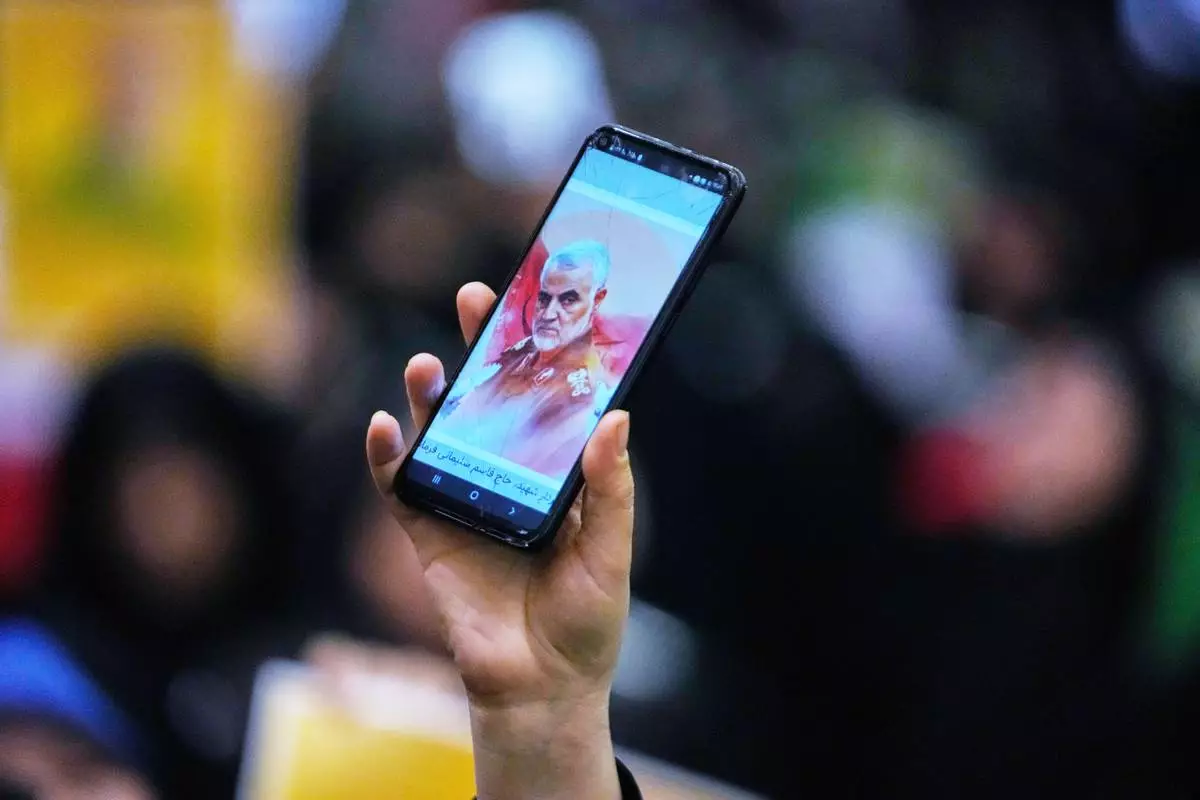
A woman shows a portrait of the late commander of Iran's Revolutionary Guard expeditionary Quds Force, Gen. Qassem Soleimani, who was killed in a U.S. drone attack in 2020 in Iraq, on her smartphone during a ceremony commemorating his death anniversary at the Imam Khomeini grand mosque in Tehran, Iran, Thursday, Jan. 1, 2026. (AP Photo/Vahid Salemi)

A woman shows a portrait of the late commander of Iran's Revolutionary Guard expeditionary Quds Force, Gen. Qassem Soleimani, who was killed in a U.S. drone attack in 2020 in Iraq, on her smartphone during a ceremony commemorating his death anniversary at the Imam Khomeini grand mosque in Tehran, Iran, Thursday, Jan. 1, 2026. (AP Photo/Vahid Salemi)

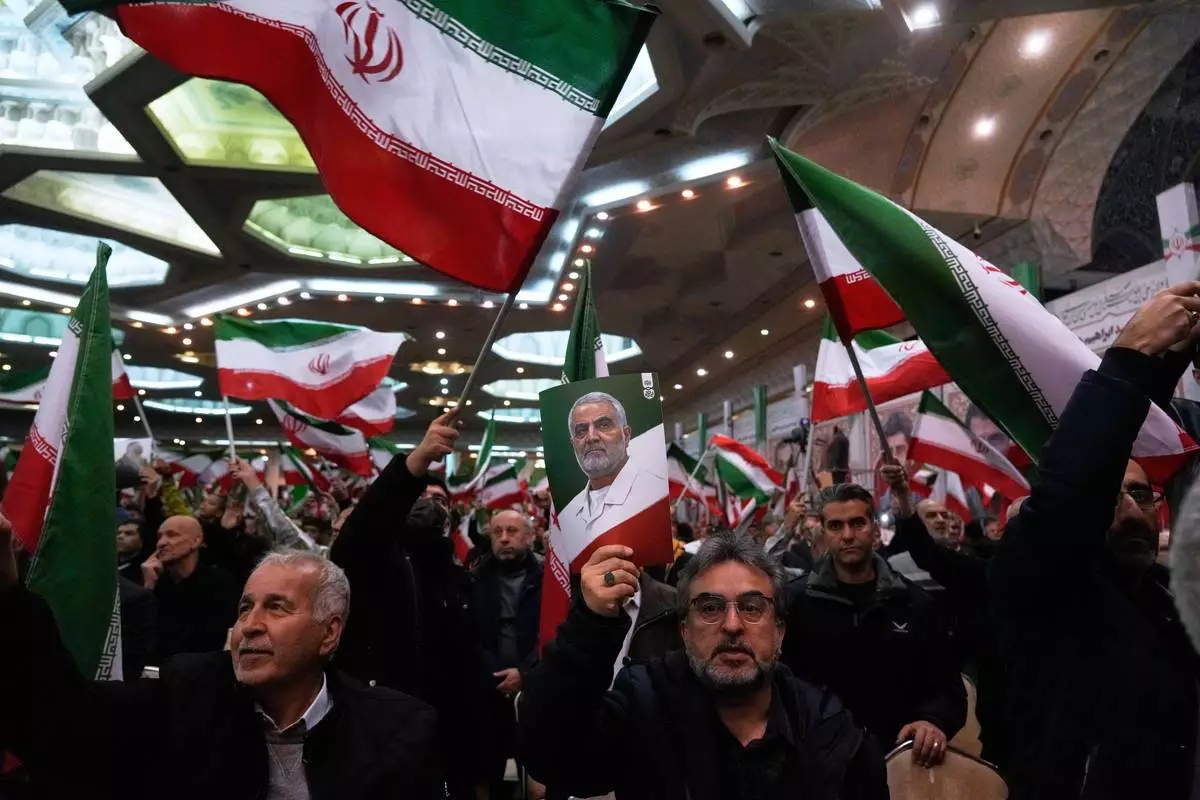
People wave Iranian flags as one of them holds up a poster of the late commander of the Iran's Revolutionary Guard expeditionary Quds Force, Gen. Qassem Soleimani, who was killed in a U.S. drone attack in 2020 in Iraq, during a ceremony commemorating his death anniversary at the Imam Khomeini grand mosque in Tehran, Iran, Thursday, Jan. 1, 2026. (AP Photo/Vahid Salemi)

People wave Iranian flags as one of them holds up a poster of the late commander of the Iran's Revolutionary Guard expeditionary Quds Force, Gen. Qassem Soleimani, who was killed in a U.S. drone attack in 2020 in Iraq, during a ceremony commemorating his death anniversary at the Imam Khomeini grand mosque in Tehran, Iran, Thursday, Jan. 1, 2026. (AP Photo/Vahid Salemi)

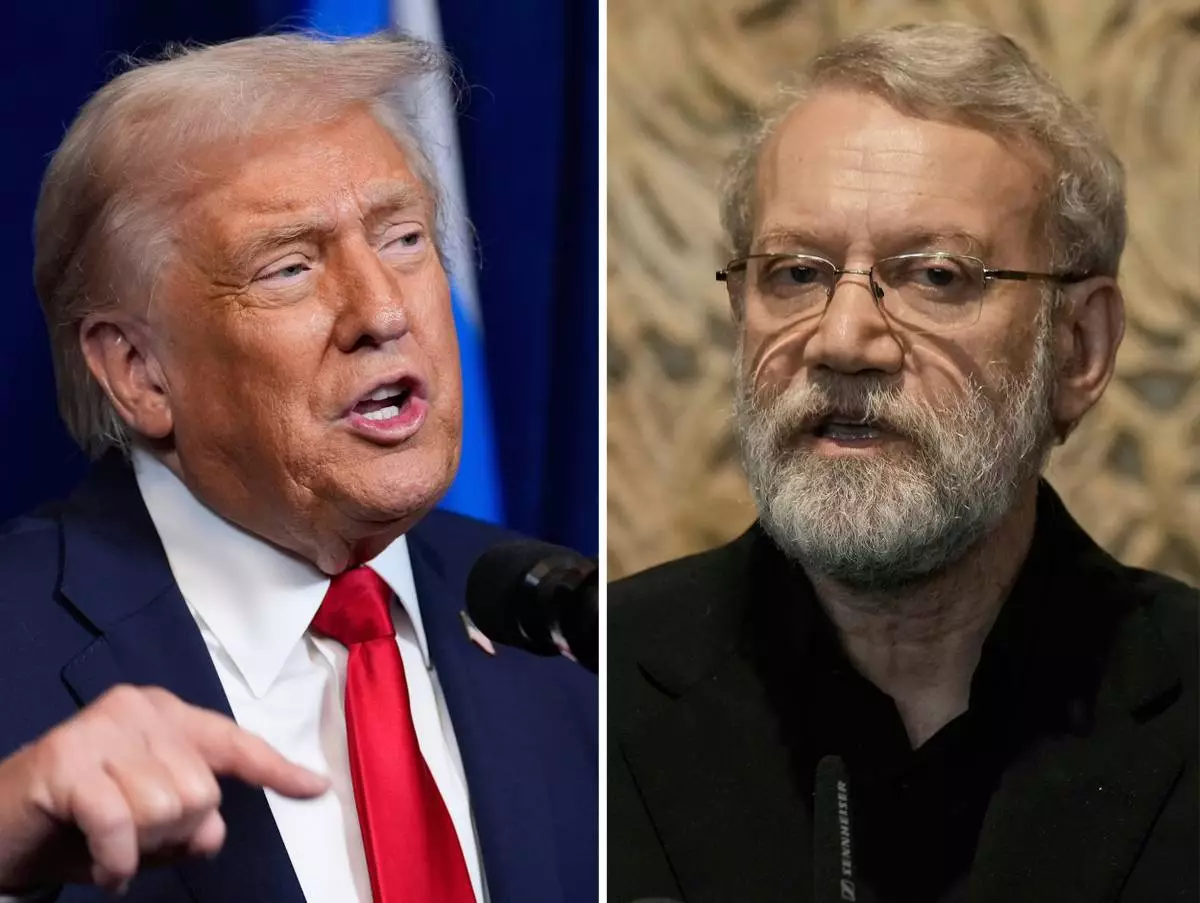
This combo shows President Donald Trump at Mar-a-Lago, Monday, Dec. 29, 2025, in Palm Beach, Fla. and Iranian Secretary of Supreme National Security Council Ali Larijani in Beirut, Lebanon, Wednesday, Aug. 13, 2025. (AP Photo/Alex Brandon, Bilal Hussein)

This combo shows President Donald Trump at Mar-a-Lago, Monday, Dec. 29, 2025, in Palm Beach, Fla. and Iranian Secretary of Supreme National Security Council Ali Larijani in Beirut, Lebanon, Wednesday, Aug. 13, 2025. (AP Photo/Alex Brandon, Bilal Hussein)

Recommended Articles