Shopping malls in China's economic hub of Shanghai are pioneering a new trend -- blending live performances with dining and retail to create immersive experiences for consumers, particularly those of the younger generation -- to boost spending.
As young consumers increasingly seek diverse cultural and entertainment experiences, watching performances in shopping malls has become an emerging trend in Shanghai.
More performance spaces are integrating into commercial districts, offering immersive cultural experiences while driving economic vitality through the deep-going fusion of culture and commerce.
In Shanghai, catching a show at a mall is in vogue.
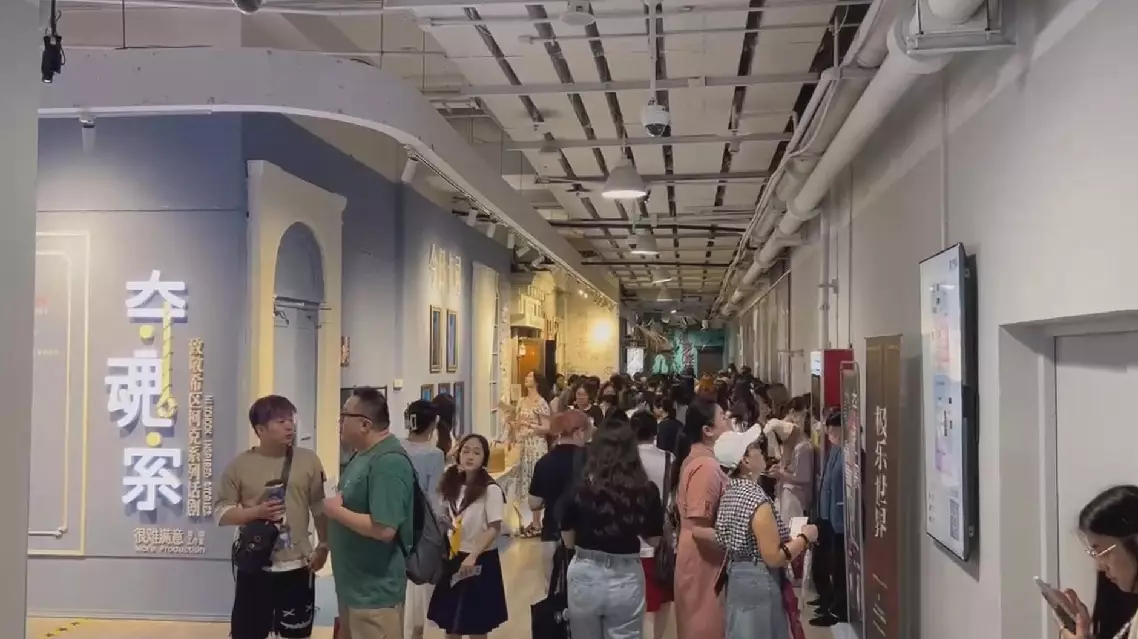
On the seventh floor of a prime-location mall along the Nanjing Road, a 5,000-square-meter space has been transformed into more than ten performance venues, hosting rotating music dramas, stand-up comedy, and more.
After watching shows, young audience members would grab coffee, dine, and discuss the performance, creating a consumption model that energizes the entire district.
This one-stop experience is heating up the local economy, turning malls from mere shopping hubs into multifaceted urban lifestyle destinations blending culture, entertainment and retail.
Mall managers reveal plans to further activate rooftop spaces with cultural markets, fan meet-ups, and nightlife dining, amplifying the cluster effect of cultural offerings.
"We now have 23 performance venues spanning nearly 10,000 square meters, featuring talk shows, immersive music dramas, modern dramas and stand-up comedy. We have received a total of more than 300,000 audience members and hosted more than 5,000 shows, merging watching shows in theaters with dining, entertainment, and leisure into a single complex and forming joint operation of a variety of business formats," said Zhang Yuan, manager of a mall on the Nanjing Road.
In Xuhui's West Bund commercial district, a multi-layered cultural matrix thrives.
Grand theaters host world-class productions, while intimate interactive stages and live music spaces draw crowds with flexible formats and high-frequency events.
After watching the performances, audience members would extend their stay with dining and shopping, fueling nighttime consumption.
"We want to leverage the entire mall's foot traffic, because the entire audience group of the cultural performance industry is mainly young consumers. Actually, this group has a lot in common with our mall's customer base. Across our entire block, throughout the designed plots, the consumption options are increasing. After they come here, besides watching performances and dining, they can also gather with friends, which offers a pretty good experience in a day," said Du Yifei, manager of a performance venue at Xuhui West Bund commercial district.
Shanghai's commercial districts boost consumption with emerging scenarios