A long-lost World War II documentary, which won an Oscar in 1942, has been restored and was screened in Los Angeles on June 24, offering a rare glimpse into China's resistance against Japanese invasion and a reminder of the wartime bond that existed between China and the United States.
Filmed in the late 1930s by U.S. war correspondent Rey Scott and funded by Chinese-American playwright Li Ling-Ai, "Kukan" was the first color documentary produced by U.S. nationals to chronicle China's wartime resistance.
In the summer of 1937, after hearing radio reports of Japan's bombings in China, Li Ling-Ai arranged for Scott to travel to China to document the war. With a 16-millimeter color camera, Scott filmed across Chongqing, Guizhou, Lanzhou and other regions, capturing the realities of China's resistance -- most notably, the relentless bombing of Chongqing, which was the country's provisional wartime capital.
The resulting film, "Kukan", meaning "bitter struggle" or "hard work" in Chinese, premiered in New York in 1941. Inspired by the documentary, some young U.S. citizens later joined the American Volunteer Group to help China fight the Japanese invaders.
Long believed to have been lost after the war, the film was rediscovered in 2009. A team in Chongqing restored the 83-minute film. Using both manual techniques and AI-powered tools, they reassembled the film from three recovered segments, making it now a rare and valuable historical record.
As part of a China-U.S. cultural exchange event, the restored documentary was re-screened at the Academy Museum of Motion Pictures in Los Angeles. The Chongqing International Culture Association also donated the restored film to the museum for its permanent collection.
"It's very good! Very good! And I know they tried it earlier, and they couldn't do it. So you did get to do a better job than anything. It's there now forever, and then to be able to see it on the big screen. I've never seen it on a screen that big," said Mark Scott, son of Rey Scott.
The spirit of resistance of the Chinese people and the high-quality restoration of the film resonated with American audiences.
"It's amazing to watch the bombing, to see the city just being destroyed so much and to think too that they did it every day. I think it's very terrible. But you look at the modern city of Chongqing that's been rebuilt and it's an amazing city," said Richard Anderson, an American film director.
"It's amazing. I didn't think I'd ever see it again. Certainly in that form, it's much better quality. It's a phenomenal restoration and we thank you so much for it. It's just incredible," said Elizabeth, an audience member.
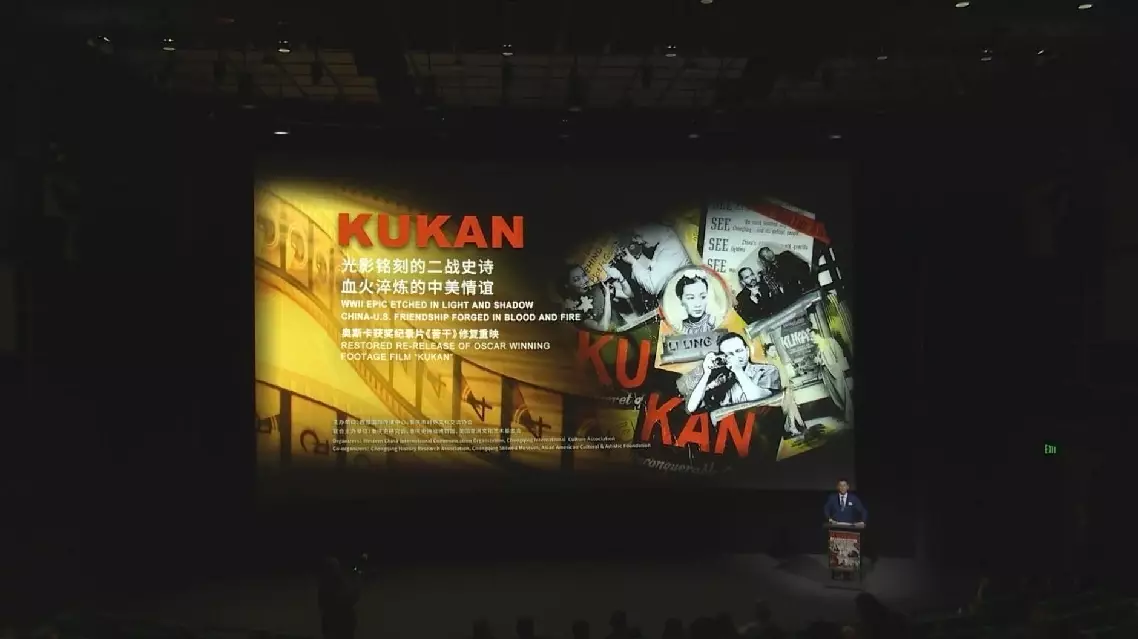
Restored Oscar-winning WWII documentary "Kukan" premieres in LA