Implementation of the Law of the People's Republic of China on Safeguarding National Security in the Hong Kong Special Administrative Region (HKSAR), which is popularly known as the Hong Kong national security law, has ensured stability and prosperity in the region and long-term and steady implementation of the "one country, two systems" since its enactment five years ago, according to experts from the HKSAR.
The Law on Safeguarding National Security in the HKSAR was passed at the 20th session of the 13th Standing Committee of the National People's Congress (NPC) on June 30, 2020.
In an interview with China Central Television on the occasion of the fifth anniversary of the entry into force of the law, HKSAR Chief Executive John Lee said the concept of national security has been well promoted among the public in Hong Kong over the past five years.
"I've seen great progress in promoting the concept of national security. In reality, there are around 20 aspects concerning national security, including financial security and energy security. Now ordinary people in Hong Kong have gained a better understanding of the broad coverage of the concept. So, I think it has had a positive effect on all residents to safeguard national security," said Lee.
The law has also helped to put the principle of "patriots administering Hong Kong" into practice, said Gordon Lam, an NPC deputy from Hong Kong.
"We see that since the entry into effect of the Law on Safeguarding National Security in Hong Kong five years ago, the region's electoral system has been improved and the principle of 'patriots administering Hong Kong' has been practiced. Now Hong Kong has restored security and stability, and it is striving for economic development and wellbeing for the people. Hong Kong has once again ranked the third globally among international financial hubs, and its international business environment and the competitiveness of talents have also returned to within the Top 10 globally. It remains the world's freest economy. These indicate the importance of national security in safeguarding economic development," said Lam.
The law-based governance in Hong Kong under the "one country, two systems" principle has been well recognized by the Chinese central government and the international community, with the International Organization for Mediation (IOMed) headquartered in the region, said Lin Feng, dean of the School of Law at the City University of Hong Kong (CityUHK).
"Headquartering IOMed in Hong Kong shows our country's trust in the region and its hope to make it an international 'capital of mediation,'" said Lin. Now Hong Kong is integrating into the national development, playing a unique role in connecting with the rest of the world and cultivating talents, said Johnny Ho, associate vice-president (enterprise) of CityUHK.
"As Hong Kong is integrating into the national development strategy, it is playing the role of a super connector and an added value creator. Hong Kong's universities have unleashed greater potential in talent cultivation, in integration between the government, industries, universities and research institutes, in making innovation breakthroughs, as well as in transforming their talent advantages into a driving force for innovation and entrepreneurship. Joint efforts are being made to promote the development of new quality productive forces in Hong Kong and realize the vision of making Hong Kong an international innovation and technology hub," said Ho.
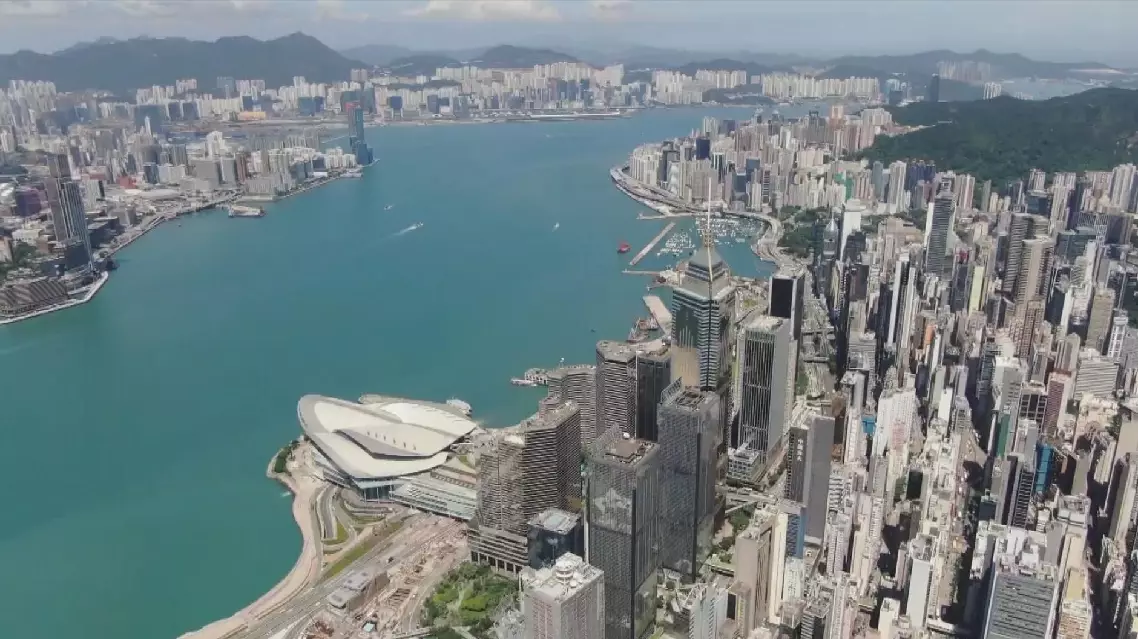
National security law ensures stability, prosperity in Hong Kong: experts
The Republic of Korea (ROK)'s consumer price inflation eased in July, breaking a multi-month accelerating trend amid stabilizing energy prices and lower farm goods prices, statistical ministry data showed Tuesday.
The consumer price index (CPI) rose 2.8 percent in July from a year earlier, falling below 3.0 percent in three months, according to the Ministry of Data and Statistics.
It marked a noticeable deceleration from 3.2 percent in June, after accelerating from 2.0 percent in February to 2.2 percent in March, 2.6 percent in April and 3.1 percent in May.
Headline inflation, however, stayed above the central bank's mid-term inflation target of 2 percent for 11 straight months since September 2025.
The Bank of Korea raised its benchmark interest rate by 25 basis points to 2.75 percent in July, turning toward monetary tightening in about three and a half years since January 2023.
Oil products price gained 15.5 percent last month, after spiking 24.7 percent in the previous month. The price lifted overall inflation by 0.60 percentage points.
Price for gasoline and diesel jumped 12.6 percent and 21.5 percent each, while computer price shot up 25.1 percent amid soaring semiconductor price. Price for industrial products, including oil products and processed food, advanced 3.7 percent in July compared to the same month last year, slower than an expansion of 4.4 percent in the previous month.
Processed food price added 1.0 percent in July from a year earlier, faster than a growth of 0.9 percent in the previous month.
Price for agricultural, livestock and fishery products climbed 0.9 percent in July from a year earlier, after picking up 3.2 percent in June.
Agricultural products price slipped 2.2 percent last month, turning downward from an increase of 1.1 percent in the prior month. Those for livestock and fishery products swelled 4.4 percent and 3.9 percent each.
Rice price mounted 7.9 percent, but those for napa cabbage, watermelon, spinach, cucumber and zucchini retreated in double figures. Those for beef, imported beef, pork, egg and mackerel increased in single digits.
Price for electricity, natural gas and tap water was up 0.4 percent in July on a yearly basis.
City gas charge and waterworks fee added in single digits, but heating cost dipped 0.2 percent.
Services price surged 2.6 percent last month, hiking up the headline inflation by 1.46 percentage points.
Public service price rose 1.4 percent, while private service price, including eating-out costs, expanded 3.5 percent.
The eating-out expense gained 2.6 percent, and the private service price excluding the dining-out cost jumped 4.1 percent.
Affected by a spike in fuel surcharges from rising oil prices, international airfares soared 21.7 percent last month.
Housing rent, including Jeonse and monthly rent, was up 1.1 percent in July from a year earlier.
Jeonse is the country's unique contract between two households where a landlord grants two-year residential rights to a tenant, who in turn lends a certain amount of money, or a deposit, to the landlord.
The livelihood items index, which gauges prices for daily necessities, climbed 2.5 percent, while the fresh food index, which measures prices for fish, shellfish, fruit and vegetables, declined 2.3 percent.
Demand-side inflationary pressure lingered. Core consumer price index, which excludes volatile agricultural and oil products, appreciated 2.5 percent last month.
The OECD-method core price, excluding volatile food and energy costs, went up 2.6 percent in the cited month.

ROK's consumer price inflation eases to 2.8 pct in July