WASHINGTON (AP) — A military veteran was sentenced Wednesday to life in prison for plotting to attack an FBI office and assassinate law enforcement officers in retaliation for his arrest on charges that he was part of the mob that stormed the Capitol on Jan. 6, 2021, court records show.
Edward Kelley was one of the first rioters to breach the Capitol. Nearly two years later, Kelley made plans with another man to attack the FBI office in Knoxville, Tennessee, using improvised explosive devices attached to vehicles and drones, according to prosecutors.
Last November, a jury convicted Kelley of conspiring to murder federal employees, solicitation to commit a crime of violence and influencing federal officials by threat.
Kelley, 36, received a pardon from President Donald Trump for his Jan. 6 convictions, but a judge agreed with prosecutors that Trump's action did not extend to Kelley's Tennessee case. That makes Kelley, who is from Maryvale, Tennessee, one of only a few Capitol riot defendants remaining in prison after the Republican president's sweeping act of clemency.
U.S. District Judge Thomas Varlan handed down Kelley's life sentence during a hearing in Knoxville, according to court records. The judge denied a request for Kelley to be released pending the outcome of an appeal.
Prosecutors had recommended a life sentence for Kelley, saying he was remorseless and incapable of rehabilitation.
“On the contrary, Kelley not only believes the actions for which he was convicted were justified but that his duty as a self-styled 'patriot' compelled him to target East Tennessee law enforcement for assassination,” they wrote.
Kelley served in the Marine Corps for eight years. He was deployed to Iraq and Afghanistan before his 2015 discharge from the military.
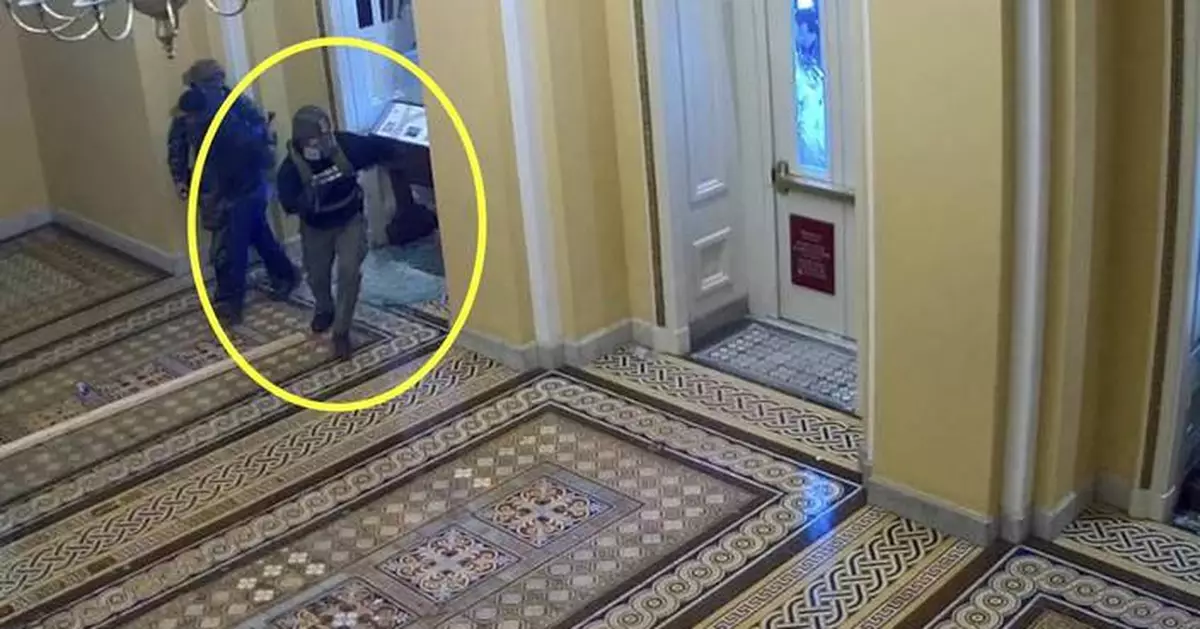
On Jan. 6, 2021, Kelley was captured on video helping two other rioters throw a Capitol Police officer onto the ground and using a piece of wood to damage a window, according to the FBI. He was the fourth person to enter the Capitol through a broken window, the FBI said.
After a trial without a jury, a federal judge in Washington convicted Kelley last November of 11 counts stemming from the riot. Before Kelley could be sentenced, Trump pardoned him and hundreds of other convicted Capitol rioters.
Kelley argued that his pardon was broad enough to cover his conduct in the Tennessee case, but the judge disagreed. Varlan said Kelley's crimes in the Tennessee case were separated from Kelley's conduct on Jan. 6 “by years and miles.” Prosecutors reached the same conclusion.
In other Jan. 6 cases, however, Trump's Justice Department has argued that the pardons apply to separate convictions. For instance, prosecutors concluded that a Kentucky man's pardon for storming the Capitol also covered his conviction for illegally possessing guns when FBI agents searched his home for the Jan. 6 investigation.
Kelley has been jailed since December 2022. His lawyer, Mark Brown, said Kelley did not hurt anybody or directly threaten anybody with violence. Brown urged the judge to reject prosecutors' request to apply a “terrorism enhancement” in calculating his client's sentence.
“Kelley does not deserve the same sentence as an actual ‘terrorist’ who injured or killed hundreds or thousands of America citizens,” Brown wrote.
Kelley's co-defendant, Austin Carter, pleaded guilty to a conspiracy charge in January 2024. He is scheduled to be sentenced on Aug. 4.
Kelley created a list of 36 law-enforcement officers to target for assassination and shared it with Carter, calling it their first “mission,” according to prosecutors. All the officers were involved in Kelley's May 2022 arrest on Capitol riot charges and the FBI's search of his home.
“The proof at trial established that Kelley targeted law enforcement because of their anticipated role in the civil war that Kelley hoped to initiate and because of his animus towards those who participated in his May 2022 arrest and search of his home,” prosecutors wrote.
Kelley, Carter and a third man used an encrypted messaging platform to discuss plans, prosecutors said. Carter testified that he met with Kelley to conduct military-style training in November 2022.
“Carter’s testimony was unequivocal — he had no doubts that, had he and Kelley not been arrested, the law enforcement personnel included on Kelley’s list would have been murdered,” prosecutors wrote.
Kelley's attorney said the case involved “little to no planning.”
“Discussions did not lead to action," Brown wrote. "And while people may not like what Mr. Kelley had to say, he stands behind his position that he has a First Amendment right to free speech.”
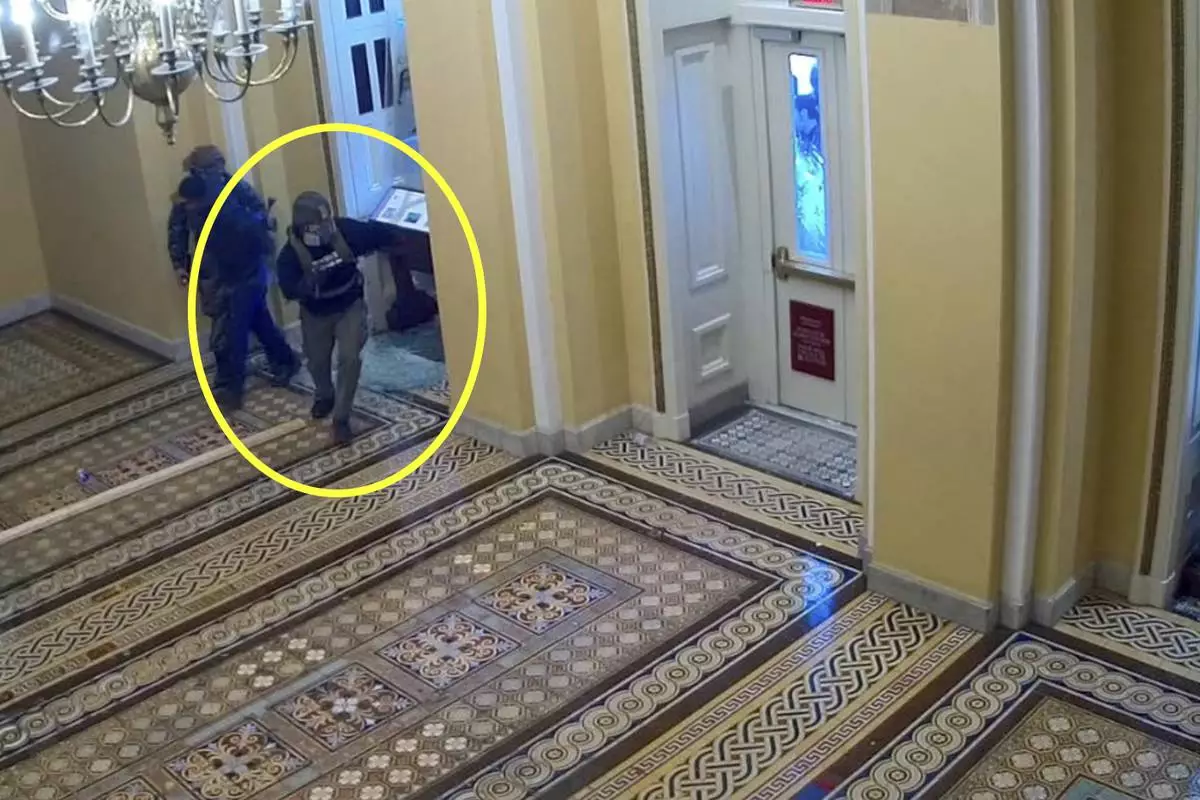
This image from U.S. Capitol Police video, contained in the statement of facts supporting the arrest warrant for Edward Kelley, and annotated by the source, shows Kelley entering the U.S. Capitol Jan. 6, 2021, in Washington. (Justice Department via AP)