Skip to Content Facebook Feature Image

A Q-tip and spotless car were key evidence linking Bryan Kohberger to murders of 4 Idaho students

News

A Q-tip and spotless car were key evidence linking Bryan Kohberger to murders of 4 Idaho students
News

News

A Q-tip and spotless car were key evidence linking Bryan Kohberger to murders of 4 Idaho students

2025-07-03 10:20 Last Updated At:10:30

BOISE, Idaho (AP) — The lead prosecutor tasked with finding justice for four University of Idaho students killed in a grisly quadruple stabbing more than two years ago laid out his key evidence Wednesday at a court hearing for Bryan Kohberger, who agreed to plead guilty earlier this week to avoid the death penalty.

The evidentiary summary — recited by lead prosecutor Bill Thompson before Kohberger entered his pleas — spun a dramatic tale that included a DNA-laden Q-tip plucked from the garbage in the dead of the night, a getaway car stripped so clean of evidence that it was “essentially disassembled inside" and a fateful early-morning Door Dash order that may have put one of the victims in Kohberger's path.

These details offered new insights into how the crime unfolded on Nov. 13, 2022, and how investigators ultimately solved the case using surveillance footage, cell phone tracking and DNA matching. But the synopsis leaves hanging key questions that could have been answered at trial — including a motive for the stabbings and why Kohberger picked that house, and those victims, all apparent strangers to him.

The small farming community of Moscow, in the northern Idaho panhandle, had not had a homicide in about five years when Kaylee Goncalves, Ethan Chapin, Xana Kernodle and Madison Mogen were found dead at a rental home near campus.

Kohberger, now 30, had begun a doctoral degree in criminal justice at nearby Washington State University — across the state line from Moscow, Idaho — months before the crimes.

“The defendant has studied crime,” Thompson said, as the victims' family members dabbed at their tears. “In fact, he did a detailed paper on crime scene processing when he was working on his Ph.D., and he had that knowledge skillset.”

Kohberger's cell phone began connecting with cell towers in the area of the crime more than four months before the stabbings, Thompson said, and pinged on those towers 23 times between the hours of 10 p.m. and 4 a.m. in that time period.

A compilation of surveillance videos from neighbors and businesses also placed Kohberger's vehicle — known to investigators because of a routine traffic stop by police in August — in the area.

On the night of the killings, Kohberger parked behind the house and entered through a sliding door to the kitchen at the back of the house shortly after 4 a.m., Thompson said. He moved to the third floor, where Madison Mogen and Kaylee Goncalves were sleeping.

After killing both of them with a knife, Kohberger left a knife sheath next to Mogen's body. Both victims' blood was later found on the sheath, along with DNA from a single male that ultimately helped investigators pinpoint Kohberger as the only suspect.

On the floor below, another student was still awake. Xana Kernodle had ordered Door Dash not long before, and as Kohberger was leaving, he crossed paths with her and killed her with a large knife, Thompson said. He then killed her boyfriend, Ethan Chapin, who was sleeping in Kernodle's bedroom.

Kohberger left two others in the house alive, including one roommate who was expected to testify at trial that sometime before 4:19 a.m. she saw an intruder there with “bushy eyebrows,” wearing black clothing and a ski mask.

Roughly five minutes later, the car could be seen on the next-door neighbor’s surveillance camera. speeding away so fast “the car almost loses control as it makes the corner,” Thompson said.

After Kohberger fled the scene, Thompson said, his cover-up was elaborate.

Prosecutors believe he drove backroads to his apartment in Pullman, Washington, to avoid surveillance cameras on the major roads and didn't turn his cell phone back on until 4:48 a.m. By 5:26 a.m., he was back in Pullman, Thompson said.

Later, Kohberger changed his car registration from Pennsylvania to Washington State — significant for investigators who were combing through surveillance camera footage because Pennsylvania law doesn't require a front license plate, making it harder to identify the vehicle.

And by the time investigators did catch up with him weeks later, his apartment and office in nearby Pullman were scrubbed clean.

“Spartan would be a kind characterization. There was nothing there, nothing of evidentiary value was found,” Thompson said of Kohberger’s apartment.

The car, too, “had been essentially disassembled inside," he added. “It was spotless. The defendant’s car had been meticulously cleaned inside.”

Investigators had honed in on Kohberger, but they needed to prove he was their suspect.

With the DNA of a single mystery male on the knife sheath, they worked with the FBI and the local sanitation department to secretly retrieve garbage from the Pennsylvania home of Kohberger's parents, seeking a DNA match to their suspect.

“They conducted what’s called a trash pull during the nighttime hours,” Thompson said, and “took trash that had been set out on the street for collection” and sent it to Idaho's forensics lab.

The pile of garbage yielded investigative gold: A Q-tip that contained DNA identified “as coming from the father of the person whose DNA was found on the knife sheath that was found by Madison Mogen’s body on the bed,” he said.

With that, Kohberger was arrested at his parents' home in Pennsylvania, where he had gone for the holidays, and ultimately was extradited to Idaho for prosecution.

Even while prosecutors detailed that night, a key question remains: Why did Kohberger target that house and those victims? Did he know them? And what was his motive?

“We do not have evidence that the defendant had direct contact with 1122 or with residents in 1122, but we can put his phone in the area on those times,” Thompson said, referring to the house number where the murders took place.

Some of that evidence may have come out at trial, and may yet be contained in documents related to the case that have been sealed by the court until after a July 23 sentencing hearing. A gag order in place for all attorneys in the case is still in effect as well.

Those documents include witness lists, a list of exhibits, an analysis of the evidence, requests for additional discovery, filings about mitigating factors and various unsuccessful defense motions that sought to introduce alternative suspects, among other things.

With the case solved, families remain divided over its resolution.

The deal stipulates that Kohberger will be spared execution in exchange for four consecutive life sentences. He also waived his right to appeal and to challenge the sentence.

Chapin's and Mogen's families support the deal.

“We now embark on a new path. We embark on a path of hope and healing,” Mogen's family said in a statement.

The family of Kaylee Goncalves publicly denounced the plea deal ahead of Wednesday's hearing and her father refused to attend the proceedings.

Goncalves 18-year-old sister, Aubrie Goncalves, said in a Facebook post that “Bryan Kohberger facing a life in prison means he would still get to speak, form relationships, and engage with the world."

“Meanwhile, our loved ones have been silenced forever," she wrote.
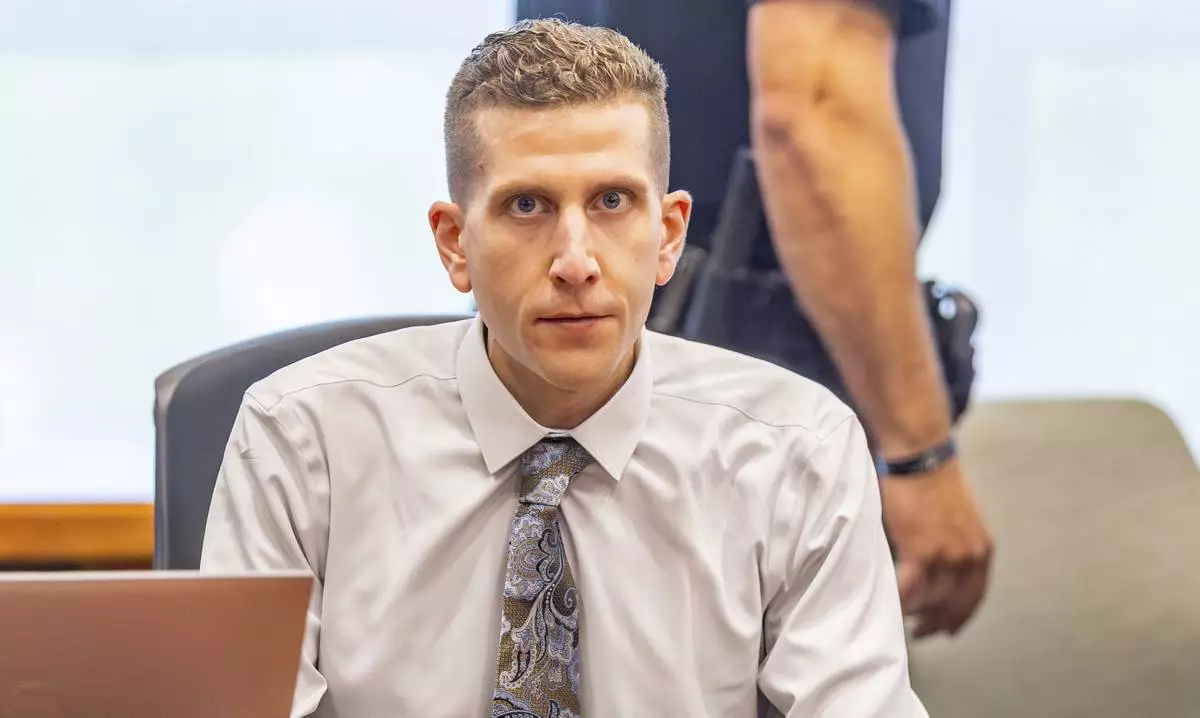
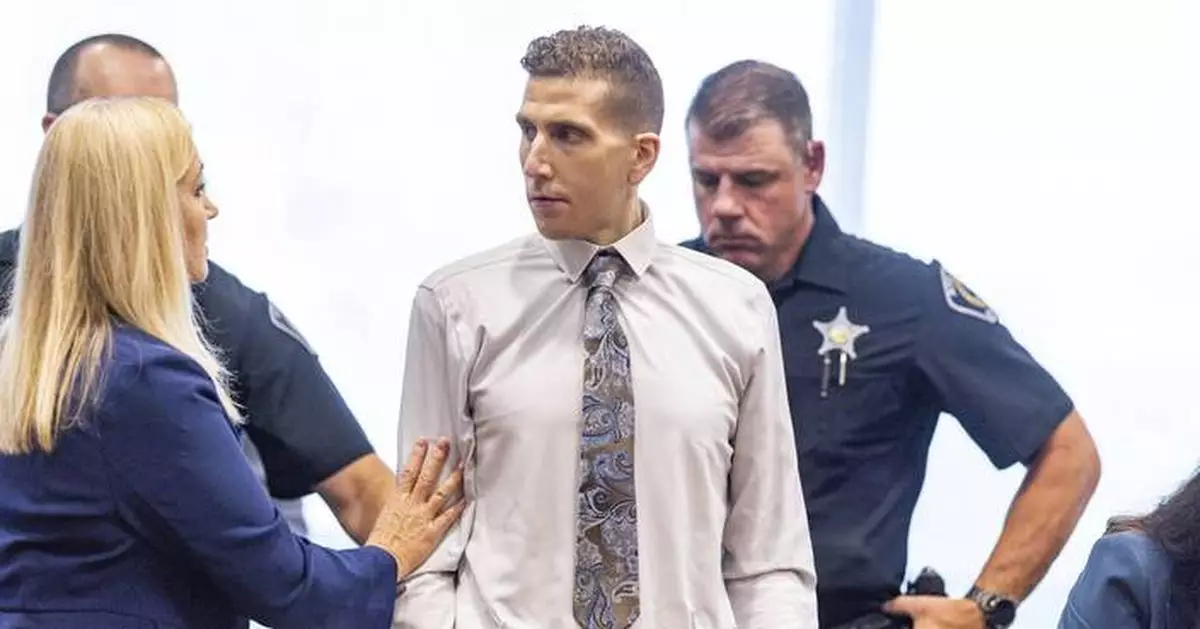
Brian Kohberger, charged in the murders of four University of Idaho students, appears at the Ada County Courthouse, Wednesday, July 2, 2025, in Boise, Idaho. (AP Photo/Kyle Green, Pool)
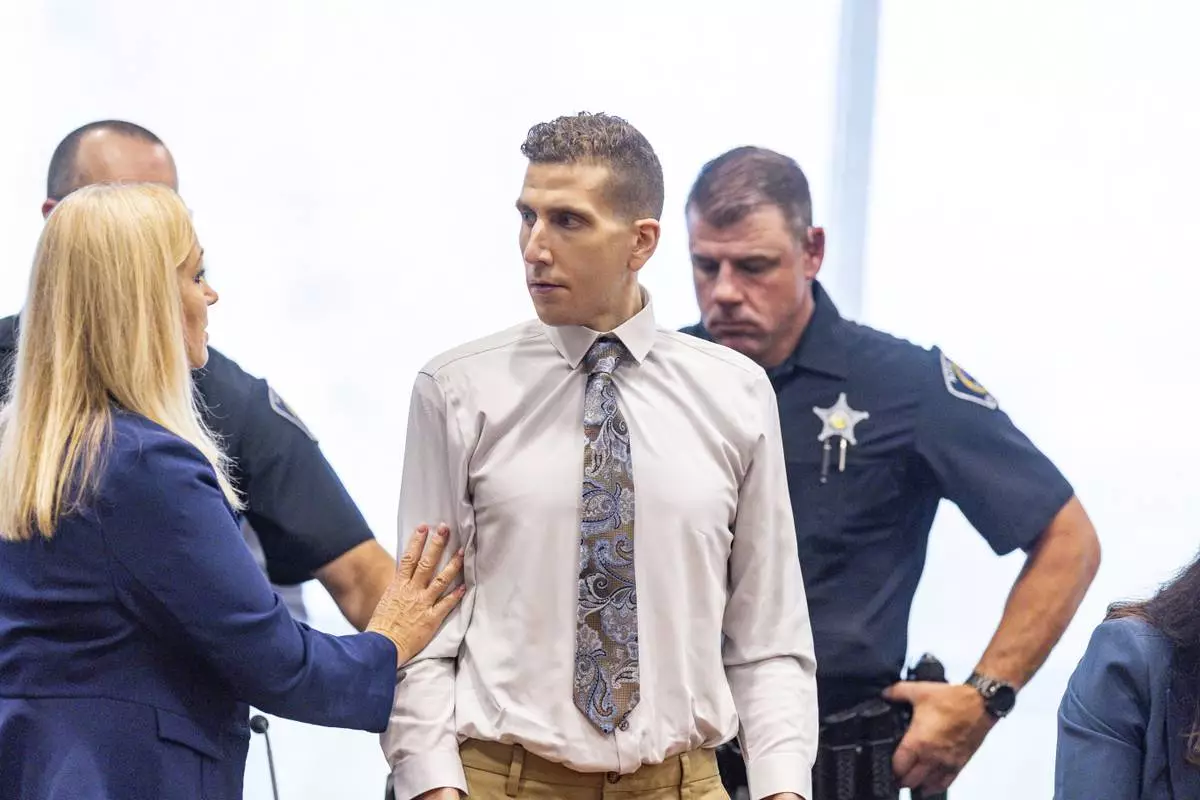
Brian Kohberger, charged in the murders of four University of Idaho students, appears at the Ada County Courthouse, Wednesday, July 2, 2025, in Boise, Idaho. (AP Photo/Kyle Green, Pool)
Brian Kohberger, charged in the murders of four University of Idaho students, appears at the Ada County Courthouse, Wednesday, July 2, 2025, in Boise, Idaho. (AP Photo/Kyle Green, Pool)
Brian Kohberger, charged in the murders of four University of Idaho students, appears at the Ada County Courthouse, Wednesday, July 2, 2025, in Boise, Idaho. (AP Photo/Kyle Green, Pool)
Protesters confronted federal officers in Minneapolis on Thursday, a day after a woman was fatally shot by an Immigration and Customs Enforcement officer.

The demonstrations came amid heightened tensions after President Donald Trump's administration dispatched 2,000 officers and agents to Minnesota for its latest immigration crackdown.

Across the country, another city was reeling after federal immigration officers shot and wounded two people in a vehicle outside a hospital in Portland, Oregon.

The killing of 37-year-old Renee Good in Minneapolis on Wednesday set off a clash between federal and state officials over whether the shooting appeared justified and whether a Minnesota law enforcement agency had jurisdiction to investigate.

Here's what is known about the shooting:

The woman was shot in her SUV in a residential neighborhood south of downtown Minneapolis, about a mile (1.6 kilometers) from where police killed George Floyd in 2020. Videos taken by bystanders and posted online show an officer approaching a vehicle stopped in the middle of the road, demanding the driver open the door and grabbing the handle.

The Honda Pilot begins to pull forward and a different ICE officer standing in front of the vehicle draws his gun and immediately fires at least two shots at close range, jumping back as the vehicle moves toward him.

It is not clear from the videos if the officer gets struck by the SUV, which speeds into two cars parked on a curb before stopping.

It’s also not clear what happened in the lead-up to the shooting.

Homeland Security Secretary Kristi Noem said the SUV was part of a group of protesters that had been harassing agents and “impeding operations” that morning. She said agents had freed one of their vehicles that was stuck in snow and were leaving the area when the confrontation and shooting occurred.

No video has emerged to corroborate Noem’s account. Bystander video from the shooting scene shows a sobbing woman who says the person shot was her wife. That woman hasn’t spoken publicly to give her version of events.

Good died of gunshot wounds to the head.

A U.S. citizen born in Colorado, Good described herself on social media as a “poet and writer and wife and mom." Her ex-husband said Good had just dropped off her 6-year-old son at school Wednesday and was driving home when she encountered ICE agents on a residential street.

He said Good and her current partner moved to Minneapolis last year from Kansas City, Missouri.

Good's killing is at least the fifth death to result from the aggressive U.S. immigration crackdown the Trump administration launched last year.

Noem said Thursday that there would be a federal investigation into the shooting, though she again called the woman’s actions “domestic terrorism.”

“This vehicle was used to hit this officer,” Noem said. “It was used as a weapon, and the officer feels as though his life was in jeopardy.”

Vice President JD Vance said the shooting was justified and referred to Good's death as “a tragedy of her own making.”

Minneapolis Police Chief Brian O’Hara gave no indication that the driver was trying to harm anyone when he described the shooting to reporters Wednesday. Minneapolis Mayor Jacob Frey said he had watched videos of the shooting that show it was avoidable.

The agent who shot Good is an Iraq War veteran who has served for nearly two decades in the Border Patrol and U.S. Immigration and Customs Enforcement, according to records obtained by The Associated Press.

Jonathan Ross has been a deportation officer with ICE since 2015, records show. He was seriously injured this summer when he was dragged by the vehicle of a fleeing suspect whom he shot with a stun gun.

Federal officials have not named the officer. But Noem said he was dragged by a vehicle in June, and a department spokesperson confirmed Noem was referring to the Bloomington, Minnesota, case in which documents identified the injured officer as Ross.

Court documents say Ross got his arm stuck in the window as a driver fled arrest in that incident. Ross was dragged 100 yards (91 meters), and cuts to his arm required 50 stitches.

According to police, officers initially responded to a report of a shooting outside a hospital Thursday afternoon.

Minutes later police heard that a man who had been shot was asking for help in a residential area a couple of miles away. Officers went there and found a man and a woman with gunshot wounds. Officers determined they were wounded in a shooting with federal agents.

Police Chief Bob Day said the FBI was leading the investigation and he had no details about events that led to the shooting.

The Department of Homeland Security said the vehicle’s passenger was “a Venezuelan illegal alien affiliated with the transnational Tren de Aragua prostitution ring” who was involved in a recent shooting. When agents identified themselves to the occupants during a “targeted vehicle stop,” the driver tried to run them over, the department said. An agent fired in self-defense, it said.

There was no immediate independent corroboration of that account or of any gang affiliation of the vehicle’s occupants.

Trump and his allies have consistently blamed Tren de Aragua for being at the root of violence and illicit drug dealing in some U.S. cities.

Drew Evans, head of Minnesota Bureau of Criminal Apprehension, said Thursday that federal authorities have denied the state agency access to evidence in the Good case, barring the state from investigating the shooting alongside the FBI.

Minnesota Gov. Tim Walz demanded that state investigators be given a role, telling reporters that residents would otherwise have a difficulty accepting the findings of federal law enforcement.

“And I say that only because people in positions of power have already passed judgment from the president to the vice president to Kristi Noem,” Walz said.

Noem denied that Minnesota authorities were being shut out, saying: “They don’t have any jurisdiction in this investigation.”

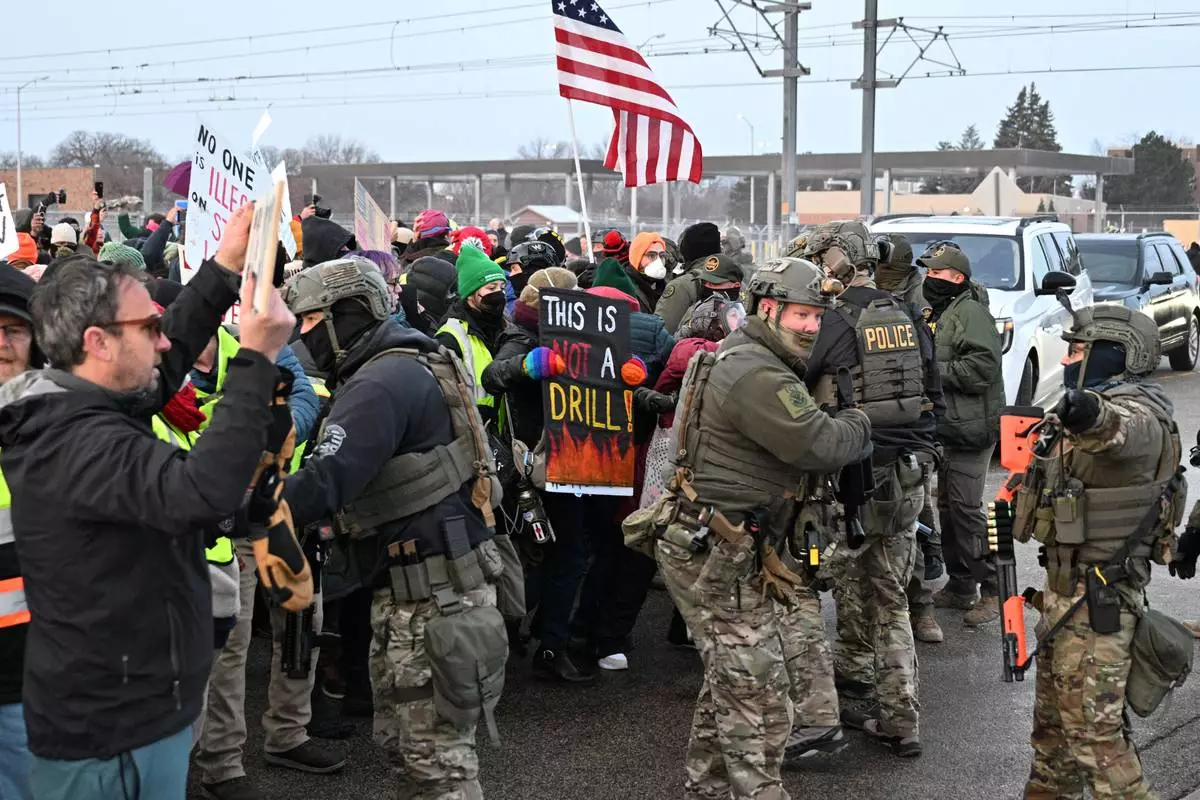
Dozens of protesters gathered Thursday morning outside a Minneapolis federal building being used as a base for the immigration crackdown. Border Patrol officers fired tear gas and doused demonstrators with pepper spray to push them back from the gate.

Area schools were closed as a safety precaution.

Protests were also planned across the U.S. in cities including New York, New Orleans and Seattle.

Associated Press writer Audrey McAvoy contributed.

Protesters confront federal agents outside the Bishop Henry Whipple Federal Building, Thursday, Jan. 8, 2026, in Minneapolis, Minn. (AP Photo/Tom Baker)

Protesters confront federal agents outside the Bishop Henry Whipple Federal Building, Thursday, Jan. 8, 2026, in Minneapolis, Minn. (AP Photo/Tom Baker)

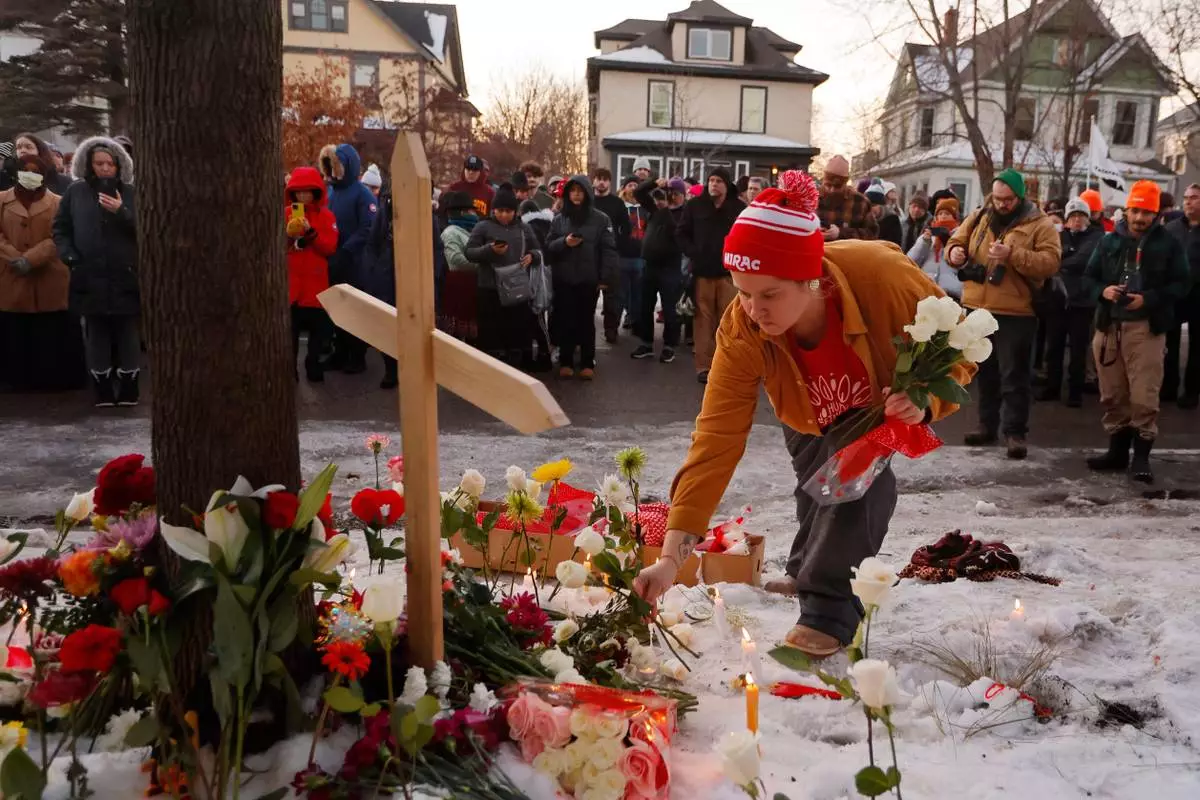
People gather for a vigil after an Immigration and Customs Enforcement officer shot and killed a motorist earlier in the day, Wednesday, Jan. 7, 2026, in Minneapolis. (AP Photo/Bruce Kluckhohn)

People gather for a vigil after an Immigration and Customs Enforcement officer shot and killed a motorist earlier in the day, Wednesday, Jan. 7, 2026, in Minneapolis. (AP Photo/Bruce Kluckhohn)

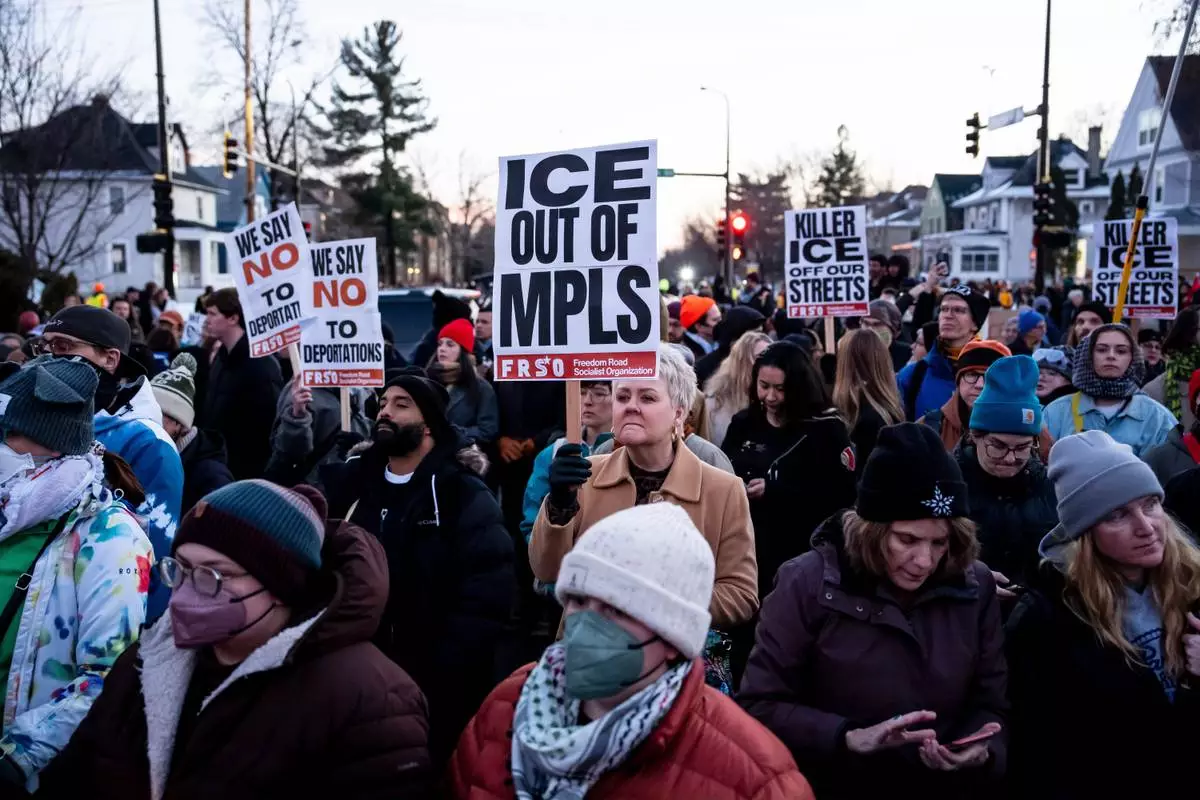
People participate in a protest and vigil after an Immigration and Customs Enforcement officer shot and killed a woman in Minneapolis, on Wednesday, Jan. 7, 2026. (Christopher Katsarov/The Canadian Press via AP)

People participate in a protest and vigil after an Immigration and Customs Enforcement officer shot and killed a woman in Minneapolis, on Wednesday, Jan. 7, 2026. (Christopher Katsarov/The Canadian Press via AP)

Recommended Articles