LONDON (AP) — Perhaps Jordan Thompson deserved a tip of the cap for winning a set-ending point at Wimbledon while clutching his hat after it fell off his head during a serve. His opponent Friday, Luciano Darderi, thought that point shouldn't have been awarded to Thompson, but the chair umpire disagreed.
“I mean, my hat’s fallen off before, and I know what the rules are. It didn't hinder him; it hindered me,” said Thompson, an Australian ranked 44th who will face U.S. Open runner-up Taylor Fritz next. “So I don't know what he was complaining about.”
At 5-4, 40-15 against Darderi, Thompson used a hat trick to put a lid on the opening set en route to a 6-4, 6-4, 3-6, 6-3 victory that sent him to the fourth round at the All England Club for the first time.
On a second serve, the backward baseball cap Thompson was wearing slid off as he landed on his follow-through. Thompson immediately grabbed it with his left hand and continued to wield his racket with his right hand for a point that wound up lasting seven strokes.
It was capped by Thompson's backhand volley winner as he ran to the net with hat in hand.
Has he ever carried that bit of his outfit around during a point before?
“That’s the first time I can remember,” Thompson said.
In the moment, Darderi thought chair umpire Mohamed Lahyani would stop the point and order them to replay it because of what happened with Thompson's chapeau. The 59th-ranked Darderi, who was born in Argentina and represents Italy, walked to the sideline pointing in Thompson's direction and pleading his case with Lahyani.
At one point, Darderi yanked off his own white hat and yelled, “It's the rule!”
But Lahyani wouldn't budge, and Darderi chucked his racket toward the sideline seat, drawing some boos from spectators at Court 18.
As the conversation between Darderi and Lahyani continued during the changeover between sets, Thompson pointed out that the rules address when a player's hat hits the court — “Happened to me a few times,” he said — rather than if it's caught out of the air.
“It didn’t seem normal to me to play a point with a hat in your hand. It was strange,” Darderi said at his news conference later. “But it was just one point. It didn’t change the match.”
On that, both players certainly agreed.
“It’s not like it was 5-all in the fifth, deuce,” Thompson said. “Every point’s big, but it is what it is.”

Australia's Jordan Thompson returns during his match against Italy's Luciano Darderi during their men's singles third round match on day five of the Wimbledon Tennis Championships in London, Friday July 4, 2025. (Ben Whitley/PA via AP)

Australia's Jordan Thompson returns during his match against Italy's Luciano Darderi during their men's singles third round match on day five of the Wimbledon Tennis Championships in London, Friday July 4, 2025. (Ben Whitley/PA via AP)
FAIRFAX, Virginia (AP) — Kilmar Abrego Garcia wasn't an activist and he didn't choose to become locked in to what has become one of the most contentious immigration issues of the Trump administration, his lawyer told The Associated Press on Monday.
But as he experiences some of the few days he's had with his family since being sent erroneously to an El Salvador prison in March, his lawyer said he's still hoping for a just resolution to his case.
“He’s been through a lot, and he’s still fighting,” said his lawyer Simon Sandoval-Moshenberg during an interview with AP following Abrego Garcia's court-ordered release from detention last week. “What it is he can fight for is circumscribed by the law and by the great power of the United States government, but he’s still fighting.”
Abrego Garcia's mistaken deportation to El Salvador helped galvanize opposition to President Donald Trump’s immigration policies. He was held in a notoriously brutal prison there despite having no criminal record.
U.S. officials claimed Abrego Garcia was an MS-13 gang member, an allegation he denies and which he wasn’t charged for. He was later charged with human smuggling, accusations his lawyers have called preposterous and vindictive.
The Trump administration fought efforts to return him to the U.S. but eventually complied. Since then, his case has been a twisted turn of legal filings and wranglings that has seen Abrego Garcia, a Salvadoran national, released from detention once since March — and that time just for a weekend — while the government has pursued smuggling charges against him and announced plans to deport him to a series of African countries.
Then last week, a federal district court judge in Maryland ordered him to be released and barred the government for now from detaining him again until a hearing can be held in his case, possibly as early as this week, said Sandoval-Moshenberg.
The Department of Homeland Security criticized the judge’s decision to release him last week and vowed to appeal, calling the ruling “naked judicial activism” by a judge appointed during the Obama administration. On Monday, Homeland Security declined to comment for this story, citing restrictions on public comments put in place by a judge in Tennessee.
Sandoval-Moshenberg said Abrego Garcia has a number of paths forward. He said he thought that his client had a strong case for asylum. His original asylum claim in 2019 was rejected because he applied after the one-year deadline. But Sandoval-Moshenberg argued the government essentially reset the clock by removing him to El Salvador and then bringing him back.
And after the alleged abuse Sandoval-Moshenberg said Abrego Garcia suffered in El Salvador this year, he thought he would have a “rock solid” asylum case. But, citing the twists and turns of his case and how he's become a symbol for the administration's pursuit of immigrants, he's concerned about his chances of getting a fair trial in immigration court.
“I think they’ve already shown that they’re willing to stack the deck," said Sandoval-Moshenberg.
Abrego Garcia could also apply for a green card since he's married to an American citizen. But that would require getting a waiver from the government, said Sandoval-Moshenberg, and the lawyer is doubtful one would be granted.
Or he could continue to seek removal to Costa Rica, said Sandoval-Moshenberg, a country that has offered to allow him to enter as a refugee and live and work legally. And he wouldn't be returned to El Salvador, the attorney said.
But he also believes the government would continue to fight that option.
“They’re focused on beating him. They’re focused on punishing him. They’re focusing on making him miserable. I guess Costa Rica isn’t miserable enough,” he said.
Sandoval-Moshenberg said he spent some time with Abrego Garcia and his family over the weekend talking through the government's next steps and what Abrego Garcia might want for his future.
“There’s so many different ways it could go. And so much of it depends on just how dirty the government’s willing to play,” he said.
Sandoval-Moshenberg said that he thought that if the government was willing to remove him to Costa Rica, his client would accept it although he stressed that the decision was up to him.
He said that Abrego Garcia and his legal team wouldn't consider that justice — that to him would mean staying with his family in the U.S. But Sandoval-Moshenberg said that given everything he's faced and the “fact that they’re apparently willing to use infinite prosecutorial resources against him, deportation to Costa Rica is an acceptable outcome for him.”
Sandoval-Moshenberg also stressed that there is one place that Abrego Garcia does not want to go.
“His number one priority is not to end up back in CECOT,” said Sandoval-Moshenberg, referring to the prison in El Salvador where his client was held. Sandoval-Moshenberg said Abrego Garcia had been tortured there, claims authorities in El Salvador have denied and that the AP could not independently verify.
“His number one priority is avoiding getting sent back to that prison.”
Sandoval-Moshenberg said he has no idea why the government seems to have chosen Abrego Garcia’s case to fight tooth and nail.
“This isn’t a case where he’s an activist, like an immigrants rights activist, or he’s been, you know, persecuted by the government for his pro-Palestinian speech or something like that,” the attorney said. “He’s a random guy.”
The whole process of deportation, imprisonment and return has "just been this really sort of bizarre, out of world experience for him,” Sandoval-Moshenberg said.
The judge temporarily barred the Trump administration from detaining Abrego Garcia last Friday until the next court hearing.
While no date has been set for that, it could happen as early as later this week, Sandoval-Moshenberg said, noting the whiplash of the case has been a struggle for Abrego Garcia and his family.
“The ground underneath his feet, it’s just earthquake after earthquake,” he said.
Loller reported from Nashville, Tennessee.
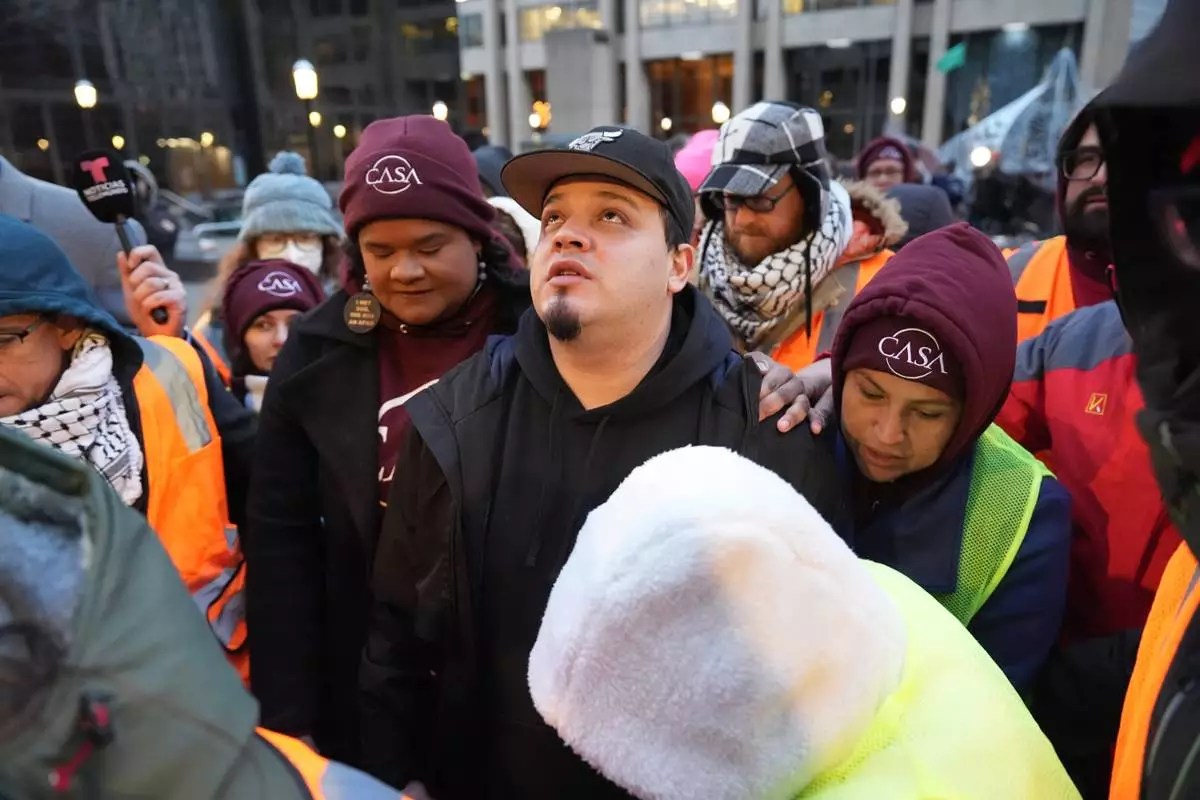
Kilmar Abrego Garcia waits to enter the building for a mandatory check at the Immigration and Customs Enforcement office in Baltimore, Friday, Dec. 12, 2025, after he was released from detention on Thursday under a judge's order. (AP Photo/Stephanie Scarbrough)

Simon Sandoval-Moshenberg, a lawyer on Kilmar Abrego Garcia's legal team who specializes in federal immigration cases, poses for a portrait in Fairfax, Va., Monday, Dec. 15, 2025. (AP Photo/Jacquelyn Martin)

Simon Sandoval-Moshenberg, a lawyer on Kilmar Abrego Garcia's legal team who specializes in federal immigration cases, is interviewed in Fairfax, Va., Monday, Dec. 15, 2025. (AP Photo/Jacquelyn Martin)

Simon Sandoval-Moshenberg, a lawyer on Kilmar Abrego Garcia's legal team who specializes in federal immigration cases, is interviewed in Fairfax, Va., Monday, Dec. 15, 2025. (AP Photo/Jacquelyn Martin)

Simon Sandoval-Moshenberg, a lawyer on Kilmar Abrego Garcia's legal team who specializes in federal immigration cases, is interviewed in Fairfax, Va., Monday, Dec. 15, 2025. (AP Photo/Jacquelyn Martin)