NAIROBI, Kenya (AP) — Kenyans disaffected with President William Ruto hold placards proclaiming “WANTAM,” a sensational slogan distilling their efforts to disgrace him as a “one-term” leader. They stick their index fingers in the air, saying Ruto must vacate the presidency when his term expires in 2027.
For others who want him gone only three years after he was elected, even that's a long time.
Kenya's fifth president became a remarkably unpopular leader barely two years into his presidency after proposing aggressive tax measures that many saw as a betrayal of his campaign promise to support working-class people. Ruto said new taxes were necessary to keep the government running.
Ruto survived the tax-protest movement last year as thousands of young people took to the streets in an unsuccessful attempt to force his resignation. In the most violent incident that left at least 22 people dead, protesters sacked and attempted to burn the parliamentary building in the capital, Nairobi. Ruto said that would never happen again.
Ruto now faces a new wave of protests provoked most recently by the death of a blogger in police custody. Many Kenyans saw the incident as symptomatic of bad rule in Kenya, with the president firmly in control of the legislature and security apparatus.
“He has control of the institutions, but he doesn't have control of the people,” said Karuti Kanyinga, an analyst and professor of development studies at the University of Nairobi. He noted Ruto suffers such “a low level of public confidence” that he is probably the most hated man in Kenya.
Ruto likely will stay in power until 2027, but “violence will continue to deepen” as young people, opposition politicians and others try to make an example of him in an escalating campaign to reform Kenya's government, Kanyinga warned.
Protesters say they want to rid the government of corruption, marked by theft of public resources and the seemingly extravagant lifestyles of politicians. Some disparage Ruto as “Zakayo,” referring to the biblical tax collector Zacchaeus, and others call him “mwizi," Kiswahili for thief.
The demonstrators also are inflamed by what they see as incessant deal-making under Ruto, who last year was forced to terminate an agreement worth an estimated $2 billion that would have seen Kenya's main airport controlled by the Indian conglomerate Adani Group.
That deal, which became public months after security forces violently quelled anti-tax protests, reignited public discontent and reinforced a view of Ruto as unrepentant and unwilling to listen to his people.
To a degree rare for an African leader, Ruto constantly speaks about efforts to expand the tax base. His negotiations for new debt with the International Monetary Fund have drawn criticism from those who say proposed reforms will hurt poor people while benefitting politicians and the business class.
Last year, he told Harvard Business School’s Class of 2025 that he wasn’t going to preside over “a bankrupt country.”
Protesters are “not feeling heard and there's a sense that things have not really changed since the protests last year,” said Meron Elias, an analyst in Kenya with the International Crisis Group. “There's a lot of grief and bitterness from last year's protest that is also feeding into current tensions.”
Peter Kairu, a 21-year-old student, agreed, saying he didn't expect the government to address issues of corruption and nepotism raised by the protesters.
“Until we ourselves become the change we want," he said.
Eileen Muga, who is unemployed in Nairobi, expressed safety concerns about disappearing “the moment you say something about the government."
After thousands of people marched in Nairobi last week to mark the anniversary of the previous year's anti-tax protests, Ruto said he was not going anywhere, warning if there was no Kenya for him, that also would be the case for others.
“If we go this route, we will not have a country,” he said of the protest movement. “Yes, and the country does not belong to William Ruto. The country belongs to all of us. And if there's no country for William Ruto, there's no country for you.”
The speech was characteristic of Ruto and underscored why many Kenyans are afraid of him even as they try to challenge him.
Kipchumba Murkomen, Ruto’s interior minister, has also spoken forcefully against protesters, saying they will be dealt with harshly.
Years ago, as Kenya's deputy president, Ruto outmaneuvered his predecessor, Uhuru Kenyatta, in a bad-tempered power struggle that the president lost.
Photos sometimes showed Ruto glowering over Kenyatta. The local press reported an incident when Ruto was so angry with his boss that he felt he wanted to slap him. The two embodied a close, almost brotherly relationship in their first term but quickly fell out at the beginning of their second when Kenyatta tried to dismantle Ruto's sway over the official bureaucracy.
Ruto won the 2022 presidential election by a narrow margin, defeating opposition leader Raila Odinga, who had Kenyatta's backing. Ruto has since co-opted Odinga, drawing him close as a political ally but also eliminating a potential rival in the next election.
Ruto fell out with his deputy, Rigathi Gachagua, within the first two years of the presidency. In October, legislators with the ruling party impeached Gachagua in a parliamentary process Ruto said he had nothing to do with. Gachagua insisted lawmakers were acting at Ruto's instigation.
Ruto did to Gachagua what Kenyatta chose not to do to Ruto, and some saw Gachagua's removal as yet another sign that Ruto is intolerant and can't be trusted, political analyst Macharia Munene said.
When he ran for president, Ruto positioned himself as an outsider and rallied for electoral support as the leader of a so-called “hustler nation,” a campaign that he said would economically empower ordinary Kenyans.
The strategy appealed to millions struggling with joblessness and inequality. Informal traders, passenger motorcyclists and market women were often among his supporters. Ruto also aligned himself with the evangelical Christian movement, often seen carrying a Bible and preaching at pulpits.
After taking office, Ruto spoke of an urgent need to make Kenya's debt sustainable. The tax hikes in a controversial finance bill came months later. He also removed the fuel subsidies that many Kenyans had come to take for granted.
“I think it's a question of overpromising and underdelivering," said attorney Eric Nakhurenya, a government policy analyst. “That's why Kenyans are angry.”
Muhumuza reported from Kampala, Uganda.
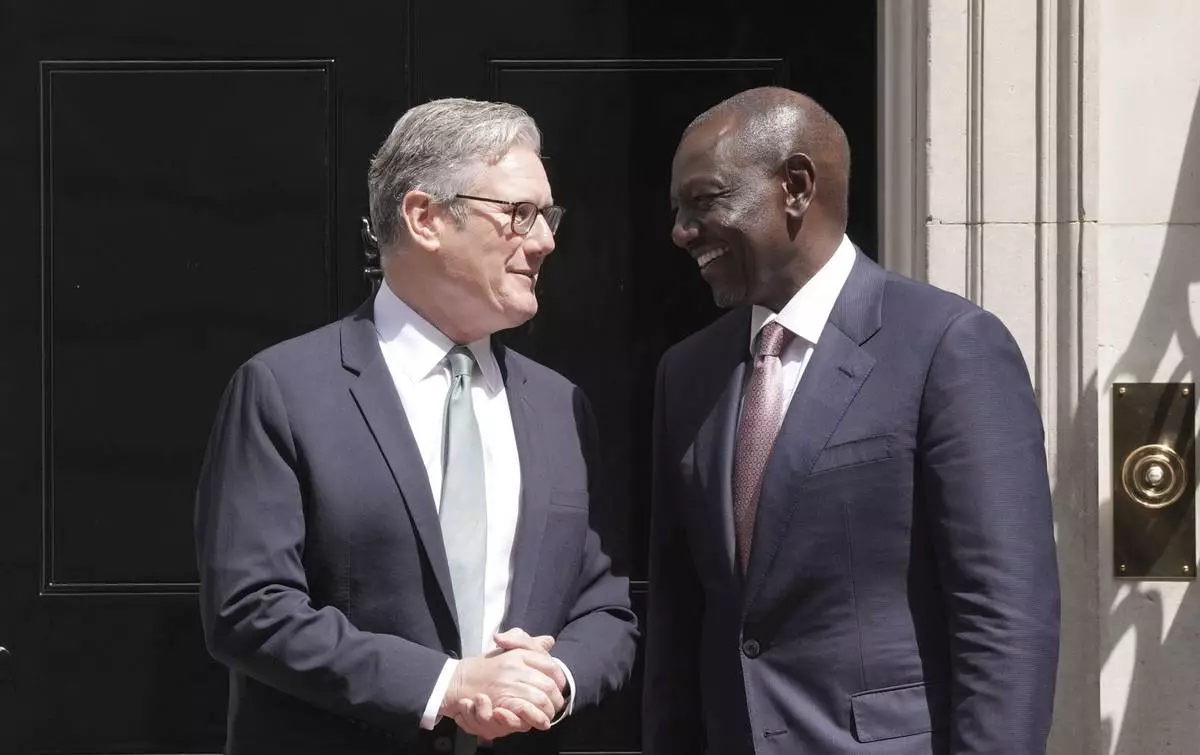
British Prime Minister Keir Starmer, left, shakes hands with President of Kenya William Ruto, in Downing Street, London, ahead of a bilateral meeting, Tuesday July 1, 2025. (Stefan Rousseau/PA via AP)
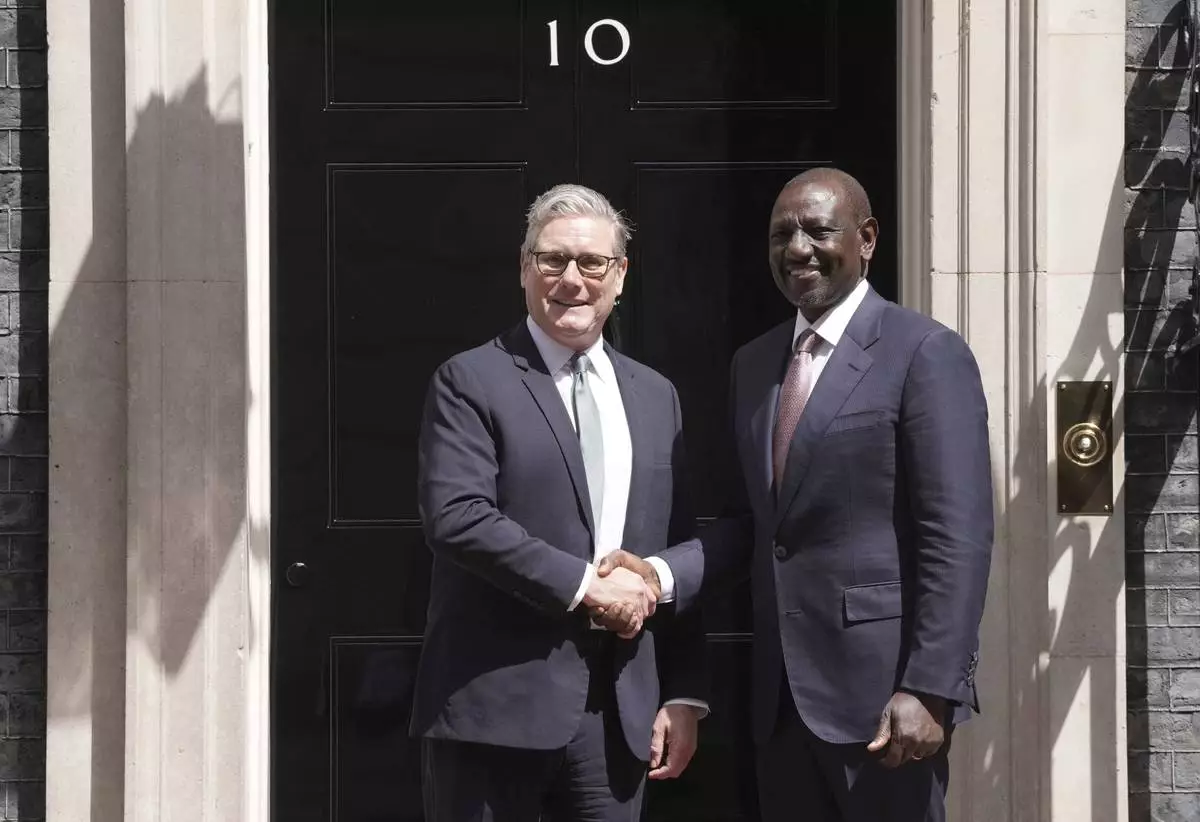
British Prime Minister Keir Starmer, left, shakes hands with President of Kenya William Ruto, in Downing Street, London, ahead of a bilateral meeting, Tuesday July 1, 2025. (Stefan Rousseau/PA via AP)