Skip to Content Facebook Feature Image

French police are slashing boats but migrants are still determined to reach the UK

News

French police are slashing boats but migrants are still determined to reach the UK
News

News

French police are slashing boats but migrants are still determined to reach the UK

2025-07-07 15:07 Last Updated At:15:20

ECAULT BEACH, France (AP) — Across the English Channel, the U.K.'s white cliffs beckon. On fine days, men and women with children in their arms and determination in their eyes can see the shoreline of what they believe will be a promised land as they attempt the perilous crossing clandestinely, ditching belongings to squeeze aboard flimsy inflatable boats that set to sea from northern France.

In a flash, on one recent crossing attempt, French police swooped in with knives, wading into the water and slashing the boat's thin rubber — literally deflating the migrants' hopes and dreams.

More Images
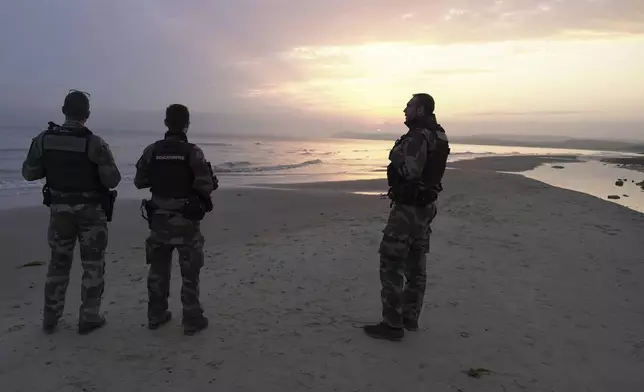
Gendarmes patrol on Chatelet beach, north of Boulogne-sur-Mer, northern France, Wednesday July 2, 2025. (AP Photo/John Leicester)
Gendarmes patrol on Chatelet beach, north of Boulogne-sur-Mer, northern France, Wednesday July 2, 2025. (AP Photo/John Leicester)

"Taxi boat" motor to pre-arranged off-shore pick-up points, where migrants waiting on the beaches then wade into the water, Friday July 4, 2025 on Hardelot beach south of Boulogne-sur-Mer, northern France. (AP Photo/John Leicester)
"Taxi boat" motor to pre-arranged off-shore pick-up points, where migrants waiting on the beaches then wade into the water, Friday July 4, 2025 on Hardelot beach south of Boulogne-sur-Mer, northern France. (AP Photo/John Leicester)

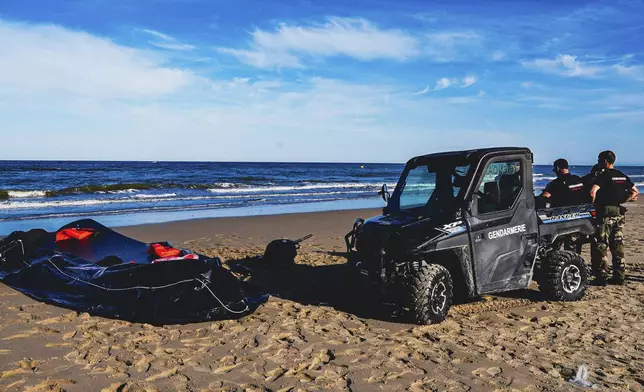
Police officers stand close to a ripped migrant inflatable dinghy lies on Ecault beach, northern France, Friday, July 4, 2025 northern France (AP Photo/Nicolas Garriga)
Police officers stand close to a ripped migrant inflatable dinghy lies on Ecault beach, northern France, Friday, July 4, 2025 northern France (AP Photo/Nicolas Garriga)

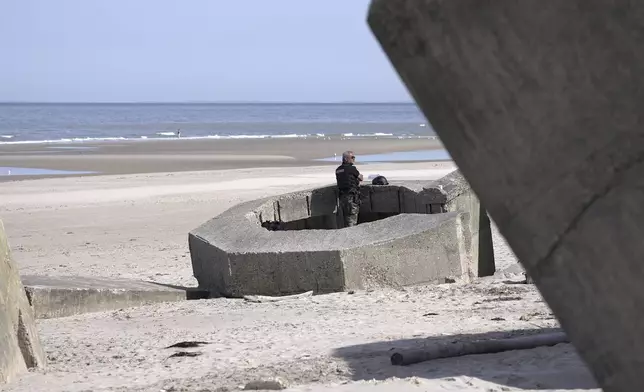
A gendarme stands in a WWII nazi bunker at Ecault beach, Friday July 4, 2025. (AP Photo/John Leicester)
A gendarme stands in a WWII nazi bunker at Ecault beach, Friday July 4, 2025. (AP Photo/John Leicester)

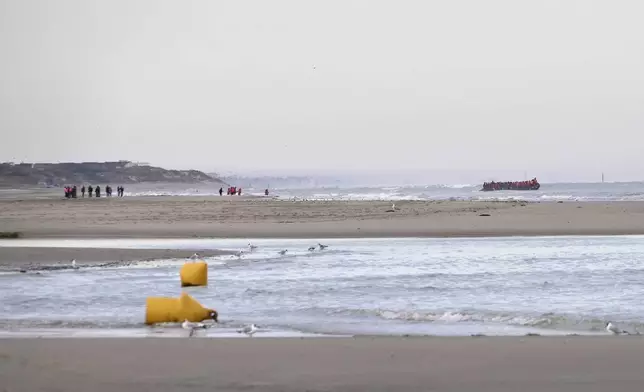
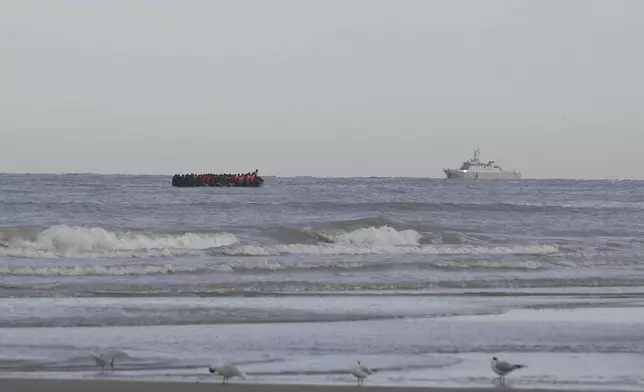
A French Navy vessel sails by a "Taxi boat" carrying migrants, Friday July 4, 2025 on Hardelot beach south of Boulogne-sur-Mer, northern France. (AP Photo/John Leicester)

A French Navy vessel sails by a "Taxi boat" carrying migrants, Friday July 4, 2025 on Hardelot beach south of Boulogne-sur-Mer, northern France. (AP Photo/John Leicester)

Some of the men put up dispirited resistance, trying to position themselves — in vain — between the boat and the officers' blades. One splashed water at them, another hurled a shoe. Cries of “No! No!" rang out. A woman wailed.

But the team of three officers, one also holding a pepper-gas canister, lunged at the boat again and again, pitching some of those aboard into the surf as it quickly deflated. The Associated Press obtained video of the police boat-slashing, filmed on a beach near the French port of Boulogne.

France's northern coast has long been fortified against invasion, with Nazi bunkers in World War II and pre-French Revolution forts. Now, France is defending beaches with increasing aggression against migrants trying at a record pace to go the other way — out to sea, to the U.K.

Under pressure from U.K. authorities, France's government is preparing to give an even freer hand to police patrols that, just last week, were twice filmed slashing boats carrying men, women and children.

The video obtained by AP was filmed Monday. Four days later, on Écault beach south of Boulogne, the BBC filmed police wading into the surf and puncturing another boat with box cutters, again pitching people into the water as it deflated.

An AP journalist who arrived moments later counted multiple lacerations and saw dispirited people, some still wearing life jackets, clambering back up sand dunes toward woods inland. There, AP had spent the previous night with families and men waiting for a crossing, sleeping rough in a makeshift camp without running water or other basic facilities. Exhausted children cried as men sang songs and smoked around a campfire.

The French Interior Ministry told AP that police haven't been issued orders to systematically slash boats. But the British government — which is partly funding France's policing efforts — welcomed what it called a “toughening” of the French approach. The U.K. is also pushing France to go further and let officers intervene against boats in deeper waters, a change the government in Paris is considering. Campaigners for migrant rights and a police union warn that doing so could endanger both migrants and officers.

Of the slashing filmed Friday by the BBC, the Interior Ministry said the boat was in distress, overloaded and riding low in the water, with migrants "trying to climb aboard from the back, risking being caught by the propeller.”

“The gendarmes, in water up to their knees, intervened to rescue people in danger, pull the boat to shore and neutralize it,” the ministry said.

Around the campfire, the men stared into the flames and ruminated. Deniz, a Kurd with an infectious laugh and a deep singing voice, wanted more than anything to cross the channel in time to celebrate his 44th birthday in August with his 6-year-old daughter, Eden, who lives with her mother in the U.K. Like nearly all the migrating people that AP interviewed, surviving in camps that police frequently dismantle, Deniz didn't want to give his full name.

Refused a short-stay U.K. visa, Deniz said he had no other option than the sea route, but four attempts ended with police wrecking the boats. He said that on one of those occasions, his group of around 40 people begged an officer patrolling alone to turn a blind eye and let them take to sea.

“He said, ‘No,’ nobody going to stop him. We could stop him, but we didn’t want, you know, to hurt him or we didn’t want to argue with him,” Deniz said. “We just let him, and he cut it with a knife.”

He believes that U.K. funding of French policing is turning officers into zealots.

“I say, 'Because of the money, you are not France soldiers, you’re not France police. You are the English dogs now," he said.

The coastal battle between police and migrants never lets up, no matter the hour or weather. Drones and aircraft watch the beaches and gendarmes patrol them aboard buggies and on foot. On Écault beach, a WWII Nazi gun emplacement serves as their lookout post.

Inland waterways have been sealed off with razor wire and floating barriers to prevent launches of so-called “taxi boats." They motor to offshore pickup points, where waiting migrants then wade into the sea and climb aboard, children in their arms and on their shoulders.

AP saw a 6 a.m. pickup Friday on Hardelot beach south of Boulogne. Many dozens of people squeezed aboard, straddling the sausage-like inflated sides — one foot in the sea, the other in the boat. It left about a half-dozen people on the beach, some in the water, apparently for lack of room. Gendarmes on the beach watched it motor slowly away.

Campaigners who work with migrants fear that allowing police to intervene against boats farther offshore will panic those aboard, risking casualties. French officials are examining the possibility of police interventions up to 300 meters (980 feet) from the water's edge.

“All that will happen is that people will take greater and greater risks,” said Diane Leon, who coordinates aid efforts for the group Médecins du Monde along the coast. “The police entering the water — this was something that, until now, we saw only rarely. But for us, it raises fears of panic during boarding or of boats arriving farther and farther out, forcing people to swim to reach the taxi boats.”

In an AP interview, police union official Régis Debut voiced concerns about potential legal ramifications for officers if people drown during police attempts to stop departures. He said officers weighed down by equipment could also drown.

“Our colleagues don't want to cross 300 meters to intercept the small boats. Because, in fact, we're not trained for that,” said Debut, of the union UNSA Police.

“You also need to have the proper equipment. You can’t carry out an arrest wearing combat boots, a police uniform and the bullet-proof vest. So the whole process needs to be reconsidered.”

Around the campfire, men laughed off the risks of the crossings that French authorities say claimed nearly 80 lives last year. They had nothing left to lose and the channel was just one more hardship after tortuous journeys to France filled with difficulties and misery, they said.

“We will never give up,” Deniz said.

According to U.K. government figures, more than 20,000 people made the crossing in the first six months of this year, up by about 50% from the same period in 2024, and potentially on course toward a new annual record. About 37,000 people were detected crossing in 2024, the second-highest annual figure after 46,000 in 2022.

Qassim, a 26-year-old Palestinian, messaged AP after crossing last week with his wife and their daughters, aged 6 and 4. The boat labored through waves for eight hours, he said.

“Everyone was praying,” he wrote. “We were patient and endured and saw death. The children were crying and screaming.”

“Now we feel comfortable, safe, and stable. We are starting a new page," he wrote. “We will do our best to protect our children and ourselves and to make up for the difficult years we have been exposed to."

Associated Press writer Jill Lawless in London contributed to this report.

Follow AP’s global migration coverage at https://apnews.com/hub/migration
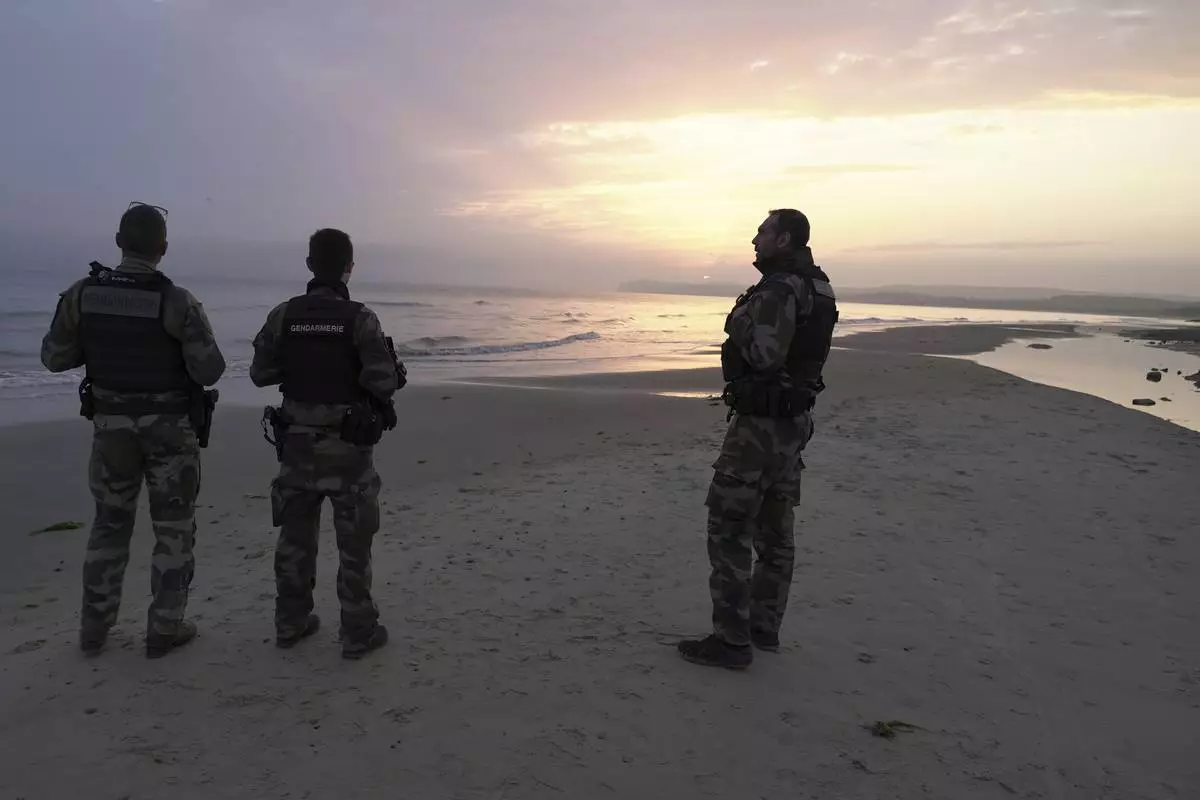
Gendarmes patrol on Chatelet beach, north of Boulogne-sur-Mer, northern France, Wednesday July 2, 2025. (AP Photo/John Leicester)
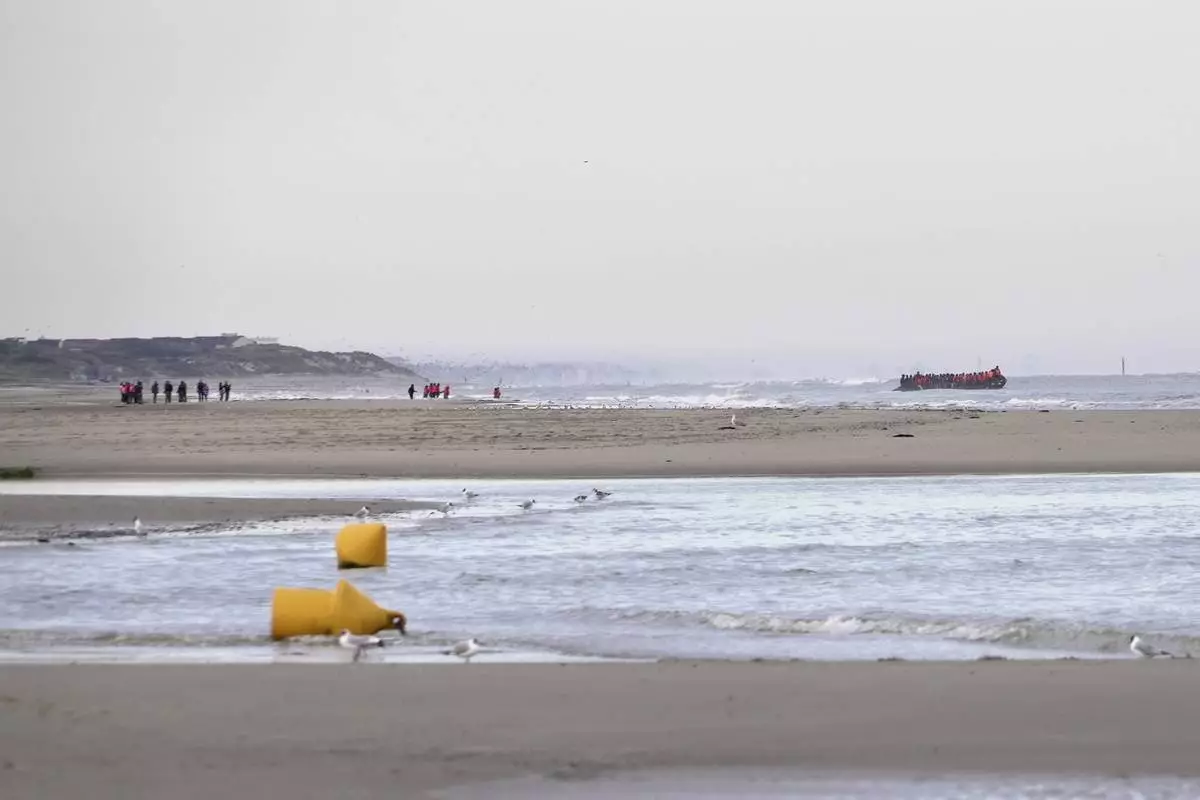
Gendarmes patrol on Chatelet beach, north of Boulogne-sur-Mer, northern France, Wednesday July 2, 2025. (AP Photo/John Leicester)

"Taxi boat" motor to pre-arranged off-shore pick-up points, where migrants waiting on the beaches then wade into the water, Friday July 4, 2025 on Hardelot beach south of Boulogne-sur-Mer, northern France. (AP Photo/John Leicester)
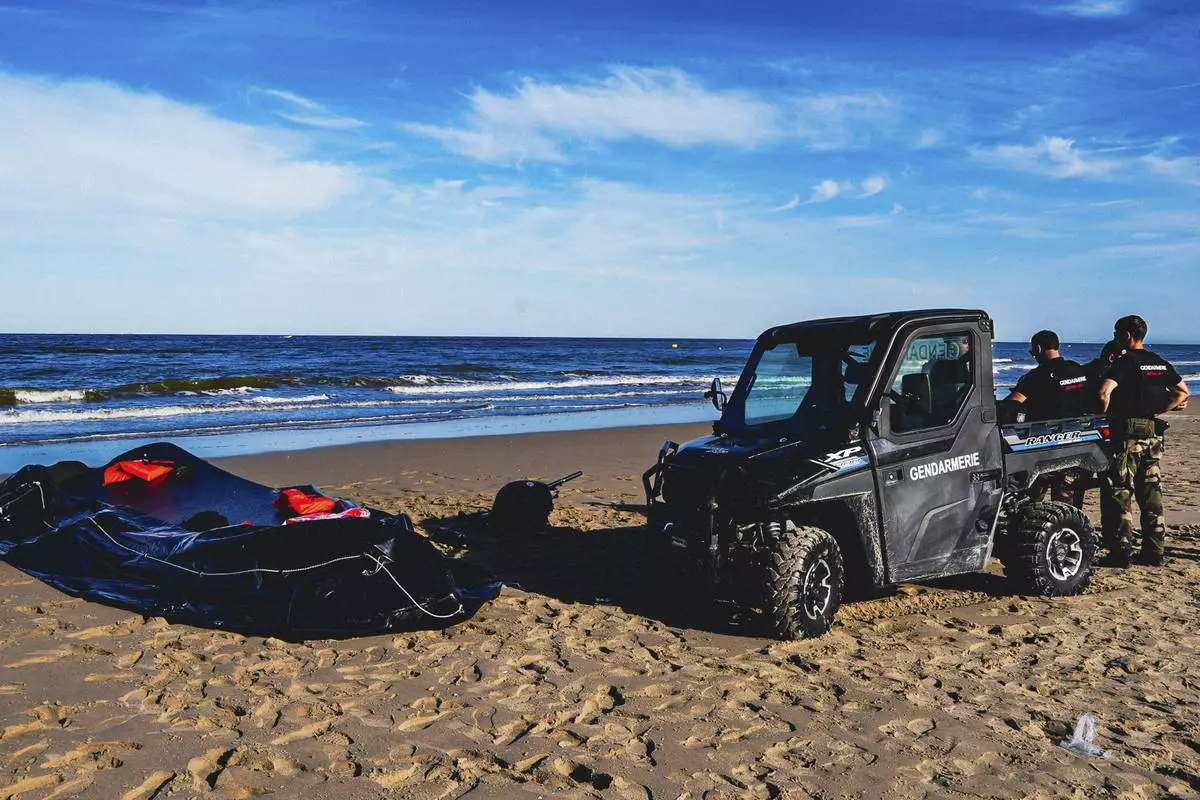
"Taxi boat" motor to pre-arranged off-shore pick-up points, where migrants waiting on the beaches then wade into the water, Friday July 4, 2025 on Hardelot beach south of Boulogne-sur-Mer, northern France. (AP Photo/John Leicester)

Police officers stand close to a ripped migrant inflatable dinghy lies on Ecault beach, northern France, Friday, July 4, 2025 northern France (AP Photo/Nicolas Garriga)
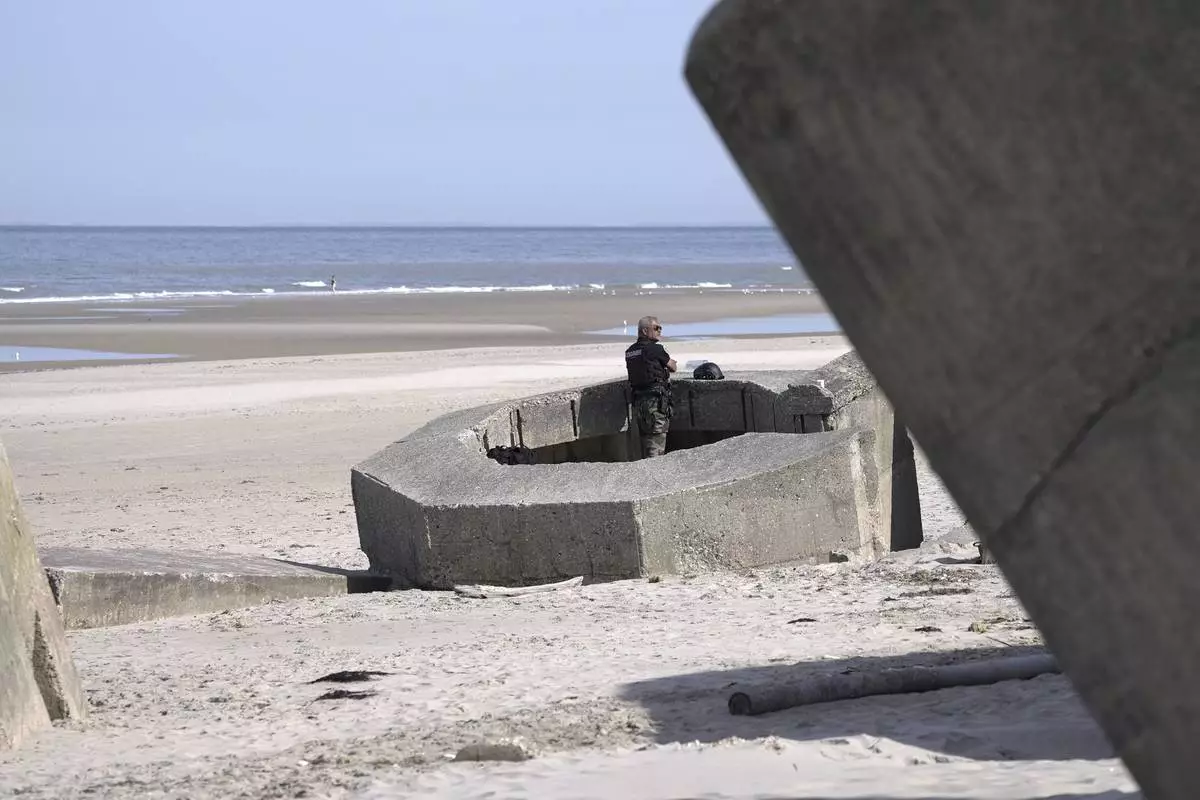
Police officers stand close to a ripped migrant inflatable dinghy lies on Ecault beach, northern France, Friday, July 4, 2025 northern France (AP Photo/Nicolas Garriga)

A gendarme stands in a WWII nazi bunker at Ecault beach, Friday July 4, 2025. (AP Photo/John Leicester)
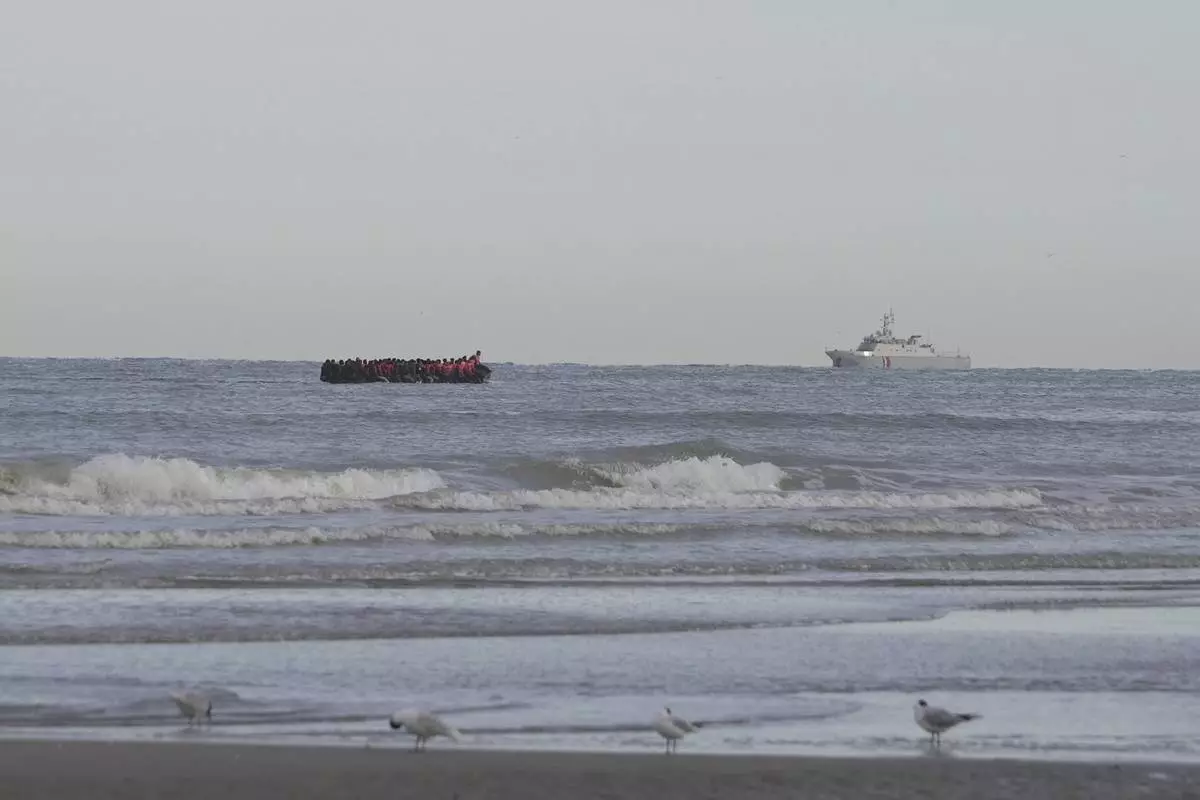
A gendarme stands in a WWII nazi bunker at Ecault beach, Friday July 4, 2025. (AP Photo/John Leicester)

A French Navy vessel sails by a "Taxi boat" carrying migrants, Friday July 4, 2025 on Hardelot beach south of Boulogne-sur-Mer, northern France. (AP Photo/John Leicester)


A French Navy vessel sails by a "Taxi boat" carrying migrants, Friday July 4, 2025 on Hardelot beach south of Boulogne-sur-Mer, northern France. (AP Photo/John Leicester)

WASHINGTON (AP) — Becky Pepper-Jackson finished third in the discus throw in West Virginia last year though she was in just her first year of high school. Now a 15-year-old sophomore, Pepper-Jackson is aware that her upcoming season could be her last.

West Virginia has banned transgender girls like Pepper-Jackson from competing in girls and women's sports, and is among the more than two dozen states with similar laws. Though the West Virginia law has been blocked by lower courts, the outcome could be different at the conservative-dominated Supreme Court, which has allowed multiple restrictions on transgender people to be enforced in the past year.

The justices are hearing arguments Tuesday in two cases over whether the sports bans violate the Constitution or the landmark federal law known as Title IX that prohibits sex discrimination in education. The second case comes from Idaho, where college student Lindsay Hecox challenged that state's law.

Decisions are expected by early summer.

President Donald Trump's Republican administration has targeted transgender Americans from the first day of his second term, including ousting transgender people from the military and declaring that gender is immutable and determined at birth.

Pepper-Jackson has become the face of the nationwide battle over the participation of transgender girls in athletics that has played out at both the state and federal levels as Republicans have leveraged the issue as a fight for athletic fairness for women and girls.

“I think it’s something that needs to be done,” Pepper-Jackson said in an interview with The Associated Press that was conducted over Zoom. “It’s something I’m here to do because ... this is important to me. I know it’s important to other people. So, like, I’m here for it.”

She sat alongside her mother, Heather Jackson, on a sofa in their home just outside Bridgeport, a rural West Virginia community about 40 miles southwest of Morgantown, to talk about a legal fight that began when she was a middle schooler who finished near the back of the pack in cross-country races.

Pepper-Jackson has grown into a competitive discus and shot put thrower. In addition to the bronze medal in the discus, she finished eighth among shot putters.

She attributes her success to hard work, practicing at school and in her backyard, and lifting weights. Pepper-Jackson has been taking puberty-blocking medication and has publicly identified as a girl since she was in the third grade, though the Supreme Court's decision in June upholding state bans on gender-affirming medical treatment for minors has forced her to go out of state for care.

Her very improvement as an athlete has been cited as a reason she should not be allowed to compete against girls.

“There are immutable physical and biological characteristic differences between men and women that make men bigger, stronger, and faster than women. And if we allow biological males to play sports against biological females, those differences will erode the ability and the places for women in these sports which we have fought so hard for over the last 50 years,” West Virginia's attorney general, JB McCuskey, said in an AP interview. McCuskey said he is not aware of any other transgender athlete in the state who has competed or is trying to compete in girls or women’s sports.

Despite the small numbers of transgender athletes, the issue has taken on outsize importance. The NCAA and the U.S. Olympic and Paralympic Committees banned transgender women from women's sports after Trump signed an executive order aimed at barring their participation.

The public generally is supportive of the limits. An Associated Press-NORC Center for Public Affairs Research poll conducted in October 2025 found that about 6 in 10 U.S. adults “strongly” or “somewhat” favored requiring transgender children and teenagers to only compete on sports teams that match the sex they were assigned at birth, not the gender they identify with, while about 2 in 10 were “strongly” or “somewhat” opposed and about one-quarter did not have an opinion.

About 2.1 million adults, or 0.8%, and 724,000 people age 13 to 17, or 3.3%, identify as transgender in the U.S., according to the Williams Institute at the UCLA School of Law.

Those allied with the administration on the issue paint it in broader terms than just sports, pointing to state laws, Trump administration policies and court rulings against transgender people.

"I think there are cultural, political, legal headwinds all supporting this notion that it’s just a lie that a man can be a woman," said John Bursch, a lawyer with the conservative Christian law firm Alliance Defending Freedom that has led the legal campaign against transgender people. “And if we want a society that respects women and girls, then we need to come to terms with that truth. And the sooner that we do that, the better it will be for women everywhere, whether that be in high school sports teams, high school locker rooms and showers, abused women’s shelters, women’s prisons.”

But Heather Jackson offered different terms to describe the effort to keep her daughter off West Virginia's playing fields.

“Hatred. It’s nothing but hatred,” she said. "This community is the community du jour. We have a long history of isolating marginalized parts of the community.”

Pepper-Jackson has seen some of the uglier side of the debate on display, including when a competitor wore a T-shirt at the championship meet that said, “Men Don't Belong in Women's Sports.”

“I wish these people would educate themselves. Just so they would know that I’m just there to have a good time. That’s it. But it just, it hurts sometimes, like, it gets to me sometimes, but I try to brush it off,” she said.

One schoolmate, identified as A.C. in court papers, said Pepper-Jackson has herself used graphic language in sexually bullying her teammates.

Asked whether she said any of what is alleged, Pepper-Jackson said, “I did not. And the school ruled that there was no evidence to prove that it was true.”

The legal fight will turn on whether the Constitution's equal protection clause or the Title IX anti-discrimination law protects transgender people.

The court ruled in 2020 that workplace discrimination against transgender people is sex discrimination, but refused to extend the logic of that decision to the case over health care for transgender minors.

The court has been deluged by dueling legal briefs from Republican- and Democratic-led states, members of Congress, athletes, doctors, scientists and scholars.

The outcome also could influence separate legal efforts seeking to bar transgender athletes in states that have continued to allow them to compete.

If Pepper-Jackson is forced to stop competing, she said she will still be able to lift weights and continue playing trumpet in the school concert and jazz bands.

“It will hurt a lot, and I know it will, but that’s what I’ll have to do,” she said.

Heather Jackson, left, and Becky Pepper-Jackson pose for a photograph outside of the U.S. Supreme Court in Washington, Sunday, Jan. 11, 2026. (AP Photo/Jose Luis Magana)

Heather Jackson, left, and Becky Pepper-Jackson pose for a photograph outside of the U.S. Supreme Court in Washington, Sunday, Jan. 11, 2026. (AP Photo/Jose Luis Magana)

Heather Jackson, left, and Becky Pepper-Jackson pose for a photograph outside of the U.S. Supreme Court in Washington, Sunday, Jan. 11, 2026. (AP Photo/Jose Luis Magana)

Heather Jackson, left, and Becky Pepper-Jackson pose for a photograph outside of the U.S. Supreme Court in Washington, Sunday, Jan. 11, 2026. (AP Photo/Jose Luis Magana)

Becky Pepper-Jackson poses for a photograph outside of the U.S. Supreme Court in Washington, Sunday, Jan. 11, 2026. (AP Photo/Jose Luis Magana)

Becky Pepper-Jackson poses for a photograph outside of the U.S. Supreme Court in Washington, Sunday, Jan. 11, 2026. (AP Photo/Jose Luis Magana)

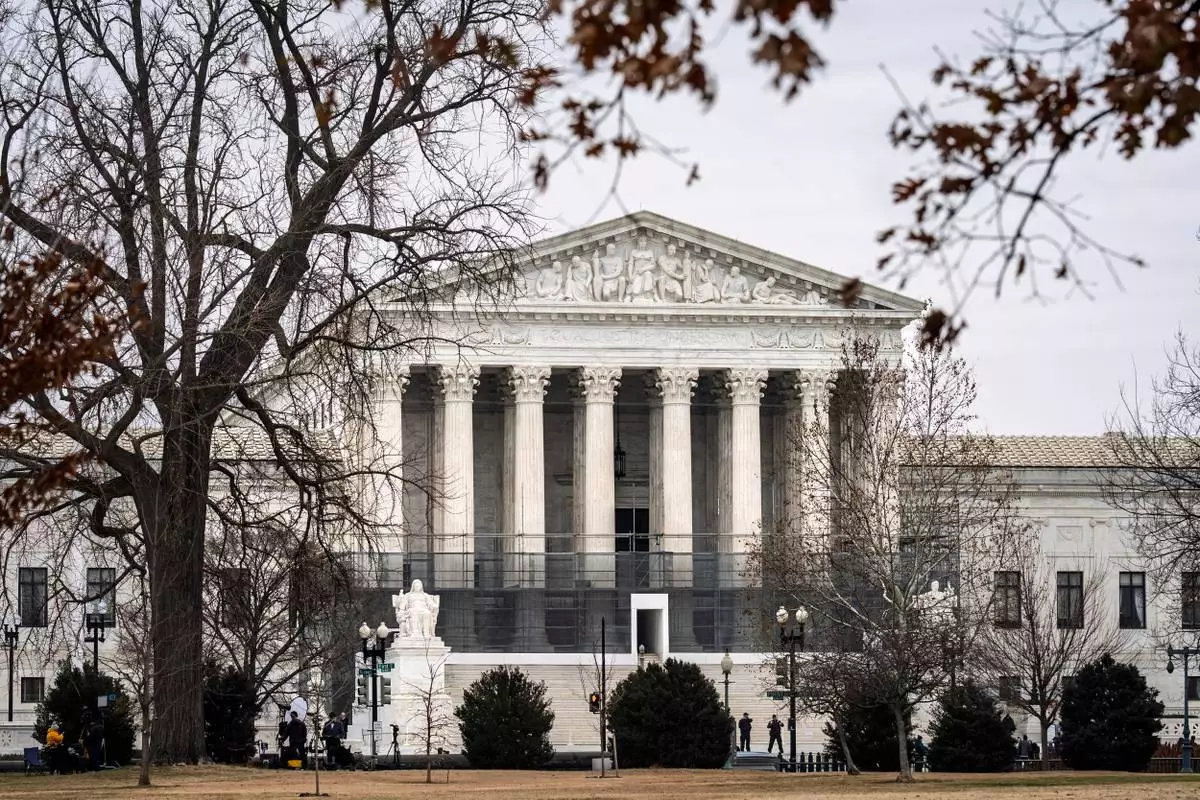
The Supreme Court stands is Washington, Friday, Jan. 9, 2026. (AP Photo/J. Scott Applewhite)

The Supreme Court stands is Washington, Friday, Jan. 9, 2026. (AP Photo/J. Scott Applewhite)

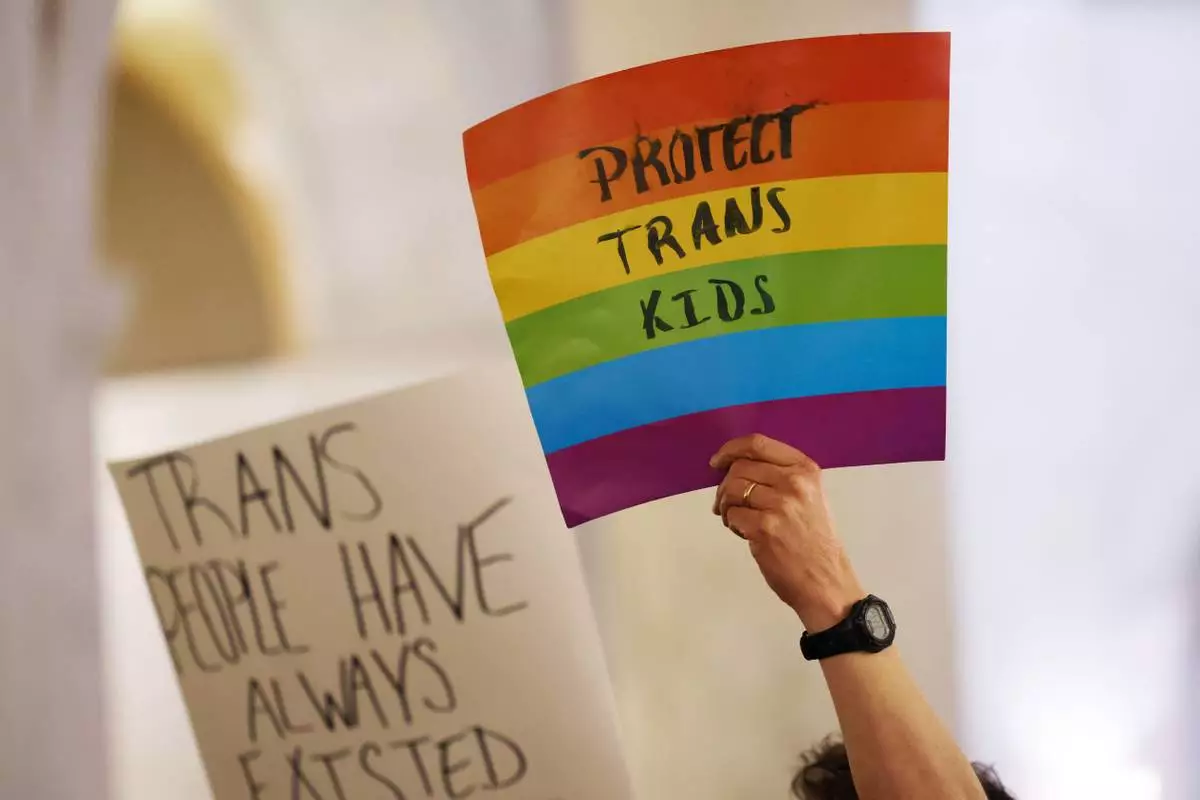
FILE - Protestors hold signs during a rally at the state capitol in Charleston, W.Va., on March 9, 2023. (AP Photo/Chris Jackson, file)

FILE - Protestors hold signs during a rally at the state capitol in Charleston, W.Va., on March 9, 2023. (AP Photo/Chris Jackson, file)

Recommended Articles