PORT-AU-PRINCE, Haiti (AP) — Haiti’s once-illustrious Grand Hôtel Oloffson, a beloved Gothic gingerbread home that inspired books, hosted parties until dawn and attracted visitors from Mick Jagger to Haitian presidents, was burned down by gangs this past weekend.
Hundreds of Haitians and foreigners mourned the news as it spread across social media, with the hotel manager on Monday confirming the fire on X. Even though gang violence had forced the hotel in Haiti's capital, Port-au-Prince, to close in recent years, many had hoped it would reopen.
“It birthed so much culture and expression,” said Riva Précil, a Haitian-American singer who lived in the hotel from age 5 to 15. In a tearful phone interview, Précil recalled how she learned to swim, dance and sing at the Oloffson.
Longtime hotel manager Richard Morse, who had been overseeing the property remotely from the United States since the hotel's closure in 2022, told The Associated Press on Monday that for several months, there were persistent rumors that the hotel had burned.
“So when I heard Sunday morning that it burned, I did what I usually do, which is call someone who has drones and have them go take a look,” he said. “This time, when they called back, they said something like, ‘take a seat.’ I knew then that this wasn’t like the other times.”
The attack on the community where the hotel was located began late Saturday, according to James Jean-Louis, who lives in the hills above the Oloffson. He told The Associated Press over the phone on Sunday that he observed the flames as he and other residents were chased out while police and gangs exchanged heavy gunfire.
Journalists are currently unable to visit the site and verify the damage at the hotel because gangs control the area, which remains inaccessible. Patrick Durandis, director of the Institute for Safeguarding National Heritage, also confirmed the fire in a message to the AP.
Among those lamenting the fire was Michael Deibert, author of “Notes From the Last Testament: The Struggle for Haiti,” and “Haiti Will Not Perish: A Recent History.”
He landed in Miami on Sunday only to open his phone and see a flurry of messages from friends in Haiti.
“When you went to the Oloffson, you really felt you were being connected with Haiti’s political and cultural history,” he said. “You went to Haiti and were never the same. And the Oloffson really captured that.”
The hotel attracted artists, intellectuals and politicians from Haiti and beyond, including Jacqueline Onassis and Tennessee Williams. It also survived coups, dictatorships and the devastating 2010 earthquake.
Isabelle Morse, daughter of Richard Morse, said he loved having writers, photographers and other artists at the Oloffson.
“His sense of community was very important to him,” she said in a phone interview Monday, describing the hotel as “his whole life.”
“For him, it represented freedom, where people from all walks of life could come in and share that space," she said.
Richard Morse said he was reluctant to talk about what happened to the hotel given that in Haiti “so many people are dying and being raped and losing everything that I don’t want the focus to be on the hotel.”
Morse spent nearly 30 years at the Oloffson. It's where he met his wife, had his children and started his band, RAM.
“There’s no life without hope, so we have to consider bringing Haiti back and bringing the hotel back and bringing the art and the culture back,” he said.
Isabelle Morse said her parents had hoped to reopen the Oloffson.
“It’s not only a business, it’s our home. We were raised there,” she said. “It was more about moving back home rather than reopening the business.”
The Oloffson served as a presidential summer palace in the early 1900s and then became a U.S. Marine Corps Hospital before a Swedish sea captain converted it into a hotel in the 1930s.
It also served as inspiration for the fictional Hotel Trianon in Graham Greene’s 1966 novel “The Comedians,” set in Haiti under the brutal dictatorship of Francois Duvalier, best known as “Papa Doc.”
In real life, tourism dwindled under the Duvaliers, and the hotel became a respite for aid workers and foreign correspondents.
In the late 1980s, Richard Morse became the hotel’s manager. His band, RAM, played Haitian roots music on Thursday nights that became legendary, as were the Day of the Dead celebrations known as Fèt Gede that drew in Vodou practitioners.
“It was a vessel for so many people to gather and freely express themselves,” Précil recalled. “RAM really created that culture and that environment, made it a space that welcomed people from all types of denominations and sexual preferences.”
The Oloffson was nestled in the upscale community of Pacot in the southeast corner of the country's capital. It was surrounded by lush gardens and often described as a mythical place, renowned for its intricate latticework, turrets and spires and creaking parquet floors that characterize Haiti's endangered gingerbread homes.
A 1940s advertisement by Haiti’s tourism department said that the hotel was situated “in the coolest section of the town” and noted that English, French, German and Spanish were spoken there.
The hotel closed in recent years as gangs began raiding and seizing control of once peaceful communities.
“A lot of Haiti’s architectural heritage is going up in flames right now with so-called leaders stand by with their hands in their pockets,” Deibert said. ”The destruction of the Oloffson is symbolic of the destruction of Haiti’s history and culture that we’ve been watching over the last several years.”
Coto reported from San Juan, Puerto Rico.

Security guards stand watch as Haiti's Prime Minister Alix Didier Fils-Aime, center, talks with the Mexico's Charge d'Affaires Jesus Cisneros after attending an event marking one year since the start of the Multinational Security Support Mission in Port-au-Prince, Haiti, Thursday, June 26, 2025. (AP Photo/Odelyn Joseph)
WASHINGTON (AP) — Becky Pepper-Jackson finished third in the discus throw in West Virginia last year though she was in just her first year of high school. Now a 15-year-old sophomore, Pepper-Jackson is aware that her upcoming season could be her last.
West Virginia has banned transgender girls like Pepper-Jackson from competing in girls and women's sports, and is among the more than two dozen states with similar laws. Though the West Virginia law has been blocked by lower courts, the outcome could be different at the conservative-dominated Supreme Court, which has allowed multiple restrictions on transgender people to be enforced in the past year.
The justices are hearing arguments Tuesday in two cases over whether the sports bans violate the Constitution or the landmark federal law known as Title IX that prohibits sex discrimination in education. The second case comes from Idaho, where college student Lindsay Hecox challenged that state's law.
Decisions are expected by early summer.
President Donald Trump's Republican administration has targeted transgender Americans from the first day of his second term, including ousting transgender people from the military and declaring that gender is immutable and determined at birth.
Pepper-Jackson has become the face of the nationwide battle over the participation of transgender girls in athletics that has played out at both the state and federal levels as Republicans have leveraged the issue as a fight for athletic fairness for women and girls.
“I think it’s something that needs to be done,” Pepper-Jackson said in an interview with The Associated Press that was conducted over Zoom. “It’s something I’m here to do because ... this is important to me. I know it’s important to other people. So, like, I’m here for it.”
She sat alongside her mother, Heather Jackson, on a sofa in their home just outside Bridgeport, a rural West Virginia community about 40 miles southwest of Morgantown, to talk about a legal fight that began when she was a middle schooler who finished near the back of the pack in cross-country races.
Pepper-Jackson has grown into a competitive discus and shot put thrower. In addition to the bronze medal in the discus, she finished eighth among shot putters.
She attributes her success to hard work, practicing at school and in her backyard, and lifting weights. Pepper-Jackson has been taking puberty-blocking medication and has publicly identified as a girl since she was in the third grade, though the Supreme Court's decision in June upholding state bans on gender-affirming medical treatment for minors has forced her to go out of state for care.
Her very improvement as an athlete has been cited as a reason she should not be allowed to compete against girls.
“There are immutable physical and biological characteristic differences between men and women that make men bigger, stronger, and faster than women. And if we allow biological males to play sports against biological females, those differences will erode the ability and the places for women in these sports which we have fought so hard for over the last 50 years,” West Virginia's attorney general, JB McCuskey, said in an AP interview. McCuskey said he is not aware of any other transgender athlete in the state who has competed or is trying to compete in girls or women’s sports.
Despite the small numbers of transgender athletes, the issue has taken on outsize importance. The NCAA and the U.S. Olympic and Paralympic Committees banned transgender women from women's sports after Trump signed an executive order aimed at barring their participation.
The public generally is supportive of the limits. An Associated Press-NORC Center for Public Affairs Research poll conducted in October 2025 found that about 6 in 10 U.S. adults “strongly” or “somewhat” favored requiring transgender children and teenagers to only compete on sports teams that match the sex they were assigned at birth, not the gender they identify with, while about 2 in 10 were “strongly” or “somewhat” opposed and about one-quarter did not have an opinion.
About 2.1 million adults, or 0.8%, and 724,000 people age 13 to 17, or 3.3%, identify as transgender in the U.S., according to the Williams Institute at the UCLA School of Law.
Those allied with the administration on the issue paint it in broader terms than just sports, pointing to state laws, Trump administration policies and court rulings against transgender people.
"I think there are cultural, political, legal headwinds all supporting this notion that it’s just a lie that a man can be a woman," said John Bursch, a lawyer with the conservative Christian law firm Alliance Defending Freedom that has led the legal campaign against transgender people. “And if we want a society that respects women and girls, then we need to come to terms with that truth. And the sooner that we do that, the better it will be for women everywhere, whether that be in high school sports teams, high school locker rooms and showers, abused women’s shelters, women’s prisons.”
But Heather Jackson offered different terms to describe the effort to keep her daughter off West Virginia's playing fields.
“Hatred. It’s nothing but hatred,” she said. "This community is the community du jour. We have a long history of isolating marginalized parts of the community.”
Pepper-Jackson has seen some of the uglier side of the debate on display, including when a competitor wore a T-shirt at the championship meet that said, “Men Don't Belong in Women's Sports.”
“I wish these people would educate themselves. Just so they would know that I’m just there to have a good time. That’s it. But it just, it hurts sometimes, like, it gets to me sometimes, but I try to brush it off,” she said.
One schoolmate, identified as A.C. in court papers, said Pepper-Jackson has herself used graphic language in sexually bullying her teammates.
Asked whether she said any of what is alleged, Pepper-Jackson said, “I did not. And the school ruled that there was no evidence to prove that it was true.”
The legal fight will turn on whether the Constitution's equal protection clause or the Title IX anti-discrimination law protects transgender people.
The court ruled in 2020 that workplace discrimination against transgender people is sex discrimination, but refused to extend the logic of that decision to the case over health care for transgender minors.
The court has been deluged by dueling legal briefs from Republican- and Democratic-led states, members of Congress, athletes, doctors, scientists and scholars.
The outcome also could influence separate legal efforts seeking to bar transgender athletes in states that have continued to allow them to compete.
If Pepper-Jackson is forced to stop competing, she said she will still be able to lift weights and continue playing trumpet in the school concert and jazz bands.
“It will hurt a lot, and I know it will, but that’s what I’ll have to do,” she said.

Heather Jackson, left, and Becky Pepper-Jackson pose for a photograph outside of the U.S. Supreme Court in Washington, Sunday, Jan. 11, 2026. (AP Photo/Jose Luis Magana)

Heather Jackson, left, and Becky Pepper-Jackson pose for a photograph outside of the U.S. Supreme Court in Washington, Sunday, Jan. 11, 2026. (AP Photo/Jose Luis Magana)

Becky Pepper-Jackson poses for a photograph outside of the U.S. Supreme Court in Washington, Sunday, Jan. 11, 2026. (AP Photo/Jose Luis Magana)
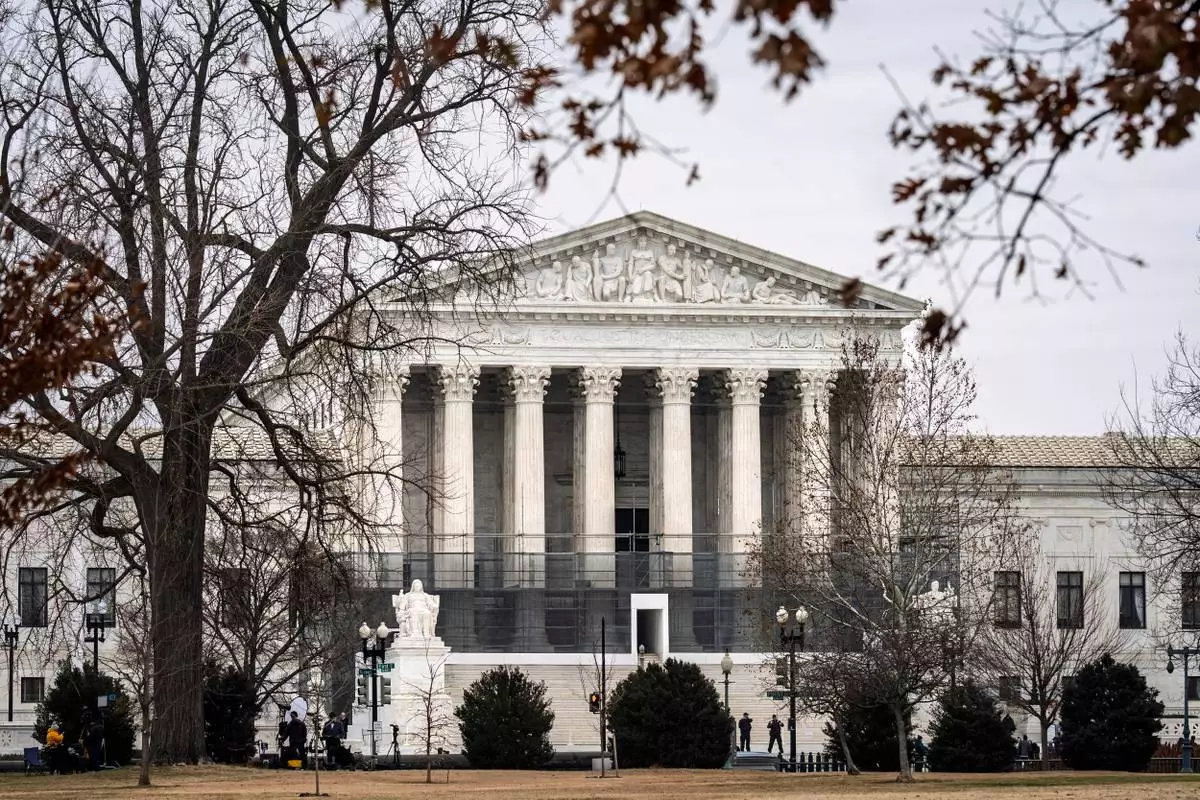
The Supreme Court stands is Washington, Friday, Jan. 9, 2026. (AP Photo/J. Scott Applewhite)
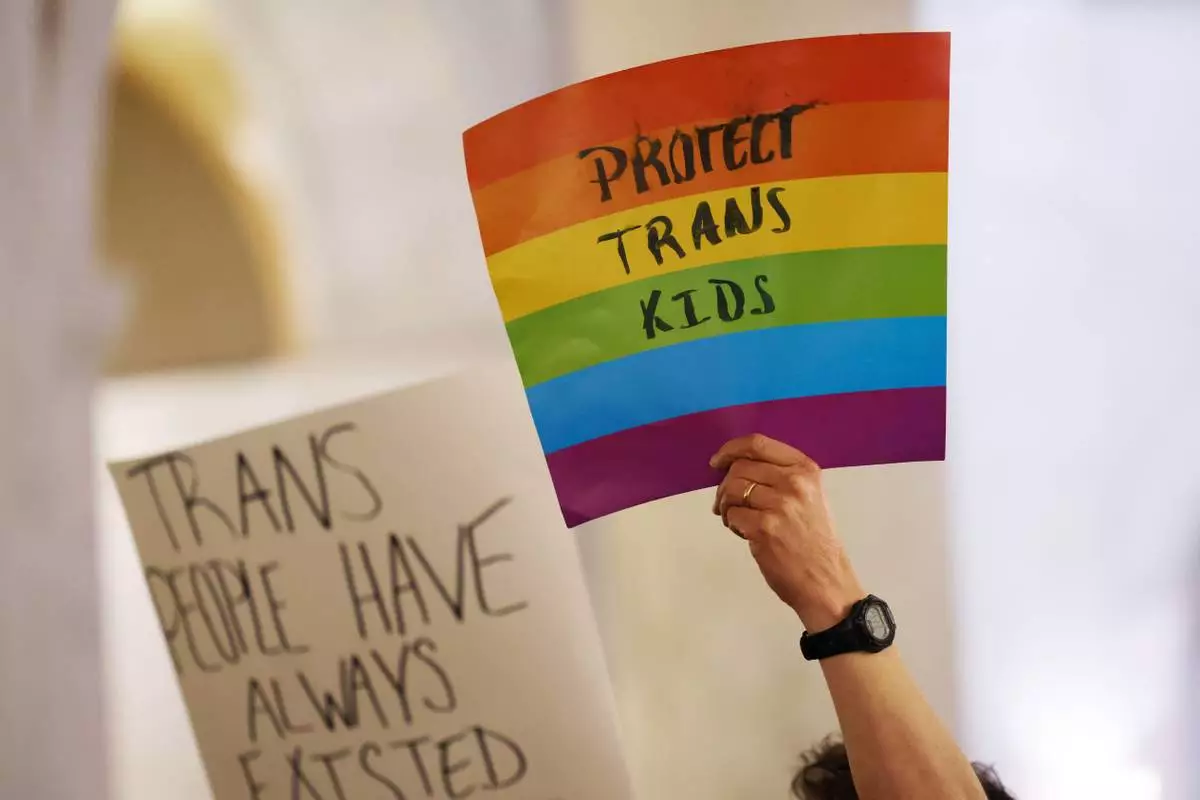
FILE - Protestors hold signs during a rally at the state capitol in Charleston, W.Va., on March 9, 2023. (AP Photo/Chris Jackson, file)