WASHINGTON (AP) — When President Donald Trump last rolled out tariffs this high, financial markets quaked, consumer confidence crashed and his popularity plunged.
Only three months later, he’s betting this time is different.
In his new round of tariffs being announced this week, Trump is essentially tethering the entire world economy to his instinctual belief that import taxes will deliver factory jobs and stronger growth in the U.S., rather than the inflation and slowdown predicted by many economists.
On Tuesday, he told his Cabinet that past presidents who hadn't aggressively deployed tariffs were “stupid.” Ever the salesman, Trump added that it was “too time-consuming” to try to negotiate trade deals with the rest of the world, so it was just easier to send them letters, as he's doing this week, that list the tariff rates on their goods.
The letters marked a change from his self-proclaimed April 2 “Liberation Day” event at the White House, where he had posterboards with the rates displayed, a choice that led to a brief market meltdown and the 90-day negotiating period with baseline 10% tariffs that will end Wednesday. Trump, instead, chose to send form letters with random capitalizations and punctuation and other formatting issues.
“It’s a better way,” Trump said of his letters. "It’s a more powerful way. And we send them a letter. You read the letter. I think it was well crafted. And, mostly it’s just a little number in there: You’ll pay 25%, 35%. We have some of at 60, 70."
When Trump said those words, he had yet to issue a letter with a tariff rate higher than 40%, which he levied Monday on Laos and Myanmar. He plans to put 25% tariffs on Japan and South Korea, two major trading partners and allies deemed crucial for curbing China's economic influence. Leaders of the 14 countries tariffed so far hope to negotiate over the next three weeks before the higher rates are charged on imports.
“I would say that every case I’m treating them better than they treated us over the years,” Trump said.
The president said Tuesday evening on Truth Social that he would be releasing letters to “a minimum of 7 Countries” on Wednesday morning, with additional letters coming out in the afternoon.
His approach is at odds with how major trade agreements have been produced over the last half-century, detailed sessions that could sometimes take years to solve complex differences between nations.
There are three possible outcomes to this political and economic wager, each of which could drastically reshape international affairs and Trump's legacy.
Trump could prove most economic experts wrong and the tariffs could deliver growth as promised. Or he could retreat again on tariffs before their Aug. 1 start in a repeat of the “Trump Always Chickens Out” phenomenon, also known as TACO. Or he could damage the economy in ways that could boomerang against the communities that helped return him to the White House last year, as well as hurt countries that are put at a financial disadvantage by the tariffs.
Sen. Ron Wyden, D-Ore., said Trump's letters had “extended his tariff purgatory for another month,” essentially freezing in place the U.S. economy as CEOs, foreign leaders and consumers are unclear of Trump's actual strategy on foreign trade.
“The TACO negotiating tactic pioneered by Trump is making his threats less and less credible and reducing our trading partners’ willingness to even meet us halfway,” Wyden said. “There’s no sign that he’s any closer to striking durable trade deals that would actually help American workers and businesses.”
So far, the stock and bond markets are relatively calm, with the S&P 500 stock index essentially flat Tuesday after a Monday decline. Trump is coming off a legislative win with his multitrillion-dollar income tax cuts. And he's confidently levying tariffs at levels that previously rocked global markets, buoyed by the fact that inflation has eased so far instead of accelerating as many economists and Democratic rivals had warned.
“By floating tariffs as high as 40% to even 100%, the administration has ‘normalized’ the 25% tariff hikes — yet this is still one of the most aggressive and disruptive tariff moves in modern history," said Wendong Zhang, an economist at Cornell University. "This gradual unveiling, paradoxically, risks normalizing what would otherwise be considered exceptionally large tariff hikes."
Others simply see Trump as a source of nonstop chaos, with the letters and their somewhat random tariff rates showing the absence of a genuine policy process inside his administration.
“It’s really just a validation that this policy is all over the place, that they’re running this by the seat of their pants, that there is no real strategy," said Desmond Lachman, a senior fellow at the American Enterprise Institute, a right-leaning think tank.
With Trump's 90-day tariff negotiation period ending, he as of Monday had sent letters to 14 countries that place taxes on imported goods ranging from 25% to 40%. He said Tuesday he would sign an order to place 50% tariffs on copper and added that at some point pharmaceutical drugs could face tariffs of as much as 200%. All of that is on top of his existing 50% tariffs on steel and aluminum, 25% tariffs on autos and his separate import taxes on Canada, Mexico and China.
“The obvious inference is that markets for now are somewhat skeptical that Trump will go through with it, or alternatively they think compromises will be reached,” said Ben May, a director of global economic research at the consultancy Oxford Economics. “That’s probably the key element.”
May said the tariffs are likely to reduce the growth in U.S. household incomes, but not cause those incomes to shrink outright.
Trump has said his tariffs would close U.S. trade imbalances, though it's unclear why he would target nations such as Tunisia that do relatively little trade with America. Administration officials say trillions of dollars in tariff revenues over the next decade would help offset the revenue losses from the continuation and expansion of his 2017 tax cuts that were signed into law Friday.
The federal government has collected $98.2 billion in tariff revenues so far this year, more than double what it collected last year, according to the Bipartisan Policy Center.
At Tuesday's Cabinet meeting, Treasury Secretary Scott Bessent said the tariff revenues could be “well over $300 billion by the end of the year.” Bessent added that “we don’t agree” with the Congressional Budget Office estimate that tariffs would bring in $2.8 trillion over 10 years, “which we think is probably low.”
The governments of Japan, South Korea, Malaysia, Myanmar, Thailand, Cambodia and South Africa have each said they hope for further negotiations on tariffs with Trump, though it's unclear how that's possible as Trump has said it would be too “complicated” to hold all those meetings.
Instead on Tuesday, Trump posted on social media that the tariffs would be charged as scheduled starting Aug. 1.
"There has been no change to this date, and there will be no change," Trump said on Truth Social. “No extensions will be granted.”
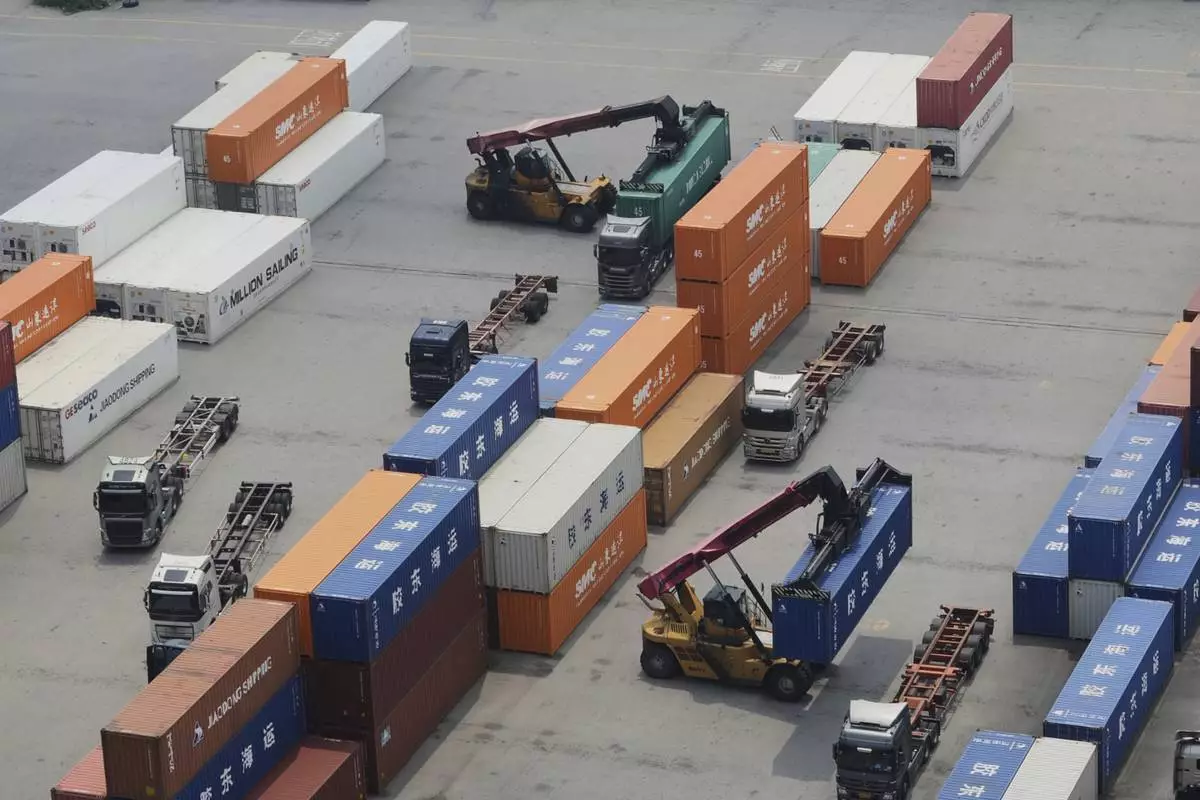
Cranes and shipping containers are seen at a port in Pyeongtaek, South Korea, Tuesday, July 8, 2025. (AP Photo/Ahn Young-joon)
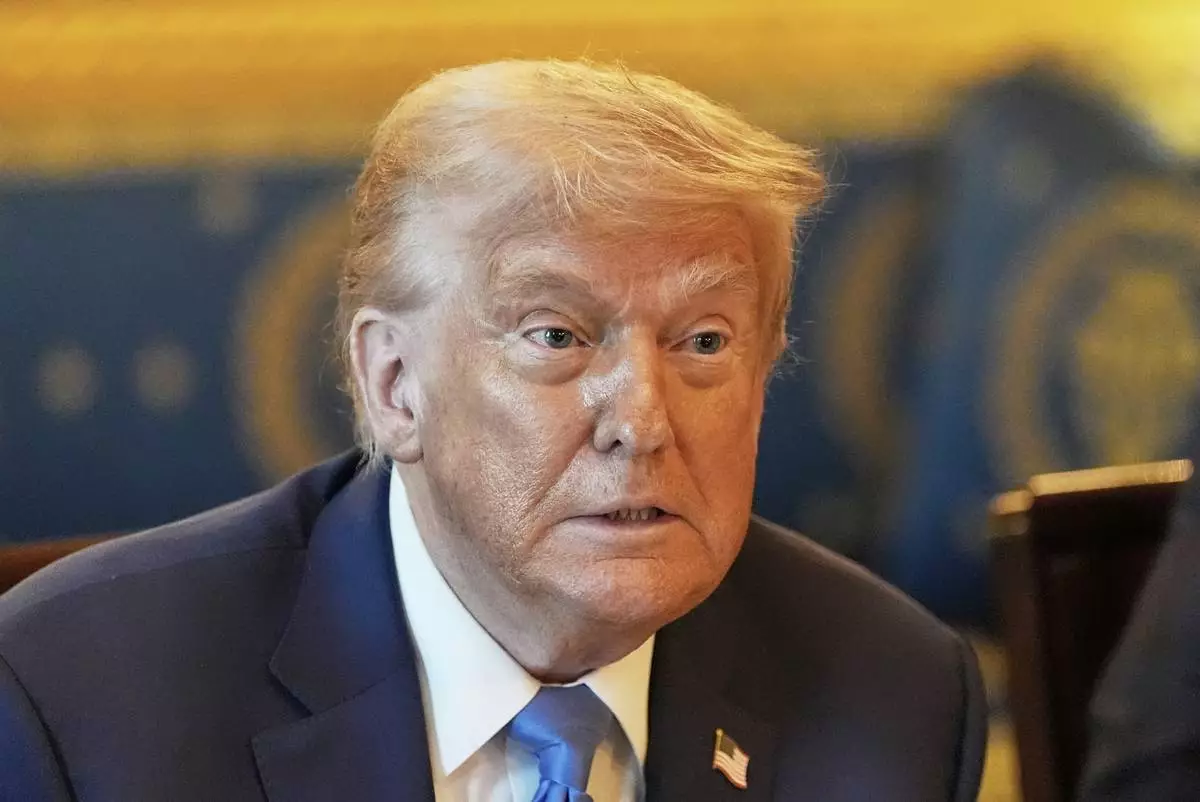
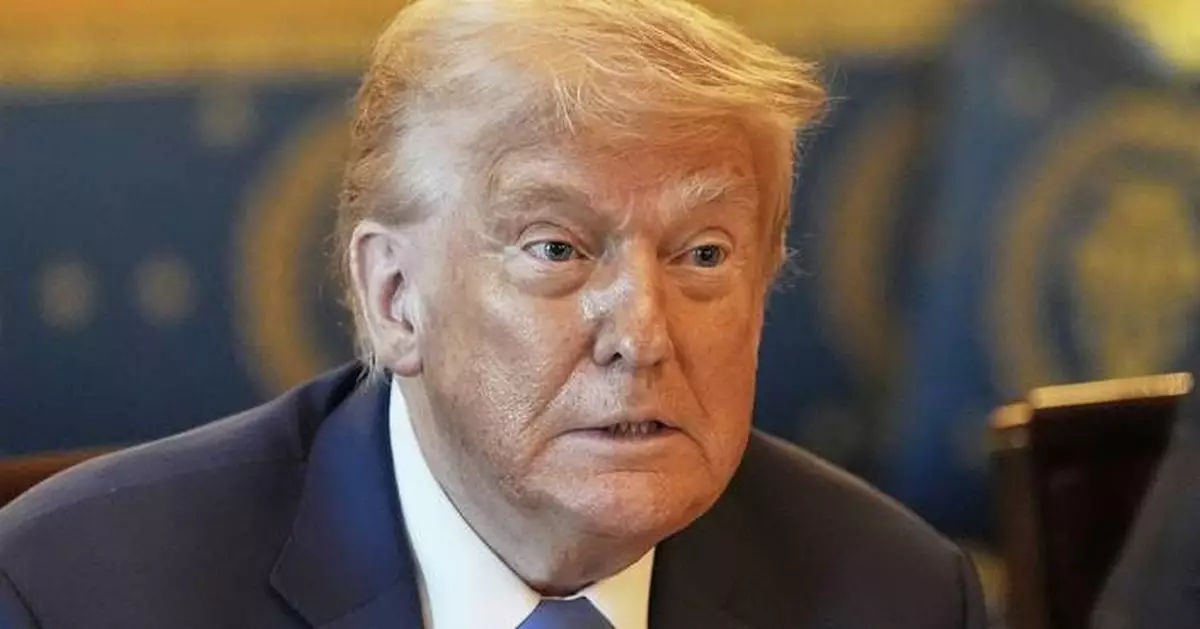
President Donald Trump attends a meeting with Israel's Prime Minister Benjamin Netanyahu in the Blue Room of the White House, Monday, July 7, 2025, in Washington. (AP Photo/Alex Brandon)