The royal mausoleums complex of the emperors in ancient China's Western Xia Dynasty (1038-1227) is currently under review for UNESCO World Heritage status at the ongoing 47th World Heritage Committee session.
The burial complex, located at the foot of the Helan Mountain, 30 km west of the city of Yinchuan, capital of northwest China's Ningxia Hui Autonomous Region, is the best-preserved and largest cultural heritage site from the ancient Tangut civilization. The Tangut people were a Han-Tibetan people who founded and inhabited the Western Xia Dynasty
The site was accidentally discovered in the 1930s by German pilot Wulf-Dieter Castell. It was later recognized as one of China's top archaeological finds of the 20th century.
The mausoleum offers crucial insights into the Western Xia Dynasty, which ruled for nearly two centuries.
"The Western Xia Mausoleum is the largest, the highest-grade and best-preserved archaeological site from the Western Xia period," said Ren Xiufen, head of the cultural relics protection section at the site administration.
The Western Xia Mausoleum comprises nine imperial tombs, 271 subordinate tombs, the ruins of 32 flood control facilities and the site of one large architectural complex, according to Ren.
"The nine imperial tombs are arranged sequentially from the south to the north. In its overall layout, the Western Xia Mausoleum preserves the central axis symmetry of the Central Plains. Many of the structures, such as the mausoleum city and some of the stele pavilions, were inherited from the Tang (618-907) and Song (960-1279) Dynasties. It also retains many ethnic features, such as in the core buildings, mausoleum towers and sacrificial halls. The central axis of the core building is biased to the west. This reflects the traditional Tangut belief that ghosts and gods inhabit the center," Ren explained.
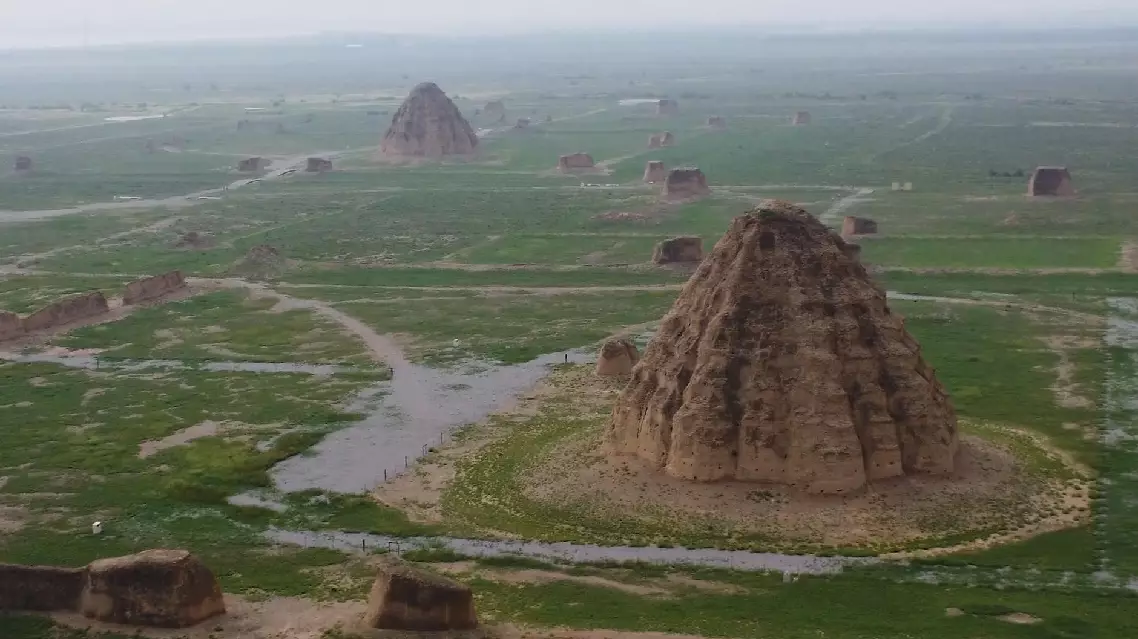
Ancient China's Western Xia Imperial Tombs nominated for World Heritage status
The Chinese Embassy in South Africa on Monday held an event in Pretoria, the country's administrative capital, to celebrate the launch of the 2026 China-Africa Year of People-to-People Exchanges.
This year also marks the 70th anniversary of the establishment of diplomatic relations between China and African countries.
Chinese Ambassador to South Africa Wu Peng said that over the past seven decades, under the joint guidance of leaders from both sides, China-Africa people-to-people and cultural exchanges have continued to expand, yielding fruitful outcomes.
Noting that the world is undergoing profound changes unseen in a century, Wu said China and Africa need to uphold fairness and justice, strengthen solidarity and mutual assistance, and enhance exchanges and cooperation more than ever before.
Taking the launch of the China-Africa Year of People-to-people Exchanges as an opportunity, Wu called for upholding the original aspiration of friendship, solidifying the foundation of cooperation, enhancing two-way efforts, and accelerating the building of an all-weather China-Africa community with a shared future for the new era.
Mmapaseka Steve Letsike, South Africa's deputy minister of women, youth, and persons with disabilities, said South Africa and China enjoy strong and historic bonds of friendship as close international cooperation partners in the political, economic, social, technical and multilateral domains.
"The significance of people-to-people is really about how we elevate the people's life to a just and equitable stance that we want to see. We want a better Africa; we want a better world. And that for us is significant," said Letsike.
"Through people-to-people exchanges, we promote mutual understanding, and that is the basis of building mutual trust, building peaceful coexistence. People-to-people exchange is a very important instrument for peace and mutual understanding," said Bongani Maimele, director of international relations with South Africa's National School of Government.
The opening ceremony of the 2026 China-Africa Year of People-to-People Exchanges was held at the African Union headquarters on Jan 8. According to the Chinese Foreign Ministry, the two sides will jointly host nearly 600 cultural and people-to-people exchange activities in 2026 to enhance exchanges and mutual learning between the two civilizations, and promote mutual understanding and connection between the peoples.
Organizing the 2026 China-Africa Year of People-to-People Exchanges is an important consensus reached by leaders from both sides at the Forum on China-Africa Cooperation Beijing Summit in 2024.
Chinese Embassy in South Africa unveils 2026 China-Africa Year of People-to-People Exchanges