China released a series of brain mapping research results in world-renowned academic journals on Thursday, sharing breakthroughs in high-precision neurological mapping in higher-level species with the global scientific community.
The brain is the most complex and sophisticated organ in the human body, composed of approximately 86 billion neurons and trillions of neural connections. Exploring its inner workings is a crucial area of interest in the international scientific community.
The ground-breaking research, which achieved a leap in single-cell resolution brain maps from rodents to primates, was completed by Chinese research institutions including the Center for Excellence in Brain Science and Intelligence Technology of the Chinese Academy of Sciences (CAS) and the BGI Research, as well as scientists from countries such as France, Sweden, and the United Kingdom, after years of sincere efforts.
Ten landmark findings were published in international academic journals such as Cell and Neuron.
The results cover key species such as reptiles, birds, rodents, non-human primates and humans, significantly advancing the international standard for brain mapping research in cross-species comparisons and spatiotemporal dynamic analysis.
These achievements mark a shift from prior incremental progress, enabling a transition from mere structural understanding to functional research, as well as providing new perspectives and critical tools for unraveling the mysteries of the brain.
"China's brain research plan is broader and more comprehensive than that of other countries, especially Europe and the United States. In addition to basic brain science, we attach great importance to its practical application, that is, the diagnosis and treatment of brain diseases, as well as the promotion of a new generation of brain-like artificial intelligence, including the promotion of brain-computer interfaces, all of which are carried out simultaneously. Therefore, we have a plan of 'one body, two wings'. The one body is basic research, and the two wings are two major application directions," said CAS academician Pu Muming, also director of the CAS Center for Excellence in Brain Science and Intelligence Technology.
As one of China's key international mega-science initiatives, the brain mapping project is progressively focusing its core mission toward creating an atlas of whole-brain neural connectivity at single-cell resolution for both non-human primates and humans.
This latest series of achievements under the project represents a collaborative effort by more than 300 researchers across over 30 domestic and international research institutions, which will provide crucial support for understanding brain function mechanisms, according to the researchers behind the breakthroughs.
"The study of brain maps is of great significance. It provides important support for our understanding of the working principles of the brain, understanding diseases, and developing targets and plans for treating diseases. Another very important significance is that we can draw on the architectural principles of the human brain or primate brain to inspire the development of brain-like artificial intelligence," said Sun Yangang, deputy director of the CAS research center.
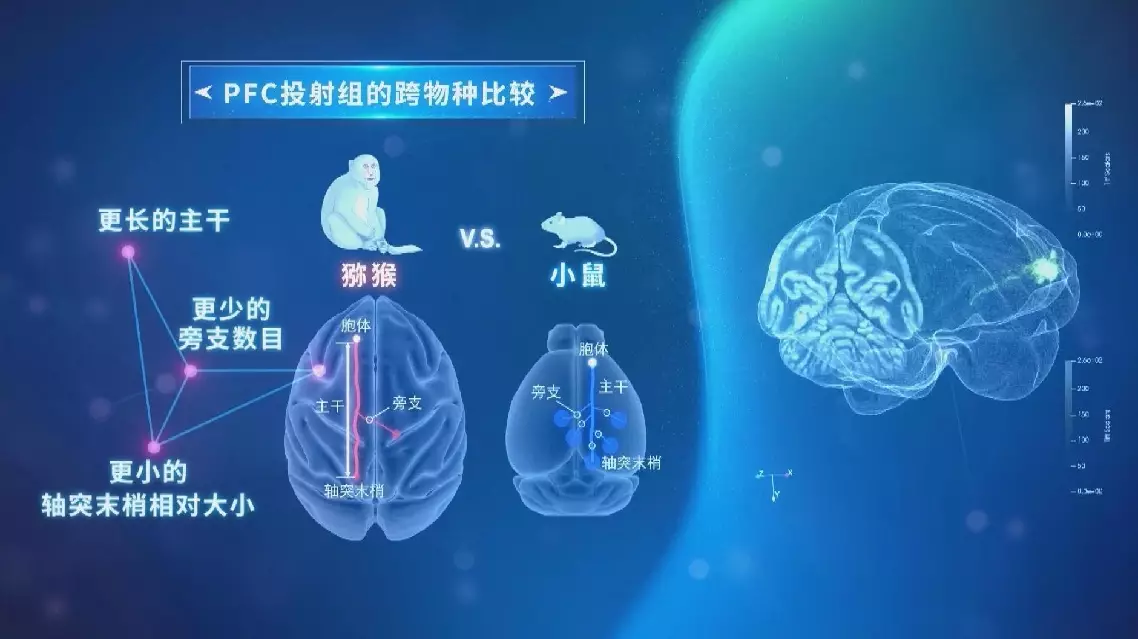
China publishes groundbreaking achievements in brain mapping