 |
- Europe exits two-year slump, led by German export rebound and domestic demand recovery
- U.S. manufacturers purchasing surges ahead of U.S. 'tariff pause' ending
- Asia supply chains pick up, though capacity remains underutilized in Southeast Asia
- No signs of cost inflation escalation yet despite the 10% universal tariff imposed by the U.S.
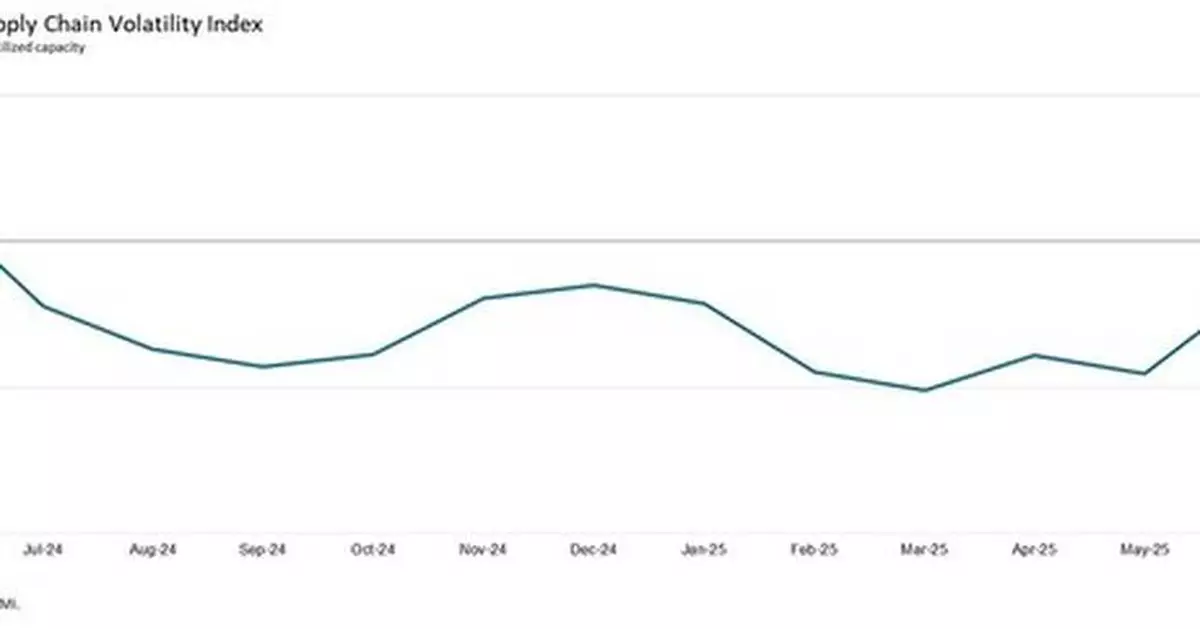
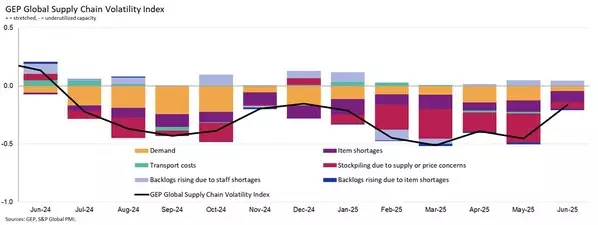
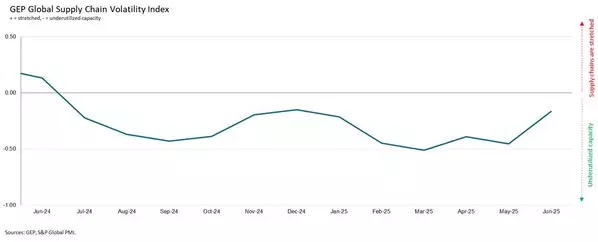
CLARK, N.J., July 11, 2025 /PRNewswire/ -- GEP Global Supply Chain Volatility Index — a leading indicator tracking demand conditions, shortages, transportation costs, inventories, and backlogs based on a monthly survey of 27,000 businesses — jumped to -0.17 in June, from -0.46 in May, its highest in 2025 as worldwide supply chain activity picked up despite the 10% tariffs imposed by the US administration.
For the first time in more than two years, European manufacturers operated at full tilt, driven by front-loaded orders from US customers, and a rebound in both domestic and export demand, particularly across Germany.
In North America, demand for inputs surged as U.S. manufacturers moved quickly to secure inputs – commodities, parts, components and raw materials – ahead of a potential end to the current tariff pause.
Asia's supply chains also showed signs of recovery, with stronger activity in India, Japan, and South Korea. However, spare capacity remains across Southeast Asia, where factory purchasing continues to lag, notably in China.
Notably, there is no evidence in the data of cost inflation escalating dramatically, despite the tariffs.
"In June, Europe shook off its long slump and global supply chains ran at full capacity — despite the uncertainty and on-and-off again tariffs," said John Piatek, VP, Consulting, GEP. "But under the surface, companies are putting in place contingencies: stockpiling inputs, reshaping supplier networks, near-shoring operations, and securing supply chain financing."
Interpreting the data:
Index > 0, supply chain capacity is being stretched. The further above 0, the more stretched supply chains are.
Index < 0, supply chain capacity is being underutilized. The further below 0, the more underutilized supply chains are.
Interpreting the data:
Index > 0, supply chain capacity is being stretched. The further above 0, the more stretched supply chains are.
Index < 0, supply chain capacity is being underutilized. The further below 0, the more underutilized supply chains are.
JUNE 2025 REGIONAL KEY FINDINGS
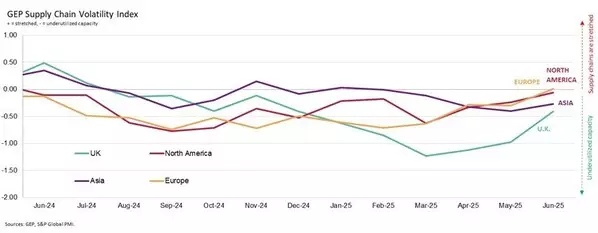
- ASIA: Index rises to -0.27, from -0.40, indicating a pick-up in Asian market activity, but the region's supply chains remain underutilized overall. This mostly reflects subdued factory conditions in Southeast Asia.
- NORTH AMERICA: Index rises to -0.06, from -0.24 as US manufacturers ramp up purchasing sharply ahead of the tariff pause coming to an end. North American supply chains effectively ran at full capacity in June.
- EUROPE: Index rises to 0.01, from -0.30, signaling full capacity utilization across Europe's supply chains in June as the continent's industrial sector emerges from its prolonged downturn.
- U.K.: Index rises to -0.41, from -0.97, its highest for seven months, but still indicative of an elevated level of slack across the U.K.'s supply chains.
JUNE 2025 KEY FINDINGS
- DEMAND: Global factory purchasing activity continued to trend upwards in June, with demand at its most robust in just over a year. This was driven by a considerable rise in North America, driven by the US, as manufacturers ramped up buying ahead of the pause on US tariffs coming to an end.
- INVENTORIES: There were increased reports from businesses of a rise in stockpiling due to price or supply concerns during June. Mentions of safety buffers being built into warehouses were their highest so far in 2025 globally, with the prospect of higher tariffs driving procurement managers into precautionary action.
- MATERIAL SHORTAGES: The global item shortages indicator, which measures the prevalence of supply problems, remains historically low, indicating robust availability.
- LABOR SHORTAGES: Suppliers' workforce capacity remains sufficient to process current order loads, according to our data. Reports of manufacturing backlogs rising due to staff shortages remain stable at historically typical levels.
- TRANSPORTATION: Global transportation costs were once again in line with their long-term average in June. Reports from surveyed businesses of logistic cost pressures remain anchored.
For more information, visit www.gep.com/volatility.
Note: Full historical data dating back to January 2005 is available for subscription. Please contact economics@spglobal.com.
The next release of the GEP Global Supply Chain Volatility Index will be 8 a.m. ET, Aug. 12, 2025.
About the GEP Global Supply Chain Volatility Index
The GEP Global Supply Chain Volatility Index is produced by S&P Global and GEP. It is derived from S&P Global's PMI® surveys, sent to companies in over 40 countries, totaling around 27,000 companies. The headline figure is a weighted sum of six sub-indices derived from PMI data, PMI Comments Trackers and PMI Commodity Price & Supply Indicators compiled by S&P Global. For more information about the methodology, click here.
About GEP
GEP® delivers AI-powered procurement and supply chain solutions that help global enterprises become more agile and resilient, operate more efficiently and effectively, gain competitive advantage, boost profitability and increase shareholder value. Headquartered in Clark, New Jersey, GEP has offices and operations centers across Europe, Asia, Africa and the Americas. To learn more, visit www.gep.com.
About S&P Global
S&P Global (NYSE: SPGI) S&P Global provides essential intelligence. We enable governments, businesses and individuals with the right data, expertise and connected technology so that they can make decisions with conviction. From helping our customers assess new investments to guiding them through ESG and energy transition across supply chains, we unlock new opportunities, solve challenges and accelerate progress for the world. We are widely sought after by many of the world's leading organizations to provide credit ratings, benchmarks, analytics and workflow solutions in the global capital, commodity and automotive markets. With every one of our offerings, we help the world's leading organizations plan for tomorrow, today.
- Europe exits two-year slump, led by German export rebound and domestic demand recovery
- U.S. manufacturers purchasing surges ahead of U.S. 'tariff pause' ending
- Asia supply chains pick up, though capacity remains underutilized in Southeast Asia
- No signs of cost inflation escalation yet despite the 10% universal tariff imposed by the U.S.
CLARK, N.J., July 11, 2025 /PRNewswire/ -- GEP Global Supply Chain Volatility Index — a leading indicator tracking demand conditions, shortages, transportation costs, inventories, and backlogs based on a monthly survey of 27,000 businesses — jumped to -0.17 in June, from -0.46 in May, its highest in 2025 as worldwide supply chain activity picked up despite the 10% tariffs imposed by the US administration.
For the first time in more than two years, European manufacturers operated at full tilt, driven by front-loaded orders from US customers, and a rebound in both domestic and export demand, particularly across Germany.
In North America, demand for inputs surged as U.S. manufacturers moved quickly to secure inputs – commodities, parts, components and raw materials – ahead of a potential end to the current tariff pause.
Asia's supply chains also showed signs of recovery, with stronger activity in India, Japan, and South Korea. However, spare capacity remains across Southeast Asia, where factory purchasing continues to lag, notably in China.
Notably, there is no evidence in the data of cost inflation escalating dramatically, despite the tariffs.
"In June, Europe shook off its long slump and global supply chains ran at full capacity — despite the uncertainty and on-and-off again tariffs," said John Piatek, VP, Consulting, GEP. "But under the surface, companies are putting in place contingencies: stockpiling inputs, reshaping supplier networks, near-shoring operations, and securing supply chain financing."
Interpreting the data:
Index > 0, supply chain capacity is being stretched. The further above 0, the more stretched supply chains are.
Index < 0, supply chain capacity is being underutilized. The further below 0, the more underutilized supply chains are.
Interpreting the data:
Index > 0, supply chain capacity is being stretched. The further above 0, the more stretched supply chains are.
Index < 0, supply chain capacity is being underutilized. The further below 0, the more underutilized supply chains are.
JUNE 2025 REGIONAL KEY FINDINGS
- ASIA: Index rises to -0.27, from -0.40, indicating a pick-up in Asian market activity, but the region's supply chains remain underutilized overall. This mostly reflects subdued factory conditions in Southeast Asia.
- NORTH AMERICA: Index rises to -0.06, from -0.24 as US manufacturers ramp up purchasing sharply ahead of the tariff pause coming to an end. North American supply chains effectively ran at full capacity in June.
- EUROPE: Index rises to 0.01, from -0.30, signaling full capacity utilization across Europe's supply chains in June as the continent's industrial sector emerges from its prolonged downturn.
- U.K.: Index rises to -0.41, from -0.97, its highest for seven months, but still indicative of an elevated level of slack across the U.K.'s supply chains.
JUNE 2025 KEY FINDINGS
- DEMAND: Global factory purchasing activity continued to trend upwards in June, with demand at its most robust in just over a year. This was driven by a considerable rise in North America, driven by the US, as manufacturers ramped up buying ahead of the pause on US tariffs coming to an end.
- INVENTORIES: There were increased reports from businesses of a rise in stockpiling due to price or supply concerns during June. Mentions of safety buffers being built into warehouses were their highest so far in 2025 globally, with the prospect of higher tariffs driving procurement managers into precautionary action.
- MATERIAL SHORTAGES: The global item shortages indicator, which measures the prevalence of supply problems, remains historically low, indicating robust availability.
- LABOR SHORTAGES: Suppliers' workforce capacity remains sufficient to process current order loads, according to our data. Reports of manufacturing backlogs rising due to staff shortages remain stable at historically typical levels.
- TRANSPORTATION: Global transportation costs were once again in line with their long-term average in June. Reports from surveyed businesses of logistic cost pressures remain anchored.
For more information, visit www.gep.com/volatility.
Note: Full historical data dating back to January 2005 is available for subscription. Please contact economics@spglobal.com.
The next release of the GEP Global Supply Chain Volatility Index will be 8 a.m. ET, Aug. 12, 2025.
About the GEP Global Supply Chain Volatility Index
The GEP Global Supply Chain Volatility Index is produced by S&P Global and GEP. It is derived from S&P Global's PMI® surveys, sent to companies in over 40 countries, totaling around 27,000 companies. The headline figure is a weighted sum of six sub-indices derived from PMI data, PMI Comments Trackers and PMI Commodity Price & Supply Indicators compiled by S&P Global. For more information about the methodology, click here.
About GEP
GEP® delivers AI-powered procurement and supply chain solutions that help global enterprises become more agile and resilient, operate more efficiently and effectively, gain competitive advantage, boost profitability and increase shareholder value. Headquartered in Clark, New Jersey, GEP has offices and operations centers across Europe, Asia, Africa and the Americas. To learn more, visit www.gep.com.
About S&P Global
S&P Global (NYSE: SPGI) S&P Global provides essential intelligence. We enable governments, businesses and individuals with the right data, expertise and connected technology so that they can make decisions with conviction. From helping our customers assess new investments to guiding them through ESG and energy transition across supply chains, we unlock new opportunities, solve challenges and accelerate progress for the world. We are widely sought after by many of the world's leading organizations to provide credit ratings, benchmarks, analytics and workflow solutions in the global capital, commodity and automotive markets. With every one of our offerings, we help the world's leading organizations plan for tomorrow, today.
Media Contacts
Derek Creevey
Joe Hayes
S&P Global Market Intelligence
Director, Public Relations
Principal Economist
Corporate Communications
GEP
S&P Global Market Intelligence
Email: Press.mi@spglobal.com
Phone: +1 646-276-4579
Phone: +44-1344-328-099
Email:
Email:
derek.creevey@gep.com
joe.hayes@spglobal.com
** The press release content is from PR Newswire. Bastille Post is not involved in its creation. **
TARIFF PAUSE SPURS GLOBAL MANUFACTURING ACTIVITY IN JUNE, WITH GLOBAL SUPPLY CHAINS NOW OPERATING CLOSE TO FULL CAPACITY: GEP GLOBAL SUPPLY CHAIN VOLATILITY INDEX
TARIFF PAUSE SPURS GLOBAL MANUFACTURING ACTIVITY IN JUNE, WITH GLOBAL SUPPLY CHAINS NOW OPERATING CLOSE TO FULL CAPACITY: GEP GLOBAL SUPPLY CHAIN VOLATILITY INDEX
TARIFF PAUSE SPURS GLOBAL MANUFACTURING ACTIVITY IN JUNE, WITH GLOBAL SUPPLY CHAINS NOW OPERATING CLOSE TO FULL CAPACITY: GEP GLOBAL SUPPLY CHAIN VOLATILITY INDEX
SHANGHAI, April 4, 2026 /PRNewswire/ -- From April 2 to 31, the Assembly Character Toys brand Blokees made its debut at the 2026 Thailand Toy Expo. Blokees unveiled its two major categories — Blokees Model Kits and Blokees Wheels, highlighting a diverse product matrix of more than 300 products across 17 globally recognized IPs, including Ultraman, Transformers, DC, Evangelion, Naruto, Minions, Jurassic World, Hatsune Miku, and Hero Infinity. Four new model kits also made their global debut, emerging as key highlights of the event.
Mario Maurer attended the opening ceremony of Blokees Thailand Toy Expo as a special guest and engaged in interactive exchanges with consumers.
In the Blokees Model Kits category, Blokees exhibited its Champion, Legend, and Fantastic Series, featuring popular IPs such as Transformers, DC, Mega Man, Saint Seiya, Evangelion, and Naruto. More than 50 products were presented to consumers. Among them, four newly launched items—including Blokees Saint Seiya-Champion Class-12-Phoenix Ikki, Blokees Saint Seiya-Champion Class-14-Andromeda Shun, Blokees DC-Champion Class 05-Batman (HUSH), and Blokees DC-Champion Class 06-Catwoman (Hush)—drew strong interest from fans.
Blokees also highlighted its HERO5 and HERO10 series, featuring well-known IPs including Transformers, Saint Seiya, and Naruto, catering to consumers of hero-themed collectible models.
The DaaLaMode series introduced a range of products inspired by popular IPs such as Hatsune Miku, appealing to female consumers. Meanwhile, the TERRAVENTURE series presented nature and creature-themed model kits based on Jurassic World, further expanding Blokees' offerings across different consumer segments.
In the Blokees Wheels category, which integrates construction, play, and customization, products are organized into the C, E, and S series. The lineup includes IP-based offerings from Transformers, Ultraman, and Batman, with upcoming collaborations featuring Fast & Furious and Ford.
In addition, Blokees highlighted its global consumer ecosystem, BFC (Blokees Family Creator). Selected works from 2025 The 3rd BFC Creation Contest Stellar Season were exhibited in Thailand for the first time, reflecting strong user creativity and engagement. 2026 The 4th BFC Creation Contest Season of Awakening has officially launched, further encouraging global participation.
Under its "Universally appealing, Stepwise pricing, Globally promoting" strategy, Blokees continues to expand across Southeast Asia, Europe, North America, and Latin America. Thailand is rapidly becoming a strategic hub in its regional expansion, as the company strengthens both product innovation and community-driven growth worldwide.
** This press release is distributed by PR Newswire through automated distribution system, for which the client assumes full responsibility. **

Blokees made its debut at 2026 Thailand Toy Expo, exhibiting multiple products