PORTRUSH, Northern Ireland (AP) — A hole-by-hole look at Royal Portrush Golf Club, site of the 153rd British Open to be played July 17-20:
Avoid two bunkers off the tee, and out-of-bounds to the left, then the real challenge begins. The second shot is to an elevated, two-tier green with a false front. The front two pin positions are the most demanding because any shot that comes up short will fall back off the front and run down the approach or into the cavernous bunkers.
Players will have to avoid three bunkers down the right side. A bunker on the left side also comes into play. A good tee shot allows the player to decide whether to lay up short of the cross bunkers or go for the contoured green.
The first of the par 3s is one of the high points on the golf course, with a view over most of the links and out to the Scottish island of Islay. The green falls away on all sides and requires a very accurate tee shot to hold the putting surface. Anything that misses will be a difficult par save from all sides.
One of the signature holes is named after Portrush local Fred Daly, the 1947 champion golfer. The out-of-bounds runs all the way down the right. The tee shot needs to thread the left fairway bunkers and the out-of-bounds. The green is surrounded by sand hills, making it difficult to hit. The flag typically is partially hidden from view.
The green teeters on the edge of the cliffs, providing a gorgeous backdrop. Two bunkers add some definition to the tee shot, but most players will take on the green. Out-of-bounds is just over the back of the green, and there is a ridge in the green that makes it challenging to hit. Players will be disappointed to walk away without making birdie.
With no bunkers around the green, this par 3 is defended by the natural undulations of its surroundings. The elevated green has a false front that will punish any shot that comes up short.
This par 5 cuts through the dunes starting with a downhill tee shot. A replica of the “Big Nellie” bunker is on the right, but the bunker on the left figures to be more in play. The second shot is uphill through a narrow approach to a well-contoured green. The wind strength and direction will determine how many players can reach in two shots.
This slight dogleg left begins with a tee shot over a ravine and tempts players to take off as much of the steep dune bank as they can. Players will need to avoid the bunkers down the right side to leave a short, simple shot to the green. Any approach short and left will find some difficult spots well below the elevated green.
This is typically the hardest hole for the members. The hole bends gently from right to left, and a bunker on the right will cause problems for players who want to keep driver in the bag. Two cross bunkers from the approach make the green appear closer than it is. The green is protected by a bank to the right, leaving a tough up-and-down.
A strong tee shot is required to get to the corner of the short dogleg to have a clear view of the green. There are no bunkers on this hole. The defense is dramatic contours in play on the tee shot and approach, and more contours on the long, narrow green.
Padraig Harrington once said this tee shot was the most difficult in golf. It starts with a narrow shot through the mounds on either side of the fairway. A good tee shot to the corner brings the putting surface into view. The green is perched among sand dunes above fairway level with a false front that will repel anything short.
A championship tee left of the 11th green adds 50 yards to the hole and allows it to be played as a par 5. The fairway slopes from the left, bringing bunkers on the right into play. The green can be reached in two, but it is elevated with a false front.
One of the most photogenic par 3s, this hole has a dramatic elevation change from tee to green. The putting surface slopes toward the back and is surrounded by five bunkers. The toughest pin position is to the front and the left.
The narrow tee shot should avoid the bunkers, including one down the left. The fairway slopes to the left, but the test is the second shot to an elevated green with a severe slope to the front and back, and a difficult bunker from which to get up-and-down on the left.
The tee shot is uphill to a wide fairway that slopes against the route of the hole. A fairway bunker to right will make players think twice before hitting drive, but laying too far back will leave the green out of view on the approach. The green is small and guarded by bunkers on the left and severe slope front and right.
No bunkers are required for “calamity” to strike. The tee shot is slightly uphill over an expansive ravine of rough. And a shot short and right is a tough par save from as much as 50 feet below the green. Bobby Locke decided to play to the left all four rounds in 1951, aiming to a hollow that now bears his name. He got up-and-down all four times.
This requires a good tee shot to find the slope and take on the green. The severe slope means players might be tempted to go for the green, but a bunker to the left might cause second thoughts. Playing safely to the top of the hill leaves a tricky, downhill pitch to a narrow greens protected by bunkers on the left and right.
The tee shot needs to be down the left portion of the fairway for the best view of the green on the second shot. The green sits slightly sideways with a drop-off to the left that will collect anything missing in that direction. Max Faulkner played a spectacular shot from against the out-of-bounds fence down the left when he won in 1951.
AP golf: https://apnews.com/hub/golf

FILE - Northern Ireland's Rory McIlroy, in blue top and cap, squats down to look at his putt on the 6th green during the first round of the British Open Golf Championships at Royal Portrush in Northern Ireland, July 18, 2019. (AP Photo/Matt Dunham, File)
PITTSBURGH (AP) — Lamar Jackson thought it was over. That the Baltimore Ravens' unwieldy season would end up in a familiar spot: the playoffs.
Then, rookie kicker Tyler Loop's potential game-winning field goal from 44 yards out drifted a little right. And then a little further right. And then a little further right still.
By the time it fluttered well wide of the goalposts, the playoffs were gone. So was Jackson's certainty after a 26-24 loss to Pittsburgh on Sunday night sent the Ravens into what could be a turbulent offseason.
“I'm definitely stunned, man,” Jackson said. “I thought we had it in the bag. ... I don't know what else we can do.”
Jackson, who never really seemed fully healthy during his eighth season as he battled one thing after another, did his part. The two-time NFL MVP passed for 238 yards and three touchdowns, including two long connections with Zay Flowers in the fourth quarter that put the Ravens (8-9) in front.
It just wasn't enough. Baltimore's defense, which played most of the second half without star safety Kyle Hamilton after Hamilton entered the concussion protocol, wilted against 42-year-old Steelers quarterback Aaron Rodgers.
Rodgers passed for a season-high 294 yards, including a 26-yard flip to a wide-open Calvin Austin with 55 seconds to go after a defender slipped, symbolic of a season in which Baltimore's defense only occasionally found its form.
Still, the Ravens had a chance when Jackson found Isaiah Likely for a 28-yard gain on fourth down from midfield. A couple of snaps later, the 24-year-old Loop walked on to try to lift Baltimore to its third straight division title.
Instead, the rookie said he “mishit” it. Whatever it was, it never threatened to sneak between the goalposts.
“It’s disappointing,” Loop said.
Loop was talking about the game. He might as well have been talking about his team's season.
The Ravens began 1-5 as Jackson dealt with injuries and the defense struggled to get stops. Baltimore found a way to briefly tie the Steelers for first in late November, only to then split its next four games, including a home loss to Pittsburgh.
Still, when Jackson and the Ravens walked onto the Acrisure Stadium turf on Sunday night in the 272nd and final game of the NFL regular season, Baltimore was confident. The Ravens drilled Pittsburgh in the opening round of the playoffs a year ago behind the ever-churning legs of running back Derrick Henry.
When Henry ripped off a gain of 40-plus yards on the game's first offensive snap, it looked like it was going to be more of the same. While Henry did rush for 126 yards and joined Hall of Famer Barry Sanders as the only running backs in NFL history to have five 1,500-yard seasons, he was less effective in the second half.
Even that first run was telling of what night it was going to be, as an illegal block by wide receiver Zay Flowers cost Baltimore some field position. The Ravens ended up scoring on the drive anyway, thanks to a 38-yard fourth-down flip from Jackson to a wide-open Devontez Walker, but it started a pattern that was hard to shake as several steps forward were met with one step back on a night the Ravens finished with nine penalties for 78 yards.
“We were having a lot of penalties, which kept stopping drives," Jackson said. “But I'm proud of my guys because we kept overcoming. We kept overcoming adversity and situations like this. Divisional games (can) be like that sometimes.”
Particularly when the Steelers are on the other side of the line of scrimmage. Pittsburgh has won 10 of the last 13 meetings. And while a handful of them have been in late-season matchups with the Ravens already assured of reaching the playoffs, the reality is the Steelers have been able to regularly do something that most others have not: found a way to beat Jackson.
“It comes down to situations like this,” Jackson said. “Two-point conversion one year. Field goal another year. And again this year. Just got to find a way to get that win here.”
And figure out who is going to be around to help get it.
Head coach John Harbaugh's 18th season in Baltimore ended with the Ravens missing the playoffs for just the second time in eight years. Jackson turns 29 this week and is still one of the most electric players in the league.
Yet Harbaugh and Jackson have yet to find a way to have that breakthrough season that Harbaugh enjoyed with Joe Flacco in 2013 when the Ravens won the Super Bowl.
There was hope when the season began that the roadblocks that have long been in the franchise's way — Kansas City and Patrick Mahomes chief among them — would be gone.
While the Ravens did get their way in a sense — the Chiefs will watch the playoffs from afar for the first time in a decade after a nightmarish season of their own — it never all came together.
Jackson declined to endorse Harbaugh returning for a 19th season, saying the loss was still too fresh to zoom out on what it might mean for the franchise going forward.
Harbaugh, for his part, certainly seems up for running it back in the fall.
“I love these guys,” he said afterward. “I love these guys.”
AP NFL: https://apnews.com/hub/nfl
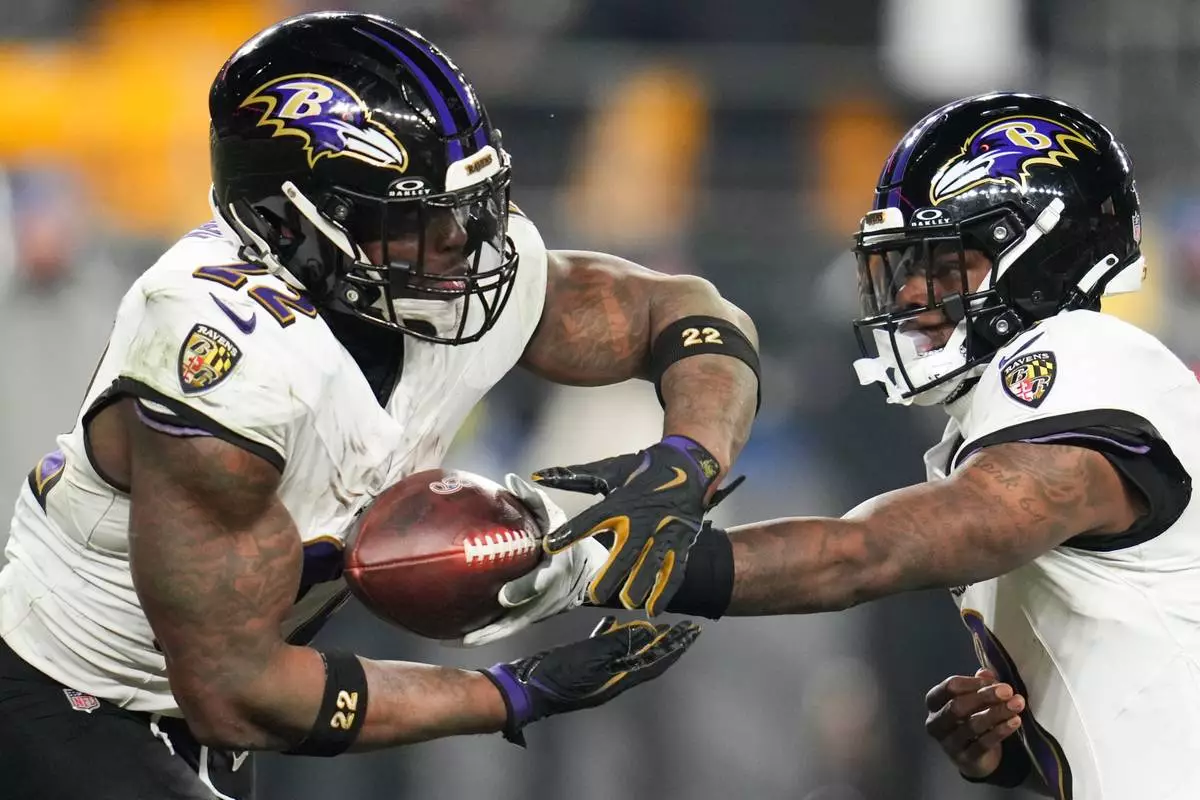
Baltimore Ravens quarterback Lamar Jackson, right, hands the ball off to running back Derrick Henry (22) during the first half of an NFL football game against the Pittsburgh Steelers, Sunday, Jan. 4, 2026, in Pittsburgh. (AP Photo/Gene J. Puskar)
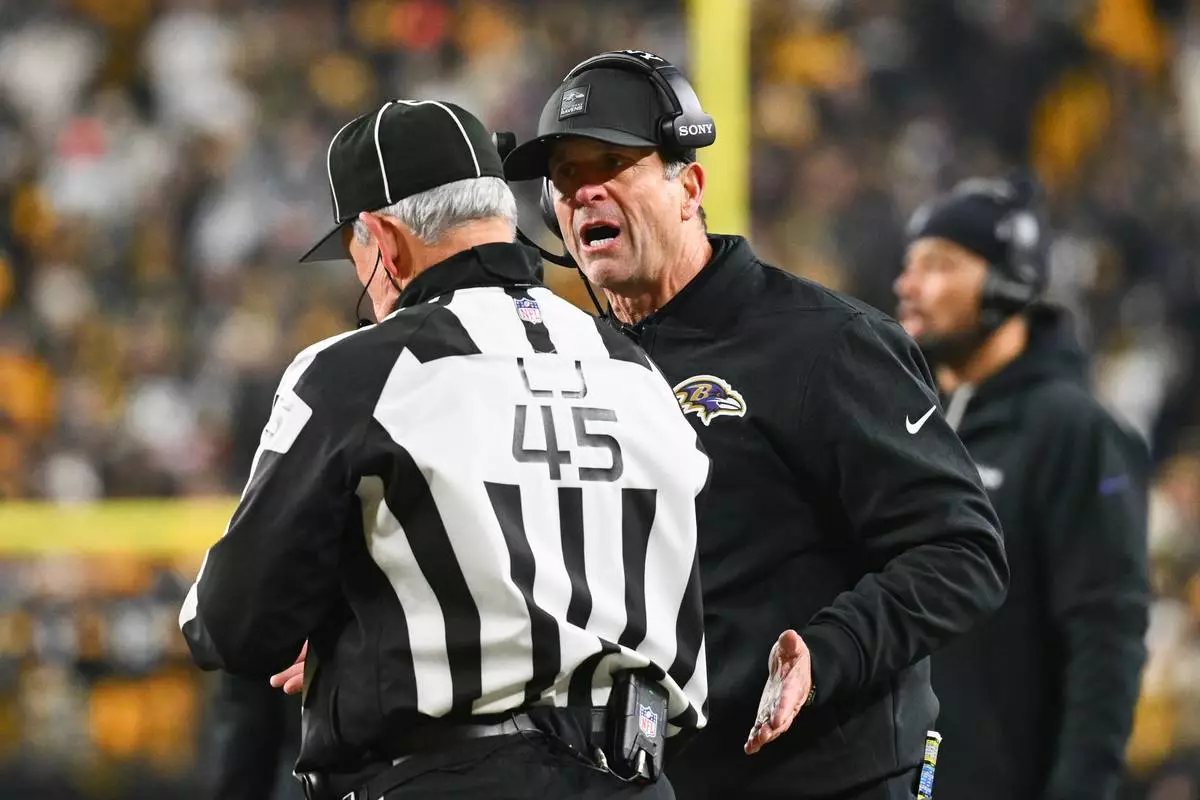
Baltimore Ravens head coach John Harbaugh talks with an offical during the second half of an NFL football game against the Pittsburgh Steelers, Sunday, Jan. 4, 2026, in Pittsburgh. (AP Photo/Justin Berl)
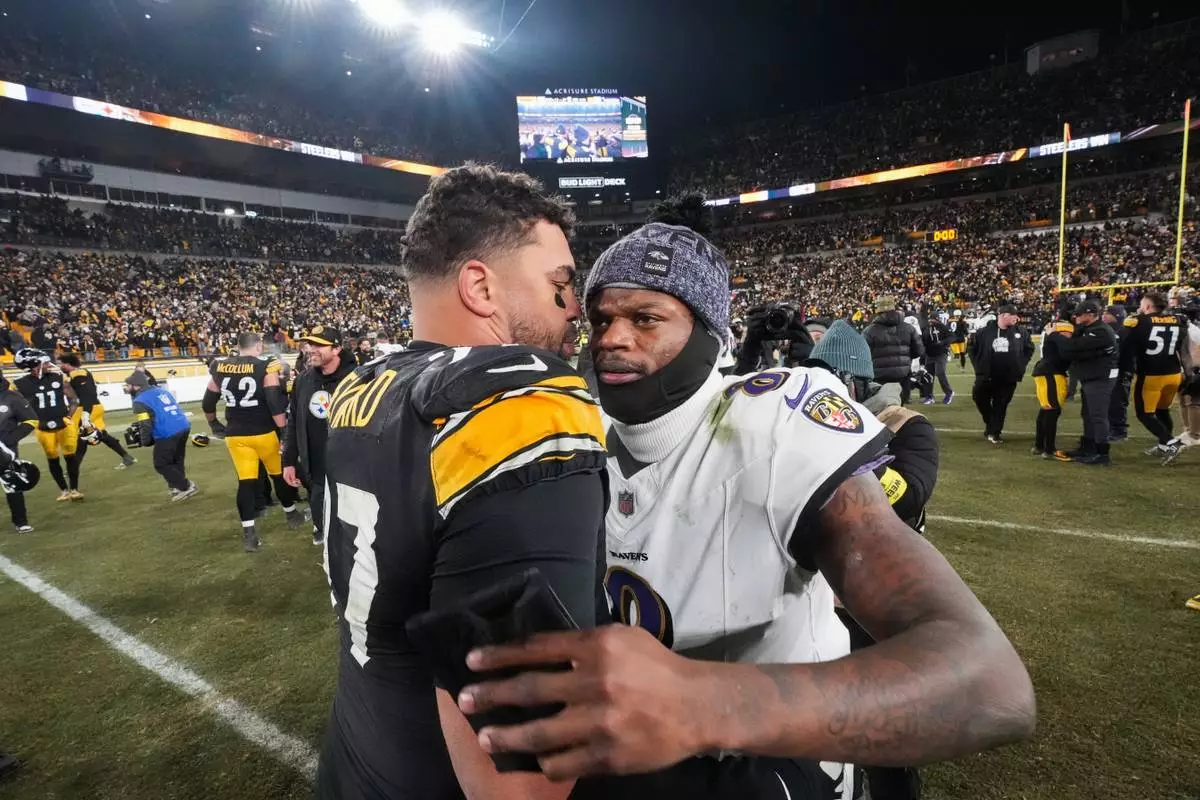
Pittsburgh Steelers defensive tackle Cameron Heyward, left, greets Baltimore Ravens quarterback Lamar Jackson (8) after an NFL football game Sunday, Jan. 4, 2026, in Pittsburgh. (AP Photo/Gene J. Puskar)
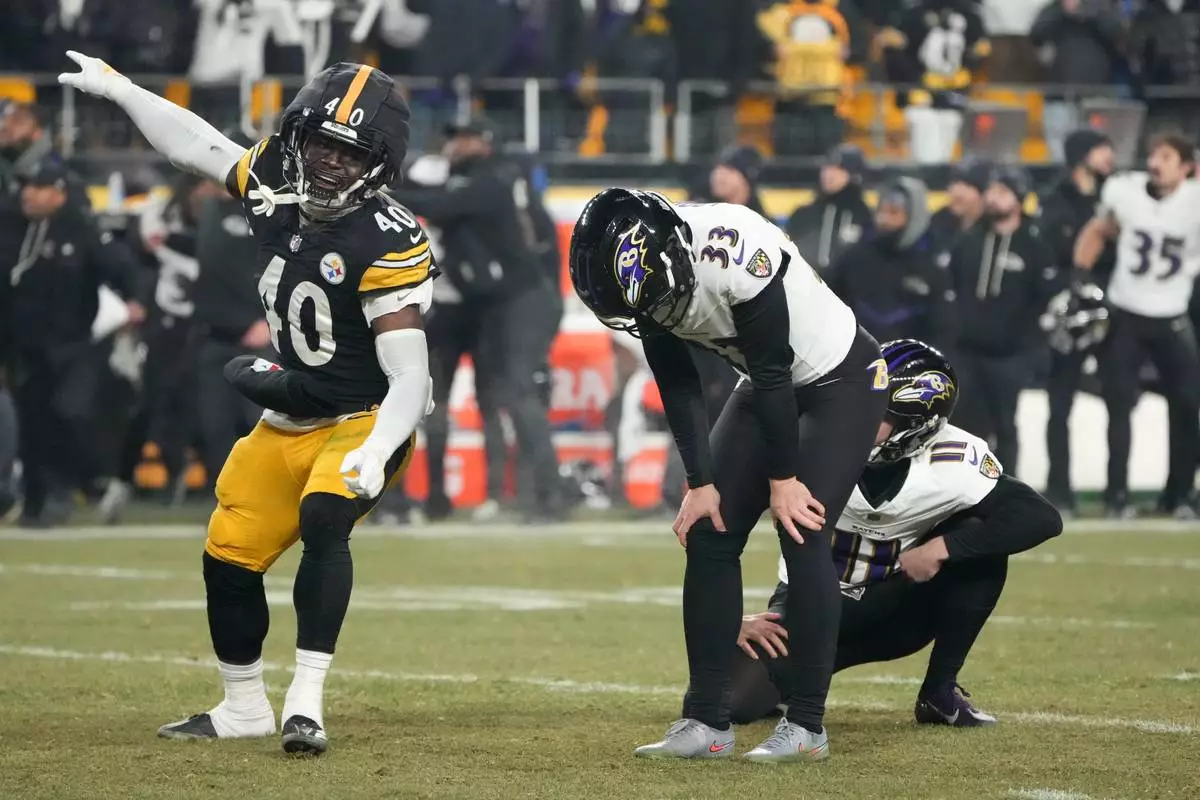
Pittsburgh Steelers safety Jabrill Peppers (40) reacts after Baltimore Ravens kicker Tyler Loop (33) missed a field goal attempt in the second half of an NFL football game against the Pittsburgh Steelers, Sunday, Jan. 4, 2026, in Pittsburgh. (AP Photo/Gene J. Puskar)