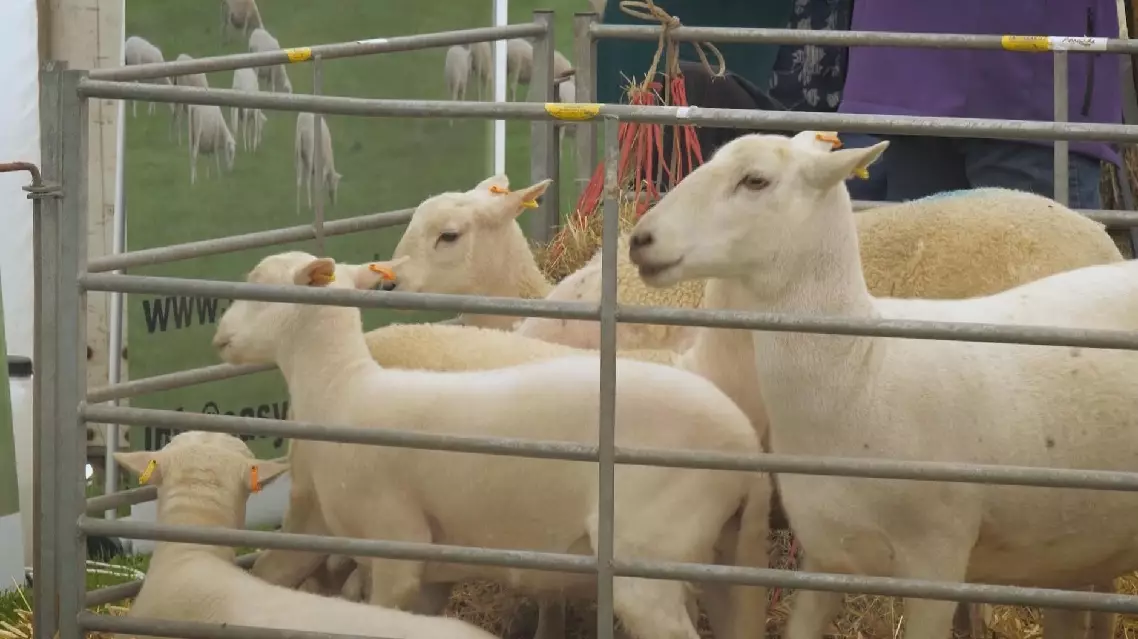
A wool-shedding breed of sheep known as Exlana is helping to reduce the burden of care for farmers in the UK.
Through genetic modifications, animals are able to shed their wool naturally and enables ewes to give birth without human help.
To shear or not to shear - that is the question that's dominating this year's gathering of sheep farmers in rural Devon. Farmers have developed a new breed of sheep, designed to get naked. They call the sheep Exlana, Latin for "without wool," which can shed gradually during the warmer months.
There are many benefits when it comes to the welfare of the sheep. For example, farmers don't need to dock the tails as they do with traditional sheep, and they don't have to spray the sheep with lots of chemicals to protect them from flies.
Exlana sheep are bred to give birth easily, without help from humans.
"They should be able to lamb on their own, the lambs need to be born easily, shake their head, jump up and start suckling the mother and the mother has enough milk for two lambs," Said Bill Geen, an Exlana sheep farmer.
It costs farmers around 10 U.S. dollars per ewe to maintain a fleece and to shear it. And these days, the wool is sold for cents. Financially, it's a no-brainer.
"If you sit down with a blank sheet of paper, and design the sheep for the future, it won't have wool," said Peter Baber, an Exlana Sheep breeder.
It's not just wool. "Breed for Change" is an organization that tests methane emissions from sheep, so farmers can breed from the ones that burp the least. And reducing methane emissions can be good for the environment.
"When we look at some of the traits like methane or efficiency of things, we can't judge that just by looking at the animal. We need the data and the science to help us identify the animals that have got the best genetics," said Janet Roden, a geneticist from Innovis, a leading supplier of sheep breeding technologies in the UK.
Some question the morality of genetically modifying animals, but science and farming have been working hand in hand for generations.
"We've been involved in natural selection for hundreds of years. Darwin, when he wrote, was observing differences when breeding pigeons and dogs and cats and the modern livestock we have today. So there's so much variation within a species, you can bring about tremendous change, selecting in that manner," said Sam Boon, a senior animal breeding manager from Agricultural and Horticultural Development Board.
Local farmers say that with margins so tight and farming precarious, the sheep of tomorrow could be very different.
Wool-shedding sheep breed helps to reduce care burden for UK farmers
Wool-shedding sheep breed helps to reduce care burden for UK farmers