WASHINGTON (AP) — President Donald Trump prides himself on being a dealmaker, but his negotiating style is more ultimatum than compromise.
In the last week, Trump has slapped trading partners with tariffs rather than slog through prolonged talks to reach agreements. He ratcheted up the pressure on the Federal Reserve to cut interest rates. And his administration launched a new investigation into higher education as he tries to reshape universities.
For Trump, a deal isn’t necessarily agreement in which two sides compromise — it’s an opportunity to bend others to his will. While Trump occasionally backs down from his threats, the past week is a reminder that they are a permanent feature of his presidency.
As Trump tightens his grip on independent institutions, there are fewer checks on his power. Republicans in Congress fear primary challenges backed by the president, and the Supreme Court is stocked with appointees from his first term.
Trump recently summed up his approach when talking to reporters about trade talks with other countries. “They don’t set the deal," he said. "I set the deal.”
Trump’s allies believe his aggression is required in a political ecosystem where he's under siege from Democrats, the court system and the media. In their view, the president is simply trying to fulfill the agenda that he was elected to achieve.
But critics fear he's eroding the country’s democratic foundations with an authoritarian style. They say the president's focus on negotiations is a facade for attempts to dominate his opponents and expand his power.
“Pluralism and a diversity of institutions operating with autonomy — companies, the judiciary, nonprofit institutions that are important elements of society — are much of what defines real democracy,” said Larry Summers, a former Treasury secretary and former president of Harvard University. “That is threatened by heavy handed, extortionist approaches.”
Harvard has been a top target for Trump, starting in April when he demanded changes to the university's governance and new faculty members to counteract liberal bias.
As Harvard resisted, administration officials terminated $2.2 billion in federal grants. The money is the lifeblood of the university's sprawling research operation, which includes studies on cancer, Parkinson's disease, space travel and pandemic preparedness.
Trump has also attempted to block Harvard from hosting roughly 7,000 foreign students, and he's threatened to revoke its tax-exempt status. His administration recently sent subpoenas asking for student data.
“They’ll absolutely reach a deal," Trump said Wednesday.
Administration officials also pulled $175 million from the University of Pennsylvania in March over a dispute around women's sports. They restored it when school officials agreed to update records set by transgender swimmer Lia Thomas and change their policies.
Columbia University bent to Trump by putting its Middle East studies department under new supervision, among other changes, after the administration pulled $400 million in federal funding. At the University of Virginia, President James Ryan resigned under pressure following a Justice Department investigation into diversity, equity and inclusion practices. A similar investigation was opened Thursday at George Mason University.
“Federal funding is a privilege, not a right, for colleges and universities," said Kush Desai, a White House spokesman.
Such steps were unheard of before Trump took office. Ted Mitchell, president of the American Council on Education and an Education Department official under President Barack Obama, said Trump isn't seeking deals but is “demanding more and more and more.”
"Institutional autonomy is an important part of what makes higher education work," he said. “It’s what enables universities to pursue the truth without political considerations.”
The Fed has also faced Trump's wrath. He blames Fed Chair Jerome Powell for moving too slowly to cut interest rates, which could make consumer debt like mortgages and auto loans more affordable. It could also help the U.S. government finance the federal debt that's expected to climb from the tax cuts that Trump recently signed into law.
Powell has held off on cutting the central bank's benchmark rate, as Trump's tariffs could possibly worsen inflation and lower rates could intensify that problem. Desai said the White House believes the Fed should act based on what the data currently shows, which is that "President Trump’s policies have swiftly tamed inflation.”
Although Trump has said he won't try to fire Powell — a step that might be impossible under the law anyway — he's called on him to resign. In addition, Trump's allies have increased their scrutiny of Powell's management, particularly an expensive renovation of the central bank's headquarters.
David Wessel, a senior fellow in economic studies at the Brookings Institution, said Trump's approach could undermine the Fed's credibility by casting a political shadow over its decisions.
“There will be real costs if markets and global investors think the Fed has been beaten into submission by Trump," he said.
Trump originally wanted to enact sweeping tariffs in April. In his view, import taxes would fix the challenge of the U.S. buying too much from other countries and not selling enough overseas.
After a backlash in financial markets, Trump instituted a three-month negotiating period on tariffs. Peter Navarro, one of his advisers, said the goal was “90 deals in 90 days.”
The administration announced a few trade frameworks with the United Kingdom and Vietnam, but Trump ran out of patience. He's sent letters to two dozen nations and the European Union informing them of their tariff rates, such as 30% against the EU and Mexico, potentially undercutting the work of his own negotiators.
Desai said Trump's approach has generated “overwhelming interest” from other countries in reaching trade deals and gives the U.S. leverage in negotiations.
John C. Brown, a professor emeritus of economics at Clark University in Massachusetts, said the “willy-nilly setting of tariffs according to one person’s whims has no precedence in the history of trade policy since the 17th century.”
“It’s just bizarre,” Brown said of Trump’s moves. “No one has done this in history.”
The president has also used the threat of tariffs in an attempt to help political allies and influence other countries' court systems. He told Brazil that he would implement a 50% tariff if the country didn't drop its prosecution of former President Jair Bolsonaro, who like Trump was charged with trying to overturn an election.
Inu Manak, a fellow on trade policy at the Council on Foreign Relations, said Trump's inconsistent approach will foster distrust of U.S. motives.
She noted that two of the letters went to Canada and South Korea, allies who have existing trade agreements with the U.S. approved by Congress.
By imposing new tariffs, she said, Trump is raising “serious questions about the meaning of signing any deal with the United States at all.”
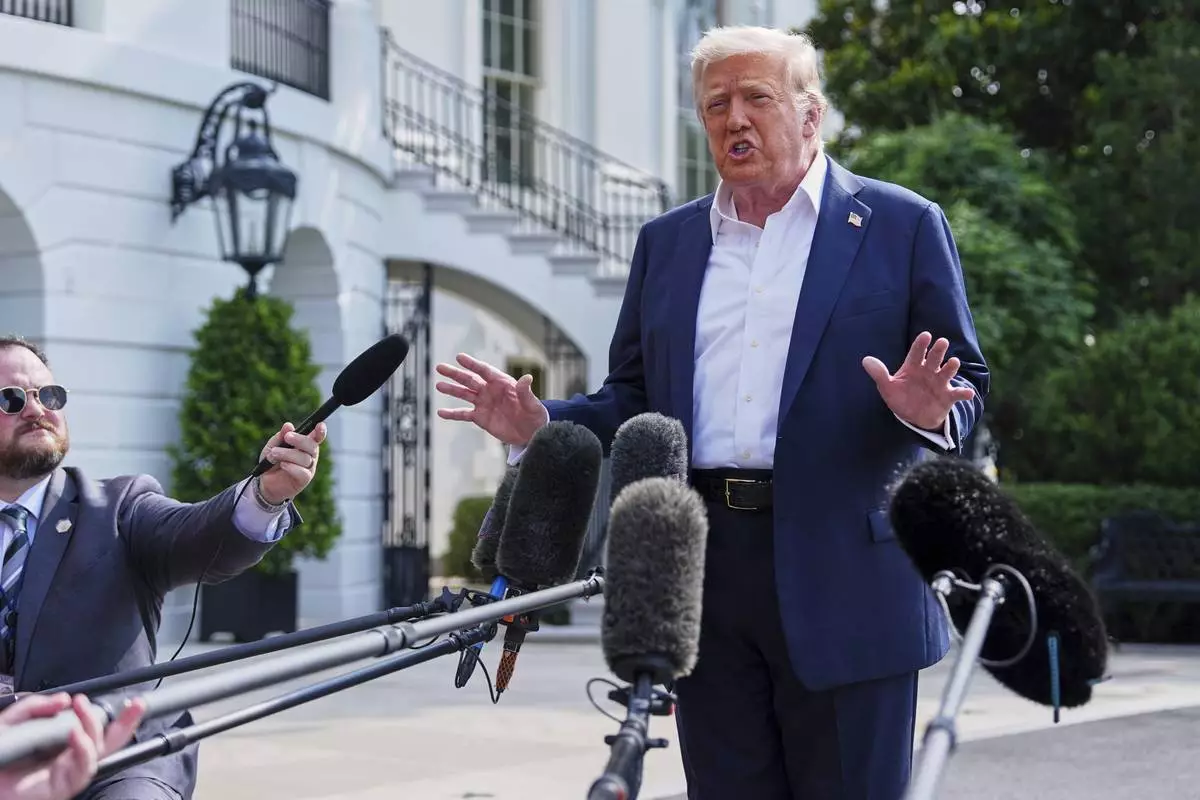
President Donald Trump speaks with reporters before departing the White House, Friday, July 11, 2025, in Washington. (AP Photo/Evan Vucci)
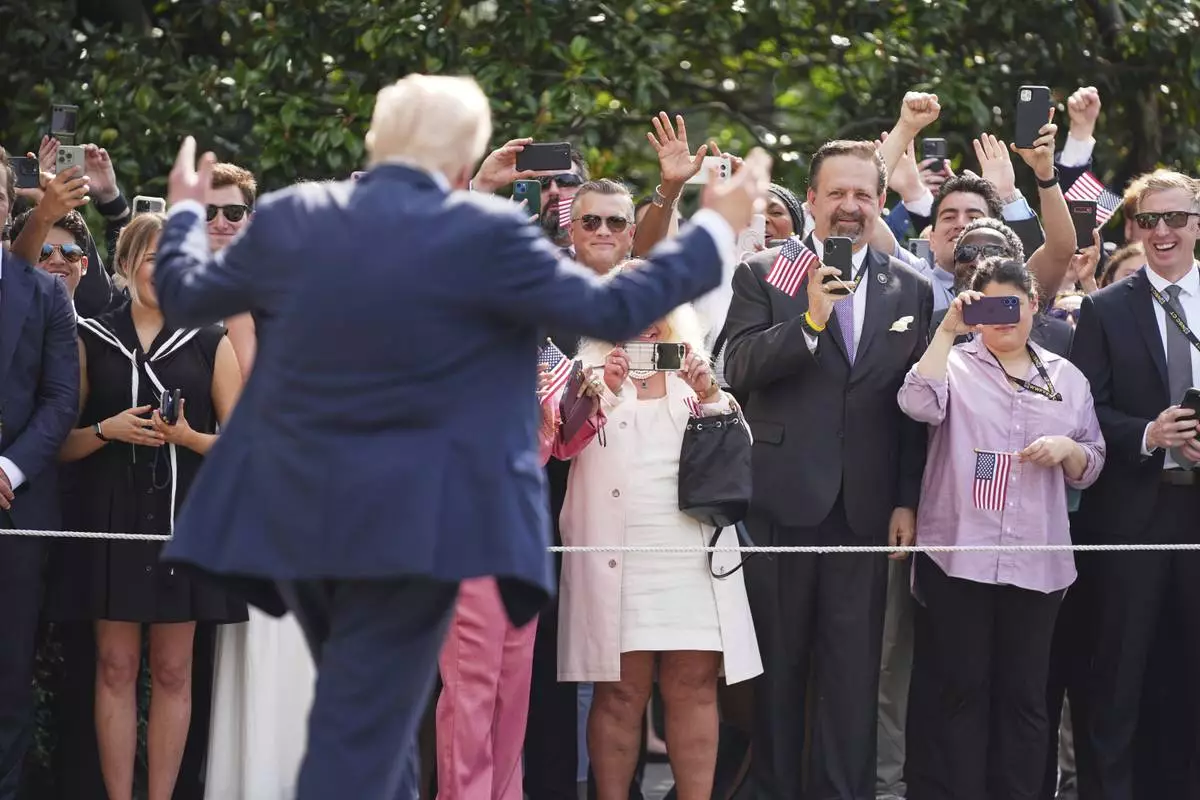
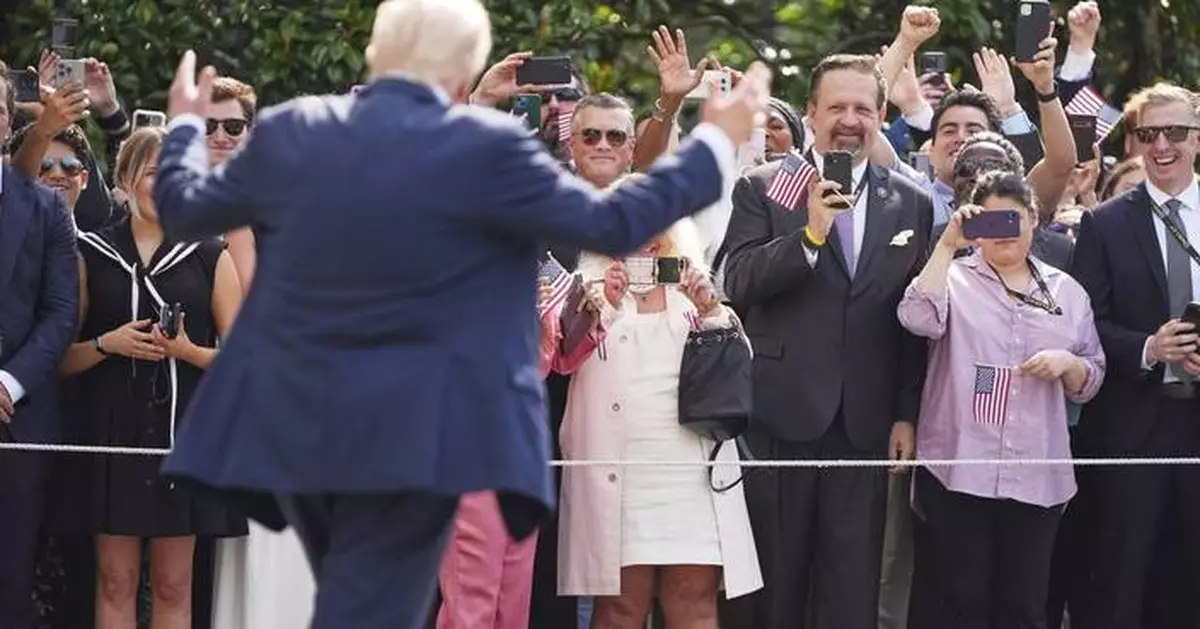
President Donald Trump departs the White House, Friday, July 11, 2025, in Washington. (AP Photo/Evan Vucci)
BRUSSELS (AP) — Belgium insisted on Thursday that its European Union partners must provide ironclad guarantees that it will be protected from Russian retaliation before it would back a massive loan for Ukraine. Ukrainian President Volodymyr Zelenskyy pleaded for a decision now to keep Ukraine afloat in the new year.
At a summit in Brussels with exceptionally high stakes for both the EU and Ukraine, the 27-nation bloc’s leaders are set to decide on whether to use tens of billions of euros in frozen Russian assets to underwrite a loan to meet Ukraine’s military and financial needs over the next two years.
The bulk of the assets — some 193 billion euros ($227 billion) as of September — are held in the Brussels-based financial clearing house Euroclear. Russia’s Central Bank sued Euroclear last week.
“Give me a parachute and we’ll all jump together,” Prime Minister Bart De Wever told members of the Belgian parliament just before the summit began. “If we have confidence in the parachute that shouldn’t be a problem.”
Belgium fears that Russia will strike back and would prefer that the bloc borrow the money on international markets. It wants frozen assets held in other European countries to be thrown into the pot as well, and for its partners to guarantee that Euroclear will have the funds it needs should it come under legal attack.
European officials say Russia is waging a campaign of sabotage and disruption across the continent. The Central Bank lawsuit ramped up pressure on Belgium and its European partners ahead of the summit.
The “reparations loan” plan would see the EU give 90 billion euros ($106 billion) to Ukraine. Countries like the U.K., Canada and Norway would make up any shortfall.
Russia's claim to the assets would still stand, but the assets would remain locked away at least until the Kremlin ends its war on Ukraine and pays for the massive damage it's caused.
In mapping out the loan plan, the European Commission set up safeguards to protect Belgium, but De Wever remains unconvinced.
“I have not yet seen a text that could satisfactorily address Belgium’s concerns," he said. "I hope to see one today.”
De Wever insisted that Belgium remains “a faithful ally” of Ukraine and wants to continue to help.
Soon after arriving in Brussels, Zelenskyy sat down with the Belgian prime minister to make his case for freeing up the frozen funds. The war-ravaged country is at risk of bankruptcy and needs new money by spring.
“Ukraine has the right to this money because Russia is destroying us, and to use these assets against these attacks is absolutely just,'' Zelenskyy told a news conference.
In an appeal to Belgian citizens who share their leader's worries about retaliation, Zelenskyy said, “One can fear certain legal steps in courts from the Russian Federation, but it’s not as scary as when Russia is at your borders.''
“So while Ukraine is defending Europe, you must help Ukraine.”
Whatever method they use, the EU leaders have pledged to meet most of Ukraine's needs in 2026 and 2027. The International Monetary Fund estimates that would amount to 137 billion euros ($160 billion).
“We have to find a solution today," European Commission President Ursula von der Leyen told reporters. EU Council President António Costa, who is chairing the meeting, has vowed to keep leaders negotiating until an agreement is reached, even if it takes days.
Polish Prime Minister Donald Tusk said: “Now we have a simple choice. Either money today or blood tomorrow."
EU envoys have worked around the clock in recent weeks to flesh out the details and narrow differences among the 27 member countries. If enough countries object, the plan could be blocked. There is no majority support for a plan B of raising the funds on international markets.
German Chancellor Friedrich Merz said that he hopes Belgium's concerns can be addressed.
"The reactions of the Russian president in recent hours show how necessary this is. In my view, this is indeed the only option. We are basically faced with the choice of using European debt or Russian assets for Ukraine, and my opinion is clear: We must use the Russian assets.”
Hungary and Slovakia oppose von der Leyen’s plan for a reparations loan. Apart from Belgium, Bulgaria, Italy and Malta are also undecided.
“I would not like a European Union in war," said Hungarian Prime Minister Viktor Orbán, who sees himself as a peacemaker. He’s also Russian President Vladimir Putin’s closest ally in Europe. “To give money means war.”
Orbán described the loan plan as “a dead end.''
The outcome of the summit has significant ramifications for Europe's place in negotiations to end the war. The United States wants assurances that the Europeans are intent on supporting Ukraine financially and backing it militarily, even as the peace talks drag on with few results so far.
The loan plan in particular also poses important challenges to the way the bloc goes about its business. Should a two-thirds majority of EU leaders decide to impose the scheme on Belgium, which has most to lose, the impact on decision-making in Europe would be profound.
The EU depends on consensus, and finding voting majorities and avoiding vetoes in the future could become infinitely more complex if one of the EU's founding members is forced to weather an attack on its interests by its very own partners.
De Wever too must weigh whether the cost of holding out against a majority is worth the hit his government's credibility would take in Europe.
Whatever is decided, the process does not end at this summit. Legal experts would have to convert any political deal into a workable agreement, and some national parliaments may have to weigh in before the loan money could start flowing to Ukraine.
Associated Press Writers Kirsten Grieshaber in Berlin and Illia Novikov in Kyiv contributed to this report.
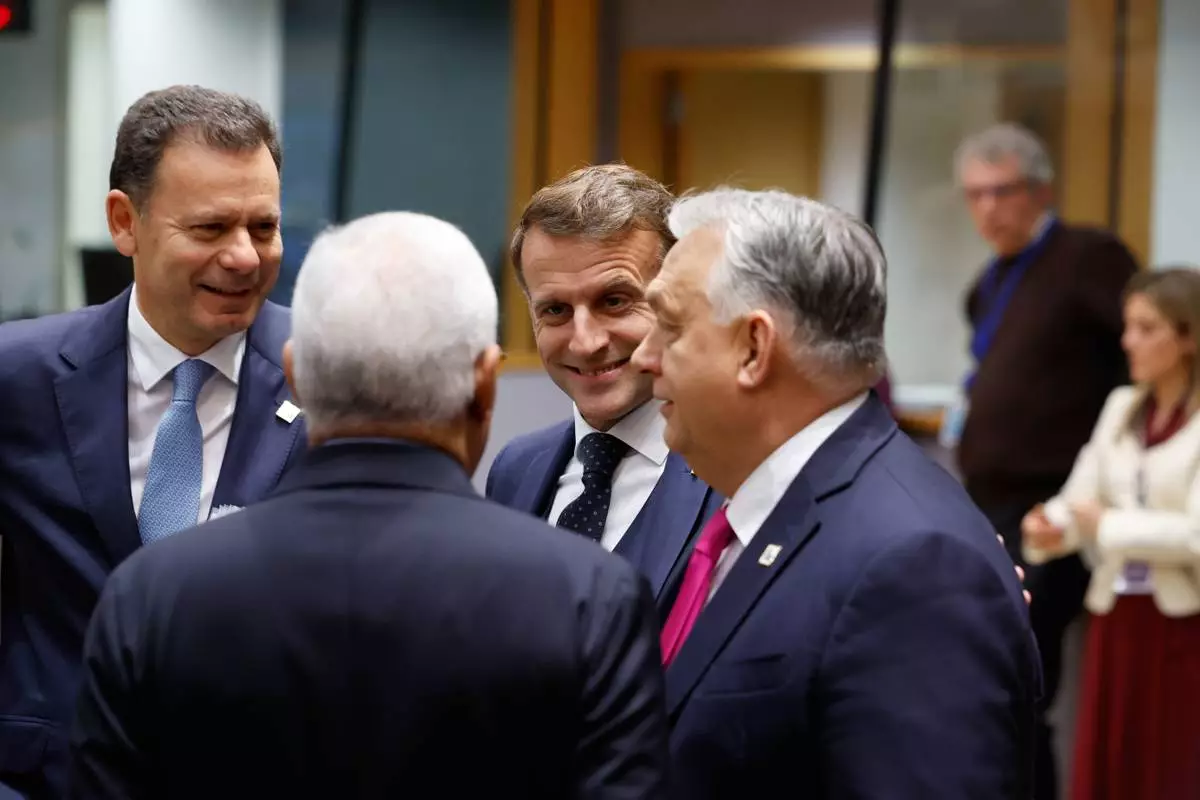
From left, Portugal's Prime Minister Luis Montenegro, European Council President Antonio Costa, French President Emmanuel Macron and Hungary's Prime Minister Viktor Orban during a round table meeting at the EU Summit in Brussels, Thursday, Dec. 18, 2025. (AP Photo/Geert Vanden Wijngaert)
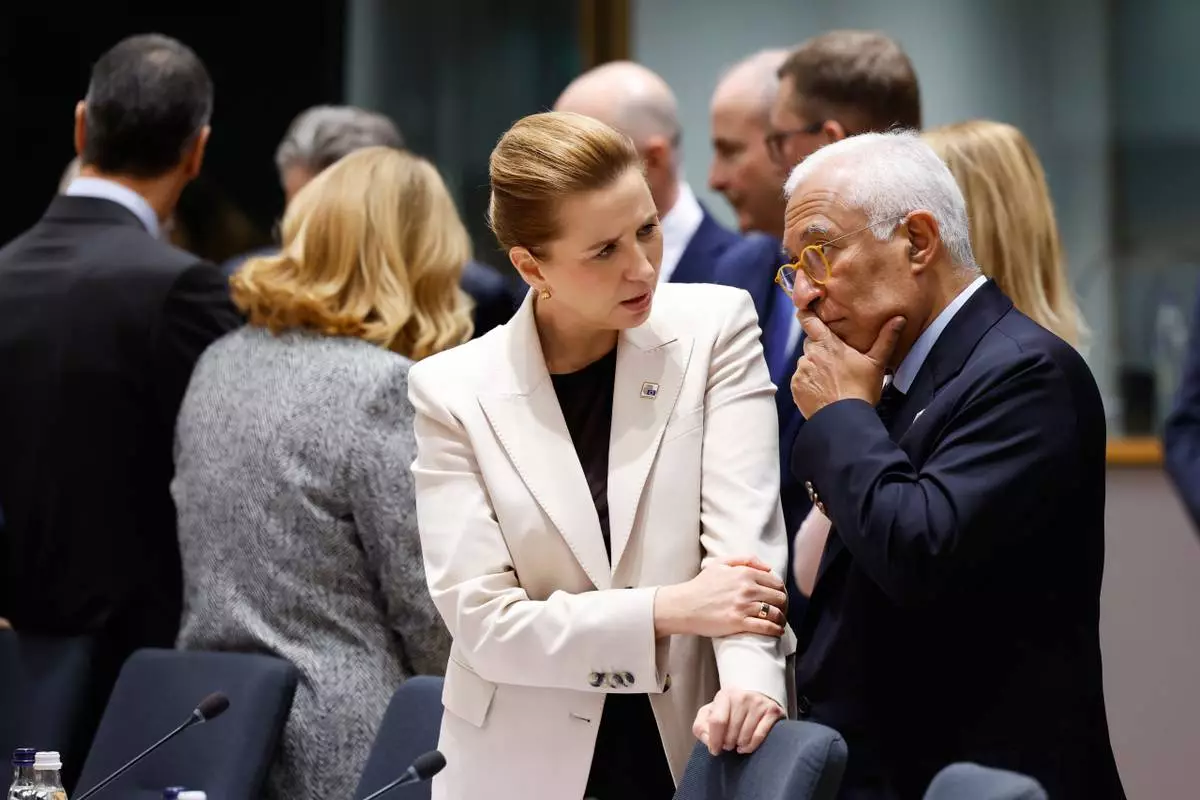
European Council President Antonio Costa, center right, speaks with Denmark's Prime Minister Mette Frederiksen, center left, during a round table meeting at the EU Summit in Brussels, Thursday, Dec. 18, 2025. (AP Photo/Geert Vanden Wijngaert)
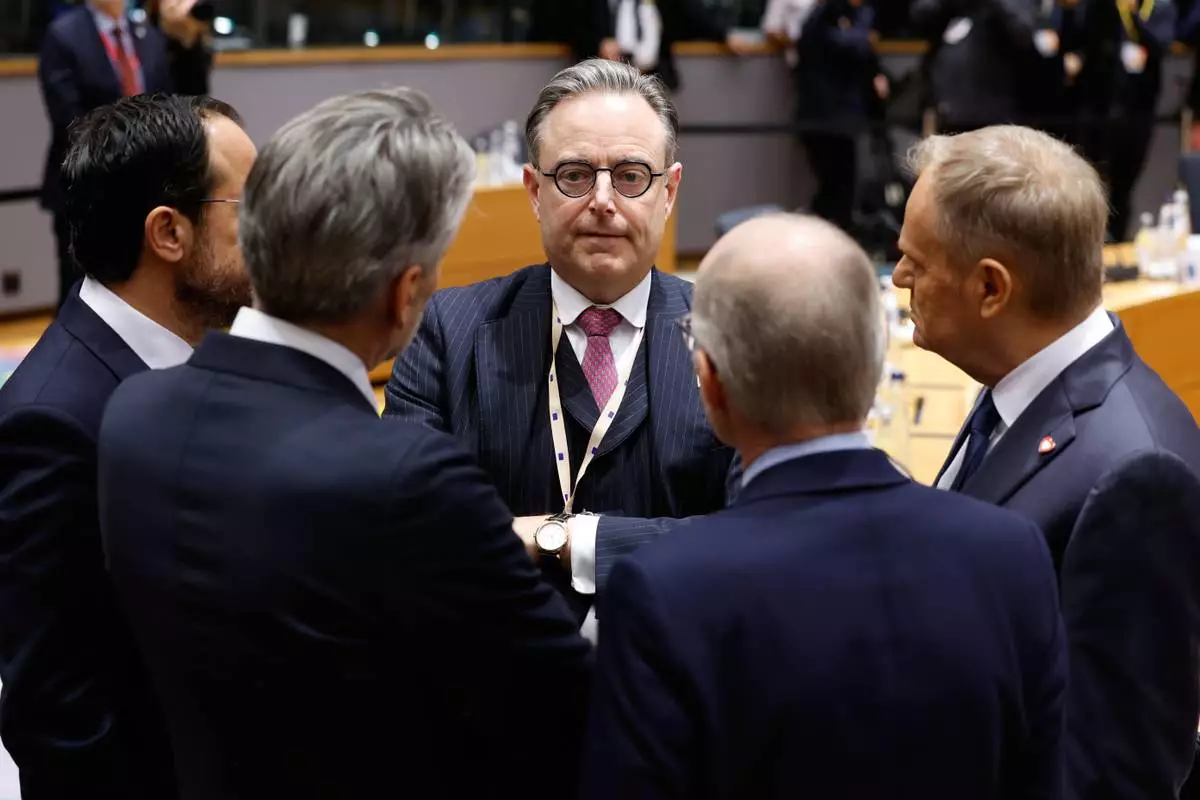
Belgium's Prime Minister Bart De Wever, center, speaks with from left, Cypriot President Nikos Christodoulides, Netherland's Prime Minister Dick Schoof, Luxembourg's Prime Minister Luc Frieden and Poland's Prime Minister Donald Tusk during a round table meeting at the EU Summit in Brussels, Thursday, Dec. 18, 2025. (AP Photo/Geert Vanden Wijngaert)
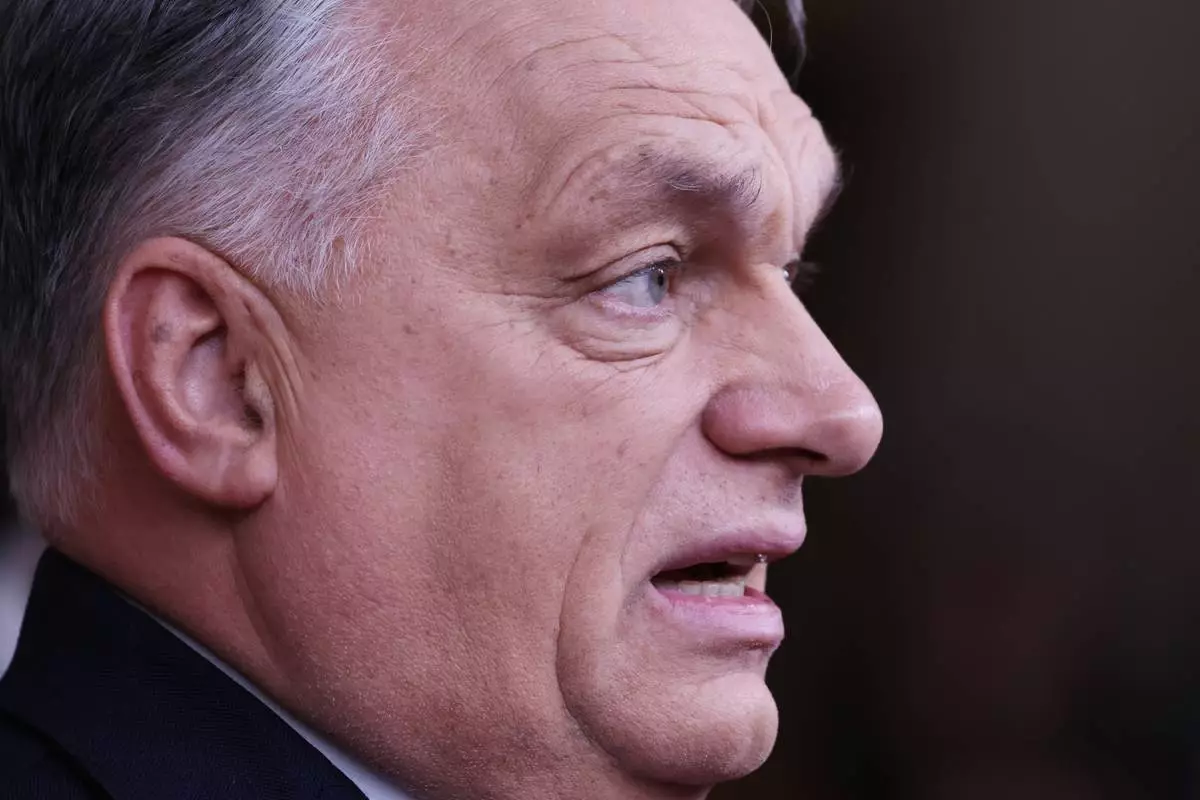
Hungary's Prime Minister Viktor Orban speaks with the media as he arrives for the EU Summit in Brussels, Thursday, Dec. 18, 2025. (AP Photo/Geert Vanden Wijngaert)
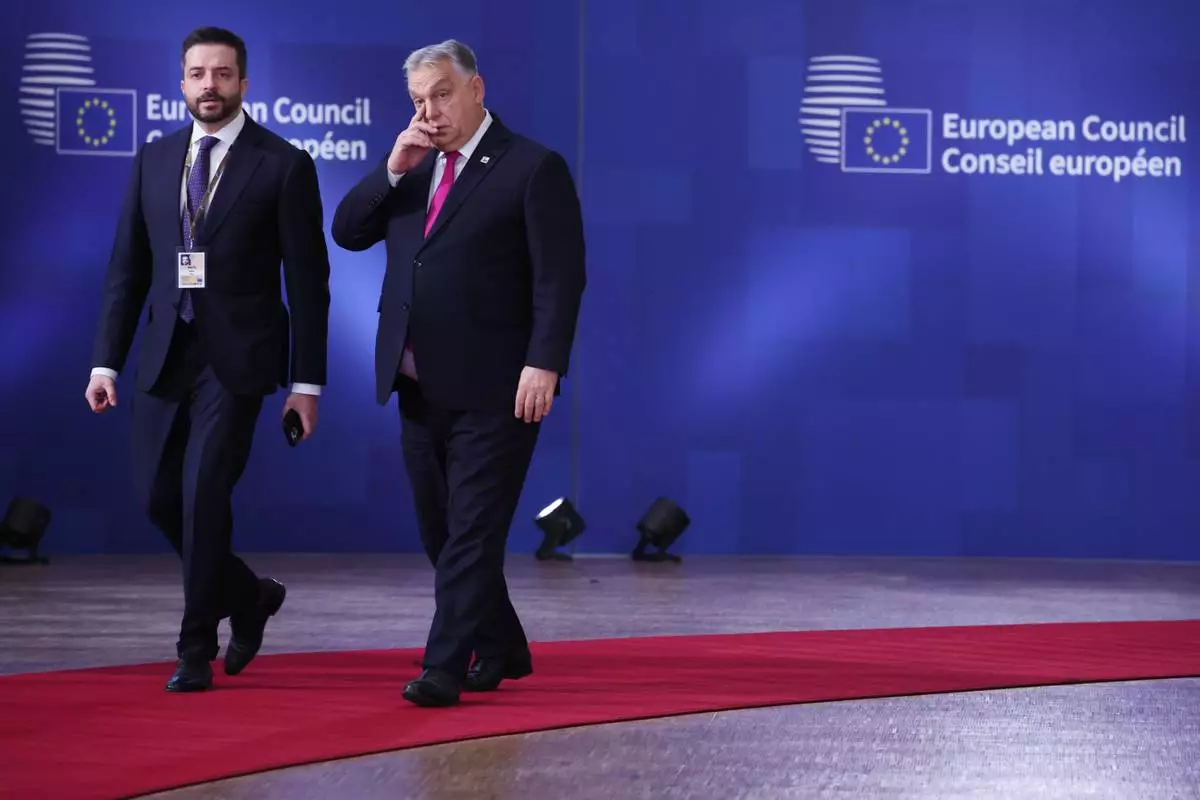
Hungary's Prime Minister Viktor Orban, right, arrives for the EU Summit in Brussels, Thursday, Dec. 18, 2025. (AP Photo/Omar Havana)
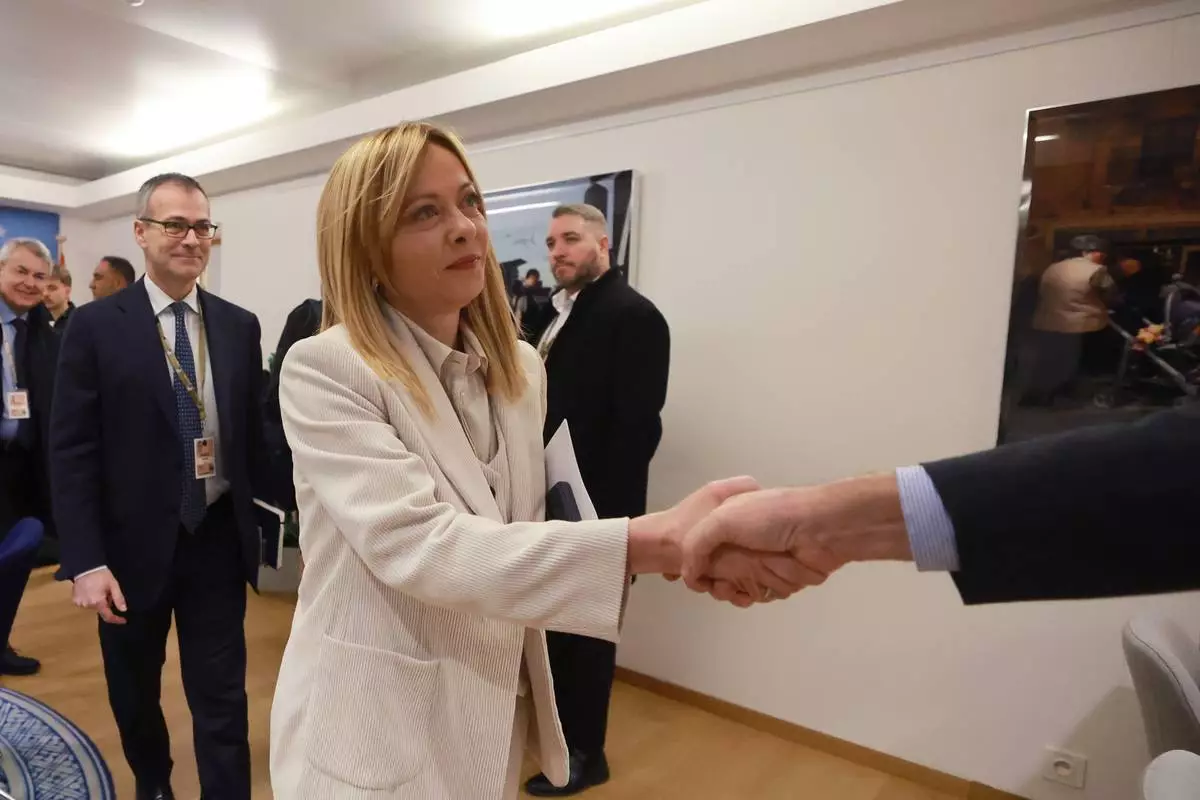
Italy's Prime Minister Giorgia Meloni, center, is greeted as she arrives for a round table meeting on migration at the EU Summit in Brussels, Thursday, Dec. 18, 2025. (AP Photo/Olivier Hoslet, Pool Photo via AP)
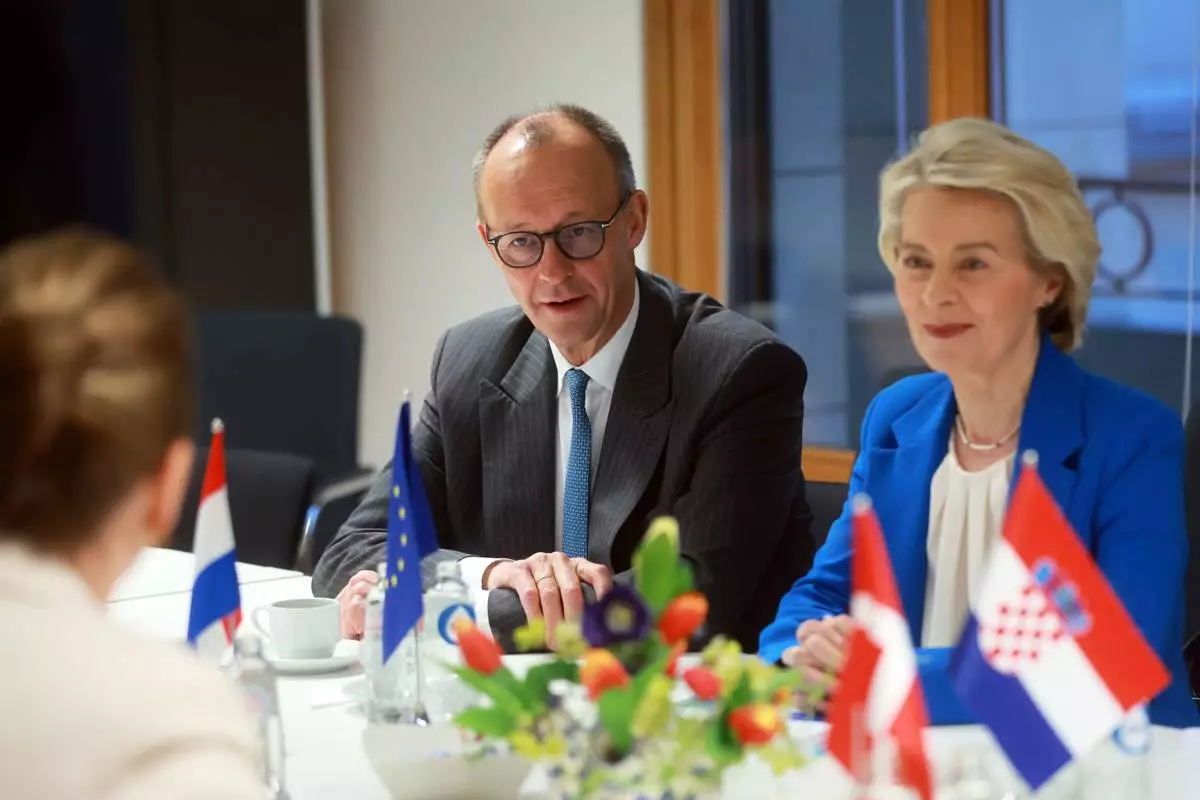
European Commission President Ursula von der Leyen, right, and Germany's Chancellor Friedrich Merz, left, attend a round table meeting on migration at the EU Summit in Brussels, Thursday, Dec. 18, 2025. (AP Photo/Olivier Hoslet, Pool Photo via AP)

FILE - A view of the headquarters of Euroclear in Brussels, on Oct. 23, 2025. (AP Photo/Geert Vanden Wijngaert, File)