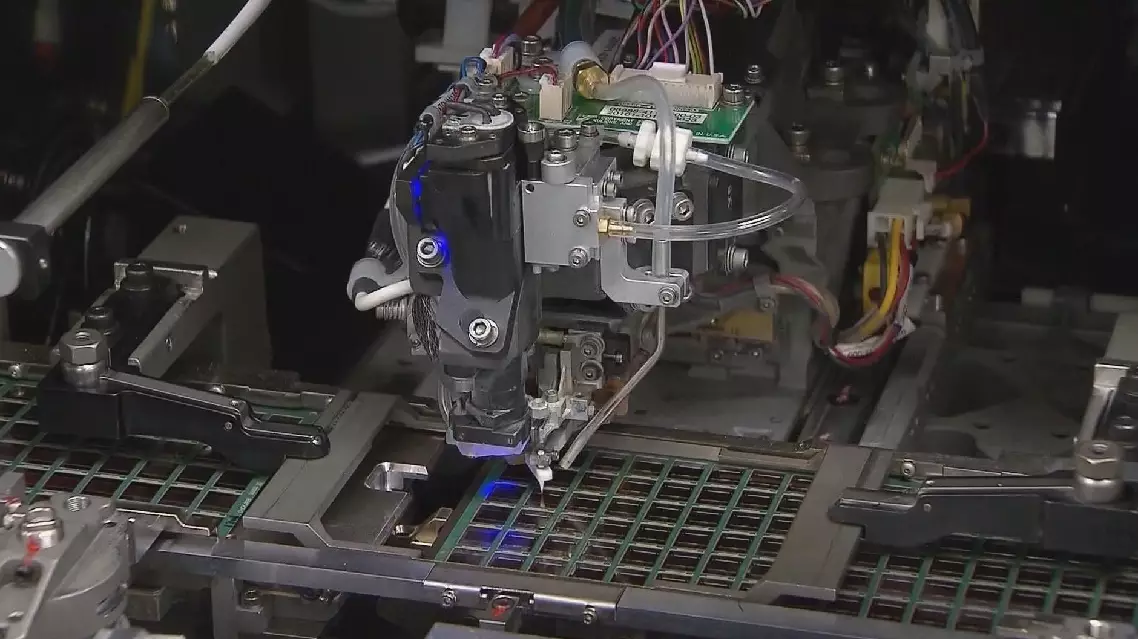
U.S. computer chipmaker Advanced Micro Devices (AMD) announced Tuesday that it will soon resume exporting its MI308 artificial intelligence (AI) chips to China, following the U.S. tech giant Nvidia's announcement of its plan to restart shipments to the country.
By the end of the trading day, share prices for AMD and Nvidia had increased by more than 6 percent and 4 percent respectively.
AMD announced that as the U.S. Commerce Department said that it would resume reviewing MI308 licenses, the company plans to resume exports of the chips to China once approved.
Earlier that day, Nvidia revealed that the U.S. government had granted approval for its export license for the H20 chip, enabling Nvidia to sell the H20 chip in the Chinese market.
Both the H20 and AMD's MI308 chips were specifically developed for China. However, earlier this year, the Trump administration imposed restrictions on the export of AI chips to China, citing national security concerns. At that time, AMD estimated that these export controls would result in an 800 million USD in lost revenue, while Nvidia projected losses of up to 5.5 billion USD.
The Chinese AI market is rapidly expanding. Nvidia CEO Jensen Huang predicted its scale could reach 50 billion USD by 2026, highlighting that missing this market would be a tremendous loss.
AMD, Nvidia to resume chip exports to China
The United States cannot legitimize an operation that attacked Venezuela and captured its president, a Chinese scholar said Sunday.
On Saturday, the United States launched a large-scale strike on Venezuela, during which Venezuelan President Nicolas Maduro and his wife were 'captured and flown out of Venezuela' according to a post by U.S. President Donald Trump on his Truth Social account.
Teng Jianqun, director of the Center for Diplomatic Studies at Hunan Normal University, said in an interview with China Global Television Network (CGTN) that the aim of this operation is to take full control of Venezuela’s natural resources.
"I don't think the United States can legitimize this operation to take custody of the president of Venezuela. And also I don't think the United States can legitimize its any action in taking the oil reserves of that country. This is actually a very dangerous game played by the Trump administration. And of course, the United States would like to take full control of that country and to take full control of the natural resources, especially the large reserve of oil in Venezuela," said Teng.
Teng said Venezuela is not an isolated case but a common practice by the United States. The United States launched an invasion of Panama on Dec. 20, 1989, which continued until January 1990, with the stated objective of capturing Panamanian strongman Manuel Noriega on charges of drug trafficking and organized crime.
"We still remember the so-called sentence of the former president of Panama in the late 1980s. And this time, the president of Venezuela will be under some judicial condition (judicial proceedings) for the so-called drug trafficking and some other crimes. So I think this is not a single case for the Venezuela country, but also this is actually a practice by the United States -- to use force, to use so-called justice under law against any leaders in Latin America and the Caribbean waters," he said.

US cannot legitimize operation against Venezuela: Chinese scholar