PORT-OF-SPAIN, Trinidad (AP) — Trinidad and Tobago declared a new state of emergency Friday after authorities accused a criminal network operating in prisons across the country of plotting to kill key government officials and attack public institutions.
It's the second state of emergency to be declared in the twin-island republic in a matter of months. Last December, authorities took similar action citing concerns about gang violence. That state of emergency lasted until mid-April.
Police said that smuggled cell phones enabled those involved in the plot to exchange encrypted messages. Months of intelligence gathering led investigators to believe the targets included senior police officers, members of the judiciary and employees at the state prosecution office, police said. There were no particular threats to any politicians, police said.
“They were planning, actively so, to carry out assassinations, robberies, and kidnappings.” Police Commissioner Allister Guevarro said at a news conference. Police described those involved as "a coordinated and highly dangerous criminal network.”
Guevarro said the intelligence report prompted him to recommend that newly elected Prime Minister Kamla Persad-Bissessar declare the emergency.
Gang leaders who were housed in a maximum-security prison in east Trinidad — where illegal possession of cellphones and other communication devices has long been a problem — have been relocated to an unidentified facility, he said, without providing any details.
“We have seen recent acts of kidnapping and homicides being perpetrated against our citizenry that we have been able to trace back to this organized crime syndicate,” Guevarro said.
Under the state of emergency, police can conduct searches and make arrests without a warrant. A curfew has not been put into effect.
Last year, the country of more than 1.4 million people reported 624 killings, its deadliest on record, according to police data. As of July 17, police said the number of killings this year stood at 214, a decline compared to 325 killings in the same period last year.
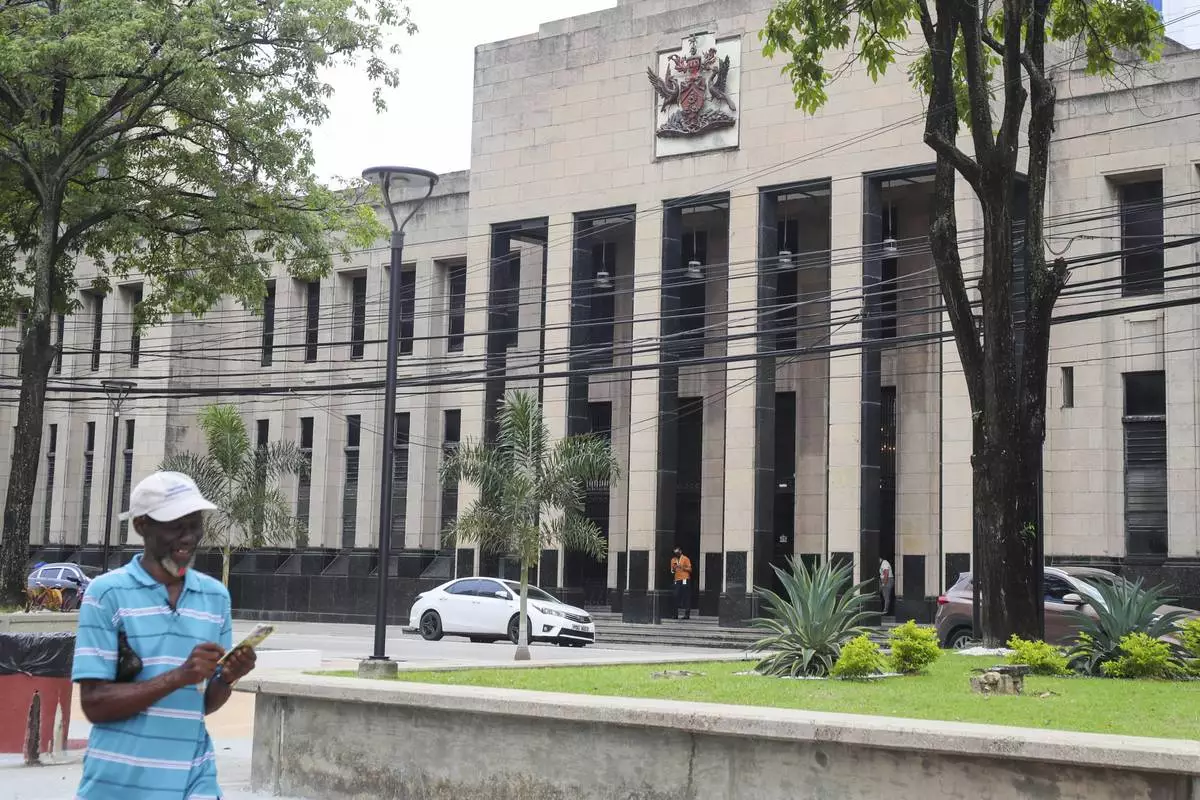
FILE - The country's coat of arms is displayed on the facade of a government building in Port-of-Spain, Trinidad and Tobago, Aug. 20, 2024. (AP Photo/Ash Allen, File)
VILNIUS, Lithuania (AP) — Belarus freed Nobel Peace Prize laureate Ales Bialiatski, key opposition figure Maria Kolesnikova and dozens of other prisoners on Saturday, capping two days of talks with Washington aimed at improving ties and getting crippling U.S. sanctions lifted on a key Belarusian agricultural export.
The U.S. announced earlier Saturday that it was lifting sanctions on Belarus' potash sector. In exchange, President Alexander Lukashenko pardoned 123 prisoners, Belarus' state news agency, Belta, reported.
A close ally of Russia, Minsk has faced Western isolation and sanctions for years. Lukashenko has ruled the nation of 9.5 million with an iron fist for more than three decades, and the country has been repeatedly sanctioned by the West for its crackdown on human rights and for allowing Moscow to use its territory in the 2022 invasion of Ukraine. Belarus has released hundreds of prisoners since July 2024.
John Coale, the U.S. special envoy for Belarus who met with Lukashenko in Minsk on Friday and Saturday, described the talks to reporters as “very productive" and said normalizing relations between Washington and Minsk was “our goal,” Belta reported.
“We’re lifting sanctions, releasing prisoners. We’re constantly talking to each other,” Coale said, adding that the relationship between the U.S. and Belarus was moving from “baby steps to more confident steps” as they increased dialogue, according to the Belarusian news agency.
Among the 123 prisoners were a U.S. citizen, six citizens of U.S. allied countries, and five Ukrainian citizens, a U.S. official told The Associated Press in an email. The official, who spoke on condition of anonymity to discuss private diplomatic negotiations, described the release as “a significant milestone in U.S.-Belarus engagement” and “yet another diplomatic victory” for U.S. President Donald Trump.
The official said Trump’s engagement so far “has led to the release of over 200 political prisoners in Belarus, including six unjustly detained U.S. citizens and over 60 citizens of U.S. Allies and partners.”
Pavel Sapelka, an advocate with the Viasna rights group, confirmed to the AP that Bialiatski and Kolesnikova were among those released.
Bialiatski, a human rights advocate who founded Viasna, was in jail when he was awarded the Nobel Peace Prize in 2022 along with the prominent Russian rights group Memorial and Ukraine’s Center for Civil Liberties. He was later convicted of smuggling and financing actions that violated public order — charges that were widely denounced as politically motivated — and sentenced to 10 years in 2023.
Bialiatski told the AP by phone Saturday that his release after 1,613 days behind bars came as a surprise — in the morning, he was still in an overcrowded prison cell.
“It feels like I jumped out of icy water into a normal, warm room, so I have to adapt. After isolation, I need to get information about what’s going on," said Bialiatski, who seemed energetic but pale and emaciated in post-release videos and photos.
He vowed to continue his work, stressing that “more than a thousand political prisoners in Belarus remain behind bars simply because they chose freedom. And, of course, I am their voice."
Kolesnikova, meanwhile, was a key figure in the mass protests that rocked Belarus in 2020, and is a close ally of an opposition leader in exile, Sviatlana Tsikhanouskaya.
Known for her close-cropped hair and trademark gesture of forming a heart with her hands, Kolesnikova became an even greater symbol of resistance when Belarusian authorities tried to deport her in September 2020. Driven to the Ukrainian border, she briefly broke away from security forces at the frontier, tore up her passport and walked back into Belarus.
The 43-year-old professional flautist was convicted in 2021 on charges including conspiracy to seize power and sentenced to 11 years in prison.
Among the others who were released, according to Viasna, was Viktar Babaryka — an opposition figure who had sought to challenge Lukashenko in the 2020 presidential election, widely seen as rigged, before being convicted and sentenced to 14 years in prison on charges he rejected as political.
Viasna reported that the group's imprisoned advocates, Valiantsin Stefanovic and Uladzimir Labkovich, and prominent opposition figure Maxim Znak were also freed. But it later said it was clarifying its report about Stefanovic's release, and Bialiatski told the AP that Stefanovic had not been freed, though he hopes he will be soon.
Most of those released were sent to Ukraine, Franak Viachorka, Tsikhanouskaya’s senior adviser, told the AP.
“I think Lukashenko decided to deport people to Ukraine to show that he is in control of the situation,” Viachorka said.
Eight or nine others, including Bialiatski, were being sent to Lithuania on Saturday, and more prisoners will be taken to the Baltic country in the next few days, Viachorka said.
Ukrainian authorities confirmed that Belarus had handed over 114 civilians. Ukrainian President Volodymyr Zelenskyy confirmed that five of them are Ukrainian nationals.
Freed Belarusian nationals “at their request” and “after being given necessary medical treatment” will be taken to Poland and Lithuania, Ukrainian authorities said.
When U.S. officials last met with Lukashenko in September, Washington said it was easing some of the sanctions on Belarus. Minsk, meanwhile, released more than 50 political prisoners into Lithuania, pushing the number of prisoners it had freed since July 2024 past the 430 mark.
“The freeing of political prisoners means that Lukashenko understands the pain of Western sanctions and is seeking to ease them,” Tsikhanouskaya, the opposition leader in exile, told the AP on Saturday.
She added: “But let’s not be naive: Lukashenko hasn’t changed his policies, his crackdown continues and he keeps on supporting Russia’s war against Ukraine. That’s why we need to be extremely cautious with any talk of sanctions relief, so that we don't reinforce Russia's war machine and encourage continued repressions.”
Tsikhanouskaya also described European Union sanctions against Belarusian potash fertilizers as far more painful for Minsk that the U.S. ones, saying that while easing U.S. sanctions could lead to the release of political prisoners, European sanctions should be used to push for long-term, systemic changes in Belarus and the end of the war in Ukraine.
Belarus, which previously accounted for about 20% of global potash fertilizer exports, has faced sharply reduced shipments since Western sanctions targeted state producer Belaruskali and cut off transit through Lithuania’s port in Klaipeda, the country’s main export route.
“Sanctions by the U.S., EU and their allies have significantly weakened Belarus’s potash industry, depriving the country of a key source of foreign exchange earnings and access to key markets,” Anastasiya Luzgina, an analyst at the Belarusian Economic Research Center BEROC, told the AP.
“Minsk hopes that lifting U.S. sanctions on potash will pave the way for easing more painful European sanctions; at the very least, U.S. actions will allow discussions to begin,” she said.
The latest round of U.S.-Belarus talks also touched on Venezuela, as well as Russia's ongoing invasion of Ukraine, Belta reported.
Coale told reporters that Lukashenko had given “good advice” on how to address the Russia-Ukraine war, saying that Lukashenko and Russian President Vladimir Putin were “longtime friends” with “the necessary level of relationship to discuss such issues.”
"Naturally, President Putin may accept some advice and not others,” Coale said.
The U.S. official told the AP that “continued progress in U.S.-Belarus relations" also requires steps to resolve tensions between Belarus and neighboring Lithuania, which is a member of the EU and NATO.
The Lithuanian government this week declared a national emergency over security risks posed by meteorological balloons sent from Belarus.
The balloons forced Lithuania to repeatedly shut down its main airport, stranding thousands of people. Earlier this year, Lithuania temporarily closed its border with Belarus, and Belarusian authorities responded by threatening to seize up to 1,200 Lithuanian trucks they said were stuck in Belarus.
The U.S. official said improving ties between U.S. and Belarus will require "positive action to stop the release of smuggling balloons from Belarus that affect Lithuanian airspace and resolve the impoundment of Lithuanian trucks.”
Associated Press writer Matthew Lee in Washington contributed to this report.

A woman holds an Old Belarusian flag as she stands waiting released Belarusian prisoners at the U.S. Embassy in Vilnius, Lithuania, on Saturday, Dec. 13, 2025. (AP Photo/Mindaugas Kulbis)
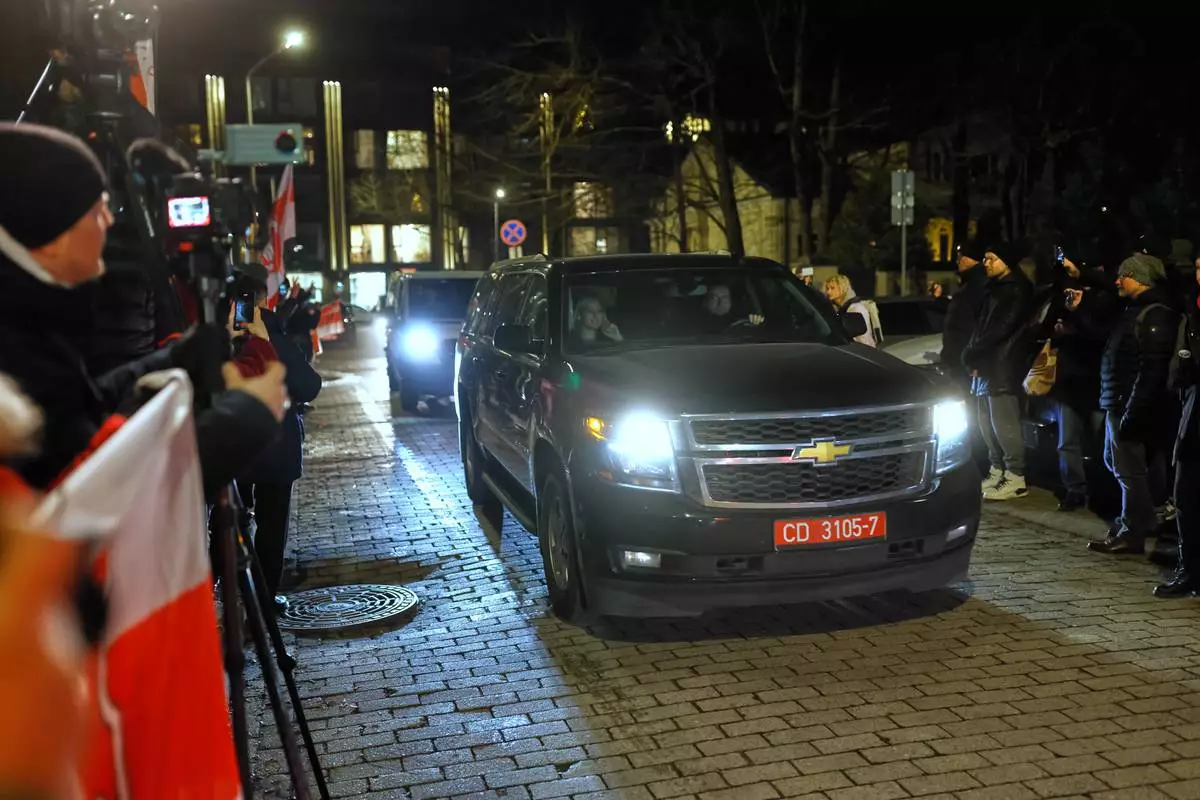
A motorcade arrives at the U.S. Embassy in Vilnius, Lithuania, on Saturday, Dec. 13, 2025. (AP Photo/Mindaugas Kulbis)
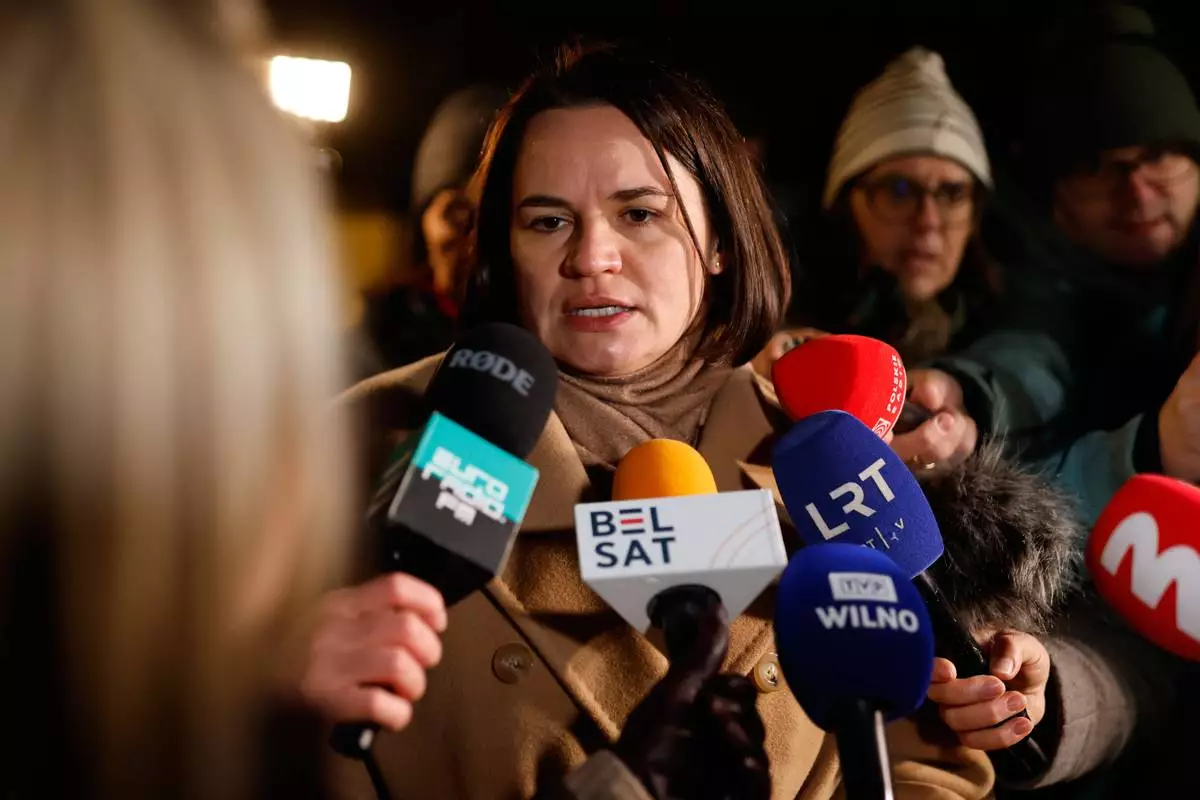
Belarusian opposition leader Sviatlana Tsikhanouskaya speaks to journalists as she waits to meet released Belarusian prisoners at the U.S. Embassy in Vilnius, Lithuania, on Saturday, Dec. 13, 2025. (AP Photo/Mindaugas Kulbis)
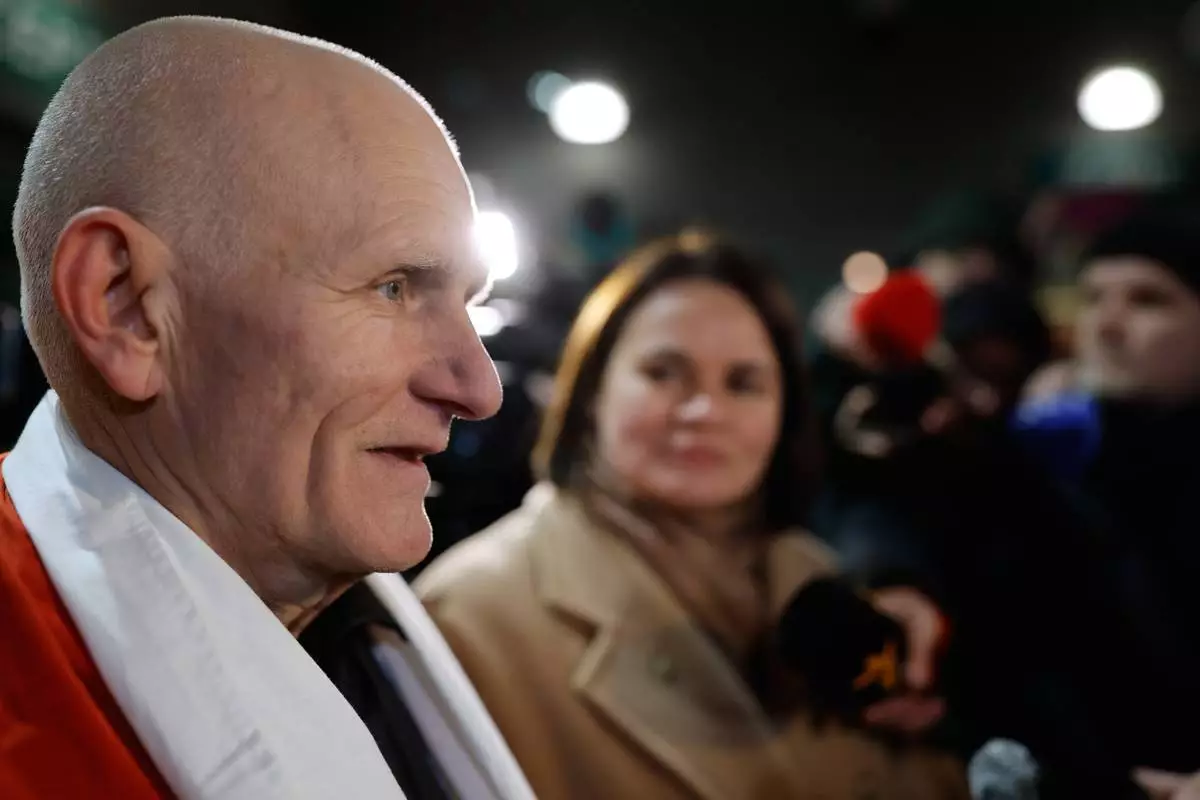
Nobel Peace Prize laureate Ales Bialiatski, one of released Belarusian prisoners, arrives at the U.S. Embassy in Vilnius, Lithuania, on Saturday, Dec. 13, 2025, as Belarusian opposition leader Sviatlana Tsikhanouskaya, background stands near. (AP Photo/Mindaugas Kulbis)
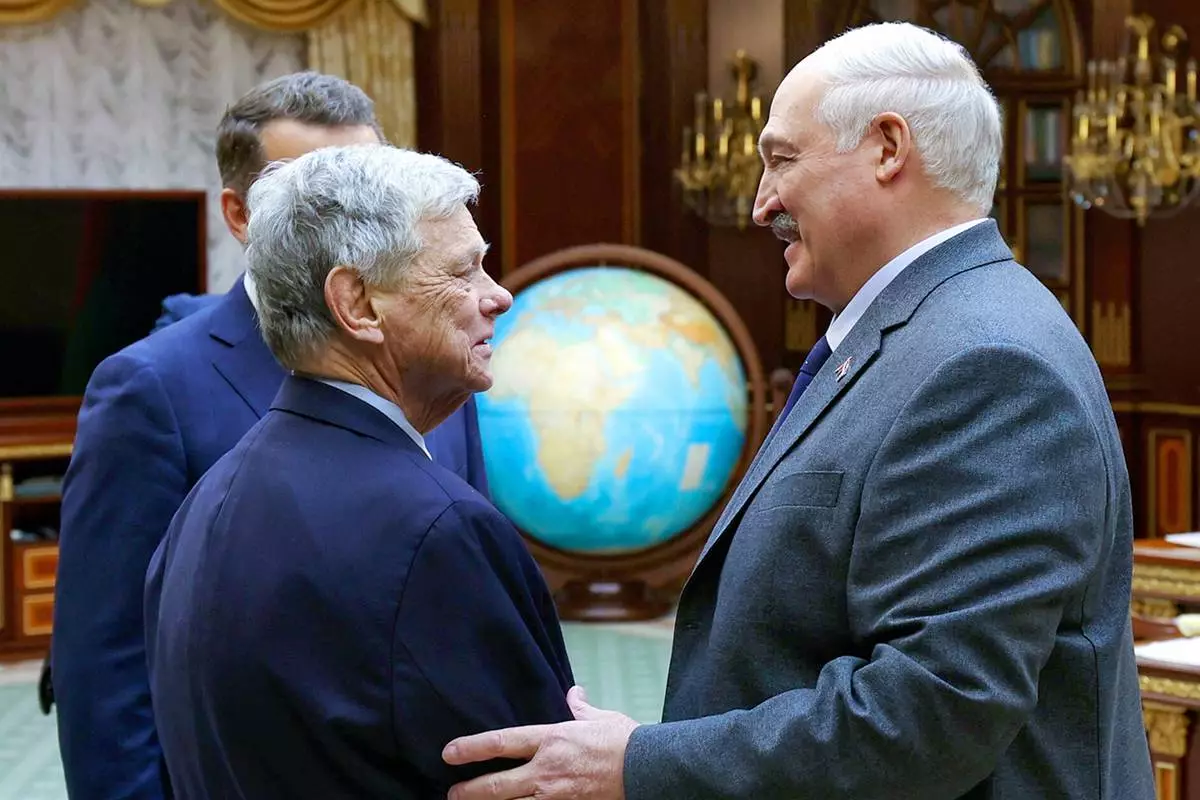
In this photo released by Belarusian presidential press service, Belarusian President Alexander Lukashenko, right, and U.S. Presidential envoy John Coale shake hands during their meeting in Minsk, Belarus, Friday, Dec. 12, 2025. (Belarusian Presidential Press Service via AP)