BOSTON (AP) — President Donald Trump's plan to end birthright citizenship for the children of people who are in the U.S. illegally will remain blocked as an order from one judge went into effect Friday and another seemed inclined to follow suit.
U.S. District Judge Joseph LaPlante in New Hampshire had paused his own decision to allow for the Trump administration to appeal, but with no appeal filed in the last week his order went into effect.
“The judge’s order protects every single child whose citizenship was called into question by this illegal executive order," Cody Wofsy, the ACLU attorney representing children who would be affected by Trump’s restrictions, said. “The government has not appealed and has not sought emergency relief so this injunction is now in effect everywhere in the country.”
The Trump administration could still appeal or even ask that LaPlante’s order be narrowed but the effort to end birthright citizenship for children of parents who are in the U.S. illegally or temporarily can’t take effect for now.
The Justice Department didn't immediately return a message seeking comment.
Meanwhile, a judge in Boston heard arguments from more than a dozen states who say Trump’s birthright citizenship order is blatantly unconstitutional and threatens millions of dollars for essential services. The issue is expected to move quickly back to the nation’s highest court.
U.S. District Judge Leo Sorokin was asked to consider either keeping in place the nationwide injunction he granted earlier or consider a request from the government either to narrow the scope of that order or stay it altogether. Sorokin, located in Boston, did not immediately rule but seemed to be receptive to arguments from states to keep the injunction in place.
Lawyers for the government had argued Sorokin should narrow the reach of his earlier ruling granting a preliminary injunction, arguing it should be “tailored to the States’ purported financial injuries.”
Much of the hearing was focused on what a narrower ruling would look like. The plaintiffs raised concerns that some alternatives floated by the Trump administration — such as giving children in states impacted by the birthright citizenship order social security numbers, but not citizenship — would be costly and unworkable.
They said such a system would burden these states with having to set up new administrative systems, sow confusion among the parents whose children are impacted and possibly turn these states into magnets for families from other states looking to access the benefits.
Government lawyers didn't seem tied to any one alternative, but told Sorokin the scope of his injunction should be limited. When pressed on how they would do that, a lawyer for the government, Eric Hamilton, would only commit to complying with whatever order was issued.
“If the court modifies the preliminary injunction or stays the preliminary injunction, it should be at most tailored to injuries plaintiffs are alleging which are primary financial,” Hamilton said.
Sorokin pushed back, at one point using an analogy of someone who sued a neighbor over loud music. The defendant offers to build a wall to limit the noise but Sorokin wondered how they could ensure it met the zoning code and was something the defendant could afford.
“What you are telling me is we will do it but, in response to my question, you have no answer how you will do it,” Sorokin said.
LaPlante issued the ruling last week p rohibiting Trump’s executive order from taking effect nationwide in a new class-action lawsuit, and a Maryland-based judge said this week that she would do the same if an appeals court signed off.
The justices ruled last month that lower courts generally can’t issue nationwide injunctions, but it didn’t rule out other court orders that could have nationwide effects, including in class-action lawsuits and those brought by states. The Supreme Court did not decide whether the underlying citizenship order is constitutional.
At the heart of the lawsuits is the 14th Amendment to the Constitution, which was ratified in 1868 after the Civil War and the Dred Scott Supreme Court decision. That decision found that Scott, an enslaved man, wasn’t a citizen despite having lived in a state where slavery was outlawed.
The Trump administration has asserted that children of noncitizens are not “subject to the jurisdiction” of the United States and therefore not entitled to citizenship.
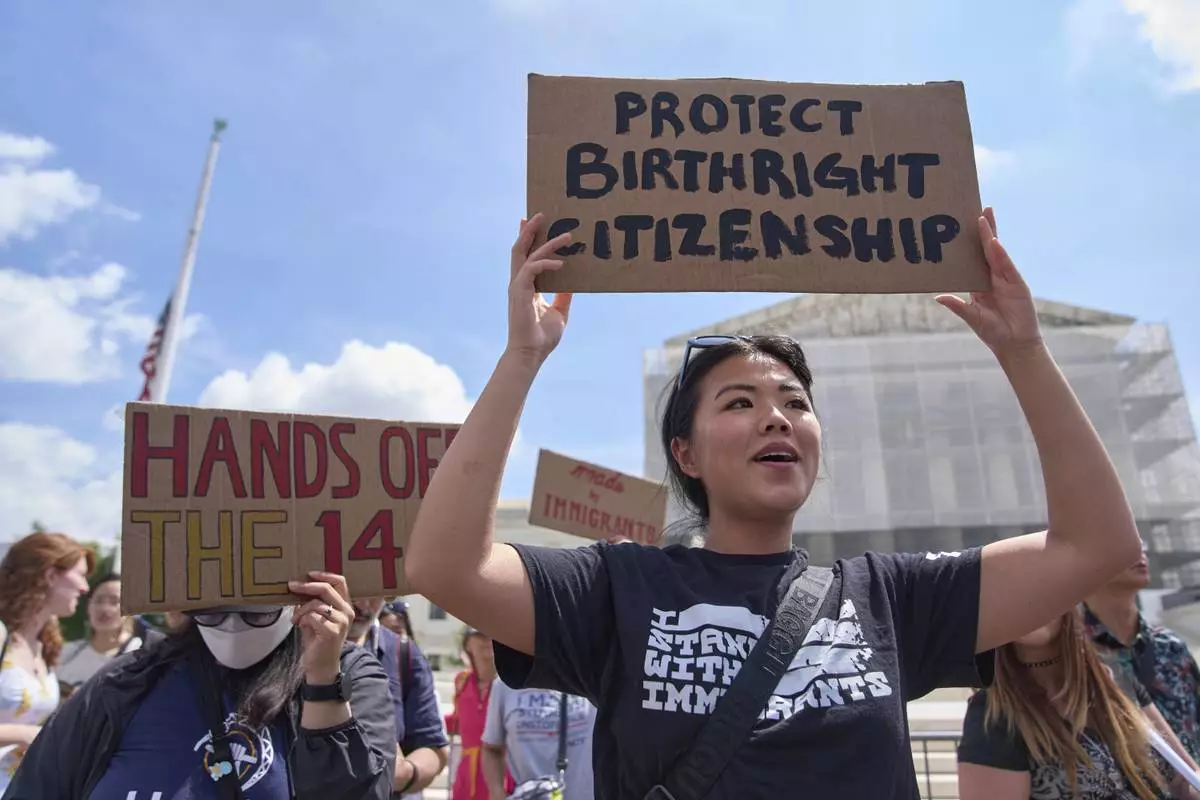
FILE - Hannah Liu, 26, of Washington, holds up a sign in support of birthright citizenship, May 15, 2025, outside of the Supreme Court in Washington. "This is enshrined in the Constitution. My parents are Chinese immigrants," says Liu. "They came here on temporary visas so I derive my citizenship through birthright." (AP Photo/Jacquelyn Martin, File)
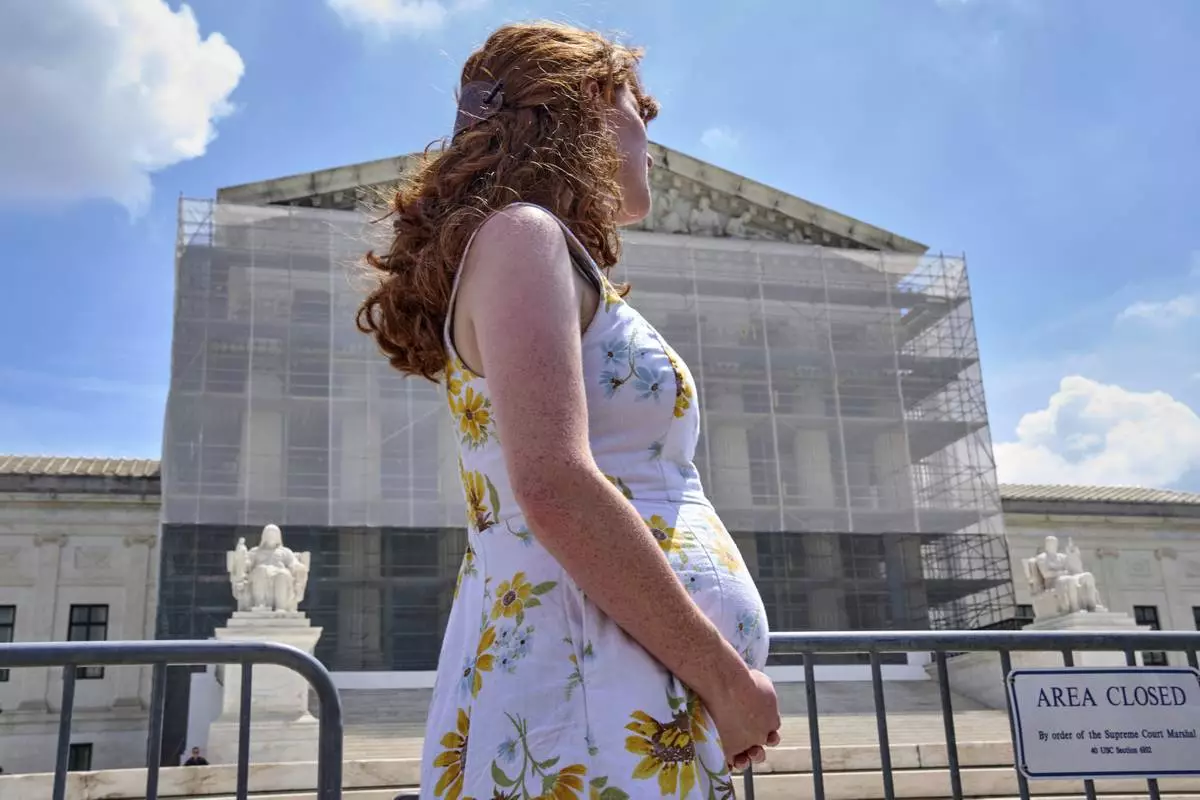
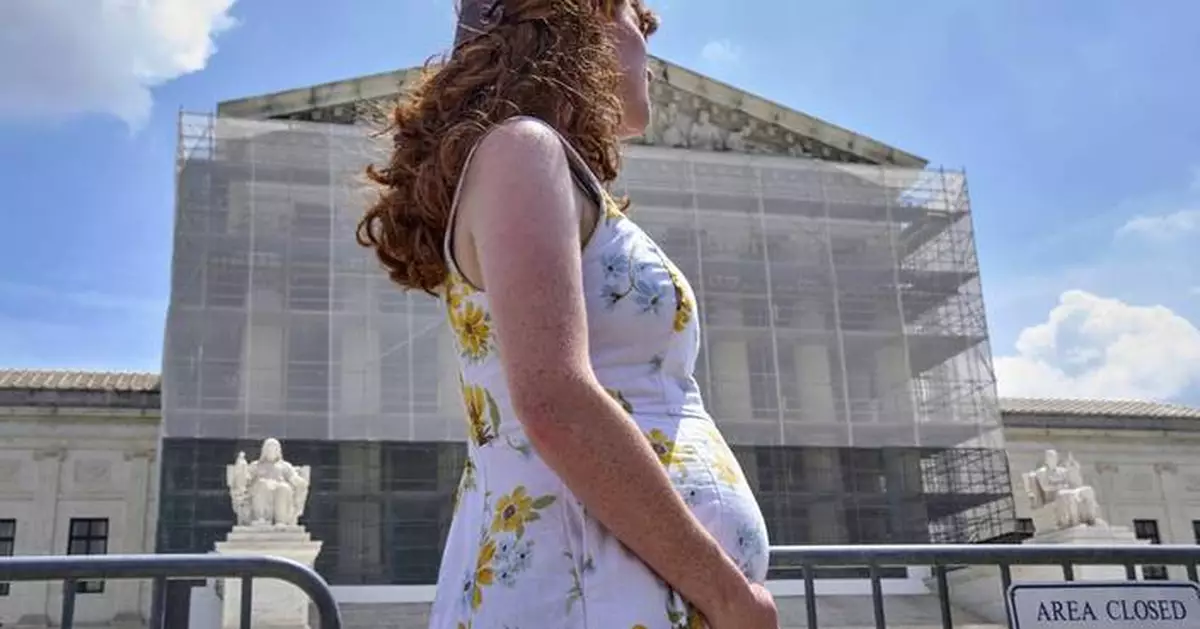
FILE - Mairelise Robinson, a U.S. citizen who is 6 months pregnant, attends a protest in support of birthright citizenship, outside of the Supreme Court in Washington, May 15, 2025. (AP Photo/Jacquelyn Martin, File)