MIAMI (AP) — Miami Marlins third baseman Connor Norby will be sidelined for several weeks after having surgery on his wrist.
The procedure on Wednesday was to repair a broke hamate bone in his left wrist and was done by hand specialist Dr. Don Sheridan in Phoenix, the team said Friday. The recovery timeline is six to eight weeks.
Norby felt wrist soreness during Miami's road series at Baltimore last week and was initially listed with wrist inflammation.
The Marlins acquired Norby from Baltimore last summer in the trade that also landed first-time All Star Kyle Stowers in Miami.
While Norby's tenure with the Marlins started strong — he hit .247 with a .315 on-base percentage while hitting seven homers in 36 games — his performance had been uneven this year, with a .241 average and .289 on-base percentage, six home runs and 26 RBI in 72 games. He was sidelined the first two months of the season with an oblique injury.
“Speaking with Connor in Baltimore, he felt like things were starting to come around,” manager Clayton McCullough said. “He felt better about himself in the box. He felt like he was making some real strides defensively, and then not knowing at the time what the length of it was going to be and what it was. But he was sore. I think he was just more disappointed, if he was going to have to miss some time, he felt right now he was trending.”
The Marlins will turn to Graham Pauley and Javier Sanoja in Norby's absence. Pauley has played 23 games at third base this season. Sanoja has played nine.
Pauley got the start at third on Friday against Kansas City as Miami began the second half of the season with a six-game homestand.
AP MLB: https://apnews.com/hub/mlb

Miami Marlins' Connor Norby hits a single during the third inning of a baseball game against the Baltimore Orioles, Friday, July 11, 2025, in Baltimore. (AP Photo/Stephanie Scarbrough)
NEW YORK (AP) — U.S. flu infections showed signs of a slight decline last week, but health officials say it is not clear that this severe flu season has peaked.
New government data posted Friday — for flu activity through last week — showed declines in medical office visits due to flu-like illness and in the number of states reporting high flu activity.
However, some measures show this season is already surpassing the flu epidemic of last winter, one of the harshest in recent history. And experts believe there is more suffering ahead.
“This is going to be a long, hard flu season,” New York State Health Commissioner Dr. James McDonald said, in a statement Friday.
One type of flu virus, called A H3N2, historically has caused the most hospitalizations and deaths in older people. So far this season, that is the type most frequently reported. Even more concerning, more than 91% of the H3N2 infections analyzed were a new version — known as the subclade K variant — that differs from the strain in this year’s flu shots.
The last flu season saw the highest overall flu hospitalization rate since the H1N1 flu pandemic 15 years ago. And child flu deaths reached 289, the worst recorded for any U.S. flu season this century — including that H1N1 “swine flu” pandemic of 2009-2010.
So far this season, there have been at least 15 million flu illnesses and 180,000 hospitalizations, the U.S. Centers for Disease Control and Prevention estimates. It also estimates there have been 7,400 deaths, including the deaths of at least 17 children.
Last week, 44 states reported high flu activity, down slightly from the week before. However, flu deaths and hospitalizations rose.
Determining exactly how flu season is going can be particularly tricky around the holidays. Schools are closed, and many people are traveling. Some people may be less likely to see a doctor, deciding to just suffer at home. Others may be more likely to go.
Also, some seasons see a surge in cases, then a decline, and then a second surge.
For years, federal health officials joined doctors' groups in recommending that everyone 6 months and older get an annual influenza vaccine. The shots may not prevent all symptoms but can prevent many infections from becoming severe, experts say.
But federal health officials on Monday announced they will no longer recommend flu vaccinations for U.S. children, saying it is a decision parents and patients should make in consultation with their doctors.
“I can’t begin to express how concerned we are about the future health of the children in this country, who already have been unnecessarily dying from the flu — a vaccine preventable disease,” said Michele Slafkosky, executive director of an advocacy organization called Families Fighting Flu.
“Now, with added confusion for parents and health care providers about childhood vaccines, I fear that flu seasons to come could be even more deadly for our youngest and most vulnerable," she said in a statement.
Flu is just one of a group of viruses that tend to strike more often in the winter. Hospitalizations from COVID-19 and RSV, or respiratory syncytial virus, also have been rising in recent weeks — though were not diagnosed nearly as often as flu infections, according to other federal data.
The Associated Press Health and Science Department receives support from the Howard Hughes Medical Institute’s Department of Science Education and the Robert Wood Johnson Foundation. The AP is solely responsible for all content.
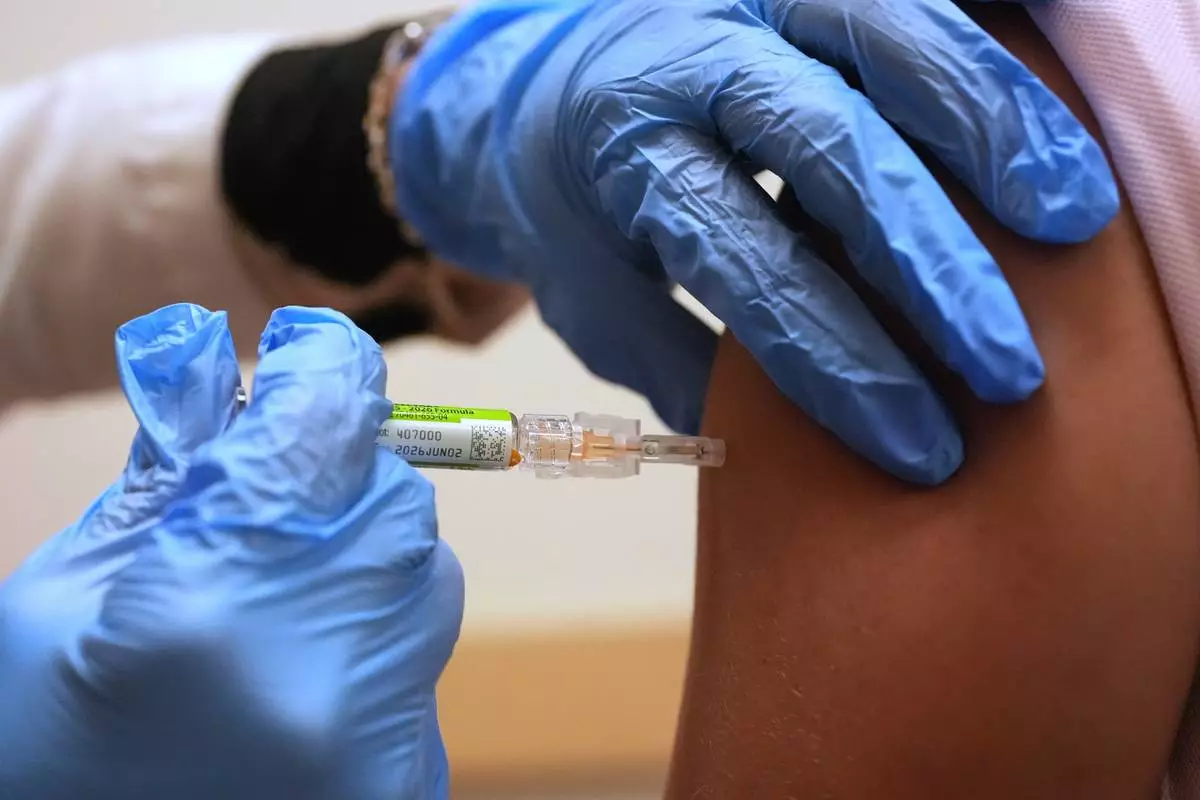
FILE - Pharmacy manager Aylen Amestoy administers a patient with a seasonal flu vaccine at a CVS Pharmacy in Miami, Tuesday, Sept. 9, 2025. (AP Photo/Rebecca Blackwell, File)