Antarctica's oldest ice has arrived in Cambridge, the United Kingdom (UK), for detailed analysis which scientists hope will reveal more about the Earth's climate and atmospheric record stretching back more than 1.5 million years.
The ice cores - cylindrical tubes of ancient ice - was retrieved from depths of up to 2,800 meters at the Little Dome C field camp in East Antarctica, through international collaboration led by the British Antarctic Survey (BAS).
Over the next few years, these samples will be meticulously analyzed at the BAS's laboratories and other European research facilities to gain understanding of the Earth's climate evolution and greenhouse gas concentrations.
For over 60 years, the BAS has been working to unlock secrets above and below the ice of the world's most remote continent.
Working with a team of experts from 10 European countries, they have successfully extracted the world's oldest ice cores, between 1.2 and 1.5 million years old.
Drilling a hole reaching an incredible 2,800 meters into the ice sheet, each 4.5-meter section of ice took around two and a half hours to recover.
The samples were split into smaller pieces, each carefully recorded before being shipped to institutions around Europe for analysis.
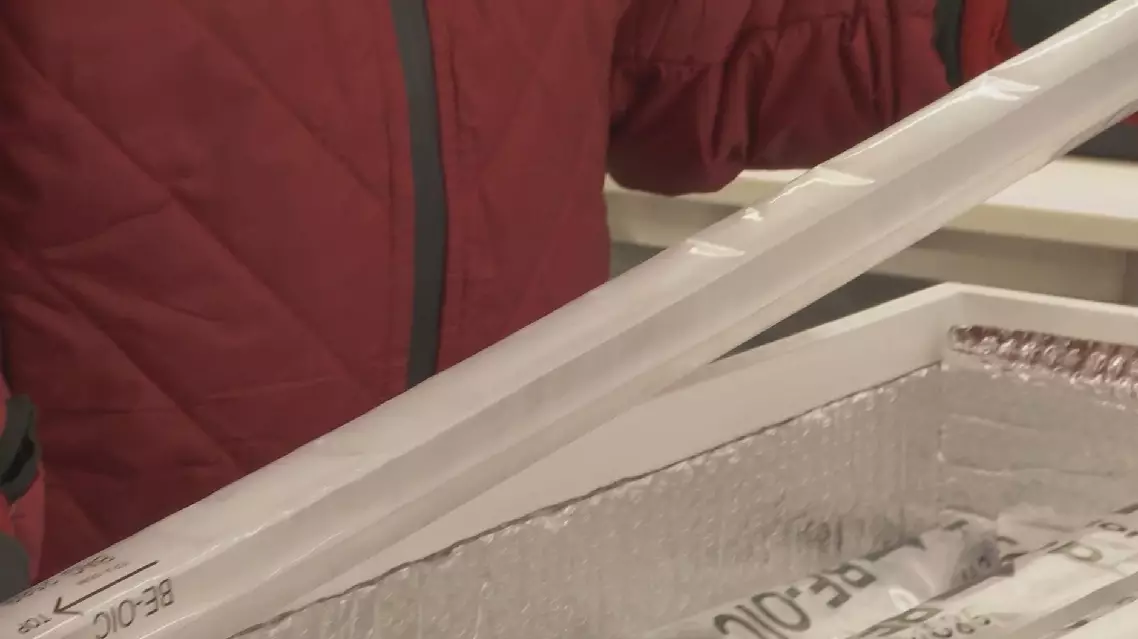
"Some of the ice in here is from the very, very bottom of the bore hole, so some of the very oldest ice. This piece here that I will very carefully pick up is from about 2,600 meters down. It is at least 1.2 million years old," James Veale, an ice core drilling engineer at the BAS, told China Global Television Network (CGTN), as he showed the ice cylinders in the BAS's freezer room on Friday.
"When you get this deep, and the ice is under this much pressure, it just looks like glass, there's very little inclusions there, the bubbles of atmosphere are trapped there, they got so small at this kind of depth, you can't even see them anymore," he explained.
Using a technique called continuous flow analysis, the team will slowly melt the ice, releasing ancient dust, gases, isotopes, and other chemical materials, which hold the information about the Earth's wind patterns, temperature, and sea levels more than a million years ago.
One of the biggest questions the ancient ice could help answer is why Earth's natural climate cycles changed.
"This question of why did we change from a 40,000 year cycle to a 100,000 year cycle remains one of the biggest questions within our scientific field. [We hope to find out] what was it that caused that transition and is it a potential analogue for how we may be changing in the future," said Dr. Liz Thomas, who heads the BAS's Ice Core Research in Cambridge.
Importantly, what is locked inside the ancient ice could reveal just how sensitive Earth's climate is to human-driven change, like rising carbon dioxide levels.
Antarctica's oldest ice arrives in UK for climate analysis