An exhibition on China's lunar exploration technology opened in Shanghai on Tuesday, drawing many visitors.
The exhibition at the Shanghai World Expo Museum is to commemorate China's three-step lunar exploration program of orbiting, landing and returning samples, which began in 2004, and mark the International Moon Day on July 20.
The exhibition highlights the very-long-baseline interferometry (VLBI) experiment system which serves as an observatory deployed in the lunar orbit 380,000 kilometers from the earth.
"These are three core sets of our entire six-unit lunar orbit VLBI experiment system. The passive hydrogen maser is the heart of the system, providing precise clock rate. This is a cryogenic electronics unit, also known as cryogenic receiver. It functions to amplify signals received by the antenna with low temperatures and low noise and converts them to intermediate frequencies, which are then processed by the data collecting terminal," Wu Xiaojing, the VLBI program director, explained.
The system was one of the payloads carried by Queqiao-2 relay satellite launched from the Wenchang Space Launch Site in south China's Hainan Province last year.
It was placed at the antenna of the Queqiao-2, an 1:2 model of which is also on display at the exhibition. The relay satellite mainly supports communication with probes exploring the farside and polar region of the moon.
By working in concert with Earth-based radio telescopes, the VLBI experiment system achieves high-precision measurements of the Moon, spacecraft, and deep-space celestial bodies.
It also plays an important role in astrophysical research such as black hole studies and tests of general relativity, according to scientists.
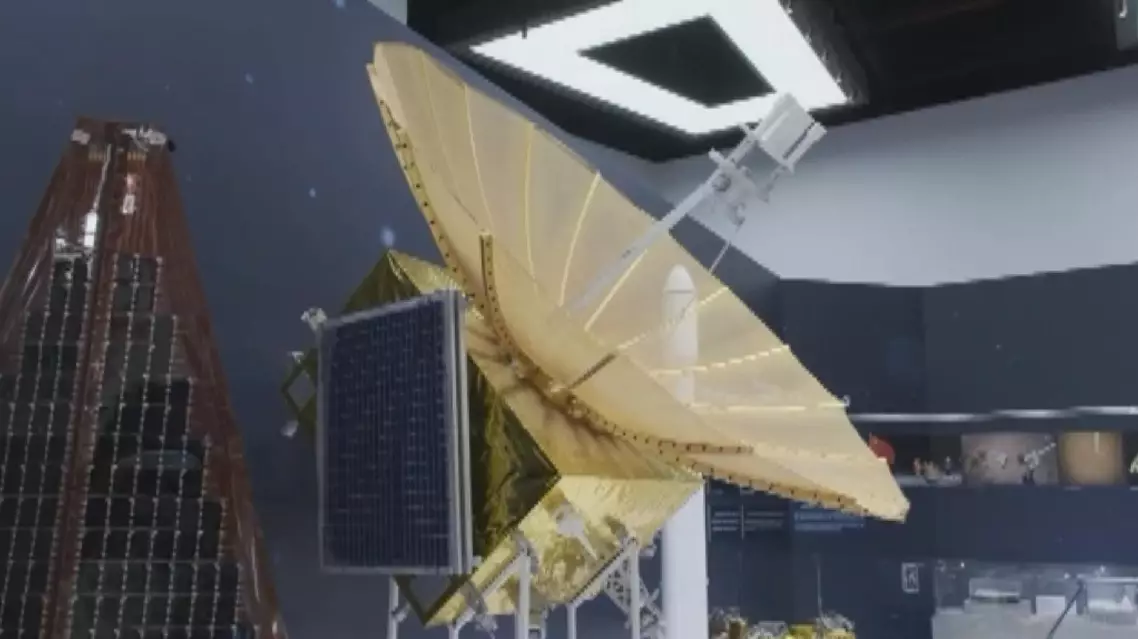
China exhibits lunar exploration tech in Shanghai