Over 270,000 people have been relocated across south China's Guangdong Province as Typhoon Wipha, the sixth typhoon of the year, approaches.
More than 500 fishing boats have returned to port for shelter, and 52 coastal scenic areas have been closed.
As of 08:00 Sunday, the Guangdong Provincial Flood Control, Drought Relief and Wind Prevention Command Headquarters maintained a Level II emergency response for Typhoon Wipha, which is expected to make landfall along the coast Sunday afternoon or evening.
China has a four-tier emergency response system, with Level I being the most severe response.
At Xitou Fishing Port in Yangxi County, Yangjiang City, fishermen are checking ropes and reinforcing moorings. Currently, the South China Sea is in the seasonal fishing ban period, and most fishing boats in the port are already docked. To mitigate the potential impact of the typhoon's winds and waves, fishermen are adjusting the boats to the best sheltered positions and securing the ropes.
In Jiangmen City, nearly 200 residents from hazardous areas have been relocated to an gym-converted emergency shelter. Staff members are distributing bottled water, instant porridge and noodles, and other essential supplies to those affected.
"The ground has already been marked, so after we arrive, we can quickly find our area. There are also volunteers who actively contact us and guide us to register one by one," said Mr. Liu, a relocated resident.
"The government has provided us with beds, blankets, and other supplies, and it makes us feel very secure," said Mr. Ning, another relocated resident.
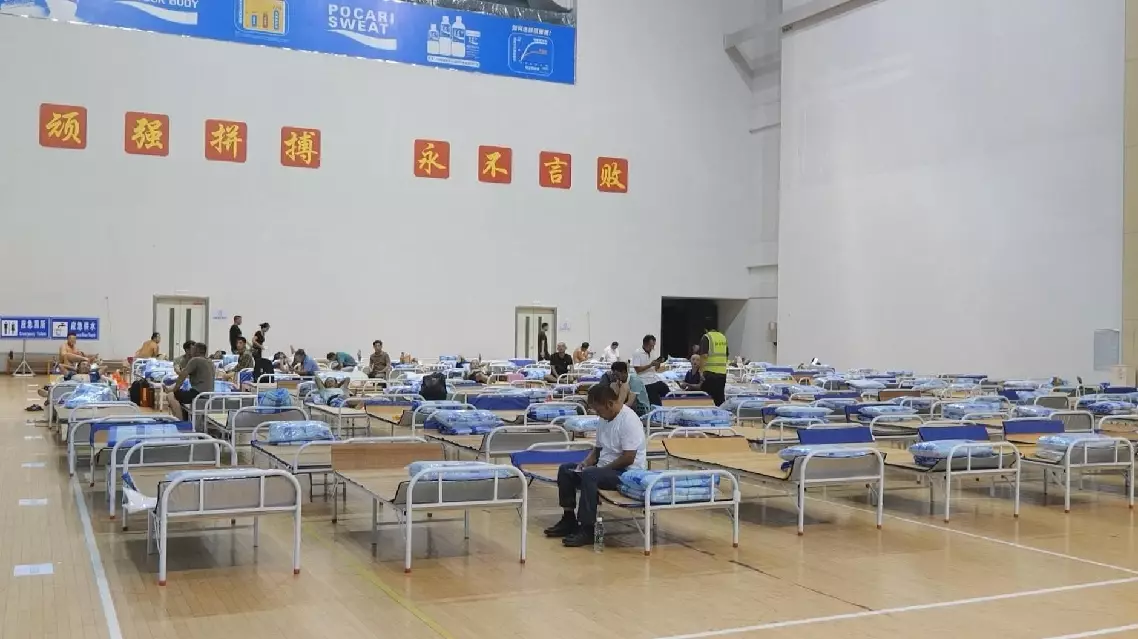
Over 270,000 people relocated across Guangdong for Typhoon Wipha
Commemorations honoring Chinese People's Volunteers (CPV) martyrs were held on the banks of the Yalu River in Dandong, Liaoning Province on Tuesday as part of ongoing tributes to those who fought in the War to Resist U.S. Aggression and Aid Korea (1950-1953).
The event was held to mark the return of the remains of 12 CPV martyrs, who were killed in the war, from the Republic of Korea (ROK) on Wednesday.
This will be the 13th such repatriation of CPV remains following the handover agreement between the two countries. Since 2014, the remains of 1,011 soldiers have been returned to China from the ROK, according to China's Ministry of Veterans Affairs.
More than 170 representatives, including veteran CPV soldiers, relatives of the martyrs, active-duty personnel, students, and other from various sectors of society, attended the event.
People boarded a ferry which slowly sailed down the Yalu River. Inside the cabin, all present stood in solemn silence as the national anthem of the People's Republic of China was played, and observed a moment of silence in honor of the CPV martyrs.
Then, they walked to the ship's railings one by one and scattered flower petals into the river to pay tribute to the martyrs.
"We, the CPV, went abroad to fight to defend our motherland, the people, and our good life and to resist U.S. imperialist aggression against the Democratic People's Republic of Korea (DPRK). I hope that our young comrades and students today will study hard and make contributions to our motherland," said Hu Changzhe, a CPV veteran.
"I feel deeply moved as these veteran soldiers are heroes who once fought for our country. Now, standing by the Yalu River, looking back on their past and remembering their comrades, they must be deeply touched," said Hong Jialu, a student at a branch of Liaoning Province Shiyan High School.
At the event, 10 student representatives from primary and middle schools read aloud a letter to express their reverence and remembrance for the heroic martyrs through their sincere words and heartfelt recitation.
The Korean War broke out in June 1950, eight months after the People's Republic of China was founded. At the request of the Democratic People's Republic of Korea (DPRK), China sent 2.9 million CPV soldiers to assist the DPRK during the war, of whom more than 360,000 were killed or injured.
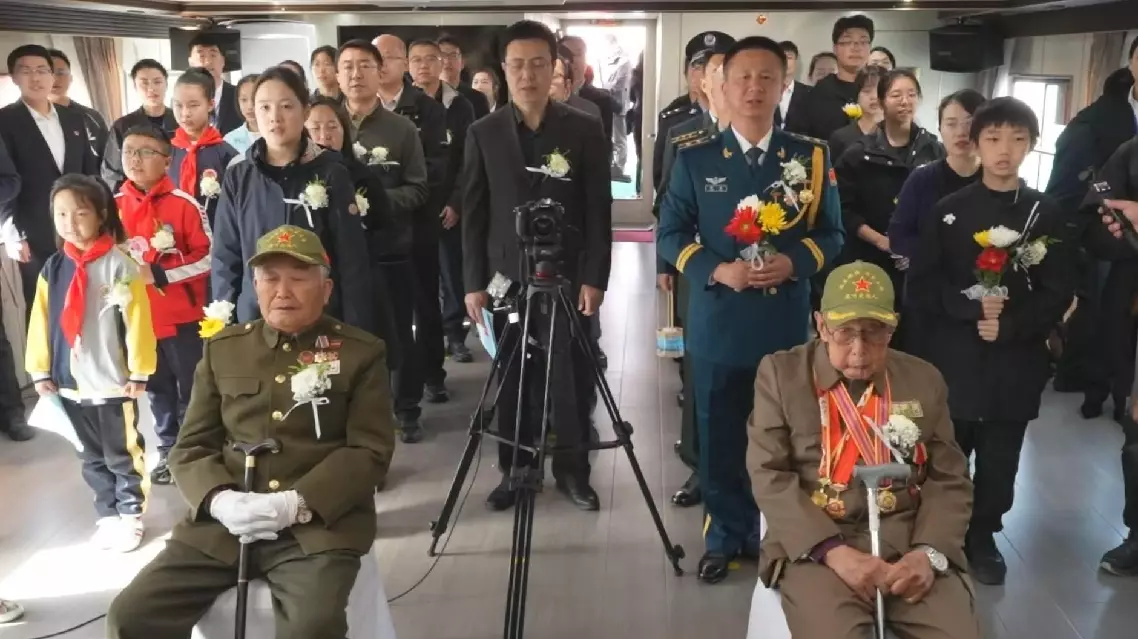
Commemorations held to pay tribute to CPV heroes in northeast China