|
LONDON, July 21, 2025 /PRNewswire/ -- People in low-income countries are twice as generous as those in high-income countries when it comes to supporting people in need and charities, according to new research by the Charities Aid Foundation (CAF).
CAF's new World Giving Report uses insights gathered from more than 50,000 people to explore what drives giving at a global level and across 101 countries. The research introduces a generosity measure to compare countries, assessing the amount of money donated as a proportion of income.
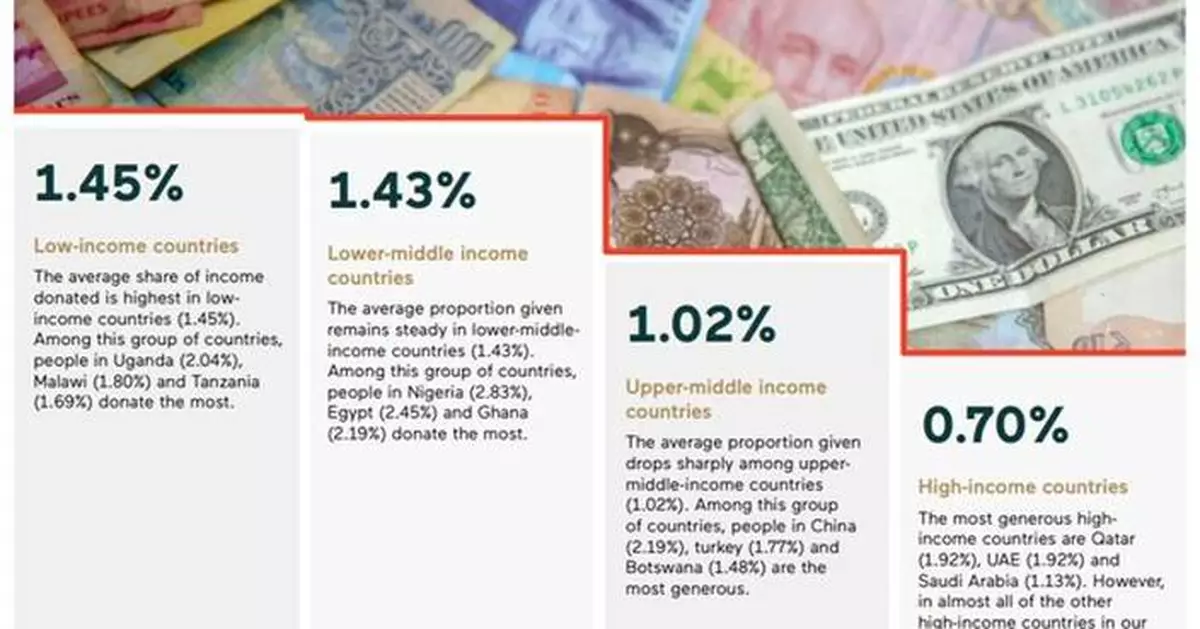
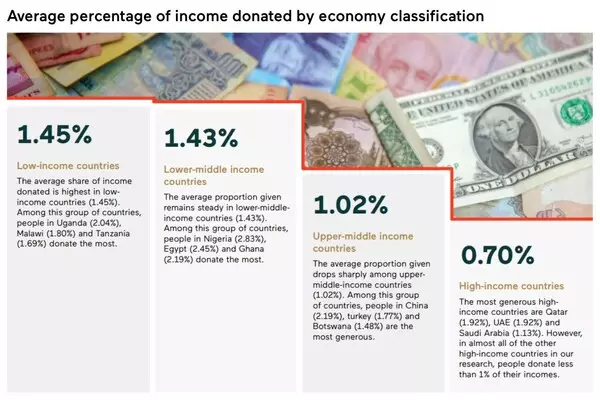
People in low-income countries give away an average of 1.45% of their income to good causes, compared to 0.7% in high-income countries. In Africa, people donate an average of 1.54% of their income to good causes, compared to 0.64% in Europe.
Nigeria is the most generous country, where people give an average of 2.83% of their income to charities, religiously or to people in need. However, three G7 countries have some of the lowest levels of donations as a proportion of income (France 0.45%, Germany 0.39%, and Japan 0.16%).
Across the world, those aged 35-44 donated almost 1.5 times as much of their income as those over 65-years (1.18% vs 0.83%).
Worldwide, the most popular cause is children and young people, supported by 29% of people, and a top cause in every continent. One in four (26%) donors supported humanitarian aid and disaster relief efforts and people in Asia (16%) were the most likely to support environmental causes.
Most people donate to make a difference to a cause they care about (65%). Nearly a fifth (18%) are inspired by something they saw on the news, and social media is the top way people discover new charities (14%).
Globally, people tend to trust and value local charities the most, followed by national and then international charities. The research also finds that people are more generous when their government encourages giving. When a government encourages giving, people are also more likely to trust and think of them as more important to society.
Neil Heslop, CAF's Chief Executive, said:
"Around the world, social purpose organisations are facing severe financial headwinds. Traditional funding models need to change as patterns of behaviour evolve and governments cut back on their aid and development spending with philanthropy seeking to respond.
"Individual giving remains the cornerstone of generosity. Yet there is wide disparity, with the most dynamic cultures of giving often in countries where the populations are also much in need.
"It is notable that giving does not necessarily correlate with wealth or even security, but rather on the perception of necessity – and very often we perceive those closest to us to be most in need. During these challenging times, there is much we can learn about the power of connection, and the nature of compassion for our fellow citizens, whether they be across the street or around the world."
Further information: www.worldgivingreport.org.
LONDON, July 21, 2025 /PRNewswire/ -- People in low-income countries are twice as generous as those in high-income countries when it comes to supporting people in need and charities, according to new research by the Charities Aid Foundation (CAF).
CAF's new World Giving Report uses insights gathered from more than 50,000 people to explore what drives giving at a global level and across 101 countries. The research introduces a generosity measure to compare countries, assessing the amount of money donated as a proportion of income.
People in low-income countries give away an average of 1.45% of their income to good causes, compared to 0.7% in high-income countries. In Africa, people donate an average of 1.54% of their income to good causes, compared to 0.64% in Europe.
Nigeria is the most generous country, where people give an average of 2.83% of their income to charities, religiously or to people in need. However, three G7 countries have some of the lowest levels of donations as a proportion of income (France 0.45%, Germany 0.39%, and Japan 0.16%).
Across the world, those aged 35-44 donated almost 1.5 times as much of their income as those over 65-years (1.18% vs 0.83%).
Worldwide, the most popular cause is children and young people, supported by 29% of people, and a top cause in every continent. One in four (26%) donors supported humanitarian aid and disaster relief efforts and people in Asia (16%) were the most likely to support environmental causes.
Most people donate to make a difference to a cause they care about (65%). Nearly a fifth (18%) are inspired by something they saw on the news, and social media is the top way people discover new charities (14%).
Globally, people tend to trust and value local charities the most, followed by national and then international charities. The research also finds that people are more generous when their government encourages giving. When a government encourages giving, people are also more likely to trust and think of them as more important to society.
Neil Heslop, CAF's Chief Executive, said:
"Around the world, social purpose organisations are facing severe financial headwinds. Traditional funding models need to change as patterns of behaviour evolve and governments cut back on their aid and development spending with philanthropy seeking to respond.
"Individual giving remains the cornerstone of generosity. Yet there is wide disparity, with the most dynamic cultures of giving often in countries where the populations are also much in need.
"It is notable that giving does not necessarily correlate with wealth or even security, but rather on the perception of necessity – and very often we perceive those closest to us to be most in need. During these challenging times, there is much we can learn about the power of connection, and the nature of compassion for our fellow citizens, whether they be across the street or around the world."
Further information: www.worldgivingreport.org.
** The press release content is from PR Newswire. Bastille Post is not involved in its creation. **
New Charities Aid Foundation study finds people in wealthy countries donate significantly less than low-income countries
GUANGZHOU, China, Jan. 11, 2026 /PRNewswire/ -- Recently, GAC's independently developed Quark E-Drive power domain control system has achieved the world's first dual certification for deeply integrated ASIL D functional safety and information security, accredited by DAkkS, Germany's national accreditation body. The certification was evaluated and issued by SGS-CSTC Standards Technical Services Co., Ltd. (SGS), a globally recognized certification authority.
ISO 26262 is the internationally recognized core standard for automotive functional safety. Within this framework, ASIL D represents the highest automotive safety integrity level, requiring near-zero tolerance for safety-critical failures. Achieving an ASIL D certification accredited by DAkkS signifies that the certified product meets the highest globally accepted standards for automotive safety.
The certified Quark E-Drive power domain control system has been in production use since February 2025, and is now deployed across multiple models under GAC's brands - HYPTEC and AION. As the industry's first electric drive power domain system based on deep integration using a single main control chip, the solution significantly reduces chip count, minimizes risks associated with chip-level failures, and boosts motor controller efficiency to as high as 99.9%. The certification confirms that GAC has completed the system's full product development lifecycle in strict compliance with ISO 26262:2018 functional safety and ISO/SAE 21434:2021 information security standards.
Throughout the project, GAC Technology Research Center worked closely with SGS experts, strengthening safety design across all development phases while ensuring engineering feasibility and an optimal user experience.
Zhao Hui, Vice President of SGS China, commented: "The successful certification highlights GAC's strong team and robust development systems. We are pleased to support the safety of the Quark E-Drive and look forward to closer collaboration."
This milestone represents a major breakthrough for GAC in e-drive safety and sets a new global benchmark for the intelligent electric vehicle industry.
** The press release content is from PR Newswire. Bastille Post is not involved in its creation. **
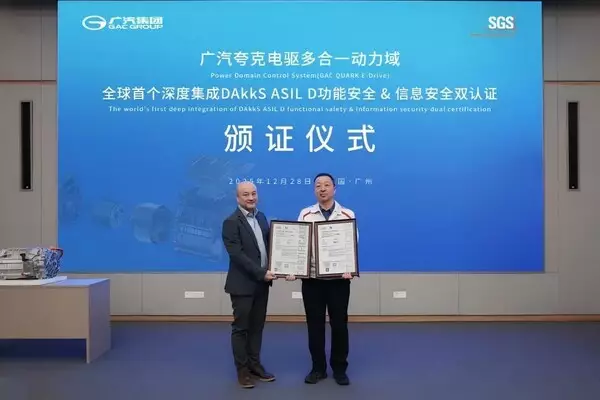
GAC's Quark Electric Drive Achieves the World's First DAkkS ASIL D Functional Safety and Information Security Dual Certification