DH announces latest situation of Legionnaires' disease cases
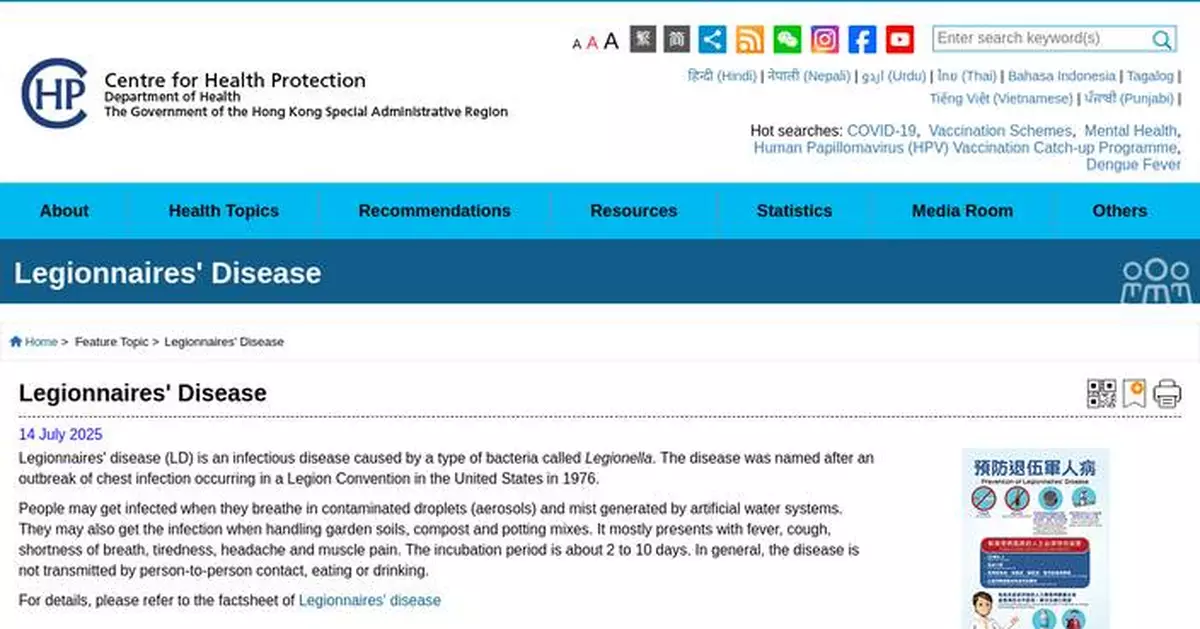
The Centre for Health Protection (CHP) of the Department of Health today (July 21) reported the latest number of cases of Legionnaires' disease (LD), and reminded the public of the importance of using and maintaining properly designed man-made water systems, adding that susceptible groups should strictly observe relevant precautions.
From July 13 to 19, the CHP recorded three community-acquired LD cases. The details of the cases are as follows:
A 70-year-old male patient with underlying illnesses living in Sha Tin District;
A 70-year-old female patient with underlying illnesses living in Sha Tin District; and
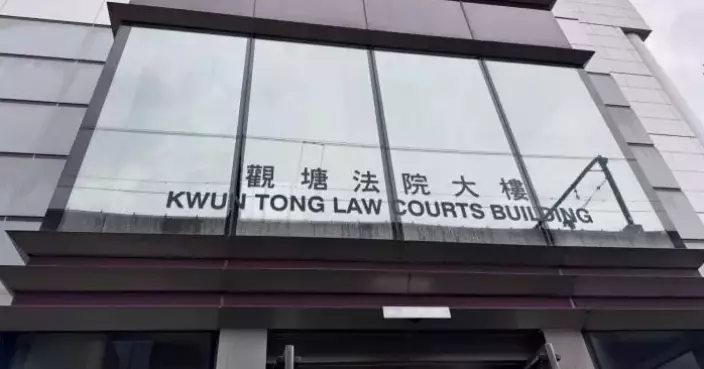
A 69-year-old male patient with underlying illnesses living in Kwun Tong District.
The CHP is conducting epidemiological investigations to identify potential sources of infection and high-risk exposure. Initial investigation revealed that all three cases are sporadic cases. No epidemiological linkages have been established between these cases and other confirmed cases previously recorded in Hong Kong.
As of July 19, 85 LD cases had been recorded this year. In 2024 and 2023, there were 135 and 121 LD cases respectively.
Men, people aged over 50, smokers, alcoholics and persons with weakened immunity are more susceptible to LD. Some situations may also increase the risk of infection, including poor maintenance of water systems; living in areas with old water systems, cooling towers or fountains; using electric water heaters, whirlpools and spas or hot water spring spas; and recent stays in hotels or vessels.
Legionellae are found in various environmental settings and grow well in warm water (20 to 45 degrees Celsius). They can be found in aqueous environments such as water tanks, hot and cold water systems, cooling towers, whirlpools and spas, water fountains and home apparatus that support breathing. People may become infected when they breathe in contaminated droplets (aerosols) and mist generated by artificial water systems, or when handling garden soil, compost and potting mixes.
Immunocompromised persons should:
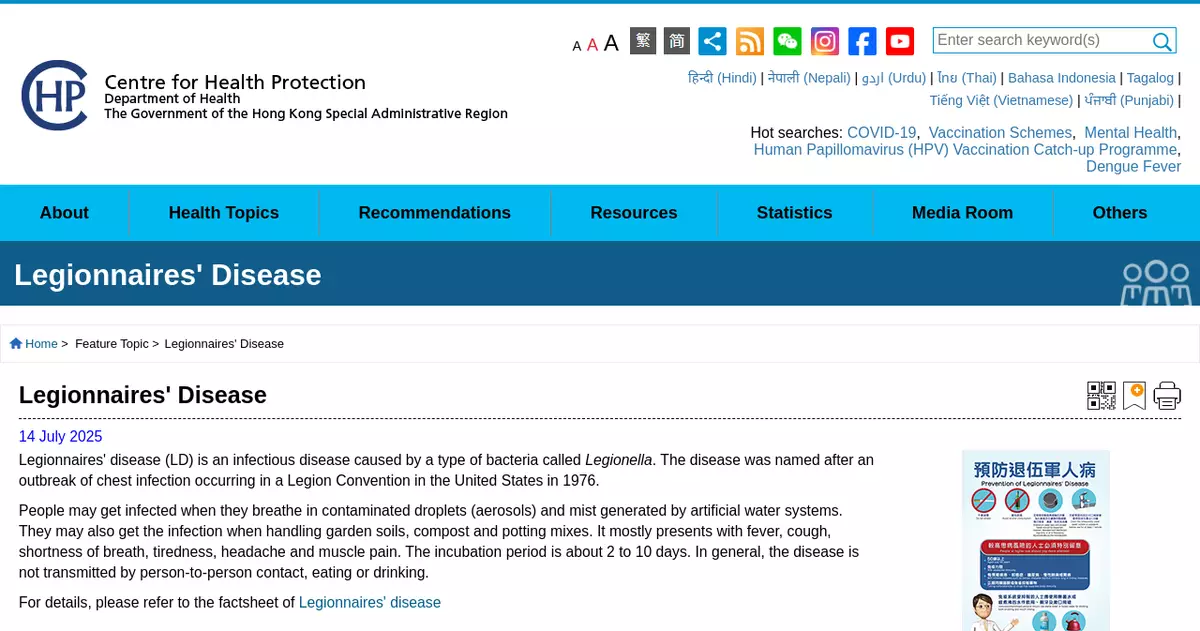 Use sterile or boiled water for drinking, tooth brushing and mouth rinsing;
Avoid using humidifiers, or other mist- or aerosol-generating devices; and
If using humidifiers, or other mist- or aerosol-generating devices, fill the water tank with only sterile or cooled freshly boiled water, and not water directly from the tap. Also, clean and maintain humidifiers/devices regularly according to manufacturers' instructions. Never leave stagnant water in a humidifier/device. Empty the water tank, wipe all surfaces dry, and change the water daily.
Use sterile or boiled water for drinking, tooth brushing and mouth rinsing;
Avoid using humidifiers, or other mist- or aerosol-generating devices; and
If using humidifiers, or other mist- or aerosol-generating devices, fill the water tank with only sterile or cooled freshly boiled water, and not water directly from the tap. Also, clean and maintain humidifiers/devices regularly according to manufacturers' instructions. Never leave stagnant water in a humidifier/device. Empty the water tank, wipe all surfaces dry, and change the water daily.
The public should observe the health advice below:
Observe personal hygiene;
Do not smoke and avoid alcohol consumption;
Strainers in water taps and shower heads should be inspected, cleaned, descaled and disinfected regularly or at a frequency recommended by the manufacturer;
If a fresh-water plumbing system is properly maintained, it is not necessary to install domestic water filters. Use of water filters is not encouraged as clogging occurs easily, which can promote growth of micro-organisms. In case water filters are used, the pore size should be 0.2 micrometres (µm) and the filter needs to be changed periodically according to the manufacturer's recommendations;
Drain and clean water tanks of buildings at least quarterly;
Drain or purge for at least one minute infrequently used water outlets (e.g. water taps, shower heads and hot water outlets) and stagnant points of the pipework weekly or before use;
Seek and follow doctors' professional advice regarding the use and maintenance of home respiratory devices and use only sterile water (not distilled or tap water) to clean and fill the reservoir. Clean and maintain the device regularly according to the manufacturer's instructions. After cleaning/disinfection, rinse the device with sterile water, cooled freshly boiled water or water filtered with 0.2 µm filters. Never leave stagnant water in the device. Empty the water tank, keep all surfaces dry, and change the water daily; and
When handling garden soil, compost and potting mixes:
Wear gloves and a face mask;
Water gardens and compost gently using low pressure;
Open composted potting mixes slowly and make sure the opening is directed away from the face;
Wet the soil to reduce dust when potting plants; and
Avoid working in poorly ventilated places such as enclosed greenhouses.
The public may visit the CHP'sLD page, theCode of Practice for Prevention of LDand theHousekeeping Guidelines for Cold and Hot Water Systems for Building Managementof the Prevention of LD Committee, and the CHP'srisk-based strategyfor prevention and control of LD.
Source: AI-found images
Public healthcare fees and charges reform strengthens protection for poor, acute, serious and critical patients number of waiver recipients is 3.5 times annual total of previous year
The following is issued on behalf of the Hospital Authority:
The Hospital Authority (HA) spokesperson announced today (January 9) that in addition to the 600 000 people who have been benefiting from medical fee waivers both before and after the reform (including Comprehensive Social Security Assistance recipients, Old Age Living Allowance recipients aged 75 or above, and holders of Residential Care Service Voucher Scheme Level 0 vouchers), as of January 7, the HA has approved 49 310 medical fee waiver applications. This figure is 3.5 times of approximately 14 000 patients who received medical fee waivers in previous year, demonstrating that the enhanced medical fee reduction mechanism has significantly strengthened support for low-income families and underprivileged groups. Over the past week, many patients have benefited from the enhanced medical fee waivers mechanism, receiving immediate fee reduction when using Accident and Emergency Departments (A&E), outpatient and inpatient services.
Medical fee waivers take effect covering more than 10 000 poor patients
As an essential component of the public healthcare fees and charges reform, the HA expanded its medical fee waivers mechanism at the same time, which significantly increased the number of eligible individuals from approximately 300 000 to about 1.4 million - around 4.6 times the previous number of beneficiaries. This ensures that limited medical resources can be more precisely directed to help those most in need: the poor, acute, serious, and critical patients. As of January 7, among the 49 310 medical fee waiver applications approved by the HA, 32 249 cases have completed assessment and received formal waiver certificates valid for up to 18 months but claimed . For patients who claim to meet the medical fee waivers eligibility criteria but are unable to submit supporting documents for financial assessment, the HA has exercised flexible arrangements to approve 17 061 "conditional waivers", allowing patients to obtain immediate medical fee reductions when using public healthcare services. These patients must submit relevant documentation within three months.
After the fees and charges reform, many patients are benefited for the first time from the expanded medical fee waivers mechanism, changing from paying full fees to receiving free services. From January 1 to 7, excluding the number of Comprehensive Social Security Assistance recipients, Old Age Living Allowance recipients aged 75 or above, and holders of Residential Care Service Voucher Scheme Level 0 vouchers who can continue to use their medical fee waivers, there are over 11 200 patients benefitted from the enhanced medical fee waivers mechanism, including:
 About 500 poor patients at A&Es,who were triaged as urgent, semi-urgent and non-urgent, received medical fee waivers, triple of last year's figure;
About 2 100 poor patients received medical fee waivers for inpatient services, 3.5 times of last year's figure; and
About 8 600 poor patients received medical fee waivers for specialist outpatient services, six times of last year's figure.
About 500 poor patients at A&Es,who were triaged as urgent, semi-urgent and non-urgent, received medical fee waivers, triple of last year's figure;
About 2 100 poor patients received medical fee waivers for inpatient services, 3.5 times of last year's figure; and
About 8 600 poor patients received medical fee waivers for specialist outpatient services, six times of last year's figure.
The HA spokesperson stated, "The data concerned shows obviously that the enhanced medical fee waivers mechanism, which is newly introduced in line with the public healthcare fees and charges reform, can allocate resources more precisely to strengthen protection for poor, acute, serious and critical patients, ensuring that no patient is denied from medical care due to lack of means."
The current situation regarding patients' applications and usage of medical fee waivers aligns with the HA's projection. The HA will continue to strengthen its manpower to provide assistance to patients in need. To ensure the integrity of the medical fee assistance system and prevent abuse, the HA will conduct regular reviews of approved cases.
Number of non-urgent A&E patients reduced significantly while treatment efficiency for emergency patients improved
Regarding A&E services, from January 1 to 7, 32 147 patients attended the 18 A&Es under the HA, significantly decreased by about 11.9 per cent of the same period last year. Among the cases, 1 807 patients were classified as critical and emergency cases, and 14 077 patients were classified as urgent cases, showing a slight increase compared to the same period last year. The remaining 16 263 patients were classified as semi-urgent and non-urgent cases, showing a significant decrease of 17.8 per cent compared to the same period last year. Since the implementation of the public healthcare fees and charges reform, the operations of public hospital A&E services has initially met expected results, including:
Significant decrease in average daily A&E attendances by about 11.9 per cent;
In the past seven days, about 1 800 critical and emergency patients exempted from A&E fees under the new fees and charges reform. These patients were required to pay the fees before the reform;
For patients classified as urgent cases, the percentage of those being treated within 30 minutes - meeting the service pledge target - increased from 82.7per cent last year to 88.8 per cent, with average waiting time reduced from 22 to 19 minutes; and
Among the five triage categories, semi-urgent and non-urgent patients decreased from 54.2 per cent in the same period last year to 50.6 per cent.
The HA spokesperson said, "The service data of the past week shows that the fees and charges reform allowed A&Es to perform their emergency care function more effectively. A&Es can better concentrate resources, treat patients with urgent medical needs more effectively, and improve treatment efficiency for urgent cases."
The HA will continue to closely monitor the fees and charges reform as well as the overall operations of services of public hospitals, in order to ensure achieving the aim of protecting poor, acute, serious or critical patients.
Source: AI-found images