MIAMI (AP) — Elon Musk fought court cases on opposite coasts Monday, raising a question about the billionaire that could either speed his plan to put self-driving Teslas on U.S. roads or throw up a major roadblock: Can this wildly successful man who tends to exaggerate really be trusted?
In Miami, a Tesla driver who has admitted he was wrong to reach for a dropped cell phone moments before a deadly accident, spoke of the danger of putting too much faith in Musk's technology — in this case his Autopilot program.
“I trusted the technology too much,” said George McGee, who ran off the road and killed a woman out stargazing with her boyfriend. “I believed that if the car saw something in front of it, it would provide a warning and apply the brakes.”
In unusual coincidence, regulators arguing an Oakland, California, case tried to pin exaggerated talk about the same Tesla technology at the center of a request to suspend the carmaker from being able to sell vehicles in the state.
Musk's tendency to talk big — whether it's his cars, his rockets or his government costing-cutting efforts — have landed him in trouble with investors, regulators and courts before, but rarely at such a delicate moment.
After his social media spat with President Donald Trump, Musk can no longer count on a light regulatory touch from Washington. Meanwhile, sales of his electric cars have plunged and so a hit to his safety reputation could threaten his next big project: rolling out driverless robotaxis — hundreds of thousands of them — in several U.S. cities by the end of next year.
The Miami case holds other dangers, too. Lawyers for the family of the dead woman, Naibel Benavides Leon, recently convinced the judge overseeing the jury trial to allow them to argue for punitive damages. A car crash lawyer not involved in the case, but closely following it, said that could cost Tesla tens of millions of dollars, or possibly more.
“I’ve seen punitive damages go to the hundreds of millions, so that is the floor,” said Miguel Custodio of Los Angeles-based Custodio & Dubey. “It is also a signal to other plaintiffs that they can also ask for punitive damages, and then the payments could start compounding.”
That Tesla has allowed the Miami case to proceed to trial is surprising. It has settled at least four deadly accidents involving Autopilot, including payments just last week to a Florida family of a Tesla driver. That said, Tesla was victorious in two other jury cases, both in California, that also sought to lay blame on its technology for crashes.
Lawyers for the plaintiffs in the Miami case argue that Tesla’s driver-assistance feature, called Autopilot, should have warned the driver and braked when his Model S sedan blew through flashing lights, a stop sign and a T-intersection at 62 miles-an-hour in an April 2019 crash. Tesla said that drivers are warned not to rely on Autopilot, or its more advanced Full Self-Driving system. It says the fault entirely lies with the "distracted driver" just like so many other “accidents since cellphones were invented.”
Driver McGee settled a separate suit brought by the family of Benavides and her severely injured boyfriend, Dillon Angulo.
McGee was clearly shaken when shown a dashcam video Monday of his car jumping a Key West, Florida, road and hitting a parked Chevrolet Tahoe which then slammed into Benavides and sent her 75 feet through the air to her death. Asked if he had seen those images before, McGee pinched his lips, shook his head, then squeaked out a response, “No.”
Tesla's attorney sought to show that McGee was fully to blame, asking if he had ever contacted Tesla for additional instructions about how Autopilot or any other safety features worked. McGee said he had not, though he was heavy user of the features. He said he had driven the same road home from work 30 or 40 times. Under questioning, he also acknowledged he alone was responsible for watching the road and hitting the brakes.
Summarizing the testimony, Tesla said in a statement after the court adjourned that McGee had "stated the simple truth that we all know: If he had just paid attention to the road instead of searching for his dropped cell phone and pressing the accelerator —which he was doing for over a minute before the crash — this tragic accident would never have happened.”
But lawyers for the Benavides family had a chance in the courtroom at parrying that line of argument, asking McGee if he would have taken his eyes off the road and reached for his phone had he been driving any car other than a Tesla on Autopilot.
McGee responded, “I don’t believe so.”
The case is expected to continue for two more weeks.
In the California case, the state's Department of Motor Vehicles is arguing before an administrative judge that Tesla has misled drivers by exaggerating the capabilities of its Autopilot and Full Self-Driving features. A court filing claims even those feature names are misleading because they offer just partial self-driving
Musk has been warned by federal regulators to stop making public comments suggesting Full Self-Driving allows his cars to drive themselves because it could lead to overreliance on the system, resulting in possible crashes and deaths. He also has run into trouble with regulators for Autopilot. In 2023, the company had to recall 2.3 million vehicles for problems with the technology and is now under investigation for saying it fixed the issue though it’s unclear it has, according to regulatory documents.
The California case is expected to last another four days.
Condon reported from New York.
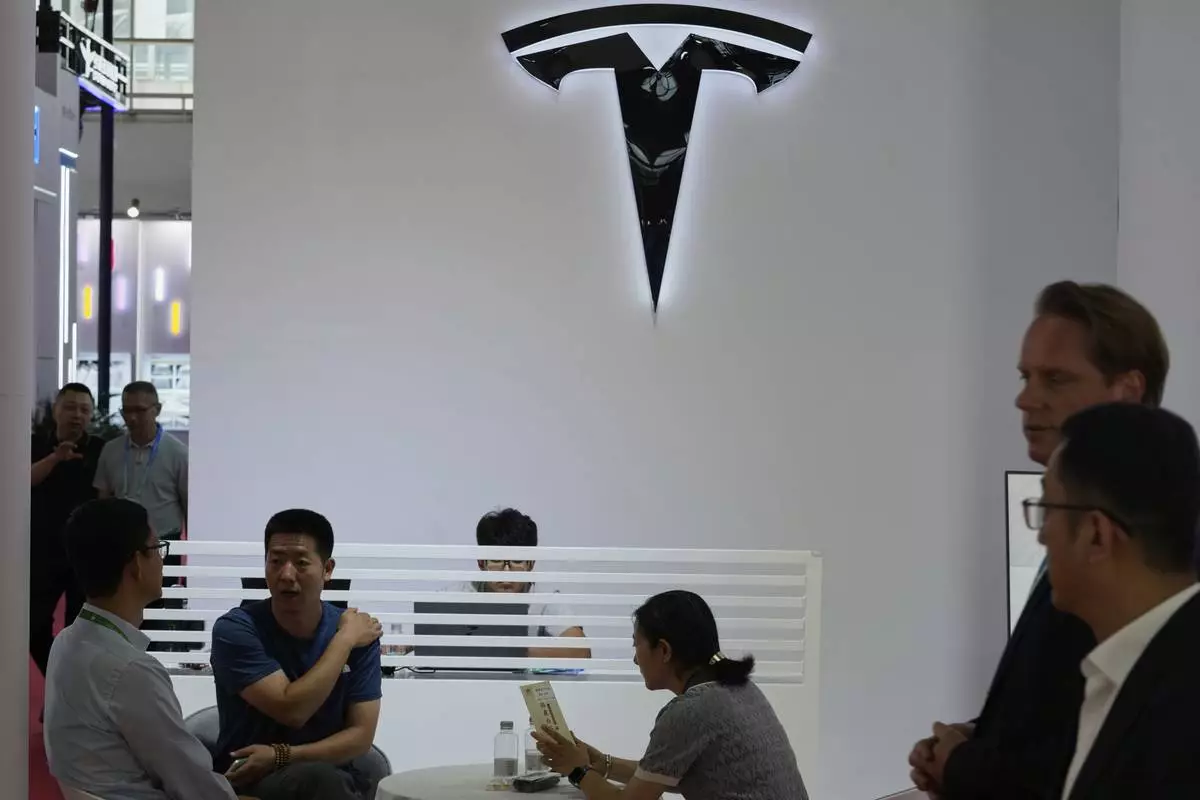
Visitors at the Tesla booth during the 3rd China International Supply Chain Expo at the China International Exhibition Center, in Beijing, China, Friday, July 18, 2025. (AP Photo/Mahesh Kumar A.)
FILE - The Tesla logo is displayed at a Tesla dealership, Thursday, March 13, 2025, in Miami. (AP Photo/Lynne Sladky, File)